

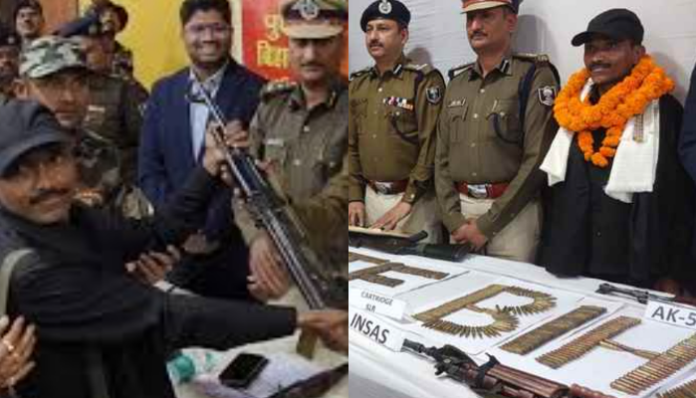
On 19th February (Thursday), Bihar authorities announced that the state is now “Naxal-free” after the surrender of prominent Maoist Suresh Koda, also known as Mustakim, who had a reward of Rs 3 lakh. He turned himself in to the Special Task Force (STF) in the Munger district a day earlier. Notably, the number of districts impacted by left-wing extremists (LWE) has also been reduced to seven, according to a recent analysis of the afflicted areas. This is in line with the union government’s pledge to eradicate the red-terror by March 2026.
BREAKING NEWS 🚨 📢
— News Arena India (@NewsArenaIndia) February 19, 2026
Officials declare Bihar 'Naxal-free' after Naxalite Suresh Koda with bounty of ₹3 lakh surrenders in Munger. pic.twitter.com/fkb3fRld8N
Deputy Inspector General of Police (DIG) of the Munger region, Rakesh Kumar informed that no armed Naxalite squad is presently operating in any of the 23 districts in Bihar that were formerly impacted by the menace. Koda also handed over three assault rifles, hundreds of magazines alongside rounds of ammunition and some cash.
He was charged in at least 60 cases many of them under the strict Unlawful Activities Prevention Act (UAPA). The police stated that he left the path of violenceas actions were being conducted to offer rewards under the “Atmasmarpan Sah Punarvaas Yojana,” a program designed to rehabilitate insurgents who give up weapons.
According to the initiative, Koda will be offered Rs 3 lakh which is the same amount as the bountry on his head. Furthermore, he is going to be granted a monthly salary of Rs 10,000 for 36 months of vocational training and also earn an incentive of Rs 5 lakh. Pramila Devi, Suresh Koda’s wife, expressed her satisfaction at the development voicing that the family is now happy and relieved.
Naxal operations impacted 23 districts in Bihar in 2012. The regions of central Bihar were most affected by the this influence that had increased dramatically in the state during the 1970s. In 2025, there were no known Naxalite incidents because of persistent efforts of centre and the state. 220 Naxalites were captured in the same year, which was a significant step toward the state’s growth and peace.
Count of Naxal affected district fall to 7
Only seven districts in the nation are still impacted by Naxalism, and three of them, Bijapur, Narayanpur and Sukma, which are in Chhattisgarh, remain in the “most affected category.” Bijapur, Narayanpur, Sukma, Kanker and Dantewada in Chhattisgarh, West Singhbhum in Jharkhand and Kandhamal in Odisha are the seven districts affected by this threat.
Kanker and West Singhbhum are designated as “districts of concern.” Despite the reduction in naxalism, targeted resource deployment is still necessary. The districts of Dantewada and Kandhamal are considered “other LWE-affected districts.”
The new classification was recently released by the Ministry of Home Affairs and took effect on 9th February in all states affected by Naxal. The centre has executed a thorough evaluation of the “National Policy and Action Plan to Address LWE,” examining 38 districts in nine states, including, Jharkhand, Bihar, Andhra Pradesh, Chhattisgarh, Madhya Pradesh, Maharashtra, Odisha, Telangana and West Bengal. This type of evaluation was last conducted in December 2025.
The Modi government, especially Home Minister Amit Shah has often declared that the Naxal problem, which was dubbed India’s largest internal security threat in 2010, will be eliminated by March of this year and the present figures are pointing to the realisation of the commitment.
