

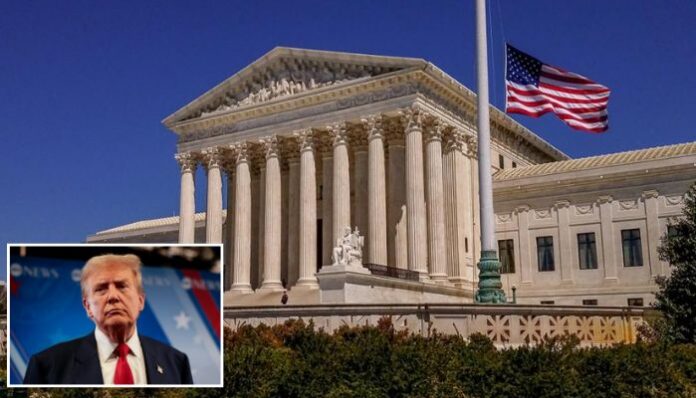
The White House clarified on Saturday, 21st February, that US trading partners, including India, will now face a flat 10% tariff, even if they had earlier agreed to higher rates under separate deals with the Trump administration. The clarification came after the US Supreme Court struck down President Donald Trump’s broad tariff policy, dealing a major blow to one of his key economic moves.
Soon after the court ruling, Trump signed a new order imposing an additional 10% duty on imports into the United States. He announced on social media that the tariff would be “effective almost immediately.” According to a White House fact sheet, the new duty will come into force on 24th February and remain in place for 150 days.
The hitherto unused Section 122 of the 1974 Trade Act, brought by the Gerald Ford administration, has been used by Trump to impose the sweeping 10% tariffs after the SCOTUS ruling negated his earlier tariffs, holding that he has no authority to impose them without Congress’s approval.
However, some sectors, such as pharmaceuticals, will reportedly continue to enjoy exemptions. Goods entering under the US-Mexico-Canada Agreement will also not be affected.
Breaking: White House officials clarify that India's tariff rate falls from 18% to 10%
— Shashank Mattoo (@MattooShashank) February 21, 2026
This explains Trump's new 10% "global tariff" pic.twitter.com/CGFA5X7a6o
The White House clarified that countries such as India, which had reached tariff understandings with Washington after Trump’s earlier tariff announcements, will now be subject to the 10% rate. This means the previously negotiated higher tariff levels will not apply for now.
However, a White House official told AFP that the administration may look for ways later to bring back “more appropriate or pre-negotiated tariff rates.”
Earlier this month, the United States and India announced a framework for an interim trade agreement. As part of that understanding, Trump had removed the 25% punitive tariffs imposed on India over its purchase of Russian oil and reduced reciprocal duties on Indian goods from 25% to 18%. With the new 10% global tariff now in place, Indian exports to the US will no longer face the 18% rate that had been agreed upon.
Speaking at the White House after the court verdict, Trump insisted that the India-US trade deal remains on track. “I think my relationship with India is fantastic, and we’re doing trade with India,” he said. When asked whether the Supreme Court ruling would affect the agreement, he replied, “Nothing changes.”
“They’ll be paying tariffs, and we will not be paying tariffs. So the deal with India is that they pay tariffs. This is a reversal of what it used to be,” Trump said. “The India deal is on… all the deals are on, we’re just going to do it” in a different way, he added.
US Supreme Court strikes down Trump’s tariffs
Earlier on Friday, 20th February, the US Supreme Court ruled six to three that Trump had wrongly used a 1977 law, the International Emergency Economic Powers Act (IEEPA), to impose sweeping tariffs on individual countries. The court said the law “does not authorise the President to impose tariffs.” Chief Justice John Roberts wrote that if Congress had intended to give such extraordinary powers, it would have clearly said so. “IEEPA contains no reference to tariffs or duties,” he noted.
Trump reacted angrily to the verdict, accusing some justices of lacking courage. “I’m ashamed of certain members of the court, absolutely ashamed, for not having the courage to do what’s right for our country,” he told reporters. He also claimed that the ruling actually left him “more powerful,” arguing that a president could still charge even higher tariffs if needed.
Treasury Secretary Scott Bessent later said that the alternative method being used would likely keep tariff revenues for 2026 almost unchanged.
