

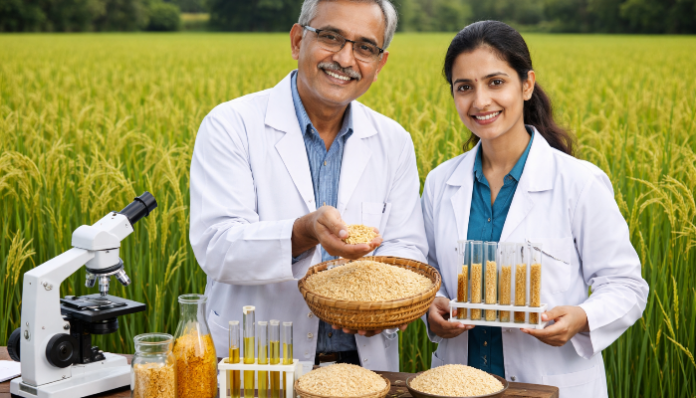
The Council of Scientific and Industrial Research-National Institute for Interdisciplinary Science and Technology (CSIR-NIIST) in Thiruvananthapuram has produced a “designer rice,” which is fortified with three times the protein of regular grains. It has a low glycaemic index (GI), which helps control diabetes. The official announcement was made by Dr Sudip Karmakar, Science Communication and Dissemination Directorate (SCDD), CSIR headquarters (HQ), on 11th March (Wednesday).
The aim is to feed millions and combat starvation “one plate at a time” by turning “broken rice into a nutrient-dense powerhouse.”
— CSIR, India (@CSIR_IND) March 11, 2026
“For generations, the rhythmic sound of a pressure cooker’s whistle has been the heartbeat of the Indian kitchen. Inside, more often than not, is white rice, the fuel for over half the global population. But for all its comforting warmth, polished white rice carries a silent burden: it is mostly starch, which the body quickly turns into sugar, contributing to a rising tide of Type 2 diabetes,” the statement read.
Hence, the institution’s researchers advanced from basic fortification to create this enhanced version of rice. CSIR referred to it as a fundamental re-architecture of the country’s staple food instead of a grain with vitamins and minerals applied on the outside.
“By deconstructing the rice grain into its primary components, starch, protein, and fiber and then precisely reassembling them, scientists have created a nutrient-dense food that functions as a proactive, structural solution for metabolic health,” it added. This method provided a better nutritional profile while preserving its well-known flavour and cooking features.
Dr C. Anandharamakrishnan, Director of CSIR-NIIST, expressed, “Think of it as food architecture.” He is the brain behind the project. “To understand this, imagine a building. If traditional rice is a house made mostly of sugar bricks (starch), the CSIR-NIIST team took that house apart. They removed a significant portion of the starch and replaced it with protein beams,” the release informed.
The scientists pulverised broken rice, which is often sold at a discount, into flour and combined it with protein and minerals like iron, folic acid and vitamin B12 using food processing technology as opposed to genetic engineering. Afterwards, they “reformed” this combination into grains that resemble the familiar rice in terms of appearance, texture and flavour.
Dealing with India’s pressing health issue
CSIR highlighted that India is dealing with a “paradoxical health crisis” and noted that it is known as the “diabetes capital of the world” because white rice’s high GI causes blood sugar levels to rise dangerously swiftly after a meal. However, millions of people experience “hidden hunger,” mineral and protein deficits, even after taking sufficient calories.
The designer rice simultaneously achieves both goals. Its GI is below 55 and prevents the sugar surges that afflict diabetics by releasing energy gradually. Moreover, this variety of rice provides more than 20% protein, compared to conventional rice’s 6 to 8%. It addresses anaemia through the incorporation of iron, folic acid and Vitamin B12 directly into the grain’s composition.
The groundbreaking advancement at economical rates
The statement conveyed, “The most brilliant science is useless if it stays in a test tube. To bridge the valley of death between a lab prototype and your local grocery store, CSIR-NIIST has officially transferred this technology to industry giants like Tata Consumer Products Limited.”
Dr Anandharamakrishnan asserted, “It tastes even better than normal rice because of the increased protein.” Above all, it doesn’t necessitate cultural transformation. Now rice can be enjoyed with three times the nourishment rather than switching to pricey quinoa or salads.
“As we look toward a future of sustainable living, this innovation also champions a circular economy. By using broken rice grains, a byproduct of the milling process, scientists are creating an opportunity for farmers to add value to a resource that was previously underutilised. From the lab in Kerala to the plates of millions, the humble rice grain has officially been upgraded. It’s no longer just a side dish; it’s a prescription for a healthier nation,” CSIR declared.
