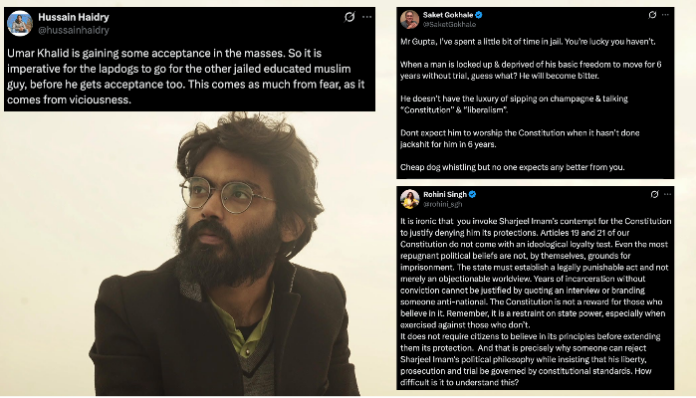
Sharjeel Imam, an accused in the anti-Hindu Delhi riots, recently expressed his disdain not merely for the Hindu community and its faith, but also for secularism, the Constitution, democracy and constitutional institutions while professing his admiration for the founders of Pakistan, during an interview with The Quint.
Interestingly, his remarks appeared to shock some among his supporters, despite him having espoused the same position for years. However, the Islam-leftist cabal has rallied to his defence, offering justifications so outrageous they might have been laughable were it not for the grave implications of legitimising a worldview that challenges the very foundations of the Indian state.
Mujib Mashal, South Asia bureau chief of The New York Times, took a different but far more dangerous stance, objecting to the use of a pseudonym by the author who penned a strong rebuttal to Imam’s statements in ThePrint.
He began by asserting his disapproval of the practice of publishing columns under pseudonyms in the current times. Mashal claimed to understand why a whistleblower might conceal their identity due to the risks involved, but he took issue with an author writing a “regular analysis column that can fire away anything on India’s most divisive issue without accountability.”
Mashal was far more concerned with the real name of the writer challenging Imam than with the latter’s incendiary rhetoric and open repudiation of India’s constitutional and democratic principles. Furthermore, he conveniently ignored the repeated instances of violence committed by Muslim mobs in response to the smallest provocation and even in the absence of any discernible trigger.
I’ve long wondered about this practice: how is it ok, in today’s age, to have a ‘pseudonym’ columnist? I’d understand for whistleblower; personal story of risk. But for a regular “analysis”column that can fire away anything on India’s most divisive issue without accountability?
— Mujib Mashal (@MujMash) October 20, 2026
Notably, attaching pseudonyms to articles is hardly uncommon across media organisations, and Mashal’s current employer has also followed the same convention. However, he seemed particularly angry at ThePrint’s decision, perhaps because the contributor had remained beyond the reach of the vitriol and potential targeting that can emanate from this vicious ecosystem, including the frenzied wrath of “Sar Tan Se Juda” fanatics.
Asad Ashraf, an “independent journalist” also affiliated with The Quint, raised similar complaints about the use of a pseudonym before launching a tiresome barrage of academic jargon, invoking critical theory, political philosophy and metaphysics to recast Imam’s utterances not as a product of his jihadi ideology, but as the musings of an enlightened intellectual.
He then dismissed Imam’s rejection of the Constitution and its core values as mere criticism. Ashraf referred to Muhammad Ali Jinnah and Muhammad Iqbal as “part of our pre-Partition intellectual and political history,” and argued that their ideas, political choices and legacies could not simply be erased, and that mentioning them did not amount to endorsing them.
However, Imam did not merely acknowledge these figures as historical personalities. There was no critical engagement but open advocacy of their hateful views, as he blamed Hindus within the Congress for partition and spoke about Iqbal’s profound influence on his own mind. He nearly validated their demand for separation and rationalised their profound Hinduphobia.
Ashraf urged others to approach the anti-national stand of the UAPA (Unlawful Activities Prevention Act) accused with patience and understand it rather than label him for what he was: an Islamist. At this rate, quantum mechanics, the Big Bang, the theory of evolution, and other such concepts would all be deemed indispensable to make sense of the diatribes of the likes of Imam.
An article has been circulating in the print media, written by an IPS officer who goes by the name of Ibn-e-Khaldun Bharti, questioning Sharjeel Imam’s politics by branding him anti-secular, Islamist, reductionist, conservative, and everything else that can be deployed to delegitimise a political subject without seriously engaging with his ideas. One cannot help but wonder why the author chooses to conceal his identity behind a pseudonym. To understand Sharjeel Imam, one must engage with critical theory, political philosophy, metaphysics, and the historical conditions that shape political thought. One cannot reduce his politics to the familiar binaries of secularism and communalism, or expect complex questions of Muslim political identity, representation, and resistance to yield to such convenient categories. It is particularly disappointing that many academics who understand these complexities choose to remain silent, even as public discourse increasingly turns into an exercise in labelling, vilification, and intellectual simplification. Sharjeel Imam’s critique of the Constitution, or his questioning of the political order it sustains, does not automatically amount to a rejection of constitutionalism. The Constitution itself provides for its amendment, while democratic politics must retain the space to question existing institutions, arrangements, and constitutional assumptions. A constitutional democracy that cannot accommodate fundamental criticism of its own framework risks reducing dissent to a privilege granted at the convenience of those in power. His invocation of Muhammad Ali Jinnah and Muhammad Iqbal must also be understood within the larger history of Muslim political thought in the subcontinent. They are part of our pre-Partition intellectual and political history, however uncomfortable that history may be. We cannot simply erase them from our historical consciousness because their ideas, political choices, or legacies are contested. To invoke Jinnah is not necessarily to endorse Jinnah, just as engaging with a political thinker does not amount to an uncritical acceptance of everything they believed or represented. History cannot be understood through selective remembrance, nor can political thought be evaluated through guilt by association. The task is to interrogate, contextualise, and critically engage with these legacies, not to banish them from legitimate discourse. The easiest thing for political polemicists to do is to call Sharjeel Imam an Islamist, reduce his arguments to a convenient ideological label, and present that label as sufficient justification for his political and social exclusion. In a climate where such labels can have consequences far beyond intellectual debate, this is a particularly dangerous exercise. Defending Sharjeel Imam does not require agreeing with every argument he has made. It requires defending the right to engage with his ideas seriously, to examine them critically, and to resist the impulse to replace argument with accusation. The question is whether we are willing to confront the complexity of Muslim political thought in India, or whether we would rather consign it to a set of labels that make it easier to condemn than to understand. #SharjeelImam
— Asad Ashraf (@Asad_Ashraf88) October 20, 2026
Rohini Singh of the propagandist website The Wire transformed into Imam’s spokesperson, accusing ThePrint founder Shekhar Gupta of trying to deprive him of the protections guaranteed under the Constitution, the very same document he so passionately despises, a fact she deliberately sidestepped.
She announced, “The Constitution is not a reward for those who believe in it. Remember, it is a restraint on state power, especially when exercised against those who don’t. It does not require citizens to believe in its principles before extending them its protection,” stressing Imam’s right to liberty and prosecution under constitutional standards.
Singh made another effort to reframe the context of his imprisonment, implying that it was a retribution for his political convictions rather than a legal measure prompted by his criminal behaviour. Importantly, Imam has not been refused any legal avenue or right, and the issue is his dangerous ideology, an uncomfortable truth for a liberal whose entire life has been spent targeting “Hindutva” rather than those who actually seek to destroy the Indian state.
It is ironic that you invoke Sharjeel Imam’s contempt for the Constitution to justify denying him its protections. Articles 19 and 21 of our Constitution do not come with an ideological loyalty test. Even the most repugnant political beliefs are not, by themselves, grounds for imprisonment. The state must establish a legally punishable act and not merely an objectionable worldview. Years of incarceration without conviction cannot be justified by quoting an interview or branding someone anti-national. The Constitution is not a reward for those who believe in it. Remember, it is a restraint on state power, especially when exercised against those who don’t. It does not require citizens to believe in its principles before extending them its protection. And that is precisely why someone can reject Sharjeel Imam’s political philosophy while insisting that his liberty, prosecution and trial be governed by constitutional standards. How difficult is it to understand this?
— Rohini Singh (@rohini_sgh) October 20, 2026
Apoorvanand, another stridently Hinduphobic figure associated with The Wire, labelled ThePrint article an attack on “a young man incarcerated on spurious charges,” presenting Imam as a victim rather than a prime accused in the Delhi unrest case being heard by the Delhi High Court, which has repeatedly rejected his bail pleas but released him for a few days on certain occasions.
Apoorvanand completely overlooked Imam’s animosity towards India and the ramifications of his outpourings for the very Constitution, secularism and other ideals this group purports to uphold and defend against “Hindutva” elements.
How courageous and intellectually honest to launch an attack on a young man incarcerated on spurious charges for more than 6 years without a trial! What timing! @ShekharGupta
— Apoorvanand अपूर्वानंद (@Apoorvanand__) October 20, 2026
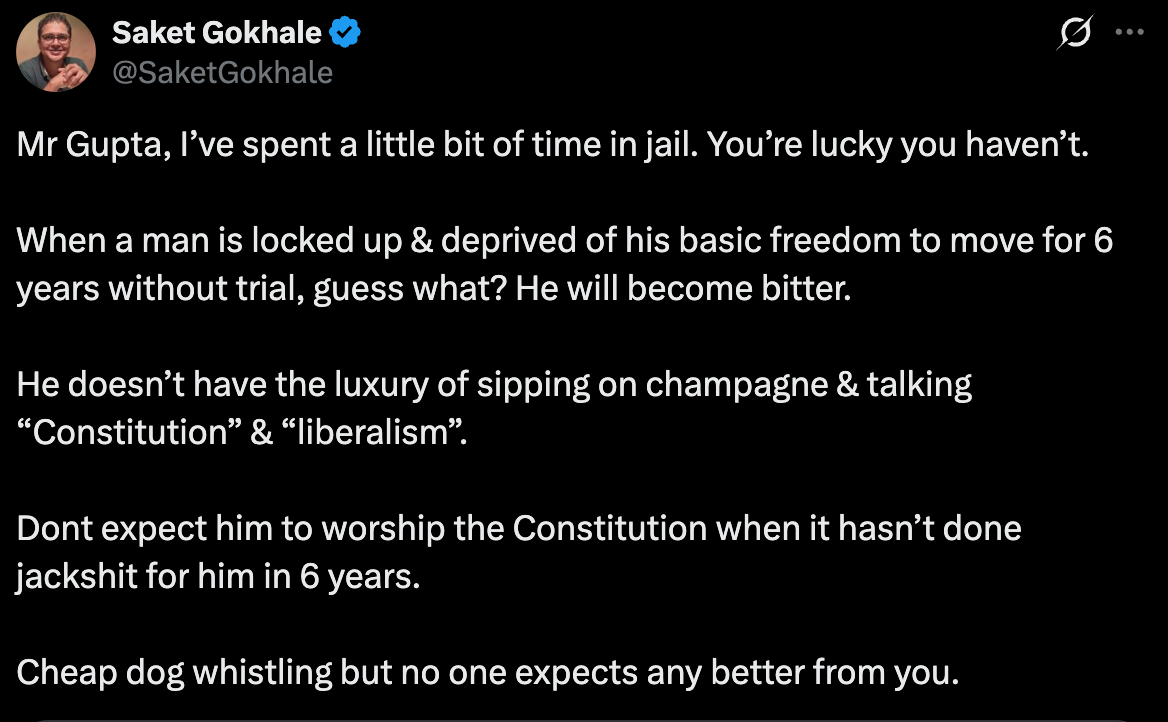
The rabidly anti-Hindu Trinamool Congress spokesperson Saket Gokhale directed his rage at Gupta for, amusingly, never having been jailed like him and Imam, and thus he was incapable of grasping their perspective.
In an almost self-confessional admission and reminiscent of the idiom, “birds of a feather flock together,” he added that 6 years behind bars had made Imam bitter, keeping him away from sipping champagne and discussing the Constitution and liberalism. Hence, he contended that the man should not be expected to respect the country or its Constitution that did not help him.
Gokhale tried to depict Imam as the only person ever to have been incarcerated, as though any individual should turn against India at the slightest trouble or grievance. Furthermore, Imam is not imprisoned for any noble cause but faces heinous accusations that have led to repeated denials of bail petitions by the court.
Gokhale has also been imprisoned on money laundering charges. He was also ordered to furnish Rs 50 lakh over his defamatory posts against former diplomat Lakshmi Puri and apologised to her last year.
Of course, Gokhale was also irked by the use of a pseudonym, preferring the author’s identity to be potentially exposed to a pack of bloodthirsty zombies as he rejoiced from the sidelines.
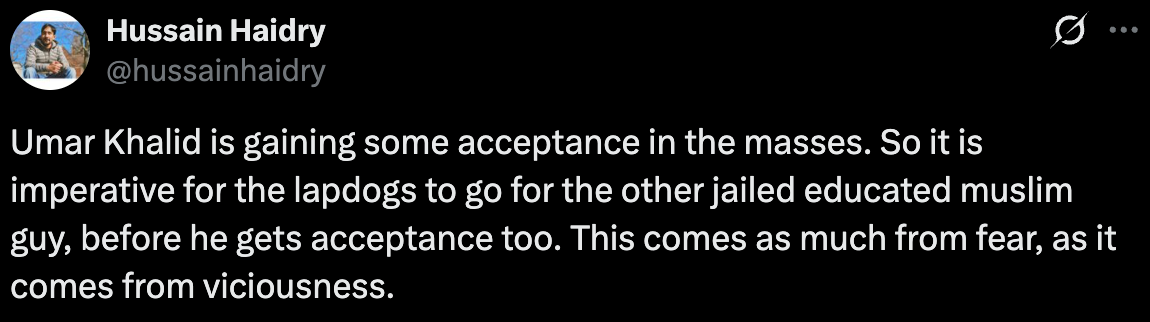
Another Islamist, Hussain Haidry, wrote that “lapdogs’ had been sent to attack Imam because Umar Khalid had been “gaining some acceptance in the masses.” He argued that this was an attempt to prevent the “educated Muslim guy” from gaining wider recognition, adding, “This comes as much from fear as it comes from viciousness.”
He framed the episode as though the outrage had not erupted because Imam openly voiced his anti-India stance and hatred for Hindus, but was instead part of a conspiracy against him, and people should have readily embraced him without paying heed to the consequences of his radical beliefs for the country and its future.
Haidry is right about the fear, a sentiment every Indian should feel when confronted with matters of this nature. The only viciousness evident so far, however, has come from him, Imam, and their cabal.
Muzzammil Imam, brother of Sharjeel Imam, predictably insisted that people should consider the “vantage point” from which the latter’s pronouncements were made, while feigning astonishment at the uproar against the ingrained enmity directed at the Indian state and the Hindu community.
Muzzammil described Imam as a “scholar and intellectual” entitled to interpret history in his own way. Truth and lie, right and wrong are clearly matters of tactical convenience and subjective interpretation for this group.
Muzzammil also alleged that Imam, as a member of the minority, had “articulated the lived reality of generations of Muslims in our country,” the same vulnerable community that partitioned the nation, and those who remained in India continued to peddle a victimhood narrative ever since. He also sought to paint his brother’s anti-democratic stance as “criticism of the Constitution” and insinuated that the backlash against him was a consequence of him sharing the truth.
Mr Gupta like many others needs to understand the vantage point Sharjeel coming from. And need to ask themselves why this discomfort with Sharjeel’s politics. I’d like to remind them of a few things: 1. Sharjeel is not just a political activist but also a researcher and student of History. And as a scholar and intellectual he is well within his rights to give a different interpretation of history. A critique of the constitution is well within the rights of all citizens of this country. 2. Sharjeel @_imaams interpretation is coming from being a member of a minority community and he articulates the lived reality of generations of Muslims in our country. We probably need to ask ourselves if the reason it makes us so uncomfortable is because there is truth in his ideas? Why can’t people treat Muslim rights as a universal, human rights issue? Why is Sharjeel being hounded as an Islamist when he is talking about human values but in the context of a certain community? The concept of a standpoint theorization should not be such a surprise to anybody who understands critical thinking. #SharjeelImam
— Muzzammil Imam | مزمل إمام (@imammuzzammil) October 20, 2026
Conclusion
The Islamo-leftists have stooped to a new low by defending Imam in the name of the Constitution. At least Imam can be acknowledged for dropping all pretence, not that it fooled anyone except those who are wilfully blind, and publicly venerated Iqbal and Jinnah while conveying his abhorrence for India, the Constitution and its fundamentals, alongside Hindus, declaring them as “permanently communal” and stating that “shirk” idolatry or polytheism are the origins of all evils.
However, the same cannot be said of his apologists, who routinely accuse “Hindutvavadis” of being anti-Constitution, opposed to secularism and averse to democracy, but they have either retreated into conspicuous silence or rushed to justify him after it has become increasingly apparent who actually fits these descriptions.
Obviously, no one anticipated them to protest over his Hindumisia, as they are all on the same page on the subject. However, their reaction, or rather, the lack of it, to his anti-India statements points to a deeper convergence of the sinister common interests that bind this faction together.
More importantly, for the umpteenth time, they have shown how such terms are deployed as political weapons rather than genuinely revered as values, demonstrating that no one can engage in Goebbelsian propaganda better than they do, and continue to accuse others of the very things they are guilty of themselves.
They do not even pause for a second before twisting statements to suit their agenda. After all, scratch a leftist and an opportunistic fascist does start to bleed.