

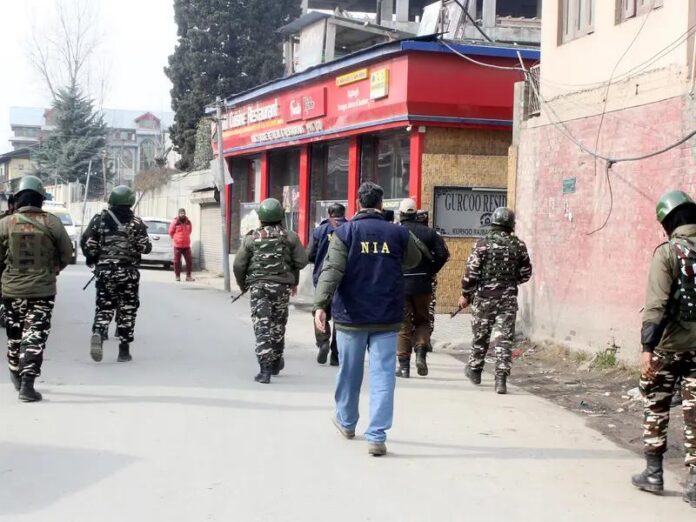
In a development that underscores the growing complexity of transnational security threats in India’s Northeast, a Special NIA Court at New Delhi has remanded seven foreign nationals to 11 days of National Investigation Agency (NIA) custody over alleged links with insurgent networks and illegal cross-border activities.
The accused include Matthew Aaron Van Dyke, a US national, and six Ukrainian citizens: Hurba Petro, Slyviak Taras, Ivan Sukmanovskyi, Stefankiv Marian, Honcharuk Maksim, and Kaminskyi Viktor. They were produced before the Special NIA Court at Patiala House, which granted the central agency custody for further interrogation.
Special NIA Court at New Delhi remanded 7 Accused persons, namely Matthew Aaron Van Dyke (US), Hurba Petro (Ukrainian), Slyviak Taras (Ukrainian), Ivan Sukmanovskyi (Ukrainian), Stefankiv Marian (Ukrainian), Honcharuk Maksim (Ukrainian), and Kaminskyi Viktor (Ukrainian), in 11… https://t.co/VFEkjj0SdB
— ANI (@ANI) March 17, 2026
According to the NIA, preliminary investigations suggest that the accused were in contact with armed operatives carrying assault rifles, including AK-47s, and may have actively abetted unlawful and potentially terrorist activities. The agency has alleged that the group maintained links with ethnic armed organisations operating in the India–Myanmar border region and extended support to proscribed insurgent outfits within India.
Investigators claim the accused travelled to India on valid visas but subsequently entered Mizoram, a protected area requiring special permits for foreign nationals. From there, they allegedly crossed into Myanmar, where they are believed to have established contact with ethnic armed groups engaged in ongoing conflicts.
The NIA further alleges that the individuals received training in Myanmar and were also involved in imparting training to these armed groups. Of particular concern to the agency is the claim that the accused facilitated the movement of a significant consignment of drones from Europe into India, equipment that could potentially be repurposed for surveillance or hostile operations.
Legal proceedings and custody
The Patiala House Court, after hearing submissions from the NIA, observed the seriousness of the allegations and granted 11 days of custodial interrogation. Officials indicated that this period would be crucial to uncovering the full extent of the network, including potential links to international actors and insurgent ecosystems within India.
Ukraine pushes back, seeks consular access
The detention has triggered a diplomatic response from Ukraine, which has strongly contested the narrative that Ukrainian nationals were involved in training terrorists and infiltrated highly sensitive border zones in India.
In an official statement, Ukraine’s Ministry of Foreign Affairs confirmed that six of its citizens were detained in India on 13 March 2026. It noted that the charges, based on preliminary information, relate primarily to unauthorized entry into Mizoram and the illegal crossing of the India–Myanmar border.
However, the Ukrainian government brazened it out, claiming that no conclusive evidence has yet been established linking its citizens to “unlawful or terrorist activities” in either India or Myammar.
Ukraine also raised procedural concerns, stating that its embassy in New Delhi had not received formal notification of the detention, a step typically expected under international consular norms, it claimed. It also alleged that despite embassy representatives attended a court hearing on 16 March, they were reportedly not permitted direct access to the detainees.
The Ukrainian side has formally protested the situation, with Ambassador Dr Oleksandr Polishchuk meeting senior officials from India’s Ministry of External Affairs, including Secretary (West) Sibi George, to demand immediate consular access and the release of the detained individuals.
A case with strategic and diplomatic implications
The case sits at the intersection of internal security, cross-border insurgency, and diplomatic sensitivity. India’s Northeast, particularly the porous India–Myanmar frontier, has long been a corridor for insurgent movement, arms trafficking, and informal networks that operate across national boundaries.
The NIA’s claims, especially those related to drone procurement and training support, if substantiated, could point to an evolving pattern where foreign nationals act as facilitators or force multipliers for insurgent groups in order to foment unrest in India. For a nation already embroiled in a war with Russia to send its nationals half-way around the world to stir up trouble doesn’t bode well for India-Ukraine relationship and could carry longterm diplomatic costs for Kviv.
