

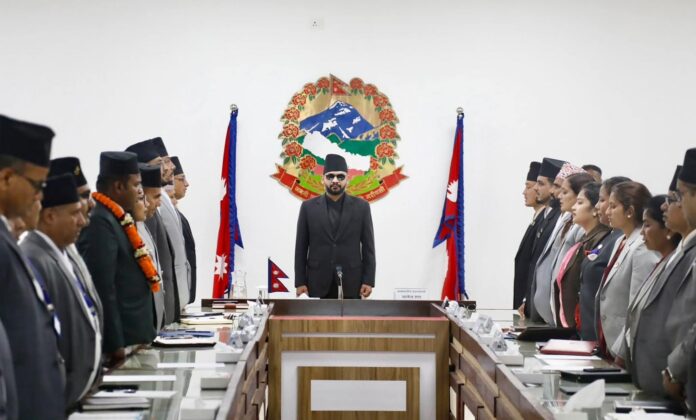
The new Nepal government headed by Rastriya Swatantra Party (RSP) Balendra Shah has approved and released a comprehensive 100-point roadmap aimed at delivering “effective, good, and delivery-based governance”. The document, spanning 20 pages, was endorsed during the Cabinet’s first meeting on Friday and made public on Saturday.
The roadmap outlines time-bound, measurable reforms across key sectors, with clear key performance indicators (KPIs), responsible officials, and periodic reporting to the Prime Minister’s Office. The overarching goal is to enhance efficiency, accountability, and direct improvements in citizens’ lives while curbing political interference and corruption.
The roadmap emphasises implementation within tight deadlines, including 15-day, 30-day, 45-day, 90-day, and 100-day targets, and includes the preparation of a “National Commitment” that synthesises implementable pledges from all political parties. It also calls for a discussion paper on constitutional amendments within seven days and the establishment of dedicated secretariats for oversight. Below is a sector-wise breakdown of the major initiatives.
Governance and administrative reforms
The government plans to reduce the number of federal ministries to 17 within 30 days to eliminate duplication and inefficiency. A “Transition Roadmap” will ensure continuity of services, personnel management, and budget allocation, supported by a new “Restructuring and Management Secretariat” under the Prime Minister’s Office.
All party-affiliated trade unions in government bodies will be abolished, and civil servants, teachers, professors, and other public-service personnel will be barred from direct or indirect political affiliations. Violations will attract strict departmental action. A Federal Civil Service Bill is to be drafted within 45 days.
Service delivery will undergo Business Process Re-engineering (BPR) to simplify procedures, limit approval layers to a maximum of three, and scrap unnecessary processes. Revised standards, monitoring mechanisms, and operational procedures will be prepared within 30 days, along with any required legal amendments.
Anti-corruption and asset investigations
A high-powered committee will be formed within 15 days under the Prime Minister’s Office to investigate the assets and properties of senior political office-holders and high-ranking officials who served after the second people’s movement. A second phase will cover those in crucial public positions between 1991 and 2006. The committee will include experts in law, finance, revenue, and research.
Immediate legal and procedural action will follow the recommendations of the commission led by former Special Court chairperson Gauri Bahadur Karki, which has already led to the arrest of former Prime Minister KP Sharma Oli and former Home Minister Ramesh Lekhak. A separate high-level committee will be constituted within one week to investigate the September 9 Gen-Z movement incidents, analyse evidence, identify those responsible, and recommend further action.
All past unimplemented inquiry commission reports will be acted upon within 30 days through legal, administrative, and procedural measures.
Education sector reforms
Party-affiliated student organisations in schools and universities will be abolished and replaced within 90 days by a new independent structure known as the Student Council or “Voice of Students”.
Universities must publish undergraduate and postgraduate examination results strictly according to an academic calendar issued by the Ministry of Education, Science and Technology. From the next academic session, internal examinations for students up to Grade 5 will be discontinued and replaced with alternative, less stressful assessment systems focused on holistic development.
Students will be allowed to enrol in studies up to bachelor’s level without producing citizenship certificates, with universities required to establish the necessary procedures immediately.
Health sector reforms
Private hospitals will be required to strictly enforce the existing legal provision allocating 10 per cent of beds free of charge to needy, poor, helpless, and abandoned patients. The same rule will apply to public hospitals.
Social justice and reconciliation
Within 15 days, the government will formally acknowledge historical injustices, discrimination, and deprivation suffered by marginalised and excluded communities. A framework for social justice, inclusivity, and reconciliatory integration, including formal state apologies, will then be prepared.
In response to the Gen-Z movement last year, an integrated rehabilitation package will be rolled out within 100 days. Eligible families of martyrs and victims will receive government, private-sector, or civil-society employment opportunities, skill development programmes, psychosocial counselling, livelihood protection, and social security benefits. The roadmap also commits to full implementation of recommendations from the Karki commission and other past inquiries.
Other initiatives
Free “Blue Bus” services for women will be introduced across all seven provinces, with at least 25 buses operational within the first 100 days to ensure safe public transportation.
Prime Minister Balendra Shah’s administration has described the roadmap as a decisive shift towards result-oriented governance that breaks from past patronage politics. By linking every ministry’s seven core areas to concrete timelines, responsible officers, and performance indicators, the government aims to restore public trust and deliver tangible change.
Full ministry-wise action plans and progress dashboards are expected to be released in the coming weeks as the Balen Shah government moves swiftly to translate its election promises into action.
