

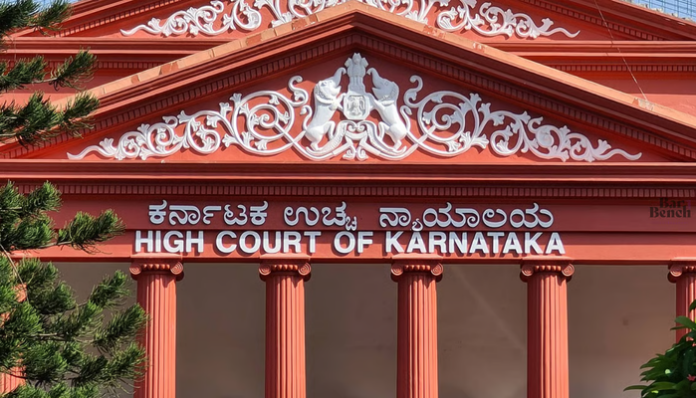
The Karnataka High Court on Thursday, 9th April, dismissed a public interest litigation (PIL) that challenged the Centre’s advisory on singing Vande Mataram in schools. The petition had raised objections to the suggestion that all six stanzas of the national song, including those mentioning Hindu deities, be sung.
A bench led by Chief Justice Vibhu Bakhru and Justice C M Poonacha made it clear that it was not willing to entertain the plea. The court noted that there is no legal requirement to sing the national song.
During the hearing, Additional Solicitor General Aravind Kamath told the court that the Union Home Ministry’s advisory only used the word “may,” which means it is optional and not compulsory. Taking this into account, the court observed, “Concededly, the national song is not covered under any statutory framework… the orders mentioned the word ‘may’ and it is not mandatory. The performance of national song is not mandatory unlike the national anthem.”
The court also pointed out that a similar petition had already been dismissed earlier by the Supreme Court of India. Based on these reasons, it decided to dismiss the PIL.
What the petitioner argued
This petition was filed by Somashekhar Rajavamshi, an advocate, saying that the advisory of the central government indirectly coerced the students studying in schools, especially government schools, to sing all the six stanzas of Vande Mataram every day.
He said he had no objection to the first two stanzas of the song, which are commonly sung and considered patriotic. However, he raised concerns about the remaining stanzas, particularly stanza five, which refers to Hindu goddesses like Durga, Lakshmi (Kamala), and Saraswati (Vani).
According to him, singing these stanzas during a school program could be unconstitutional as well. He cited that inclusion of these stanzas would be a violation of Articles 25 to 28 regarding religious rights and Articles of 14 pertaining to equality.
Rajavamshi informed the court that the government can’t impose a “religiously charged version” of a national song. He had asked the court to declare the Centre’s February 2026 advisory unconstitutional, at least in the part that includes stanzas three to six and encourages their daily singing in schools.
However, the bench was not convinced by these arguments. When the court indicated that it was not inclined to hear the matter, the petitioner said his case was different from the one earlier dismissed by the Supreme Court. Despite this, the court refused to go further into the issue.
