

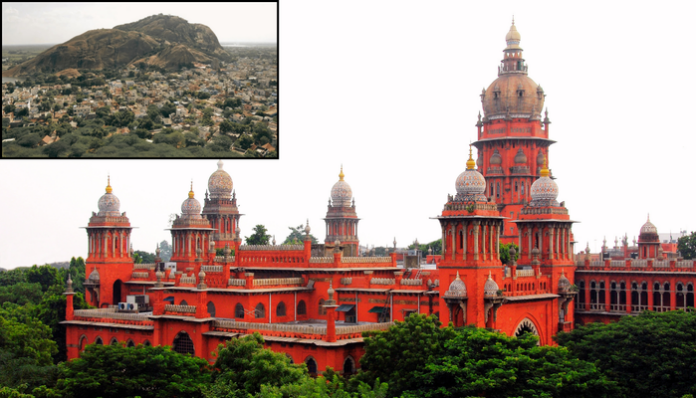
The Madurai Bench of the Madras High Court on Thursday (10th April) dismissed a PIL seeking action against the officials who denied permission to Hindu devotees to light a lamp atop Thiruparankundram hill in December last year, while allowing Muslims to offer prayers on the hill during Ramzan. The petition filed by KK Ramesh, the managing trustee of Hindu Dharma Parishad, Madurai, sought directions to the central government, Archaeological Survey of India (ASI), to instruct the Tamil Nadu government to take action against the officials.
Displeased with the petition, a Division Bench of Justices Satish Kumar and Jyothi Raman came down heavily on the petitioner and rebuked him for wasting the court’s time. “Are there no other issues in the world apart from Thiruparankundram? How many petitions will you continue to file regarding this Thiruparankundram lamp issue? The courts have already issued numerous orders in this regard. Does the court have absolutely no other work?” the Bench remarked, reprimanding the petitioner.
The Bench added that it would entertain the petition if the petitioner deposits ₹10 lakh into the temple fund. “If the petitioner deposits Rs 10 lakh into the temple’s funds in this manner, we will then take up such petitions for hearing,” the Bench said.
Notably, in January this year, the Madurai Bench of the Madras High Court upheld a single judge’s order that allowed the lighting of the Karthigai Deepam at the Deepathoon, the ancient stone lamp pillar on the top of the sacred Thiruparankundram hill near Madurai.
The petitioner had submitted before the court that the Madurai district administration and police officials prevented the lighting of Karthigai Deepam atop Thiruparankundram hill by disregarding an earlier order passed by the High Court. But the same authorities granted permission to people from the Muslim community to offer prayers at Sikandar Badhusha Avuliya Dargah, located atop the hill. The petitioner contended that the action of the district administration and the police officials was discriminatory and violative of Article 14 of the Constitution.
“Therefore, disciplinary action should be initiated against officials who failed to discharge their duties. Furthermore, based on the representation submitted on March 23, the matter should be reconsidered, and Hindus, too, should be permitted to light lamps atop the Thiruparankundram hill,” the petition stated.
Opposing the petition, the central government submitted before the High Court that due to such petitions, the state and the central governments incur huge financial losses in paying the cost of litigation. “Consequently, it is the govt that incurs a massive financial loss. Several lakhs of rupees covering legal fees for the state government’s counsel as well as the Union government’s counsel are being expended solely to address the petitions filed by this individual,” Union government’s counsel Govindarajan said. He urged the High Court to impose the maximum penalty on the petitioner to discourage such petitions in future. “A maximum penalty should be imposed on him, and the petitions ought to be dismissed,” Govindarajan said.
Representing the state government, Additional Advocate General Ravindran also requested the court to impose a penalty on the petitioner, saying that he routinely files such petitions. “Similar petitions have already been filed in the past and subsequently dismissed. Therefore, a maximum penalty should be imposed on the petitioner, and the petition must be dismissed,” Ravindran said.
“It appears that the petitioner is repeatedly filing such petitions solely with the intention of seeing his name featured in the media,” the High Court stated after hearing both sides. Subsequently, the court dismissed the petition and imposed a fine of ₹5 lakh. However, the petitioner expressed the inability to pay the amount and agreed to withdraw the petition and promised not to file such petitions in future. “…we assure you that we will not file such petitions in the future. Consequently, we request that the fine not be imposed,” the petitioner’s counsel said. The High Court reduced the fine amount to ₹50,000, but the petitioner expressed the inability to pay the reduced amount as well.
The High Court said that the fine imposed on the petitioner would be reconsidered only if he submitted an affidavit to the court undertaking not to file such frivolous petitions as PILs in the future.
