

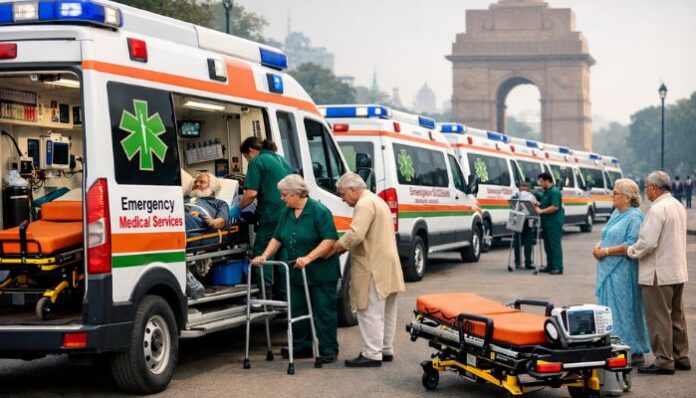
In a move to improve emergency response for the elderly, the Delhi Government has decided to add 20 specially designed geriatric ambulances to its healthcare system. Health Minister Pankaj Kumar Singh said these ambulances will help ensure that senior citizens get quick, respectful, and proper medical attention during emergencies.
These new ambulances will be equipped with modern medical facilities to provide better pre-hospital care. With their addition, the total number of ambulances in Delhi will rise from 331 to 351. Currently, the fleet is operated under the Centralised Accident and Trauma Services (CATS), which is connected to helpline numbers 102 and 112 through the Emergency Response Support System.
The government is planning a phased expansion to further strengthen the system, with a target to increase the total number of ambulances to 1,000 in the coming years. This step is part of a larger effort to improve access to healthcare and make the system more inclusive, especially for senior citizens.
The Delhi government has also set aside Rs 13,034 crore for the health sector in its budget to upgrade infrastructure and improve critical care services across the city.
Support for Resident Welfare Associations
Apart from medical services, the government is also focusing on improving the daily lives of senior citizens. Under the ‘Vayo Anand’ scheme launched in March 2026, financial support will be given to Resident Welfare Associations (RWAs) to create recreational centres for the elderly.
A budget of Rs 25 crore has been allocated for this scheme. These centres will be set up in rain baseras managed by the Delhi Urban Shelter Improvement Board (DUSIB) and in community halls of the Municipal Corporation of Delhi (MCD). Activities at these centres will include indoor games like carrom, ludo, chess, and cards, along with yoga sessions.
Groups such as RWAs, senior citizen associations, cooperative housing societies, and NGOs can apply for setting up these centres, provided they have at least 50 members. The government will offer financial assistance of Rs 3-4 lakh to selected groups to run and manage these spaces.
