

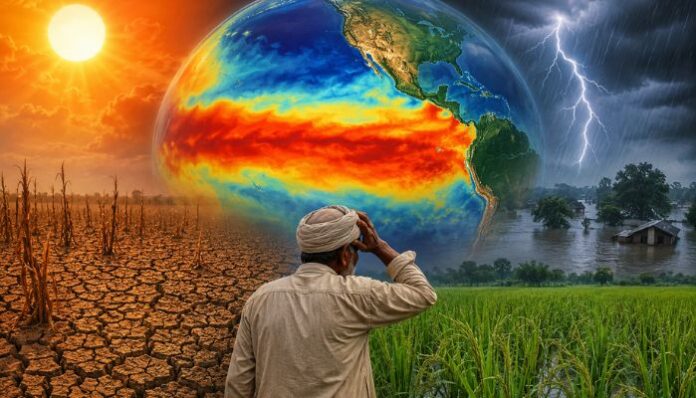
On 2nd May, the World Meteorological Organisation (WMO) warned that there is an 80% chance of El Niño developing between June and August this year, raising concerns about weather conditions across the world and the possibility of a weaker monsoon in India.
According to the United Nations weather agency, there is a more than 90% probability that El Niño conditions will continue until at least November. Scientists say the developing event could become moderate to strong, increasing the risk of droughts, floods, heatwaves and other extreme weather events in many regions.
What is El Niño?
El Niño is a natural climate pattern that occurs when sea surface temperatures in the central and eastern Pacific Ocean become warmer than normal. This usually happens after trade winds weaken, allowing warm water to move eastward across the Pacific.
The phenomenon affects global wind and rainfall patterns and typically lasts between nine and twelve months. In India, El Niño years are generally linked to hotter summers and weaker monsoon rainfall.
Concerns for India’s monsoon
The latest seasonal forecast released by the WMO suggests that rainfall during the June-September southwest monsoon could remain below normal across much of South Asia, with central regions likely to be most affected. The forecast map released by the agency indicates below-normal rainfall over most parts of India.
Keeping these concerns in mind, the Ministry of Agriculture has directed states and related agencies to activate district-level contingency plans. Agriculture Minister Shivraj Singh Chouhan has also asked officials to strengthen digital advisory systems and call centre services so that farmers receive timely information.
Two climate systems may offer relief
Despite the El Niño warning, weather experts say India still has some hope.
The first factor is the Indian Ocean Dipole (IOD), often called the “El Niño of the Indian Ocean.” If a positive IOD develops, it can reduce or even offset the negative impact of El Niño on India’s monsoon.
The second factor is the Madden-Julian Oscillation (MJO), a moving pattern of clouds and winds around the equator. When it passes over India, it can bring spells of heavy rainfall, even during years when the monsoon is otherwise weak.
Oceans are heating up rapidly
Scientists have reported unusually warm conditions beneath the Pacific Ocean. According to the WMO, subsurface temperatures are currently more than 6°C above average in some areas. This stored heat is gradually moving upward, warming the ocean surface and supporting the development of El Niño.
The agency noted that ocean temperatures in recent months have been among the highest recorded since the exceptional warming seen during the 2023-24 El Niño episode.
WMO urges countries to prepare
WMO Secretary-General Celeste Saulo said governments should prepare for the possibility of a strong El Niño event because it can worsen drought conditions, increase heavy rainfall in some regions and raise the risk of heatwaves on land and in oceans.
UN Secretary-General António Guterres also described the situation as an urgent climate warning, saying that El Niño could add further pressure to an already warming world.
Heatwave concerns are already rising
The warning comes at a time when large parts of India have already experienced an unusually early and intense summer, with temperatures crossing dangerous levels in several states. The India Meteorological Department (IMD) has issued multiple heatwave alerts in recent weeks, while several regions have recorded temperatures above 40°C.
Experts say that while global warming remains the biggest driver of rising temperatures, a strong El Niño could make heatwaves longer and more intense, put pressure on water and power supplies, and increase the risk of below-normal rainfall during the monsoon season.
The WMO has urged governments, especially agriculture, health and energy departments, to strengthen preparedness measures, stressing that timely warnings and planning can help protect lives and reduce the impact of extreme weather.
