

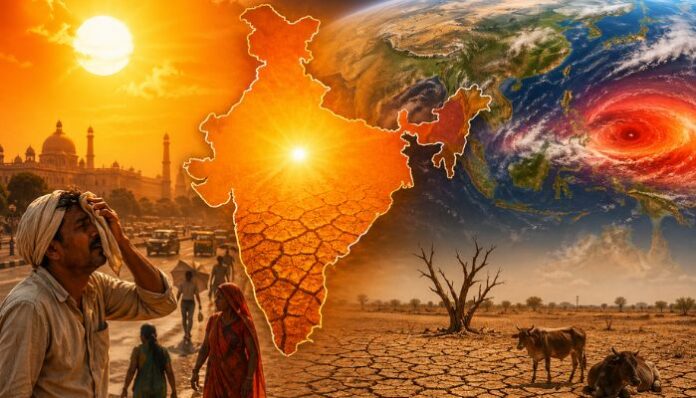
A strong and early summer has gripped large parts of India and other regions of Asia, with temperatures crossing dangerous levels in April itself. Weather experts are now watching a global climate pattern called El Nino and an even stronger version known as “Super El Nino” to understand whether it is driving this extreme heat and what lies ahead for the coming months.
Heatwave tightens grip across India
Several states across north, central and eastern India are already seeing a sharp rise in temperatures, even before peak summer has fully set in. The India Meteorological Department (IMD) has issued heatwave alerts across multiple regions, including Punjab, Haryana, Delhi, Rajasthan, Uttar Pradesh, Madhya Pradesh, Bihar and Odisha.
On 25th April, Banda in Uttar Pradesh recorded a scorching 47.4°C, the highest temperature in the country this year so far. In Delhi, temperatures touched 42.8°C at the Safdarjung observatory, which is more than 5°C above normal and qualifies as a heatwave.
In general, most parts of the country have been seeing daytime temperatures between 40°C and 45°C. Night temperatures are also staying unusually high, especially in Delhi, Haryana and Odisha, making conditions more uncomfortable.
The IMD says heatwave or severe heatwave conditions were active in at least 11 states and union territories, with some regions like Himachal Pradesh and eastern Uttar Pradesh seeing more extreme warnings.
A global heat signal, not just India’s problem
This extreme heat is not limited to India. Scientists say the current conditions are part of a much larger global pattern.
Data from NASA’s GISTEMP shows that March 2026 was among the hottest ever recorded globally, with temperatures about 1.27°C above the 1951-1980 average. Meanwhile, Europe’s Copernicus climate service pegged it at 1.48°C above pre-industrial levels, making it one of the warmest March months on record.
One of the most striking anomalies came from eastern Siberia, particularly the Yakutia region of Russia, where temperatures were recorded at more than 10°C above normal for March, something scientists say would have been “virtually impossible” without human-driven climate change.
Heat maps for late April show large parts of north India, the Sahel in Africa, and the Arabian Peninsula crossing 45°C, indicating a widespread heat zone.
What exactly is El Nino?
El Nino is a natural climate pattern that occurs every 2 to 7 years in the Pacific Ocean. Normally, strong trade winds push warm ocean water towards Asia. But during El Nino, these winds weaken, allowing warm water to shift eastward towards the central and eastern Pacific.
This warming of ocean surface temperatures changes global wind patterns and rainfall systems. As a result, it can influence weather across continents, including heat, storms, and monsoons.
In India, El Nino years are usually linked to hotter summers and weaker monsoons.
What makes a “Super El Nino” different?
A “Super El Nino” is simply a much stronger version of the same phenomenon.
While a regular El Nino sees sea surface temperatures rise by about 0.5°C to 1.4°C above average, a Super El Nino involves a spike of more than 2.0°C in the central Pacific.
Scientists track this using different climate models and indices, including the Super El Nino Index (SEI), which has shown a rising trend since the 1980s, something experts link to global warming.
According to forecasts from the European Centre for Medium-Range Weather Forecasts, the current developing El Nino could turn into one of the strongest seen in over a century.
What are scientists saying right now?
Climate agencies, including the World Meteorological Organisation (WMO), say there is growing confidence that El Nino conditions will develop between May and July 2026, after a neutral start to the year.
Wilfran Moufouma Okia, Chief of Climate Prediction at WMO, has said that climate models are now “strongly aligned” on the onset of El Nino, with the possibility of further strengthening later in the year.
However, he also pointed out a key challenge known as the “spring predictability barrier”, which makes it harder to forecast the exact strength of El Niño during this time. Forecast accuracy generally improves after April.
Some scientists have also warned that there is even a small chance that global temperature anomalies could briefly approach +2°C, which would be extremely unusual.
Is Super El Nino behind the current heat?
While it is still early to say that a Super El Nino is directly causing the current heatwave, experts believe it could intensify and prolong the conditions we are already seeing.
The IMD has already predicted above-normal heatwave days from April to June across parts of east, central and northwest India, as well as the southeast peninsula.
The current heat pattern over India also matches a broader global trend seen in recent weeks, suggesting that multiple factors, including background global warming, are at play.
What could this mean for India in 2026?
If a strong or Super El Nino develops later this year, it could have several impacts on India:
1. Longer and harsher heatwaves
Daytime temperatures could remain high for longer periods, and nights may stay warmer than usual. IMD has already recorded “warm night” and even “severe warm night” conditions in some northern regions.
2. Pressure on monsoon rainfall
El Nino is often associated with below-normal monsoon rainfall. Since the monsoon provides nearly 70% of India’s annual rainfall, any drop could lead to drought-like conditions.
3. Impact on agriculture and economy
Agriculture contributes around 18% of India’s economy and supports nearly half the population. A weak monsoon could mean smaller harvests and financial stress for farmers.
4. Water and power stress
India has already seen 60% below-normal rainfall in January-February 2026. If heat increases further, demand for water and electricity will rise sharply, increasing the risk of shortages and power cuts.
Short-term relief, but not a long-term fix
There may be brief breaks in the heat. For instance, weather systems like western disturbances can bring temporary cooling of 3-5°C, as expected around late April.
However, such relief is usually short-lived. Forecasts suggest temperatures could rise again in early May, showing that the heat cycle is far from over.
The bigger picture
The current situation highlights how local weather events are increasingly linked to global climate patterns.
India’s heatwave is not an isolated event but part of a larger warming trend seen across continents. The possibility of a Super El Nino adds another layer of uncertainty, one that could shape weather patterns not just in India, but across the world.
For now, scientists say nothing is fully certain yet. A timely and strong monsoon could still ease some of the pressure. But as things stand, the early signs point to a challenging summer and possibly an even tougher year ahead.


