

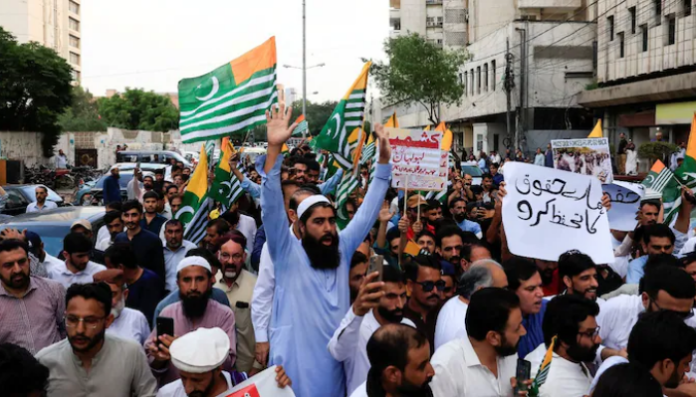
Pakistan-occupied Kashmir (PoK) is again rocked by massive violence between the country’s forces and protestors. Local activists and leaders of the Joint Awami Action Committee (JAAC) accused the military and security troops of carrying out a brutal crackdown during a funeral gathering in Rawalakot on 7th June (Sunday). The area was cordoned off following the face-off.
The incident occurred just hours before the JAAC, which has been agitating against inflation, problems with governance and Pakistan’s failure to uphold its commitments to the people of PoK, planned to shut down the entire region on 9th June. The dispute resulted in 200 injuries and at least eight fatalities, including four security personnel, reported Times Now.
According to Commissioner Sardar Waheed, the violence claimed the lives of three civilians and injured forty others. Police verified in a separate statement that the event resulted in the deaths of four officers and the injuries of twenty-three others.
The fresh conflict emerged at the Barmang Bridge. A car carrying well-known local rights activist Sardar Umar Nazir Kashmiri was stopped by security personnel. Notably, he barely managed to survive as a bullet grazed his ear, but his close aide Shahzeb Habib was shot dead. Afterwards, thousands of people took to the streets to demonstrate against the killing, economic exploitation, continuous oppression and Islamabad’s oppressive grip over local resources.
According to JAAC officials, demonstrators and mourners assembling outside the Combined Military Hospital (CMH) for Shahzaib Habib’s funeral prayers were subjected to gunfire and shelling by security officers. Habib was killed by Pakistani Rangers. They charged that the recent action resulted in at least 27 deaths.
According to other reports, JAAC activists staged a demonstration against the Pakistani government and military establishment on Sunday in Rawalakot. However, Pakistani soldiers and Rangers opened fire on them, injuring at least 4 people who were brought to CMH for medical attention.
JAAC vowed a large-scale demonstration calling for justice and accountability after Habib’s demise. The outfit, which was brought under the purview of anti-terror laws, has started a protest and declared to organise a long march. The group has been charged by the Pakistani government with “engaging in terrorism” and “creating anarchy.”
“We are not against any country, institution or individual — to link our peaceful struggle with terrorism is a great oppression. God willing, on the morning of 9th June, a historic and meaningful long march will begin. I appeal to the people to remain organised and united,” conveyed Shaukat Nawaz Mir, a JAAC member on 6th June (Saturday).
JAAC also asked for the elimination of the 12 reserved assembly seats for non-residents because it undermined the local authority. It charged that these seats would enable outsiders to influence local assembly decisions on behalf of Pakistan’s major political parties. It has submitted 38-point agenda which also demanded regional economic reforms, such as reduced energy costs along with subsidised flour and electricity.
A shutdown on communications in the area, border blocks and public outrage over the arrest of multiple JAAC leaders, escalated the tensions. The intelligence insiders revealed that “a severe breakdown of local law enforcement” is shown by the recent collapse of law and order in PoK, reported News18. They further highlighted that Pakistan “is currently dealing with critical security threats on multiple fronts.”
Meanwhile, a British parliamentary group asked the government for clarification on their assessment of the volatile situation in PoK. Bradford East MP Imran Hussain, the chair of the All-Party Parliamentary Group on Kashmir, referenced recent reports from the area of a “communications blackout, as part of a broader lockdown, alongside escalating tensions, and restrictions affecting the ability of people in the region to communicate with the outside world” in a letter to the Foreign Office of the United Kingdom on Saturday.
Nearly 30 MPs signed the letter, which called on the government to “engage proactively and use all appropriate diplomatic channels to encourage de-escalation and a peaceful resolution” in the region. It read, “We are also concerned by reports of arrests, including those of British nationals, restrictions on communications, and a breakdown in dialogue between the authorities and representatives of the Joint Awami Action Committee.”
The rights to peaceful assembly, freedom of expression, and access to communications are “important principles that help maintain stability and public confidence, particularly at times of heightened tension,” the letter stated, calling for “peaceful dialogue, restraint, and meaningful engagement with those raising concerns.”
The latest confrontations are a part of a protracted, multi-year mass struggle spearheaded by the Awami Action Committee. The local populace has been demonstrating against high electricity costs, severe inflation and an abject absence of political autonomy under Pakistani rule. Similar events unfolded on the streets of PoK since last year as well.
