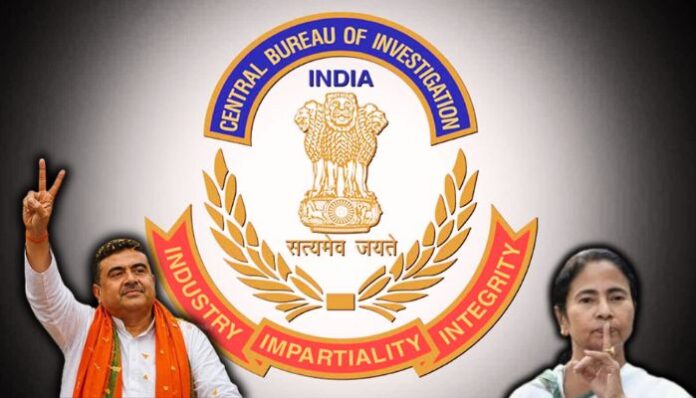
In a major step towards cleaning up TMC-era corruption in West Bengal, Chief Minister Suvendu Adhikari has restored the general sanction for the Central Bureau of Investigation (CBI). On 8th June 2026, the BJP government issued a notification restoring general sanction or consent under Section 6 of the Delhi Special Police Establishment Act, 1946.
The CBI comes under the DSPE Act, and it requires states to give the probe agency consent to act against central government employees within a state, as public order and police are State subjects. To avoid issuing separate consents for each case, states generally issue a blanket consent to the CBI, which is routinely renewed. However, once the consent is withdrawn, the agency has to seek permission for each case it wants to probe in the states, and the states may refuse to grant such permission.
The 8-year standoff ends as the Suvendu government restores general sanction for the CBI that the Mamata regime revoked
The restoration of general sanction would enable the CBI investigations into offences by central government employees, central public sector undertakings (CPSUs), as well as private persons across West Bengal, without prior case-by-case approval.
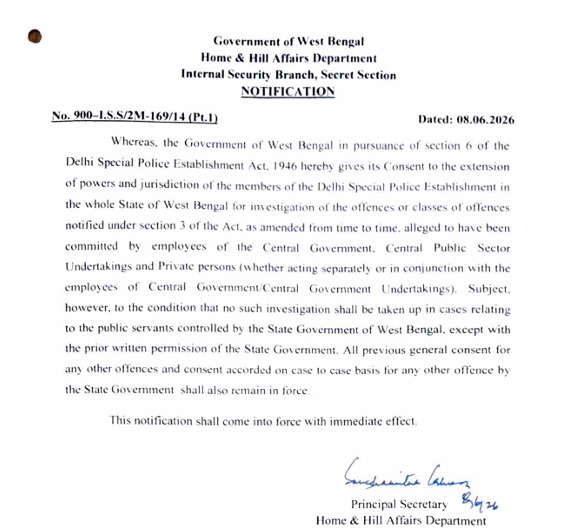
“Whereas, the Government of West Bengal in pursuance of section 6 of the Delhi Special Police Establishment Act, 1946 hereby gives its Consent to the extension of powers and jurisdiction of the members of the Delhi Special Police Establishment in the whole State of West Bengal for investigation of the offences or classes of offences notified under section 3 of the Act, as amended from time to time, alleged to have been committed by employees of the Central Government. Central Public Sector Undertakings and Private persons (whether acting separately or in conjunction with the employees of Central Government/Central Government Undertakings),” the notification issued by the West Bengal government’s Home & Hill Affairs Department reads.
The notification, however, mentions a caveat. Despite the restoration of general sanction, investigations against West Bengal state public servants still require prior state permission.
“Subject, however, to the condition that no such investigation shall be taken up in cases relating to the public servants controlled by the State Government of West Bengal, except with the prior written permission of the State Government. All previous general consent for any other offences and consent accorded on a case-by-case basis for any other offence by the State Government shall also remain in force,” the notification adds.
The move to restore general sanction came shortly after the newly elected BJP government in West Bengal granted specific sanctions for the CBI to prosecute officials in several TMC-era scams.
With the state government’s general consent for CBI restored, the Central probe agency would be able to expedite action on pending cases, improve accountability, and enhance centre-state relations on law enforcement.
Why Mamata Banerjee revoked the general sanction for CBI in 2018
Back in November 2018, then Chief Minister Mamata Banerjee-led TMC government withdrew consent, claiming that the CBI and other central probe agencies, including the Enforcement Directorate, were being ‘weaponised’ by the BJP-led Central government for ‘political vendetta’ against opposition-ruled states.
Accustomed to unchallenged rule and unchecked corruption, the TMC government was frustrated with probes by Central agencies into various scams involving TMC leaders, including the coal, cattle smuggling, teachers’ recruitment scam, cooperatives scam, municipalities cash-for-jobs scam, Saradha chit funds scam, and other graft cases.
Consequently, Mamata Banerjee misused her power as Chief Minister. She withdrew general sanction to the members of the Delhi Special Police Establishment, including CBI, to shield her corruption-accused party leaders. This was essentially an act of political interference in investigations being conducted by the Central probe agencies while hiding behind the convenient argument of ‘attack on federalism’.
With general consent withdrawn, the CBI was forced to seek case-by-case permissions repeatedly, delaying action in several cases, and even birthed legal battles as the TMC government moved the Supreme Court, challenging the CBI’s jurisdiction.
Notably, other than the Mamata government in West Bengal, instances of withdrawal of general consent have also been reported in Meghalaya, Andhra Pradesh, Rajasthan, Mizoram, Karnataka, Jharkhand, Maharashtra, Punjab and Kerala in the recent past. General sanction revocations in these states were notified when anti-BJP parties were in power.
West Bengal withdrew the consent to CBI in 2018, immediately after Andhra Pradesh. The Congress-led Chhattisgarh government had done the same in January 2019. The Congress-ruled Rajasthan government had revoked the general consent in July 2020. Aam Aadmi Party-ruled Punjab in November 2020. The Shiv Sena-Congress-NCP govt had followed suit in October 2020. Congress-ruled Karnataka withdrew general consent in September 2024.
In almost all instances, the general sanction to CBI was withdrawn exactly when the agency was investigating scams and other irregularities in these states.
Suvendu Adhikari government fixing the TMC-era systemic rot
One after the other, Chief Minister Suvendu Adhikari is initiating actions focused on restoring accountability and fixing the TMC-era systemic rot. In May this year, the BJP government granted permission for prosecution in the Teacher Recruitment Scam, Municipal Recruitment Scam, and the Cooperative Scam, discontinuing the TMC government’s practice of blocking probes for years.
On 6th June 2026, CM Suvendu Adhikari-led BJP government ordered an investigation into the 2019 anti-CAA riots by Muslim mobs that caused extensive damage to the tune of Rs 93 crore, to Indian Railways in the state.
CM Adhikari directed the West Bengal Police under DGP Siddh Nath Gupta to review and probe all complaints of arson, vandalism, and damage to public property, particularly railway assets, during the 2019 protests against the Citizenship Amendment Act.
The BJP government in West Bengal also constituted two inquiry commissions comprising retired high court judges to probe institutional corruption and atrocities against women on 18th May. These inquiry commissions commenced their work from 1st June 2026.
Earlier, CM Adhikari suspended three IPS officers on charges of mishandling of the 2024 RG Kar Medical College rape and murder case.
From the politicisation of police and bureaucracy, entrenched corruption networks, to cadre-based politics, the Suvendu government is taking measures to probe and fix the misdeeds of the TMC regime. The CBI general sanction restoration is yet another positive step in this direction.