

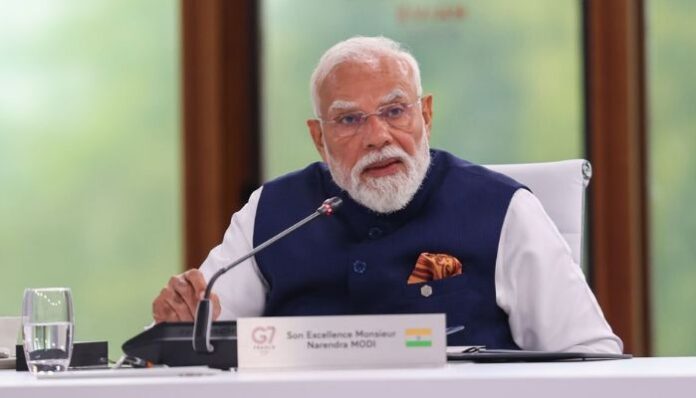
On 16th June (local time), Prime Minister Narendra Modi said that the world is not suffering from a shortage of resources, but from a shortage of trust, as he addressed the G7 Outreach Session in Evian, France. PM Modi, who is attending the 52nd G7 Summit as a partner country representative, said that trust must be at the centre of global partnerships, supply chains, technology and development. India is not a member of the G7, but has been invited to take part in the outreach sessions along with other partner nations.
Shared my thoughts at the Outreach Session on ‘Forging New Partnerships and Rebuilding International Solidarity’ at the G7 Summit in Evian. In a world that is getting more interconnected and interdependent than ever before, this subject becomes all the more vital. But,… pic.twitter.com/NjNddWGtFF
— Narendra Modi (@narendramodi) June 16, 2026
PM Modi said, “Today, the world does not suffer from a shortage of resources; it suffers from a shortage of trust. And the future of our partnerships depends on rebuilding this trust,” during the session titled “Forging New Partnerships and Rebuilding International Solidarity”. India is taking part in the G7 Summit for the 13th time and this was PM Modi’s seventh consecutive participation at the forum.
Mutual trust is the most important strategic asset today.
— Narendra Modi (@narendramodi) June 16, 2026
But, sadly, today, the world does not suffer from a shortage of resources…it suffers from a shortage of trust.
And the future of our partnerships depends on re-building this trust.
PM Modi calls for safer maritime routes
In his address, PM Modi also raised the issue of maritime security and the safety of seafarers. His statement came days after three Indian mariners were killed in a US military strike on a commercial vessel near the Strait of Hormuz.
He said, “Ensuring the safety of seafarers, who connect nations through global maritime trade, is our collective responsibility. We must ensure that sea routes remain secure and that seafarers can carry out their duties without fear.”
Against the backdrop of rising tensions in West Asia and disruptions in maritime trade through the Strait of Hormuz, PM Modi said that such disruptions had affected the global economy and had also led to the loss of Indian civilian lives. He said, “Disruptions to maritime trade through the Strait of Hormuz have adversely affected the global economy. Several Indian civilians have also lost their lives.”
The Prime Minister said that India was ready to work with its partners to strengthen maritime security and ensure that global shipping lanes remain safe.
Three Indian mariners killed in US strike
The remarks assumed significance as External Affairs Minister S Jaishankar had earlier spoken to US Secretary of State Marco Rubio to convey India’s strong protest over the death of three Indian mariners in the American strike on MT Settebello near the Strait of Hormuz.
Deck Cadet Aditya Sharma, Engine Fitter Shivanand Chaurasiya and Chief Engineer Patnala Suresh were killed in the attack. Jaishankar told Rubio that lethal action against commercial shipping was “not justified”.
However, Rubio justified the attack, saying that violations of the US blockade and the alleged illicit transport of oil from Iran would not be tolerated.
Three commercial vessels, MT Marivex, MT Settebello and MT Jalveer, had come under US Navy missile strikes near the Strait of Hormuz last week. All three vessels had Indian mariners on board. While three Indians were killed on MT Settebello, 21 others were rescued by the Royal Navy of Oman. Indian mariners on the other two vessels were also rescued safely.
The US military’s Central Command had claimed that the vessels had violated the blockade by attempting to sail to Iran or transport oil from Iran.
PM Modi to meet Trump for bilateral talks
Prime Minister Narendra Modi and United States President Donald Trump are scheduled to hold bilateral talks on the sidelines of the G7 Summit. According to reports, the meeting is expected to focus on trade, AI, supply chains, investment partnerships, energy security and global security challenges.
Earlier, the two leaders exchanged brief greetings ahead of the G7 working session. The upcoming bilateral meeting will be their second meeting after the change of guard at the White House, following their meeting in Washington DC on 13th February 2025.
Furthermore, negotiations on a bilateral trade deal are believed to be in the final stages and could be concluded in the coming weeks.
India raises Global South concerns
At the G7 Summit, PM Modi was seen engaging with world leaders on issues important to India and the Global South. He said that development must be aligned with the aspirations of people and underlined India’s “humanity first” approach.
“India’s experience demonstrates that development is most effective when it is aligned with the aspirations of the people,” he said.
He also referred to India’s guiding philosophy of “Sarv Jan Hitaye, Sarv Jan Sukhaye”, meaning welfare and happiness for all.
PM Modi said that trust was required not just between countries, but also in the way technology, supply chains and development opportunities are handled globally. He said that technology and supply chains should be used for global good and not as weapons.
India backs global health and development initiatives
The G7 nations also announced a series of global health and development initiatives with support from partner countries, including India.
The leaders called for a coordinated international response to the re-emerging Ebola outbreak in the Democratic Republic of Congo and Uganda. India, Egypt, Kenya and South Korea joined the appeal for stronger measures such as contact tracing, border surveillance and community engagement.
The G7 also reaffirmed its commitment to the global fight against cancer. Partner countries, including India and Brazil, supported the push for prevention, early diagnosis, access to quality healthcare, cancer research and responsible use of emerging technologies.
The grouping also stressed cooperation in development and investment finance to support vulnerable countries and promote sustainable growth.
PM Modi meets leaders of Japan and South Korea
On the sidelines of the summit, PM Modi also met Japanese Prime Minister Sanae Takaichi. The two leaders agreed to deepen cooperation in various sectors, with priority on trade and investment.
Had a great interaction with Prime Minister Sanae Takaichi of Japan.
— Narendra Modi (@narendramodi) June 16, 2026
India and Japan will continue to deepen ties in diverse sectors, with a priority on trade and investment.@takaichi_sanae @G7 pic.twitter.com/k0sW6URiQE
Takaichi introduced the “POWERR Asia” framework at the G7, aimed at strengthening energy and resource resilience in Asia. The initiative seeks to support emergency responses through crude oil and petroleum product procurement, maintain supply chains, secure critical minerals and diversify energy resources.
During discussions on West Asia, Takaichi also highlighted the importance of free and safe navigation in the Strait of Hormuz.
PM Modi also met South Korean President Lee Jae-Myung. The two leaders agreed to strengthen cooperation across economic, cultural and social fronts.
In Evian, had a very good conversation with the President of the Republic of Korea, Mr. Lee Jae-myung. Just two months ago, had welcomed him to India.
— Narendra Modi (@narendramodi) June 16, 2026
Our nations are working together in trade, commerce and many other futuristic sectors.@Jaemyung_Lee @G7 pic.twitter.com/8eKQy8hwup
“Prime Minister Modi and I have agreed to strengthen cooperation in all aspects, economic, cultural, and social, between Korea and India going forward, and to develop our two countries into a new relationship,” Lee said after the meeting.
PM Modi recalled Lee’s visit to India in April, when the two sides had agreed on a Joint Strategic Vision for implementing the India-ROK Special Strategic Partnership over the next five years.
India at the G7 table as a partner country
India’s participation at the G7 Summit has once again brought focus on its growing role in global conversations on trade, maritime security, technology, energy security, development, and the concerns of the Global South. PM Modi’s remarks at the summit focused on India’s key concerns, including restoring trust in international relations, protecting maritime trade routes, ensuring the safety of Indian seafarers, and building a more inclusive global order.
