

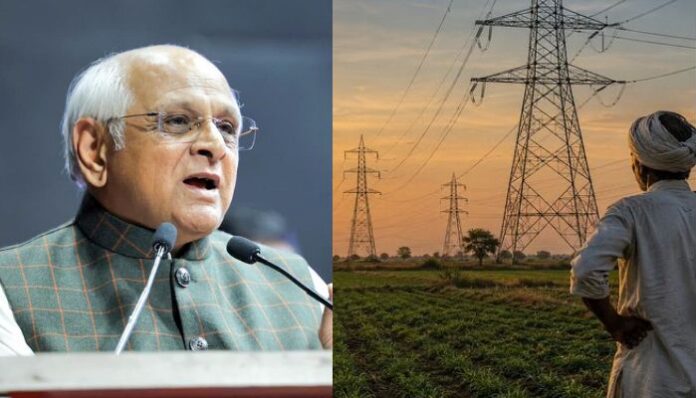
On Friday, 3rd June, the Gujarat government accepted several demands raised by farmers protesting in Morbi district over compensation for land being used for a power transmission project linked to Adani Energy Solutions Ltd (AESL). The decision comes after more than three weeks of protests in Jetpar village and is being seen as a major relief for affected farmers, though they have said they will continue their agitation until the government issues an official Government Resolution (GR).
Compensation linked to market price
The biggest change announced by the state government is in the way compensation will now be calculated. Instead of using the jantri (circle) rate, the government will consider the actual market price of the land as the base and pay farmers double that amount as compensation.
Farmers had demanded compensation equal to 400% of the market value of their land, saying that the installation of transmission towers and high-voltage power lines would permanently reduce the value and future use of their land. While the revised compensation is lower than what they sought, it is a significant increase from the earlier policy.
Protest over Adani-linked transmission line
The protest is against the construction of a 756 kV DC transmission line by Halvad Transmission Limited, a Special Purpose Vehicle of Adani Energy Solutions Ltd (AESL). The transmission line is being built over a distance of 246 kilometres, connecting the KPS-2 Pooling Station in Khavda, Kutch, to a new switching station at Halvad in Morbi.
The project affects farmers across nearly 400 villages in Kutch and Morbi, where transmission towers and high-tension electricity lines are being installed on agricultural land.
More land area to be considered for compensation
The government has also agreed to revise the area that will be considered while calculating compensation for transmission towers. Earlier, compensation was paid only for the actual base area occupied by a tower. Under the new policy, one extra square metre on each side of the tower base will also be included.
For example, in the case of a 765 kV transmission line, the compensation area has been increased from 625 square metres to 729 square metres.
Market Rate Committee to ensure transparency
Another key demand accepted by the government is the formation of a Market Rate Committee (MRC) to decide the actual market value of the land in a fair and transparent manner.
According to Ashwini Kumar, Principal Secretary of the Energy and Petrochemicals Department, the committee will be headed by the District Collector. It will also include representatives of affected landowners, a market valuer nominated by the farmers, representatives of the transmission company and a valuer appointed by the company. The inclusion of farmer representatives is expected to make the valuation process more transparent and protect their interests.
Advance payment and wider benefit
The government has also agreed to another important demand by deciding that compensation will now be paid in a single advance instalment. Earlier, the payment was made in three separate instalments, something farmers had opposed.
The revised compensation policy will also benefit farmers whose compensation had already been fixed under the earlier rules, provided the transmission projects on their land are still under construction.
Farmers continue protest
The farmers’ charter of demands included six major points. Apart from seeking compensation at 400% of the market value, they had also demanded different compensation rates for the Right of Way (RoW) area in rural, municipality and municipal corporation limits, along with advance payment and the creation of the MRC.
Announcing the changes, Gujarat Agriculture Minister and government spokesperson Jitu Vaghani said the government studied compensation policies in other states before taking the decision. He said the revised policy aims to ensure that farmers receive fair and market-based compensation. Vaghani added that the decisions were taken after consultations led by the Chief Minister and Deputy Chief Minister, who asked officials to keep farmers’ interests in mind while reviewing the policy.
The announcement came on the same day that media reports highlighted the ongoing protest in Jetpar village and a day before Prime Minister Narendra Modi’s scheduled visit to Gujarat to inaugurate a semiconductor facility in Sanand. Despite the government’s announcement, protesting farmers have made it clear that they will continue their agitation until the revised policy is formally notified through a Government Resolution.
