

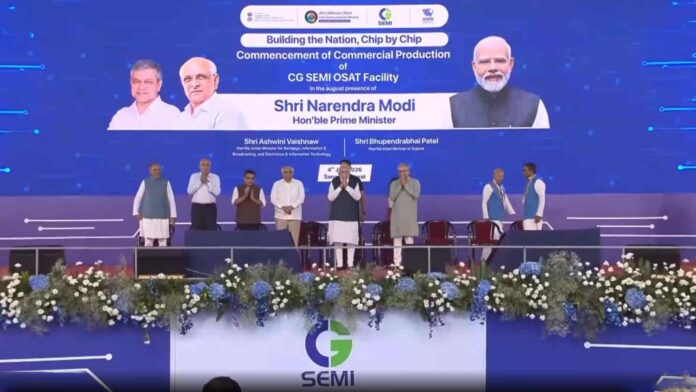
Prime Minister Narendra Modi today inaugurated the CG Semi Outsourced Semiconductor Assembly and Test (OSAT) facility in Sanand, Gujarat, formally launching commercial production at one of India’s pioneering semiconductor packaging plants developed under the India Semiconductor Mission. The event marks a key milestone in the country’s push for technological self-reliance and positions Sanand as an emerging global hub for chip assembly and testing.
The facility, developed by CG Semi Private Limited, a joint venture led by CG Power and Industrial Solutions Limited (part of the Murugappa Group), involves a total approved investment of approximately ₹7,600 crore. CG Power holds the majority stake of around 92.3 per cent, while Japan’s Renesas Electronics and Thailand’s Stars Microelectronics serve as technical partners with smaller equity holdings. The project has received 50 per cent fiscal support from the India Semiconductor Mission on a pari-passu basis for eligible capital expenditure. A second plant (G2) is already under construction and expected to be completed by the end of 2026.
The OSAT facility provides end-to-end back-end semiconductor services, including wafer sorting, assembly, packaging, testing, package design, failure analysis, reliability testing, and logistics support. It manufactures a range of semiconductor packages, from legacy types such as QFN and QFP to advanced packages like FC-BGA and FC-CSP. These chips cater to key sectors including automotive, consumer electronics, industrial equipment, telecommunications, 5G infrastructure, power management, and Internet of Things applications. The plant has already begun exporting assembled chips to Malaysia for customers of its joint venture partner Renesas, with further exports planned to markets in Japan, the United States, and Europe.
At full ramp-up, the current G1 facility is designed for a peak capacity of around 0.5 million chips per day, translating to an installed capacity of up to 4.7–5 billion units annually over the next five years. With the addition of the second plant, total daily capacity is projected to reach approximately 14.5 million chips. The facility currently employs more than 300 people and is expected to generate around 5,000 direct and indirect jobs over the next five years.
This inauguration represents the third major semiconductor facility in Sanand to commence commercial operations this year, following Micron Technology’s Assembly, Test, and Packaging (ATMP) plant in February and Kaynes Semicon’s OSAT unit in March. Sanand is rapidly evolving into India’s first dedicated chip packaging cluster, supported by Gujarat’s proactive Semiconductor Policy. Across the state, six semiconductor projects have been approved with a combined investment of around USD 14.7 billion.
In his address, the Prime Minister highlighted that the Semicon India programme is gathering rapid momentum through steady, incremental progress, described as advancing “step by step, brick by brick, and chip by chip.” He emphasised that the expansion of the semiconductor industry is the natural next phase of the electronics revolution witnessed in India over the past decade, moving from final products and components to semiconductors themselves. This, he noted, forms the definitive roadmap to Viksit Bharat and the next phase of Make in India.
PM Modi stressed the goal of building a complete semiconductor ecosystem in India, from chip design and fabrication to packaging, while developing self-reliance in high-tech materials and critical minerals. He pointed to the strong growth in the electronics sector, including a 33-fold increase in mobile phone production and nearly seven-fold rise in overall electronics output since 2014, with exports growing eleven-fold. The Prime Minister expressed confidence that India’s youth would drive the AI, robotics, and next-generation technology revolutions using Made in India chips, and called for continuous upskilling to seize emerging opportunities in research, design, and supply chain management.
He also underscored the importance of developing integrated industrial clusters, noting that one industry gives birth to ten others, transforming regional economies. The Sanand ecosystem, with its growing network of manufacturers, suppliers, design centres, and startups, exemplifies this cluster effect. Shri Modi praised the collaborative model involving Indian, Japanese, and Thai partners and reaffirmed the government’s commitment to policy stability, ease of doing business, and rapid execution to help achieve a developed India by 2047.
The commencement of commercial operations at the CG Semi facility significantly strengthens India’s position in the global semiconductor value chain, reduces import dependence for chip packaging, and supports the national target of reaching USD 500 billion in electronics production by 2030. With its focus on both legacy and advanced packaging technologies, the plant is poised to serve domestic demand as well as global markets, contributing to job creation, skill development, and technological advancement across the country.
