

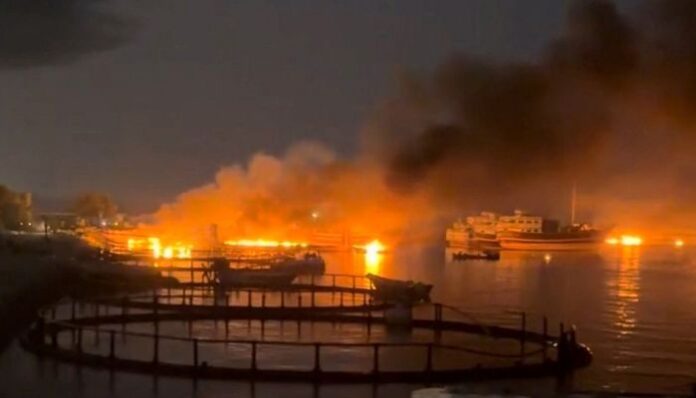
The United States carried out a fresh round of airstrikes on Iran early late Wednesday, 8th July, triggering a new wave of tensions across the Gulf region. In response, Iran launched attacks towards Bahrain, Kuwait and Qatar, raising fears that efforts to maintain a temporary ceasefire and prevent a wider war may be falling apart.
The latest escalation came only hours after US President Donald Trump declared that recent attacks on commercial ships in the Strait of Hormuz had effectively ended the fragile agreement that had briefly reduced fighting in the region.
BREAKING: U.S. Central Command (CENTCOM) carried out another round of strikes against Iran on July 8, targeting roughly 90 military sites to further weaken Tehran’s ability to threaten commercial shipping in the Strait of Hormuz. The targets included air defense systems, coastal… pic.twitter.com/DFa0p0R2Pr
— Breaking911 (@Breaking911) July 9, 2026
According to American military officials, the latest operation targeted several Iranian military installations and port facilities. The strikes followed Iran’s alleged involvement in attacks on merchant ships near the coast of Oman earlier this week.
US officials said the operation was intended to weaken Iran’s ability to threaten international shipping routes in the Strait of Hormuz, one of the world’s most important waterways for oil and gas transportation.
“Our actions are aimed at further degrading Iran’s ability to threaten freedom of navigation in the Strait of Hormuz,” the US military said in a statement.
Iranian state media reported explosions in several parts of the country, including Bushehr, which hosts Iran’s nuclear power facilities, as well as the southern cities of Chabahar, Konarak, Bandar Abbas and Sirik. Authorities also reported that an airport firefighter was killed in a strike in Iranshahr.
🚨🇮🇷 BREAKING: The IRGC claims it destroyed infrastructure at FOUR U.S. bases across Kuwait and Bahrain…
— Mario Nawfal (@MarioNawfal) July 9, 2026
-The IRGC announced a joint missile-and-drone operation against Camp Arifjan and Ali Al-Salem in Kuwait, plus Naval Support Activity Bahrain (Juffair) and Sheikh Isa Air… https://t.co/2oqOAYdBBm pic.twitter.com/z4uXivFc2I
Bahrain, Kuwait and Qatar caught in escalation
The conflict quickly spread beyond Iran’s borders as air raid sirens sounded in Bahrain, home to the headquarters of the US Navy’s Fifth Fleet.
There were no immediate reports of major damage in Bahrain, Kuwait or Qatar. However, Kuwaiti military officials said air defence systems were actively intercepting incoming drones and missiles.
Iran’s Revolutionary Guard later claimed responsibility for attacks targeting Bahrain and Kuwait.
For the first time in several months, reports also suggested that US strikes had targeted important bridges and transport infrastructure inside Iran. Iranian media reported attacks on railway bridges in the country’s northeast, while Revolutionary Guard officials said bridges leading towards Mashhad had also come under attack.
Trump issues fresh warning to Tehran
After leaving a NATO summit in Turkey, Donald Trump posted videos on social media showing what he described as explosions inside Iran and warned Tehran against carrying out further attacks on shipping routes.
“This is in retribution for yesterday’s bombing of ships by Iran. If it happens again, it will get much worse,” Trump said.
Trump says "ceasefire" with Iran over. pic.twitter.com/B4duKbSt3T
— Sidhant Sibal (@sidhant) July 8, 2026
Earlier in the day, the US President had suggested that the fighting would not develop into a prolonged military campaign, but also hinted that Washington could take stronger action if required.
“Anything that happens is going to happen very fast,” Trump said, adding that the United States could “finish the job” if necessary.
Fears grow over the collapse of ceasefire
The latest violence has raised fresh concerns that the temporary ceasefire agreement could collapse completely. Oil prices climbed after Trump’s remarks, with markets fearing that a renewed conflict could once again disrupt energy shipments passing through the Strait of Hormuz.
Trump later told reporters that, in his view, the ceasefire was effectively over, although he said negotiations could continue.
“They can talk, but I think they’re wasting their time,” he said.
Iran rejected the remarks, with Deputy Foreign Minister Kazem Gharibabadi accusing Washington of failure rather than strength. “These statements are not a sign of power but an admission of the failure of US policy towards Iran,” he said.
