

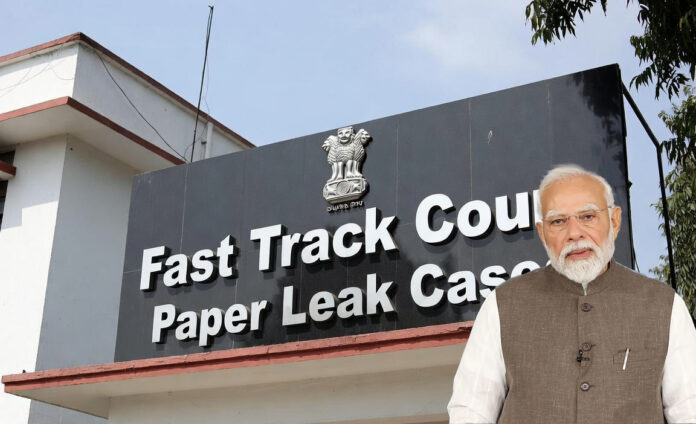
Prime Minister Narendra Modi on Thursday announced that the Central government has decided to set up fast-track courts to ensure swift and stringent punishment for those involved in examination paper leaks. In a post on X, the Prime Minister stated that nothing is more important than the welfare and future of the country’s youth, and directed concerned authorities and officials to take all necessary steps in this regard.
PM Modi emphasised that this measure continues the series of steps being taken to safeguard the interests of students. He added, “Those who try to harm the future of our youth will not be spared.”
Nothing is more important than the welfare and future of our youth!
— Narendra Modi (@narendramodi) July 23, 2026
We have decided to set up fast-track courts to ensure swift and stringent punishment for those involved in paper leaks. Have directed the concerned authorities and officials to take all necessary steps in this…
Just two days ago, Prime Minister Narendra Modi had said that those responsible for the NEET paper leak must face the strictest possible punishment and stressed that protecting the integrity of examinations is a national responsibility.
The announcement comes against the backdrop of widespread anger and ongoing protests over the NEET-UG 2026 paper leak controversy. The National Eligibility cum Entrance Test for undergraduate medical admissions was held on 3 May 2026, with over 22 lakh aspirants appearing across the country. Within days, allegations surfaced of a leaked “guess paper” circulating in coaching hubs, particularly in Sikar, Rajasthan, with significant overlaps reported with the actual question paper. As a result, the National Testing Agency cancelled the examination on 12 May, ordered a CBI probe, and conducted a re-examination on 21 June, results for which was declared on 16 July.
Despite the smooth conduct of the re-test, some student organisations, the newly formed Cockroach Janta Party and other groups have continued to protest over the matter. CJP has been conducting demonstrations at Jantar Mantar in New Delhi since last month, demanding the resignation of Union Education Minister Dharmendra Pradhan, major reforms in the National Testing Agency, and independent inquiries into systemic failures. Protests have at times turned tense and violent, with protesters clashing with police and attacking cops during the Chalo Sansad March on Monday and after that.
Paper leaks have long plagued India’s competitive examination system. In 2024, the NEET-UG examination faced similar allegations that triggered nationwide protests, court hearings and a CBI investigation. The UGC-NET examination that year was cancelled a day after it was conducted following intelligence inputs about a possible leak. Earlier instances include the cancellation of the All India Pre-Medical Test in 2015 by the Supreme Court due to a large-scale leak, the CBSE Class 10 and 12 paper leaks in 2018, and the SSC Combined Graduate Level examination controversy in 2017.
State-level recruitment tests have also been repeatedly hit, including the Uttar Pradesh police constable examination in 2024 that affected nearly 48 lakh candidates, the Bihar Public Service Commission examination in 2022, the Rajasthan Eligibility Examination for Teachers in 2021, and the notorious Vyapam scam in Madhya Pradesh. Rahul Gandhi yesterday claimed that there have been 152 paper leak cases over the last 10 years with zero convictions.
Investigations over the years have pointed to a well-entrenched nexus involving printing presses, middlemen, coaching centres and, at times, officials, with low conviction rates failing to act as a sufficient deterrent. Therefore, the govt’s decision to set up fast-track courts to ensure speedy trial in such cases is an important development in combating the menace.
The government had earlier brought in the Public Examinations (Prevention of Unfair Means) Act, 2024, which provides for stringent penalties, including imprisonment up to ten years and heavy fines for those involved in leaking papers or facilitating unfair means. The latest decision to constitute dedicated fast-track courts is being seen as an attempt to address the persistent problem of delayed justice in such cases and to restore confidence among students whose careers hang in the balance.
