

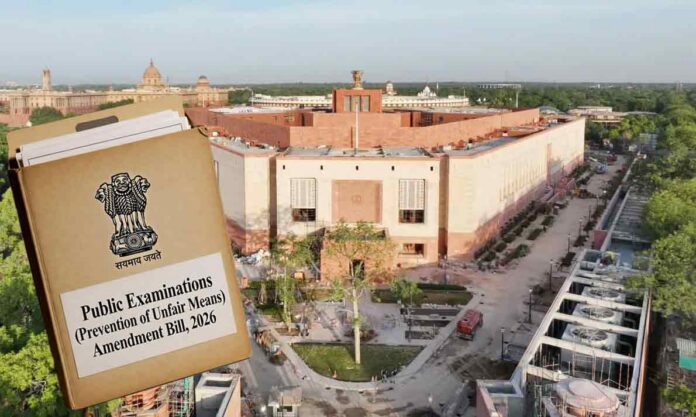
The Central Government is set to introduce the Public Examinations (Prevention of Unfair Means) Amendment Bill, 2026, in the Lok Sabha on Monday. The draft for the amendment was approved by the Union Cabinet led by Prime Minister Narendra Modi on Friday.
Union Minister of State for Personnel, Public Grievances and Pensions Dr Jitendra Singh will move for leave to introduce the legislation. The Bill introduces several key amendments designed to plug enforcement loopholes, establish dedicated judicial mechanisms and accelerate criminal trials following widespread irregularities in the NEET-UG 2026 examination.
Union Minister Dr Jitendra Singh to introduce The Public Examinations (Prevention of Unfair Means) Amendment Bill, 2026 in the Lok Sabha on Monday, July 27
— ANI (@ANI) July 25, 2026
According to the legislative business agenda, he will introduce a Bill to amend the Public Examinations (Prevention of… pic.twitter.com/PL7dECRpSA
The legislative push comes after a complete washout of the ongoing Monsoon session of Parliament, which commenced on 20 July, as opposition parties and student groups maintained unrelenting pressure on the Centre over paper leaks. The proposed legislation seeks to significantly overhaul the original 2024 framework by instituting strict time bounds for both investigations and judicial proceedings.
As per the text of Bill No. 139 of 2026, the minimum punishment under Section 10 for persons resorting to unfair means has been enhanced from three years to five years, which may extend to ten years, along with a fine of up to ₹50 lakh. For service providers, the maximum fine has been raised from one crore rupees to ₹5 crore, while the period of debarment from conducting public examinations has been increased from four years to eight years.
Directors and other persons in charge of service providers found guilty will now face a minimum of five years’ imprisonment (up from three years) and a fine of up to ₹5 crore. In cases of organised crime under Section 11, the minimum sentence has been increased from five years to seven years, with the minimum fine raised from ₹1 crore to ₹10 crore.
The Centre retains the authority to constitute a dedicated Special Task Force to investigate offences under the Act whenever required. Investigations into offences must be completed within two months, whether conducted by the empowered police officer, a Central Investigating Agency or the Special Task Force, calculated from the relevant date of recording of information, reference or notification.
Centre to introduce ‘THE PUBLIC EXAMINATIONS (PREVENTION OF UNFAIR MEANS) AMENDMENT BILL, 2026’ in Parliament on Monday.
— Marya Shakil (@maryashakil) July 25, 2026
Proposed Bill states:
• Minimum punishment for paper leak and unfair means in exams enhanced from three years to five years with maximum sentence of 10… pic.twitter.com/hDDISsLwSO
State Governments and Union Territory Administrations will be empowered, in consultation with the Chief Justice of the concerned High Court, to designate a Court of Session as a Special Fast Track Court to try offences under the Act. Such courts shall also try connected offences under the Bharatiya Nyaya Sanhita, 2023, or any other law at the same trial. Proceedings in these Special Fast Track Courts must be conducted on a day-to-day basis until all witnesses in attendance have been examined, unless adjournment is recorded in writing as necessary.
Trials are mandated to conclude within three months from the date of filing of the chargesheet. Pending cases relating to offences under the Act as on the date of commencement of the Amendment Act shall stand transferred to these courts and must also be completed within three months of receipt.
Every State Government and Union Territory Administration shall appoint one or more Special Public Prosecutors for each Special Fast Track Court. Appeals against any judgment, sentence or order (other than interlocutory orders) of a Special Fast Track Court shall lie to the High Court and shall be heard by a bench of two Judges. Such appeals are to be disposed of, as far as possible, within three months from the date of admission. Appeals against orders granting or refusing bail will also lie to the High Court. Appeals must ordinarily be preferred within thirty days, with a maximum outer limit of ninety days.
The introduction of the amendment Bill follows weeks of intense turmoil in the Capital. A 37-day-long demonstration spearheaded by the Cockroach Janata Party (CJP) alongside activist Sonam Wangchuk ended after the resignation of Education Minister Dharmendra Pradhan today after series of high-level negotiations with Union Ministers JP Nadda and Jitendra Singh.
The CJP has announced the formal withdrawal of its sit-in at Jantar Mantar “in good faith” after reaching an understanding with the Centre.
Along with the strengthening the law against irregularities in competitive exams, the administration of exams is also undergoing major reforms. As part of a broader push to restore confidence in the examination system, the Centre has initiated a complete overhaul of the National Testing Agency. Forty-seven officials have been terminated from service, with legal and criminal proceedings expected against some of them.
The restructuring, expected to be completed within a month, includes a review of the agency’s outsourcing model to minimise vulnerabilities, recruitment of new senior management and domain experts, and measures to strengthen cybersecurity, digital forensics and centre-level monitoring, all aimed at creating a more robust and leak-proof framework for national-level tests.
