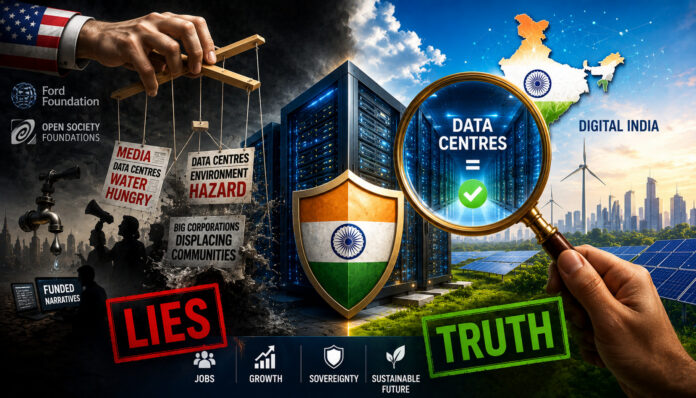
In a series that explores India’s data centre evolution, this happens to be the fifth and last article. The economic potential of the sector, cooling system engineering, the water premise argument, and the policy framework were all discussed in the previous articles. This final piece explores a documented pattern in which foreign-funded reporting networks have consistently targeted India’s biggest infrastructure objectives, and what that pattern looks like when you carefully trace the funding, the timing, and the history. This is something the preceding articles consciously avoided.
Let’s say you are going to open a new store. You’ve been making investments for years. The location is excellent. Customers are patiently waiting. Then, a week ahead of your opening, someone begins spreading rumours about your store, including the quantity of water you require, the land your store is situated on, and the amount of noise your equipment produces. Not all of the stories are incorrect. However, they are timed to cause customers to feel concerned. Upon closer inspection, you discover that the same individual circulated the same rumours about the nearby store from a year ago.
You would be curious as to who that individual is. You would also want to find out who is funding them.
India’s $180 billion moment and the stories arriving with it
Something really significant is being developed in India. The data centre sector is expected to expand to between 6.5 and 10 gigawatts of capacity by 2030, with a total investment pipeline estimated by analysts at USD 180 billion over this decade. Since 2020, its data centre capacity has nearly tripled, and pledged investment has surpassed USD 95 billion between 2019 and 2025. Cities such as Mumbai, Chennai, Hyderabad, and Visakhapatnam are emerging as key global players for a significant share of the world’s digital infrastructure, which is today primarily located in China, Europe, and the United States.
For average Indians, this is really important. These investments are not imaginary. These include engineering jobs, construction contracts, income from taxes, and, most importantly, the domestic computing capacity required for India to operate its own artificial intelligence systems, store its own citizens’ data in accordance with its own laws, and engage in the global digital economy as a producer rather than a consumer.
And the stories have started to pour in at this very moment, when the decisions regarding investments are crucial as well as most uncertain. Stories about water, land, and the displacement of neighbourhoods by powerful corporations. While some of these tales are indeed based on true events, not all of them are factual or practical. However, something becomes obvious when you examine the pattern: who is writing them, who is paying the writers, when they are published, and whose initiatives they are aiming for- that is not visible when you read each part separately.
The ‘Dirty data’ Investigation: What it was and when it appeared?

An investigation titled ‘Dirty Data’ was put out in late 2024 by an organisation known as the Environmental Reporting Collective, or ERC. As a pan Asian collective of environmental journalists, the ERC describes itself. Water use by data centres around Asia was the subject of the investigation, with India being the most carefully examined.

In order to provide the notion of unbiased merging instead of a single source, it was also published in a number of media outlets. The Indian piece was uploaded by Mongabay, one of the most popular environmental media platforms in India and around the world. In the same period, similar versions for other countries were carried by different regional media outlets.
The Environmental Reporting Collective’s financial architecture is something you won’t find there until you dive into the funding reports.
The Pulitzer Center for Crisis Reporting, which oversees the Rainforest Journalism Fund, a special grant initiative for environmental journalism in forest and water reliant regions of Asia, Africa, and Latin America, provides financing to the ERC.
The Pulitzer Center’s grantees are listed at pulitzercenter.org/grants. Projects financed by the Rainforest Journalism Fund are published at rainforestjournalismfund.org. These are actual databases that can be searched, and the funding is transparent. Less frequently observed is the fundamental result of the funding aims. A reporter’s environment, where funds from grants are directed toward reporting on the damaging consequences that large projects are having on communities and environments rather than the positive effects or the costs of alternatives.
This does not imply that any editor was given instructions over the phone. However, when funding for environmental coverage consistently encourages a specific type of narrative, the journalism that comes out will inevitably reflect that reward structure. This is not because journalists are deceitful, but rather because the stories that qualify for grants are the ones that are pitched, covered, and published.
India’s usual media funders
There is little mystery around the foundations that provide funds to the groups that cover India’s data centre topic. Their money, where declared, can be searched by the public.
Over the course of five decades, the Ford Foundation has given several hundred million of dollars to media and civil society organisations in India. The following grants database, which can be searched at fordfoundation.org, reveals regular funding for community activism, land rights reports, and environmental justice, all of which are reasonable causes that, as a fundamental consequence, generate a body of journalism that is consistently critical of major infrastructure projects.
In a similar vein, the Open Society Foundations, established by George Soros and at present controlled by his son Alexander Soros, have provided funds to civil society organisations and media-related organisations throughout South Asia. You can see their grants and yearly reports that are published at opensocietyfoundations.org. Critics and advocates of the foundation frequently overlook the fact that the influence of this contribution is more about ecosystem building instead of direct editorial control, which would be unethical and easily visible. When foundations with certain niche interests finance a sufficient number of journalism-related institutions in a country, the media ecosystem as a whole shifts in favour of such objectives.
Pierre Omidyar, the founder of eBay, formed Omidyar Network, which has engaged in funding Indian media platforms, including The Wire, which it helped to establish. According to their public impact reports on omidyar.com, Omidyar’s initiatives in India consistently favour journalism critical of the country.
There is very little journalism that looks at what India loses when infrastructure is not built, the jobs not created, the AI capacity not developed, and the data sovereignty not achieved. Most funded organisations do not support this kind of reporting, and that is one reason for the gap we see in journalism today. In simple words, it means that the lack of such journalism is partly because the funding system does not support it
Cases that prove the pattern
This pattern has been noticed in Indian infrastructure before the data centre narrative. It has a more than 10-year history, which is the most compelling proof that whatever is going on presently is not accidental.
The Sterlite Copper Plant, Thoothukudi (2018): At its height, Vedanta’s Thoothukudi copper smelter was one of the biggest domestic producers of copper in India, providing essential materials for defence production, telecommunications, and electrical cables. The factory was the subject of legitimate local environmental complaints that had been reported for years. However, in the two years preceding the 2018 shutdown order, the national and international propagation of such allegations mirrored a pattern that is now well-known. Coordinated critical coverage distributed through various platforms, funding coming from international organisations to local activist groups, legal assistance from NGOs with backing from abroad, and a relentless campaign designed to reach overseas financiers and authorities as much as the local population.
Following a period of protests where at least thirteen people were killed by law enforcement agencies, a true tragedy, the facility was shut down. However, it is important to be clear about the shutdown’s economic impact. India lost a major portion of its domestic copper manufacturing capability overnight. The environmental evidence of copper mining in Chile, the Congo, and Australia, the nations that currently supply the copper India stopped manufacturing domestically, was not subject to the same level of scrutiny by the same global networks that supported the Sterlite campaign. India became a net importer of refined copper, having previously been a net exporter. The initiative’s impact assessment makes no mention of that expense in terms of jobs, industrial self-sufficiency, or foreign exchange.
The POSCO Steel project, Odisha (2005-2013): In 2005, the Odisha government and South Korean steel firm POSCO struck a deal to construct an integrated steel mill worth USD 12 billion, which would have been India’s highest ever manufacturing foreign direct investment. National and international NGOs launched a relentless campaign opposing the proposal, which received widespread coverage in media outlets supported by international foundations. It concentrated on environmental clearances, indigenous people’s displacement, and forest rights. It mounted global pressure on South Korean institutions funding the project, led to legal steps at every stage of the clearance process, and provided foreign press attention aimed at maximising investor hardship. In 2017, POSCO ultimately gave up on the project after twelve years of relentless pushback. In one of its most economically struggling states, India lost what could have been a revolutionary manufacturing base.
The Niyamgiri Bauxite Case (2004-2013): An extremely well organised and effective international campaign began with Vedanta’s bauxite mining project in the Niyamgiri hills. Amnesty International, Survival International, and several organisations funded by global donors contributed to the case that gained international attention. The movement had a compelling base, the Dongria Kondh tribal community’s rights were at stake. However, compared to similar mining projects in other nations that have an impact on indigenous populations, this particular case received an unusual amount of international coverage. This raises the issue of why India’s project attracted a global campaign while similar projects in Australia or Brazil did not receive the same level of global scrutiny.
The Vizhinjam Deep Water Port, Kerala (2015-2024): Kerala’s Vizhinjam port was meant to capture the transhipment cargo that currently goes through Colombo and Singapore. India simply did not have a deep-water port that could handle the largest modern container ships, so that business stayed outside the country. Fishing communities living along the coast raised real concerns about how the construction would affect their livelihoods and the waters they depend on. Those worries were genuine.
What happened next followed a clear pattern. National and international networks took those local concerns and amplified them. Repeated legal interventions slowed the project down year after year. International coverage often framed the entire effort as an attack on fishing communities rather than as a strategic piece of national infrastructure. The port finally opened in 2024, years behind schedule. Every year of delay meant the revenue from handling that cargo continued flowing to Colombo and Singapore instead of staying in Kerala.
The same pattern appeared across all four cases. It is not that the opposition was manufactured or that the local grievances were fake. Legitimate local concerns existed in each instance. The difference was that these concerns were identified early, then professionally amplified by well-funded networks working at both national and international levels. The criticism was directed to create the maximum strategic disruption at the points where the projects were most vulnerable to delay. This approach was applied selectively to Indian projects. Comparable developments in countries competing for the same business did not face anything like the same level of coordinated pressure or legal challenges.
The timing analysis: Specific dates that demand explanation
Early in 2024, just as the details of the Google Adani data centre campus in Visakhapatnam were becoming public and investors were still assessing whether to back the project, Mongabay India published a detailed investigation into water scarcity risks along Andhra Pradesh’s coast. The water concerns were real, and the reporting was grounded. But the story appeared in the narrow window between the project announcement and the point where investors would make firm commitments, exactly when uncertainty could have the greatest effect on the decision.

In November 2025, as global capital was in the final stages of evaluating India’s next major wave of data centre capacity, the BBC published a prominent piece on the water challenges facing Indian data centres. It led with an S&P Global projection that 60 to 80 percent of future Indian facilities could fall in high water stress zones. That figure referred to withdrawal risk rather than actual water consumption, a distinction the third article in this series had already laid out, but one the BBC report did not explain. The stark number reached international investment discussions without the context that would have made it less alarming.

Between October and December 2025, the exact period when the government was finalising the policy framework for the Union Budget 2026-27 and foreign cloud providers were actively negotiating the proposed tax holiday structure, several critical international articles on Indian data centre regulation, water use, and land issues appeared across multiple outlets within a few weeks of each other. These were not identical stories. They simply covered much of the same ground in ways that aligned closely in timing.
Read individually, each piece looks like ordinary journalism responding to a legitimate public issue. Placed together against the actual calendar of investment decisions and budget preparations, the pattern suggests something more deliberate than coincidence.
What this costs people
When a pension fund manager in Tokyo or a technology executive in California spends six months reading this kind of coverage without any balancing context, she does not stop to run her own detailed fact check. She reads the headlines, updates her sense of the risk, and builds that uncertainty into her investment decision. The data centre that could have been built in Visakhapatnam ends up being built in Johor Bahru instead. The investment that might have anchored Tamil Nadu’s technology sector moves to Jakarta.
These are not abstract losses. It means the civil engineering teams from Andhra Pradesh’s colleges do not get hired for the project. It means the cooling systems manufacturer in Pune never receives that contract. It means the young woman from a small town near Visakhapatnam who spent months training for a data centre operations role watches the job disappear because the facility was built somewhere else. It also means the state government loses the tax revenue it was counting on to build schools and local infrastructure.
There is a deeper strategic cost. Every data centre built outside India becomes a place where Indian users’ data is processed under foreign laws. That data sits beyond the direct oversight of Indian courts and regulators. It becomes subject to legal systems in countries whose governments are not accountable to Indian voters. In practice, it can also be accessed by foreign governments under laws such as the US CLOUD Act, which can reach the data regardless of where the physical servers are located.
What India must do: A practical counter strategy
The right response to this pattern is not to attack journalists or try to suppress legitimate environmental reporting. That approach would damage India’s democratic credibility and, more dangerously, hand its critics the strongest story they could possibly use. The real answer is to become far more transparent, better organised, and more proactive than the networks producing the critical coverage.
MeitY should create a public data portal, updated every month, that shows actual water consumption figures, regulatory compliance rates, renewable energy usage, and recycled water percentages for all major data centres in India. These should be real numbers drawn directly from operator filings and made available to any investor or journalist who wants to verify them. Singapore took exactly this step when its data centre sector faced international scrutiny, and the transparency itself became the most effective counter-narrative.
Water consumption numbers alone don’t give the full picture if nobody knows what cooling system is behind them. A data centre using Direct Liquid Cooling, cold plates pressed right against the processors in a sealed closed-loop setup that barely loses any water to evaporation, has a totally different environmental impact from one still relying on open evaporative towers, even when both claim the same computing power on paper. That’s why the MeitY portal needs to list, right next to the water figures, the actual cooling method each major facility is running. Places using free cooling, pulling in cooler outside air on good days so they can skip the chiller plant, should say so. Sites with immersion cooling, where servers sit submerged in non-conductive fluid and water loss is basically zero, should report that. And facilities on newer closed-loop Direct Liquid Cooling, where the same water just keeps circulating in sealed pipes with almost no evaporation, should make that clear too.
Adding this detail turns the portal from a basic compliance checklist into a real, up-to-date snapshot of where the industry is actually going. It also gives serious investors and policymakers solid, checkable evidence they can use to push back against scary forecasts that still assume everything runs on old evaporative cooling, especially now that the sector has already quietly started moving past those systems.
India doesn’t need to look overseas for proof that this shift is already underway. Adani ConnecX, one of the country’s rapidly growing data centre operators, has published detailed technical documents showing exactly how it’s rolling out free cooling across its Indian sites.
By their own account, free cooling isn’t just a minor efficiency boost. Under the right conditions, it’s simply the smartest choice an operator can make, saving both water and money by eliminating evaporative water loss while cutting power use at the same time. Once the public portal can point to real Indian operators making these choices, explaining why, and sharing the results, the narrative changes. It stops sounding like government PR and becomes solid, hard-to-dismiss proof that the industry right here in India is already moving in the right direction on its own.
The Ministry of Environment and MeitY should jointly establish a small rapid response factual unit. Its mandate would be straightforward. Within 48 hours of any major international article on Indian data centres, publish a clear, point-by-point factual reply based on verified regulatory data. This would not be a political rebuttal. It would be a sourced document that international investors could read alongside the original story to form their own assessment.
India should also begin formally documenting, through official channels, the funding sources behind the journalism that covers its infrastructure. This would not be censorship or a blacklist. It would follow the same media funding transparency model that several European democracies already publish as routine practice. Investors and policymakers deserve to know, when they read a critical report, who funded the outlet and what that funder’s stated priorities are. That is transparency about transparency.
Finally, India should invest seriously in a proactive international narrative. This does not mean government propaganda. It means producing rigorous, independently verifiable information about what the data centre sector is actually delivering, in jobs, digital sovereignty, renewable energy deployment, and citizen services. The evidence, as this series has shown across five articles, is genuinely on India’s side. The failure has not been a lack of data. It has been the failure to put that data in front of decision makers at the moment and in the formats that actually shape their choices.
Conclusion
This article points to something larger. It identifies a broader pattern that appears to elevate a particular kind of narrative about India’s infrastructure, while also showing how such stories tend to emerge at moments of heightened strategic sensitivity. And it has shown how similar patterns, repeated across multiple cases, have already imposed real costs on India’s development trajectory.The data centre industry is not free of legitimate questions. The earlier articles in this series engaged with those questions honestly and in detail. What this final piece has asked is a different question. Whether every instance of those questions being raised reflects honest journalistic inquiry applied in proportion, or whether some of it reflects a structural incentive system that reliably produces campaigns of doubt and delay against India’s most strategically important infrastructure investments.
When you follow the money and the timing, the clear answer is that both things are true. Some of the criticism is honest and deserves proper engagement. Some of it forms part of a pattern that deserves scrutiny. India’s responsibility, and the responsibility of anyone who wants the country to succeed in the digital century, is to tell the difference clearly, respond to the first with transparency, and document the second with the same rigour that this network applies to documenting India. The best counter-narrative is a better story, told louder, with better evidence, and without blinking.