HomeNews ReportsHow CBI, INTERPOL and foreign agencies help crack cross-border CSEAM cases

How CBI, INTERPOL and foreign agencies help crack cross-border CSEAM cases

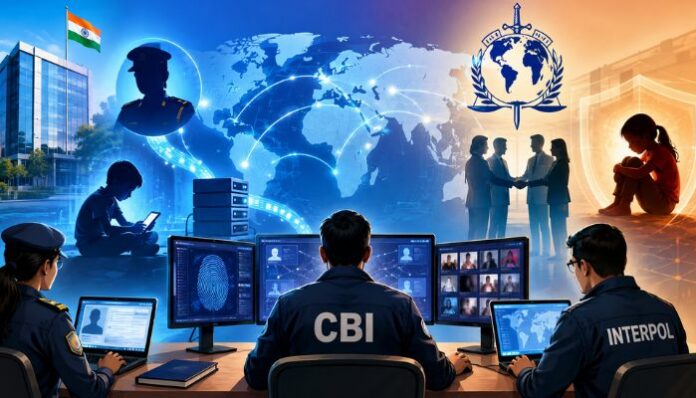
From New Zealand intelligence to ICSE matches and BHARATPOL, Indian investigations increasingly rely on international police cooperation, digital forensics and CBI coordination, even as judicial outcomes of major operations remain difficult to trace publicly clearly.

On 24th September 2022, the Central Bureau of Investigation (CBI) raided around 59 locations across 21 States and Union Territories (UTs) in connection with two cases involving the downloading, circulation and transmission of child exploitation and sexual abuse material, or CSEAM.

Notably, the investigation did not begin at an Indian police station. According to a press release by the CBI, information from New Zealand Police had reached INTERPOL’s Crime Against Children unit in Singapore for sharing with the relevant countries, and India was one of them.

The information was passed on to the CBI, which said it analysed and developed the inputs, identified suspected persons in India and registered two cases before launching the operation codenamed Operation Megh Chakra.

The sequence of how the investigation began in New Zealand and travelled to the CBI via INTERPOL shows the importance of agencies working together to neutralise CSEAM networks worldwide.

Suspects were apprehended in India while the relevant data came from abroad. Foreign police may encounter an Indian account during their own investigation. The same material may have surfaced before investigators in another country. Conversely, evidence recovered in India may reveal victims, suspects or contacts overseas. Hence, inter-agency cooperation is essential in such cases.

According to INTERPOL, online child sexual abuse is inherently transnational. The perpetrator, victim, crime scene and circulation of material may potentially be spread across different countries.

CBI has two different roles in cross-border investigations

The CBI is not deeply involved in every international case. Its significance as a central investigating agency of India comes from two separate functions. First, the CBI has the power to investigate CSEAM cases. The agency has a specialised Online Sexual Abuse and Exploitation unit, which was created in 2019. It deals with online sexual abuse and exploitation cases.

Secondly, the CBI is India’s National Central Bureau, or NCB, for INTERPOL. In that role, it acts as the liaison between Indian and foreign law-enforcement agencies and facilitates the exchange of information, INTERPOL Notices and Letters of Request.

This is where the distinction between the CBI and State law-enforcement agencies matters. A State Police force or another Central agency may remain the investigating agency even when the CBI is helping it obtain international cooperation. A CBI investigation and CBI-facilitated international cooperation are not the same thing.

To understand the flow of information from international agencies to local investigating agencies, the following chain should be considered.

Foreign law-enforcement agency -> INTERPOL channel or foreign NCB -> NCB-New Delhi at CBI -> CBI or another Indian agency -> Indian investigation

The exact route depends on what investigators need. Police intelligence can move through INTERPOL channels. However, formal evidence may require Letters of Request or other legal assistance mechanisms, which will require the CBI’s intervention. While the CBI functions under the Ministry of Home Affairs (MHA), extradition of the accused is a separate process in which the Ministry of External Affairs is India’s nodal authority.

INTERPOL itself does not send officers into India to raid premises or arrest suspects. Even a Red Notice is not an international arrest warrant. According to INTERPOL, it can be described as a request to law-enforcement agencies worldwide to locate and provisionally arrest a wanted person pending extradition, surrender or similar legal action. Each country acts on such notices under its own law.

ICSE connects cases that may otherwise look unrelated

One of the most important tools in child sexual exploitation investigations is INTERPOL’s International Child Sexual Exploitation database, or ICSE.

ICSE allows specialised investigators to compare child sexual abuse material and related clues across countries. A photograph or video recovered in India may already have appeared in an investigation elsewhere. A room, face, item of clothing, object in the background, audio clue or available metadata can help connect material to a known victim, offender, location or series.

India joined ICSE in 2022 through the CBI, giving specialised Indian investigators access to the international system.

INTERPOL’s current ICSE page says the system is available to specialised investigators from more than 72 countries, contains around 6.2 million images and videos and has helped identify around 59,400 victims worldwide. INTERPOL has also reported that ICSE helped identify more than 24,000 offenders by September 2025. India-specific numbers are, however, not available on the website.

The value of ICSE lies in telling investigators that what looks like a new case in one country may already be linked to a victim, offender or series known elsewhere.

How ICSE material led CBI to Thanjavur

A case from Thanjavur can be seen as an example of how the ICSE database helped the CBI apprehend suspects. In March 2023, the agency found CSEAM images and videos through the ICSE database and used digital forensic tools to trace the location to Thanjavur district in Tamil Nadu.

According to the CBI, examination of the material indicated sexual abuse of children. A search was conducted, electronic devices were recovered and an accused was arrested. In this case, the sequence of the investigation moved backwards from material in an international law-enforcement database.

Material -> forensic examination -> location clues -> Indian jurisdiction -> search -> suspect and victim investigation

ICSE is different from a CyberTipline report because it may help investigators establish whether the material, victim, offender or location is already connected to another investigation.

Operation Carbon showed how geographically distributed these networks can be

Before Operation Megh Chakra, the CBI had already conducted a large nationwide operation against online child sexual abuse networks.

On 16th November 2021, the agency announced that it had registered 23 separate cases against 83 accused. Searches were carried out across multiple States and Union Territories under Operation Carbon. The CBI alleged that people were involved in circulating, storing or viewing CSEAM through online platforms and groups, and said some groups under investigation included foreign nationals.

The operation resulted in three different FIRs being registered at CBI Delhi on 14th November 2021. Suspects, accounts, devices and online groups were spread across jurisdictions rather than confined to one police district. On 17th November, the CBI said seven accused were arrested as part of the ongoing investigation.

Megh Chakra showed how foreign intelligence becomes an Indian case

Operation Megh Chakra added a different dimension because the starting information came from overseas. As discussed before, the information came from New Zealand via INTERPOL and two cases were registered. According to the CBI, Indian citizens were involved in circulating, downloading and transmitting CSEAM using cloud-based storage. Searches were conducted at around 59 locations across 21 States and Union Territories.

What happened after Carbon and Megh Chakra?

The scale of the two operations is well documented. In March 2023, the CBI said Operation Carbon and Operation Megh Chakra together had involved simultaneous searches at around 138 locations across different States and Union Territories. As these cases involve children, the current orders are not available in the public domain. What OpIndia could find was that the majority of the cases are under trial at the moment.

Hisar and Aizawl show different intelligence systems converging

Recent CBI cases show that a modern CSEAM investigation may draw from several information streams at once. On 4th June 2025, the CBI announced the arrest of an accused from Hisar, Haryana, in a case involving allegations of rape and sexual assault of minor victims. The agency said material examined during the investigation was linked with INTERPOL’s ICSE database and with CyberTipline reports generated by Google and submitted to the Indian Cyber Crime Coordination Centre, or I4C.

Five days later, the CBI announced an arrest in Aizawl, Mizoram. It said forensic examination of electronic devices revealed a substantial volume of CSAM, which was corroborated with ICSE data and Google-generated CyberTipline reports shared with I4C. The agency further said forensic analysis revealed the sexual assault of a minor, whom it subsequently identified and rescued.

The importance of these cases is not that CyberTipline and ICSE do the same job. They do not. CyberTipline reports can generate or strengthen an investigative lead. ICSE is a law-enforcement database that can help establish whether material, a victim, offender, location or series is already connected with another investigation.

Hisar and Aizawl show how platform-generated intelligence, India’s CyberTip system, INTERPOL data and Indian cyberforensics can converge in a single case.

The international trail can also begin in India

Cross-border cooperation does not always mean a foreign agency sending India a tip. In a case concerning alleged abuse in Uttar Pradesh, the CBI said examination of emails indicated that the accused had allegedly remained in contact with both Indian and foreign nationals for sharing CSAM. The agency later filed a chargesheet against the accused and his wife.

The route in such a case is the reverse:

Indian offence -> Indian investigation -> electronic evidence -> foreign contacts discovered -> need for international cooperation

Once an overseas account, person or data trail becomes relevant, an Indian investigator may need assistance that cannot be obtained using domestic police powers alone.

BHARATPOL gives Indian agencies a digital route to NCB-New Delhi

India has recently tried to make international police cooperation more accessible to agencies outside the CBI.

The government launched BHARATPOL on 7th January 2025. The CBI-developed portal connects Indian law-enforcement agencies with NCB-New Delhi and international cooperation mechanisms. By February 2025, the Ministry of Home Affairs said 51 law-enforcement agencies and more than 500 unit offices had been connected through the system.

BHARATPOL has five modules. Connect links Indian agencies with the CBI as NCB-India. Broadcast transmits requests or criminal intelligence received from abroad to relevant Indian agencies. INTERPOL References allows Indian agencies to seek international assistance. INTERPOL Notices handles Notice-related requests, while Resources provides guidance and capacity-building material.

By 4th February 2025, the government said BHARATPOL had received 16 requests from Indian agencies for the publication of INTERPOL Notices and eight INTERPOL references seeking assistance from foreign law-enforcement agencies. Thirty international references received from abroad had also been forwarded to Indian agencies.

These are general international law-enforcement figures, not CSEAM-specific numbers. But the mechanism matters to CSEAM investigations because such cases can require exactly this kind of cooperation when accounts, suspects or evidence cross jurisdictions.

International intelligence is not courtroom proof

Foreign cooperation can identify an account, person, device or piece of material that deserves investigation. An ICSE match can connect evidence in India with a case abroad. A foreign police force can provide information pointing towards an Indian suspect. None of this automatically proves a criminal charge.

Indian investigators still have to establish who controlled the relevant account or device, authenticate electronic evidence, maintain the chain of custody, connect the accused with the alleged conduct and build a case capable of surviving scrutiny in court. Where evidence has to be obtained abroad, additional legal procedures may be required before it can be relied upon in an Indian prosecution.

The same principle explains why an INTERPOL Red Notice is not itself proof of guilt or even an international arrest warrant. It is an international request connected to proceedings in the requesting jurisdiction, while action in India remains governed by Indian law.

The international system can therefore tell investigators where evidence may be. It cannot replace the investigation or the court.

The missing data is what happened after the raids

India now has substantially more infrastructure for cross-border CSEAM investigations than it did a few years ago.

The CBI has a specialised online child sexual abuse unit. India joined ICSE in 2022. Operation Carbon produced 23 cases against 83 accused. Megh Chakra showed that foreign police intelligence could travel through INTERPOL and trigger searches across 21 States and Union Territories. Hisar and Aizawl showed CyberTipline reports, ICSE data and Indian cyberforensics contributing to the same investigations. BHARATPOL now gives hundreds of Indian law-enforcement units a structured route to NCB-New Delhi.

Yet the eventual judicial outcomes remain much less visible than the operations themselves, mostly because the cases involve children. For Carbon and Megh Chakra, the most useful public data would now be RC-wise figures for arrests, chargesheets, supplementary chargesheets, pending investigations, trials, convictions, acquittals, victims identified and international leads generated from Indian evidence.

Similarly, INTERPOL publishes strong global ICSE figures, but not a public India-specific breakdown showing how many victims or offenders were identified through Indian use of the system.

Without those numbers, it is easier to measure how many places were searched than how many cases ultimately reached a legally sustainable conclusion.

The investigation does not stop at India’s border

ICSE can connect evidence that would otherwise remain trapped in separate national investigations. NCB-New Delhi provides the interface through which Indian and foreign agencies cooperate. BHARATPOL is making that interface more accessible to Indian police units. But international cooperation is only one part of the chain.

The foreign lead still has to become an Indian case. The account has to be tied to a person. Digital material has to become legally sustainable evidence. A child at risk has to be identified and protected. Where the evidence supports prosecution, the case has to move from FIR to chargesheet, trial and judgment.

India has shown that police intelligence can cross borders quickly. The more important measure now is how often those international leads ultimately produce identified victims, chargesheets and convictions.

Join OpIndia's official WhatsApp channel

  Support Us  

For likes of 'The Wire' who consider 'nationalism' a bad word, there is never paucity of funds. They have a well-oiled international ecosystem that keeps their business running. We need your support to fight them. Please contribute whatever you can afford

Anurag
Anurag
Anurag is a Chief Sub Editor at OpIndia with over 22 years of professional experience, including more than six years in journalism. He is known for deep dive, research driven reporting on national security, terrorism cases, judiciary and governance, backed by RTIs, court records and on-ground evidence. He also writes hard hitting op-eds that challenge distorted narratives. Beyond investigations, he explores history, fiction and visual storytelling. Email: [email protected]

Related Articles

Trending now

The Mines and Minerals (Development and Regulation) Amendment Bill-2026: Why India’s gain should not be Odisha’s loss

A NITI Aayog assessment this February found that, under a net‑zero scenario, mineral demand will be 51% higher than under current policy. In other words, dependence deepens, not eases, precisely as India races to build EVs, batteries, defence platforms and renewable capacity.

Bridging the gap: Why India is leasing two MQ-9B Sea Guardian drones despite ordering 31 drones for purchase

India leases 2 MQ-9B Sea Guardian drones for ₹1,943 crore to bridge capability gap until 31 owned drones arrive in 2029. Full lease package explained.
- Advertisement -