

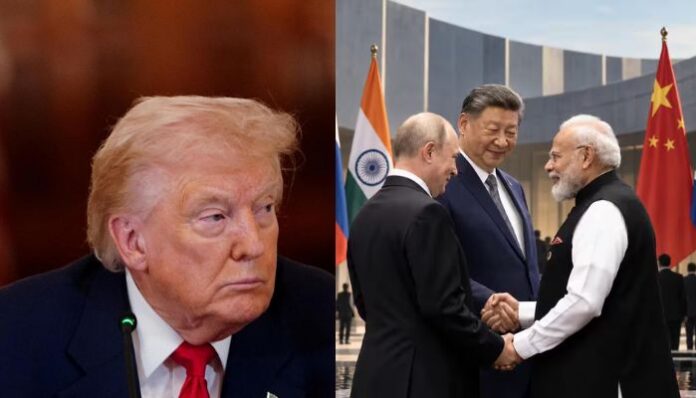
On Friday, 18th September, US President Donald Trump signed into law a Russia sanctions bill that gives his administration new powers to impose tariffs of up to 100% on countries buying Russian oil and gas, potentially putting major buyers such as India and China under threat. The legislation comes days after India successfully hosted the BRICS summit in New Delhi, where PM Narendra Modi held meetings with Russian President Vladimir Putin and Chinese President Xi Jinping.
The new law, formally called the Lindsey O. Graham Sanctioning Russia and Iran Act of 2026, lets the US president impose tariffs of up to 100% on goods imported from countries in certain categories linked to Russian energy purchases or sanctions evasion.
Trump has signed the Lindsey Graham Russia sanctions bill, starting a 30-day deadline for discretionary tariffs of up to 100% on Russia’s biggest oil and gas buyers, including China and India.
— OSINTtechnical (@Osinttechnical) September 18, 2026
It also targets Russian banks, the shadow fleet, and foreign suppliers.
What does the new Russia sanctions law say?
Under the legislation, tariffs of up to 100% can be imposed on goods from countries that are among the five largest importers of Russian crude oil or natural gas. The measure can also cover countries that knowingly make new purchases of Russian oil or gas after the law takes effect, or those considered among the five largest facilitators of efforts to evade sanctions against Russia.
The bill also contains provisions targeting Russian officials, military figures, oligarchs, financial institutions and people accused of supporting Russia’s defence industrial base or helping it evade sanctions. It also targets Russia’s so-called shadow fleet of tankers used to transport oil outside existing sanctions restrictions. The legislation further extends US sanctions authorities relating to Iran.
US Congress passed bill by a bipartisan vote of 262-159
The legislation reached Trump’s desk after the US House of Representatives passed it on Wednesday, 16th September, by a bipartisan vote of 262-159. The Senate had already approved the bill in August by an 86-11 vote. The House vote cleared the final congressional hurdle and sent the legislation to Trump for his signature.
The bill was introduced as an effort to increase economic pressure on Russia over its war in Ukraine. However, its potential impact extends beyond Moscow because of the provision allowing tariffs on major foreign purchasers of Russian energy.
India and China are among the biggest buyers of Russian crude, meaning their trade relations with Washington could be affected if the tariff authority is used against them. Analysts cited by Reuters have also pointed to the possibility that such measures could increase consumer and energy costs, giving the White House an incentive to consider the economic consequences before imposing the highest possible tariffs.
Democratic Senator Richard Blumenthal also directly warned India and China after the House passed the legislation. “To China and India: You better clean up your act. Buy your oil and gas somewhere else. Appeasement is not a strategy,” he said.
"For China and India, It would be better if you improve your performance. Buy your oil and gas from somewhere else", says US lawmaker Senator Blumenthal after passage of bill that imposes tariffs on those importing Russian energy
— Sidhant Sibal (@sidhant) September 17, 2026
Video source: Senator Blumenthal X pic.twitter.com/d20ps8Ojh2
Trump move comes days after India’s BRICS Summit
The new US law comes just days after India successfully hosted the 18th BRICS Summit in New Delhi, where Modi held bilateral meetings with both Putin and Xi.
The two-day summit concluded on 13th September with the adoption of the New Delhi Declaration by consensus. The meeting brought together the expanded BRICS grouping at a time of major geopolitical tensions involving the Russia-Ukraine war, conflicts in West Asia, trade restrictions and growing competition over technology and critical minerals.
For India, maintaining dialogue among countries with sharply different positions was one of the major challenges of the summit. New Delhi managed to secure consensus on the joint declaration despite differences among members, including over the West Asia conflict. The declaration called for dialogue and diplomacy in dealing with international disputes and also addressed trade, energy, technology, climate change and reforms in global institutions.
Modi also met Xi and Putin separately during the summit. The Modi-Xi meeting was particularly significant against the backdrop of years of tensions between India and China, while engagement with Putin highlighted India’s continuing relationship with Russia.
India has also maintained that BRICS is not an anti-American or anti-Western alliance. Instead, New Delhi has sought to present the grouping as a platform for cooperation among emerging economies and for giving developing countries a greater voice in global institutions.
India responds to US Tariff threat
India has meanwhile made clear that its energy policy will continue to be guided by domestic requirements. After the US House passed the bill, the Ministry of External Affairs said India remained committed to ensuring energy security for its 1.4 billion people.
“As stated on several earlier occasions, India remains firmly committed to ensuring energy security for its 1.4 billion people. It will continue to do so through diversified sourcing and based on evolving market dynamics,” the ministry said.
New Delhi also said it had clearly conveyed the possible implications of the US legislation for bilateral relations and global energy markets to American interlocutors during discussions in recent months.
