

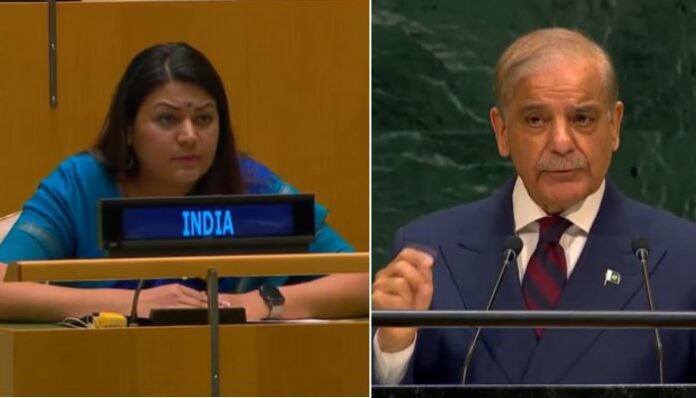
On Saturday, 26th September, India strongly responded to Pakistan Prime Minister Shehbaz Sharif’s remarks at the United Nations General Assembly, rejecting his comments on Jammu and Kashmir, the Indus Waters Treaty, and India-Pakistan relations. India also warned that continued cross-border terrorism from Pakistan would have consequences.
Gahlot rejects Pakistan’s Kashmir claims
Exercising India’s right of reply, Petal Gahlot, First Secretary at India’s Permanent Mission to the UN, said Jammu and Kashmir is an integral and inalienable part of India. Responding to Pakistan’s repeated references to Kashmir at the UN, she instead raised concerns about conditions in Pakistan-occupied Jammu and Kashmir, including reported violence and restrictions on basic rights.
#WATCH | New York | First Secretary in India's Permanent Mission to the UN, Petal Gahlot says, "References were made to the Indian Union territory of Jammu and Kashmir. This is an integral and inalienable part of my country and will always remain so. But if we must talk about… pic.twitter.com/sHVeKYPrVc
— ANI (@ANI) September 26, 2026
“References were made to the Indian Union territory of Jammu and Kashmir. This is an integral and inalienable part of my country and will always remain so,” Gahlot said.
She also said India had suffered from cross-border terrorism and would continue to exercise its right to defend itself.
“At the heart of the issue is the long-standing practice of cross-border terrorism by Pakistan,” she said. “Our right to defend ourselves against terrorism will be exercised and continued. Terrorism by Pakistan will have consequences.”
Reference to Osama bin Laden
Gahlot also referred to the 25th anniversary of the September 11 terror attacks. She pointed out that Osama bin Laden, the mastermind of the attacks, had been found living near Pakistan’s military academy in Abbottabad.
“This context is important to keep in mind because its mastermind, Osama bin Laden, was living right on the doorstep of the Pakistani Army’s premier academy,” she said.
Gahlot also criticised Pakistan’s comments on democracy and human rights, pointing to the role of the military in the country’s political system.
“We heard some hypocritical homilies about democratic rights and human values from a regime whose capital at this very moment is being fortified against its own people,” she said. She added that the situation reflected “a regime of the army, by the army, and for the army.”
Indus Waters Treaty and Kashmir
Earlier, Sharif had raised the Kashmir issue and questioned India’s decision to place the Indus Waters Treaty in abeyance. The 1960 treaty governs the sharing of the Indus river system between India and Pakistan.
India placed the treaty in abeyance after the Pahalgam terror attack and said the decision would remain until Pakistan takes credible and irreversible action against cross-border terrorism. Sharif had argued that any attempt to stop or divert Pakistan’s share of Indus waters would amount to an “act of war.”
Gahlot also accused Pakistan of presenting itself differently at international forums while continuing to support terrorism.
India further rejected Pakistan’s comments on religious tolerance and minority rights, with Gahlot saying, “They claim to uphold security during the day; they actually carry out terrorism at night.”
She also referred to Pakistan’s political system and its 27th Amendment, including what she described as lifelong immunity for the country’s “real ruler”.
Gahlot ended by saying that repeated claims against India would not change what she described as Pakistan’s record on terrorism, adding that India would continue to defend itself against cross-border terror.
