

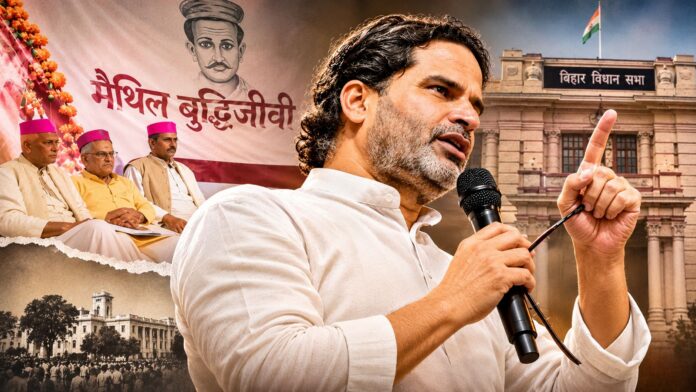
A video of Prashant Kishor lecturing Brahmins has been doing the rounds for a few days now. Speaking to a gathering of Maithil Brahmins in Darbhanga district last week, PK – as everyone calls him, and as I will too, to save some keyboard hits – explained to them why they have been slipping back in society and politics.
First things first: he is right about the slipping. There was a time when a good number of big leaders came from the Brahmin community. From the freedom struggle till roughly the 1980s – at least if we talk about North India, and Bihar in particular – that is how things were. Between 1961 and 1990, Bihar had five Brahmin chief ministers, from Binodanand Jha to Jagannath Mishra, who also happens to be the last Congress chief minister the state has had.
Then other castes rose, especially the OBCs, and today Brahmins don’t hold the sway they once did. Those days are now wrapped in nostalgia and put in the almirah of history. And like any good politician, PK was tapping into that nostalgia to connect with his audience.
That nostalgia has been stirring among Brahmins and other upper castes for a few years now, especially as reservations, the caste census and the UGC regulations started dominating social media chatter and even news headlines. A section now says openly that the Congress era was better for the upper castes. The irony is that Rahul Gandhi today drags OBC or Dalit politics into almost every conversation – ‘jitni aabaadi, utna haq’ – which is the very anti-Brahmin politics that gave birth to this nostalgia in the first place. Actually, scratch the irony. It looks like a sound strategy, and one the BJP too seems to be walking into.
I can’t say PK’s speech is part of a Congress strategy. He appears to be carving out his own politics in Bihar, all the more after his Jan Suraaj drew a blank in the 2025 assembly election. But it is worth noting who cheered his advice the loudest: Congress supporters, and those upper-caste voices who have been pining for that era for a while now.
Nostalgia is an emotion. It doesn’t have to rest on facts. Millennials go misty-eyed over Doordarshan serials and the film songs of the 1990s, but nobody seriously argues that the best work in entertainment was being done then. Well, some do. They are called millennials.
So let’s see how much factual weight PK’s arguments actually carry.
Saraswati, Facebook and Parshuram’s farsa
PK says the Brahmins’ old hold on society and respect came from the fact that they never abandoned education. “Your real strength is Goddess Saraswati,” he said.
Fair enough. But to show that Brahmins have now abandoned Saraswati, he turns to politics. If Brahmins no longer dominate politics, PK argues, then they must be making unwise political choices – in other words, they have stopped being wise, i.e. they have abandoned education.
That is a rather childish test. If political acumen were a measure of education, every PhD and post-doc in the country would be a political dhurandhar. They aren’t. Some of the shrewdest operators in Indian politics barely finished school.
PK then explains why Brahmins no longer dominate politics. He claims that the community did foolish things to drive away Muslims and the extremely backward castes (EBCs) who apparently were with Brahmins. In the Congress era, he says, Brahmin leaders won for two reasons. One, Muslims voted for them because Brahmins then – according to PK – were not Islamophobic, and Muslims respected them as ‘Guruji’. Two, the EBCs voted for them because Brahmin ancestors carried the backward castes along, and the EBCs in turn accepted them as their leaders and Panditji.
Then, PK says, Brahmins picked up the BJP flag and began abusing Muslims on Facebook. “What exactly is your fight with Muslims about? Is it about land? Is it about reservation?” he asked. Meanwhile, the backward castes drifted away as Brahmins started indulging in selfish politics like others, where they thought only about their own community. The result: no “winning coalition” left to vote for a Brahmin.
Notice what he concedes there. He accepts that fights over reservation and land are kinda expected, while scolding Brahmins for thinking only of themselves like every other caste. So which is it? Should Brahmins fight reservations and hold on to their ancestral land, or accept reservations and wealth redistribution out of love for thinking about everyone and not just about one’s own community? PK didn’t make that clear.
Nonetheless, both his original arguments are hollow. Let me explain.
‘Muslims voted for Brahmins because Brahmins weren’t Islamophobic’
First of all, there was never a Muslim–Brahmin coalition in the sense we talk of Lalu Yadav’s or Mulayam Singh Yadav’s M-Y, the Muslim–Yadav coalition. Most Muslims and Brahmins in Bihar did vote for the Congress, but for different reasons. They weren’t together for any cause, or against any caste.
For Brahmins, voting Congress was a habit. Before independence, the Congress was seen as a Hindu party, and a largely upper-caste one – in Bihar its tallest leaders were Rajendra Prasad, a Kayastha, Sri Krishna Sinha, a Bhumihar, and Anugrah Narayan Sinha, a Rajput. It was natural for Brahmins to see it as their own party, and the habit continued well beyond 1947.
Muslims had no such habit, at least not before independence. To them, the Congress was a Hindu party, and Jinnah’s Muslim League was theirs. This is not a guess. In the 1946 provincial elections, the League won 34 of Bihar’s 40 Muslim seats. And the view is alive even today. Sharjeel Imam – who incidentally hails from Bihar – said in an interview from jail in September that “we have to start from where the reformist and democratic project was paused in 1947”, called Jinnah “a great democratic leader of Indian Muslims”, and spoke of “Gandhi’s role in making Congress an essentially Hindu party”. This is how Muslims viewed Congress in general before partition,n and some, like Sharjeel, view it even today.
Now back to 1946. That October, Hindus in Noakhali, in today’s Bangladesh, faced killings, forced conversions, rape, loot, and arson. Within weeks, riots broke out in Bihar in retaliation – in Patna, Gaya, Chhapra, Munger and elsewhere. Many blame the Congress for the riots; Congressmen were allegedly involved, and the Congress government in the province was accused of not acting firmly. Little wonder that Muslims didn’t see the Congress as their party.
After Partition, though, Bihar’s Muslims chose the Congress. The League had gone off to make Pakistan, and many of its elite and powerful supporters went with it. Nehru assured those who stayed that their interests would be protected. In fact, even before Partition, touring riot-hit Bihar on 6 November 1946, Nehru warned that “aerial bombardment would be resorted to” if the “forces of retaliation” did not cease. Those forces, remember, were Hindu mobs.
So Muslims took the Congress’s hand – partly by choice, partly by compulsion – though they had been calling it a Hindu party only a few years earlier.
In other words, there was never any great friendship between Muslims and Brahmins. There can’t be – history is witness to the fact that Brahmins were butchered by Muslim rulers, for they were seen as the biggest roadblock to the path of conversion. If you must call it a friendship, it was between Muslims and Nehru – a deal, actually – after which Muslims began voting Congress, especially in Bihar, where Brahmins were voting Congress anyway.
So PK’s claim that Brahmin ancestors built a system in which Muslims voted for them is a half-truth. Congress leaders built a system in which Muslims voted Congress, and many Congress leaders happened to be Brahmins. But the Congress was hardly devoted to Brahmin interests.
It was the Congress that let the Left run education and culture – after the 1969 split, Indira Gandhi’s minority government survived on CPI support, and Nurul Hasan went on to run the education ministry – and in the years that followed, anti-Brahmin ideas went mainstream, helped along by communists who suddenly found value in Ambedkar, a man the CPI had dismissed as a “pro-imperialist and opportunist leader” in 1952. Pretty ironic, given that the pre-independence Congress had opposed such ideas, and opposed Ambedkar too. The charge being made against the BJP today – that it is, knowingly or unknowingly, strengthening anti-Brahmin ideology – fits the Congress at least as well. The Congress era looks good to some only because the effects of its decisions showed up late. And yes, the BJP must avoid repeating that mistake.
Anyway. Back to the Muslims. They neither became Congress voters out of any love for Brahmins, nor stopped voting Congress out of any anger at them. PK is writing “alternative history” here.
In Bihar, Muslims began drifting from the Congress after 1986, when they felt cheated over Ayodhya. On 1 February that year, a Faizabad district court ordered the locks at the disputed site opened so that Hindu devotees could have darshan of Ram Lalla by going to the inner courtyard. The Congress governments at the Centre and in Uttar Pradesh didn’t oppose it. The final blow in Bihar came with the Bhagalpur riots of October 1989, in which over a thousand people, most of them Muslims, were killed – under a Congress government in the state.
Muslims moved to Mulayam Singh Yadav in Uttar Pradesh and Lalu Yadav in Bihar. The Congress was routed in the 1989 UP and 1990 Bihar assembly elections, and neither state has seen a Congress chief minister ever since.
No Brahmin was abusing Muslims on Facebook then. India didn’t even have public internet until 1995. I know I’m being facetious here by taking PK literally, but the fact is that most Brahmins were still with the Congress at that point, especially in Bihar; they hadn’t turned into BJP supporters even though the Ayodhya Ram Temple movement was at its peak. Many of the big names of the Ayodhya movement weren’t Brahmins at all, and quite a few came from the backward castes. The man who laid the first brick at the 1989 shilanyas, Kameshwar Chaupal, was a Dalit from Bihar.
Bihar’s upper castes moved to the BJP en masse only after Rajiv Gandhi’s death. As long as a Gandhi was at the helm of the Congress, they stayed with it, because the alternative was the Lohiaite forces whose politics rested on opposing the upper castes. They had no other strong option, and as I said, the Congress had become a habit.
When Rajiv Gandhi was assassinated in 1991, the Congress looked finished, especially since Sonia Gandhi declined to step in. Only then did Bihar’s upper castes start considering the BJP as their primary choice. CSDS survey data [pdf] – upon which we have to rely in the absence of any other decent dataset – proves this. In 1991, 32 per cent of Bihar’s upper castes voted Congress and 25 per cent BJP. By 1996, it was 1 per cent for the Congress and per cent for the BJP and its ally, the Samata Party. By 1998, 9 against 78.
In other words, Brahmins picked up the BJP flag around six years after Muslims had left the Congress. PK has inverted the story.
‘The backward castes stayed with Brahmins because Brahmins looked after them’
Now to his second point: int; that the EBCs – and perhaps he meant Dalits too – were once with the Brahmins. PK again takes us back to the nostalgia of the Nehru–Indira–Rajiv era, when the upper castes, Dalits and Muslims were supposedly in some coalition or alliance against the backward castes. Political scientists even have a name for it: the Congress’s ‘coalition of extremes’.
As I said before, you can’t conclude that two or three social groups were in a social alliance just because they voted for the same party. That is an illusory correlation, a cognitive bias at work. To prove a social alliance, you would have to show that those groups shared a common enemy, or a common goal they were working towards – and that the party they voted for also shared that goal or targeted that enemy.
The Congress had only one goal: to stay in power and keep the reins with the Gandhi family. Any group whose support could keep it in power – feudal or communist – it co-opted. Landlords on the ground on one side, communists running education and culture on the other. That is not an alliance. That is jugaad.
We have seen why Muslims and Brahmins voted Congress. One out of habit, the other out of compulsion – no common goal, no common enemy. For Dalits and EBCs, it was both a bit of habit and some bit of compulsion.
To understand that, we need to turn a few pages of history. In South India and Maharashtra, Ambedkar–Phule–Periyar politics had taken root by the 1920s, and the ideologies that grew there in the name of uplifting Dalits and backward castes rested on opposing the Congress and the Brahmins. But the story was not the same in North India, and Bihar in particular.
Bihar did have backward caste leaders opposed to the Congress, or rather to the upper castes. In 1933, Yadav, Kurmi and Koeri leaders formed the Triveni Sangh, which took on the Congress in the 1937 elections and fared poorly. And as the Muslim League’s politics hardened and communal violence grew, most Hindus stayed with the Congress despite their quarrels with each other. Also, Brahmins were not the only face of upper-caste dominance that could have given birth to an anti-Brahmin ideology, which eventually morphed into anti-Hindu movements.
Then there were Dalit leaders like Babu Jagjivan Ram, who stayed with the Congress and had no time for Ambedkar–Phule–Periyar type politics. As early as 1931, when Ambedkar was agitating for separate electorates, Jagjivan Ram told a gathering in Patna that Dalits were Hindus and would remain so, and that he was opposed to all forms of religious conversion. He later told Ambedkar that conversion was running away from the problem. He believed caste could be reformed within Hinduism, as the Bhakti saints had shown, and saw himself in the tradition of Ravidas.
That is why North India never saw the anti-Brahmin wave that swept the South more than a hundred years ago. Only in the 1980s did Kanshi Ram try to bring Ambedkar–Phule–Periyar politics to Uttar Pradesh and Bihar. In his book The Chamcha Age, published in 1982, Kanshi Ram castigated Jagjivan Ram as the prime reason, as he saw it, why non-Brahmin politics never took off in the north.
So if Bihar’s Dalits stayed with the Congress – which PK calls staying with the Brahmins – a big reason was leaders like Jagjivan Ram. But what did Jagjivan Ram get? He had to quit the Congress in 1977 over Indira Gandhi’s ways during the Emergency. From then on, a feeling grew among Bihar’s Dalits that perhaps the Congress was not their party.
The Congress did not attempt to woo him back. Instead, in 1978, Surya – a magazine edited by Sanjay Gandhi’s wife, Maneka – published the compromising photographs of his son Suresh Ram that sank Jagjivan Ram’s prime ministerial hopes. All this strengthened a feeling among Dalits and EBCs that staying with the Congress got them nothing.
As for the EBCs, their politics was shaped by a man PK conveniently skips: Karpoori Thakur. He came from the barber community, one of Bihar’s EBCs; he was a socialist, and he was no friend of the Congress. In 1978, as chief minister, he introduced reservations in Bihar with a separate 12 per cent quota for the EBCs – before the Mandal Commission was even set up. The EBCs had found their own political voice decades before anybody started arguing about Parshuram’s farsa.
And here is the fun part. In the 2020 assembly election, around 58 per cent of Bihar’s EBCs voted for the NDA, according to Lokniti-CSDS – the same alliance most of Bihar’s upper castes have backed since the 1990s. By PK’s own yardstick, Brahmins and EBCs are still riding together. The vehicle just isn’t the Congress any more.
Yet PK ties the drift of Dalits and EBCs to the supposedly selfish politics of Brahmins and their insistence on celebrating Parshuram Jayanti. Sorry, but the Dalit drift was the doing of the Congress high command, not the Brahmins. And the EBC story was Karpoori Thakur’s. Neither had anything to do with a farsa.
Can an Upper Caste-Muslim-Dalit alliance exist?
In fairness, PK does have a point. He asked Mithila’s Brahmins why their condition hasn’t changed when their MLA has been a Brahmin for 15 years, and their MP is a Brahmin too. “If electing a Brahmin alone could solve your problems, you should not have been suffering at all,” he told them. That’s a fair question, and it applies to every caste. But it doesn’t prove that Brahmins lost their politics by angering Muslims and EBCs.
PK’s strategy is clear. He is eyeing the votes of Brahmins and other upper castes on the strength of nostalgia for the Congress era. But that era is gone, and it was the Congress that wrecked it. And as we have seen, there was never a natural alliance between Brahmins, Dalits and EBCs, and Muslims. Some habit, and some compulsion. That’s all.
If anyone wants to build such an alliance today, by all means, go ahead. But at least offer an argument beyond nostalgia for the Congress era. Neither PK nor those who never tire of talking about that era have one.
Sometimes we hear of an upper caste–OBC alliance against the SC-ST Act, sometimes of an upper caste–Dalit alliance against OBC reservations. And then randomly the equation of Muslim votes is thrown in. PK is taking a dip at this confluence of nostalgia, confusion and desperation.
The nostalgia and the desperation will carry on. But nobody should be confused into thinking that the Congress’s ‘winning coalition’ can be recreated in Bihar. Brahmins, Muslims, and Dalits and EBCs have different goals, different enemies and different priorities. It was more or less the same in the Congress era. They just happened to be riding the same vehicle – partly by chance, partly by the Congress’s design. That vehicle has since gone somewhere else.
Or as they say, that ship has sailed.


