

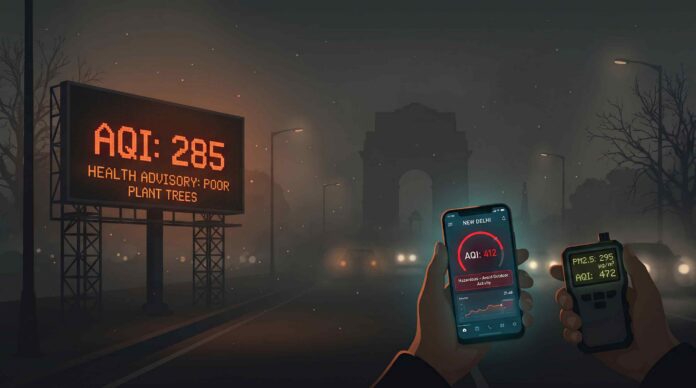
The annual winter smog over Delhi-NCR brings with it a secondary, equally impenetrable fog of conflicting data on pollution. While private weather applications reported apocalyptic Air Quality Index (AQI) readings crossing the 3,000 mark during Diwali, the official government dashboards cap out at a seemingly suppressed 500. This massive statistical gulf frequently triggers allegations of data fraud and political cover-ups. However, the true driver of this discrepancy is not a deliberate conspiracy, but a fundamental clash of monitoring hardware, different formulas, and differing regulatory frameworks.
At the core of the reporting gap lies the physical machinery used to capture the data. The Central Pollution Control Board (CPCB) relies on reference-grade infrastructure, specifically Beta Attenuation Monitors (BAM) and Tapered Element Oscillating Microbalances (TEOM) machines. These massive, highly expensive machines physically weigh particulate matter (PM2.5 and PM10) and measure toxic gases like nitrogen dioxide (NO₂) and sulphur dioxide (SO₂). Crucially, these government stations are equipped with heated inlets that vapourise winter moisture before the air is analysed. In stark contrast, private and crowd-sourced portals rely on cheap, mass-produced optical sensors that estimate pollution through light scattering. Lacking heated inlets, these consumer devices mistake harmless winter fog and humidity for severe toxic smoke, resulting in artificially inflated readings that distort the public perception of the crisis.
Beyond the hardware, the numbers diverge drastically due to the mathematical formulas applied. The official Indian NAQI system does not react to instantaneous spikes. It relies on a 24-hour rolling average to reflect sustained human exposure accurately. Therefore, a sudden midnight surge in firecracker smoke takes hours to fully impact the official index, while private apps update instantly. Furthermore, the Indian regulatory framework intentionally caps the maximum AQI at 500. The rationale is practical: any reading above 400 already triggers the most severe civic emergency protocols, making higher numbers administratively redundant. Conversely, private aggregators generally apply the United States Environmental Protection Agency (US EPA) formula, which utilises continuous linear extrapolation to let numbers climb indefinitely, creating the terrifying 3,000-plus figures seen circulating on social media.
This technological divide reached a boiling point this Diwali when over half of Delhi’s official monitoring stations suddenly stopped broadcasting data during the peak midnight hours. Political leaders immediately alleged a massive, orchestrated cover-up designed to artificially wash the air and suppress the severity of the crisis. The reality, however, stems from automated system limitations rather than human tampering. The CPCB officially clarified that their older particulate matter analysers were factory-calibrated to measure a maximum range of 0 to 1,000 micrograms per cubic metre. When the raw, unadulterated pollution from firecrackers shot well past this physical limit, the automated data validation system flagged the readings as out-of-range errors and discarded them entirely. What the public perceived as a deliberate, sinister shutdown was simply an automated system rejecting extreme data that exceeded its calibrated design range.
Ultimately, the intense media scrutiny surrounding the temporary Diwali spike obscures the capital’s structural, year-round environmental disaster. While firecrackers create an undeniable immediate hazard, the extreme numerical spikes drop off sharply within hours. The inescapable baseline of Delhi’s toxic air is driven consistently by heavy vehicular exhaust, unpaved road dust, and industrial emissions, all trapped over the landlocked city by winter temperature inversions. By fixating entirely on the brief discrepancies of festival smoke and temporary hardware glitches, both policymakers and the public risk ignoring the everyday emissions and geographical realities that actually dictate the quality of the air the city breathes for the rest of the year.
Read the full article on Chapter 1 Magazine.


