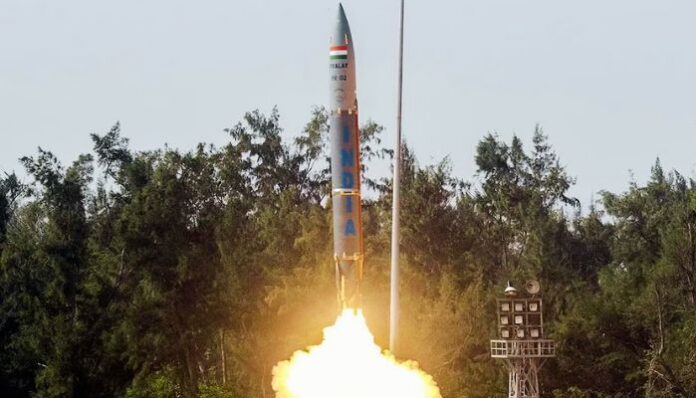
In a major success for the advancement of India’s defence, the Defence Research and Development Organisation (DRDO) has reportedly conducted a successful test of the Pralay missile near Chandipur in Odisha on 3rd November from Launchpad number 3 at the DRDO’s Integrated Test Range (ITR). The quasi-ballistic missile successfully destroyed two artificial targets 500 kilometres away.
#JustIn India flight tests a quasi ballistic missile from a defence facility off the Odisha coast. Developed by DRDO, the missile is capable of carrying multiple types of warheads against various targets at ranges of up to 500 km. The Notam was issued for 595 km. People within 2 km radius of the test range were shifted ahead of the test. Detailed evaluation is underway, sources said.
— Hemant Kumar Rout (@TheHemantRout) November 3, 2026
Why a quasi-ballistic Pralay missile matters
While the DRDO is yet to issue an official statement about the test, reports say that the tested missile was a quasi-ballistic Pralay missile. The missile is reported to have achieved Mach-5 speed, which is 5 times faster than the speed of sound, about 6174 km/h.
Post-launch, Pralay pivots at Mach 1.6 and accelerates upwards. In the terminal phase (near target), it dives at Mach 5+.
Simply put, a 500-kilometre journey takes about 7-8 minutes, and the terminal phase is so fast that defence systems like the Iron Dome or HQ-9 find it near impossible to track and intercept it, as a quasi-ballistic Pralay missile can change course in the last 30 seconds.
भारत ने ओडिशा तट के पास DRDO की स्वदेशी क्वासी-बैलिस्टिक मिसाइल ‘प्रलय’ का सफल टेस्ट किया. इस मिसाइल की खासियत कम ऊंचाई पर उड़ान भरने और रास्ते में दिशा बदलने की क्षमता है, जिससे दुश्मन के एयर डिफेंस सिस्टम के लिए इसे रोकना मुश्किल हो सकता है. परीक्षण से पहले 595 किलोमीटर के क्षेत्र के लिए NOTAM जारी किया गया और टेस्ट रेंज के दो किलोमीटर दायरे में रहने वाले लोगों को हटाया गया. #Pralay #BallisticMissile #Test #ZeeNews
— Zee News (@ZeeNews) November 3, 2026
A quasi-ballistic Pralay missile follows a low trajectory, can alter direction mid-flight, and manoeuvres in the terminal phase.
Frequent mid-air trajectory changes make it immensely challenging for enemy radar and missile defence systems to intercept the quasi-ballistic missile.
Notably, Pralay is a surface-to-surface quasi-ballistic missile developed by the DRDO. It has a range of up to 500 kilometres and can target multiple enemy targets.
Industrial partners such as Bharat Dynamics Limited and Bharat Electronics Limited significantly contributed to its manufacturing and system integration.
It employs state-of-the-art guidance and navigation to ensure high precision. The missile is capable of carrying multiple types of warheads against various targets.
Pralay missile is powered by a solid propellant rocket motor. Solid fuel offers a massive storage benefit as solid fuel can be stored in a ready state for extended periods and launched quickly when required.
Moreover, a Pralay quasi-ballistic missile can be fired from a mobile launcher, meaning that its launch is not necessarily dependent on a single launcher.
Reports say that a NOTAM covering approximately 595 km was issued ahead of the test, and residents within a 2-kilometre radius were evacuated before the test. Russia and the United States have already developed systems with similar multi-missile launch capabilities. India has developed this capability using its own indigenous technology.
A conventional ballistic missile, on the contrary, flies straight up and then back down, with its path known in advance.
Set to be inducted into both the Indian Army and the Air Force. Such short-range, high-precision weapons can play a significant role if a conflict breaks out along the Line of Control (LoC) with Pakistan.
Previous tests of the Pralay missile
While the first test of the Pralay missile was conducted in December 2021, in July 2025, the DRDO conducted two successful consecutive tests off the coast of Odisha.
It must be recalled that in December 2025, the DRDO successfully conducted the salvo launch of two Pralay missiles in quick succession from the same launcher off the coast of Odisha.
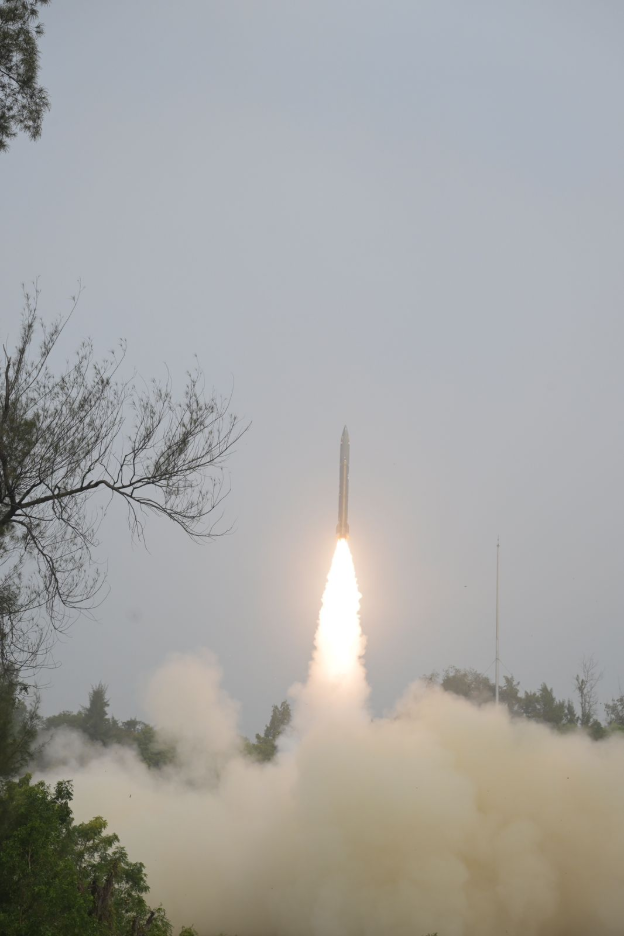
“The flight-test was conducted as part of user evaluation trials. Both the missiles followed the intended trajectory meeting all flight objectives as confirmed by tracking sensors deployed by the Integrated Test Range, Chandipur. The terminal events were confirmed by Telemetry systems installed onboard ship, deployed near the impact points,” the Ministry of Defence stated back then.