

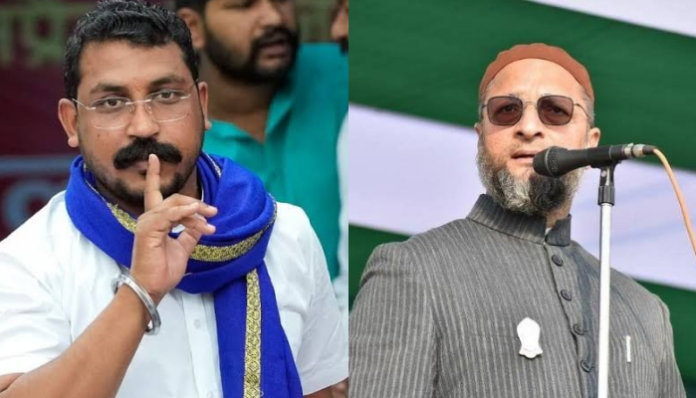
On Thursday, 12 November. Azad Samaj Party-Kanshiram (ASP-KR) president and Nagina MP Chandrashekhar Azad and All India Majlis-e-Ittehadul Muslimeen (AIMIM) chief Asaduddin Owaisi announced a joint political front named Samajik Parivartan Morcha. Both parties will contest the 2027 Uttar Pradesh Assembly elections together as allies. The announcement was made at a joint press conference in Lucknow. Owaisi declared Azad as the alliance’s chief ministerial candidate.
Both parties sought to consolidate Dalit and Muslim voters. While AIMIM has a limited electoral footprint in Uttar Pradesh, Owaisi retains influence among sections of Muslims, while Azad has been attempting to expand his support base among young Dalit voters.
Azad dismissed any characterisation of this new front as a “third front”. He said, “People have been calling it a third front, but it is not a third front. It is the Samajik Parivartan Morcha. If you understand its depth, you will realise that it is the first front”. He also stated that the coalition was open to other parties, including the Samajwadi Party and the Congress, if they wished to contest in support of the alliance to prevent the BJP from returning to power.
#WATCH | Uttar Pradesh | Azad Samaj Party-Kanshiram President and MP, Chandrashekhar Azad and AIMIM chief Asaduddin Owaisi announce ‘Samajik Parivartan Morcha’ for UP polls Azad Samaj Party-Kanshiram President Chandrashekhar Azad says, "This is not a ‘Third Front’, but a front for social change. It is strong, and it will grow even stronger. As more people from the marginalized, deprived, oppressed, exploited, and downtrodden sections join, this front will become an even more formidable force for those who are oppressed, helpless, and exploited….They promised to eradicate our poverty and helplessness, and to put an end to the oppression, caste-based violence, and atrocities inflicted upon us. But it turned out to be a deception—those who spoke of uplifting us, of bringing us into the mainstream, went on to become MLAs, MPs, Chief Ministers, and even Prime Ministers. Yet, this marginalised community remains exactly where it has always been. The truth is that governments kept changing, announcements kept being made, and even today, the Bahujan community remains deprived of basic amenities…"
— ANI (@ANI) November 12, 2026
Owaisi said the morcha would focus on issues concerning Muslim and Dalit communities. He alleged that these groups had so far been used merely as vote banks by political parties. He also took a swipe at Samajwadi Party chief Akhilesh Yadav, stating that Yadav would not become the chief minister of Uttar Pradesh.
The alliance comes after Owaisi’s attempt to join the opposition INDIA bloc’s seat-sharing arrangement in Uttar Pradesh, but it failed to materialise. Both the Samajwadi Party and the Congress gave his overtures a cold shoulder. The Samajwadi Party has publicly dismissed the significance of the new alliance. SP MP Awadhesh Prasad said, “There is no real significance to it… Akhilesh Yadav is the only leader capable of removing the BJP from power in 2027”.
‘Jai Bheem, Jai Meem’ betrayal
The political arithmetic underpinning the Owaisi-Azad alliance is encapsulated in the slogan “Jai Bheem, Jai Meem,” a formulation popularised by AIMIM. “Jai Bheem” invokes Dr B.R. Ambedkar, the foremost icon of Dalit emancipation. “Jai Meem” refers to the Urdu letter ‘M’, serving as a shorthand for Muslim political identity.
However, critics, particularly from within Dalit political discourse, argue that this formula has a documented history of backfiring and that it reduces Dalit aspirations to a mere vote-bank component of Muslim identity politics. The cautionary tale they invoke is that of Jogendranath Mandal, the most consequential Dalit leader to have bet on a Dalit-Muslim political alliance.
Mandal, a prominent Dalit leader from Bengal, was the architect of history’s first systematic Dalit-Muslim political partnership. He convinced Dalits and Muslims that, both perceived as oppressed minorities. They could forge a common front against Hindu social dominance; he cooperated with the Muslim League and campaigned for the creation of Pakistan. Following Partition, he became Pakistan’s inaugural Law and Labour Minister.
The alliance proved catastrophic for the Dalit community. Mandal urged Dalits not to retaliate during the Bengal Violence. He argued that both communities were equally victimised by upper-caste oppression. His rhetoric convinced lakhs of Hindus to stay in Pakistan.
In 1950, Mandal resigned from his ministerial position and fled to India. His resignation letter to Pakistani PM Liaquat Ali Khan documented the systematic persecution of Dalits. In Sylhet district alone, out of 350 Dalit settlements, only three survived. remaining were reduced to ash. Men faced torture, women endured mass rape, and temples were desecrated.
He trusted the Muslim League’s promises of equality and protection. But those promises by the Muslim League were sophisticated political deceptions designed exclusively for electoral gain.
“Jai Bheem, Jai Meem” slogan argues that the structural logic of the Mandal experiment remains unchanged: a numerically larger Muslim political vehicle absorbs the Dalit vote. When the strategic interests of the two communities diverge, Dalit welfare is the first casualty.
Writing on the revival of this formula ahead of the 2027 polls, “the history of Jogendranath Mandal offers a sobering reminder of the risks of political alliances built on vote-bank arithmetic,” raising the question of whether Dalit voters are being offered a credible programme of empowerment or are “once again being treated as a vote bank”.
