


According to a notice from the Directorate General of Foreign Trade, the central government on Thursday, August 3, restricted imports of laptops, tablets, and personal computers under HSN 8471 with immediate effect in a move intended to boost domestic production.
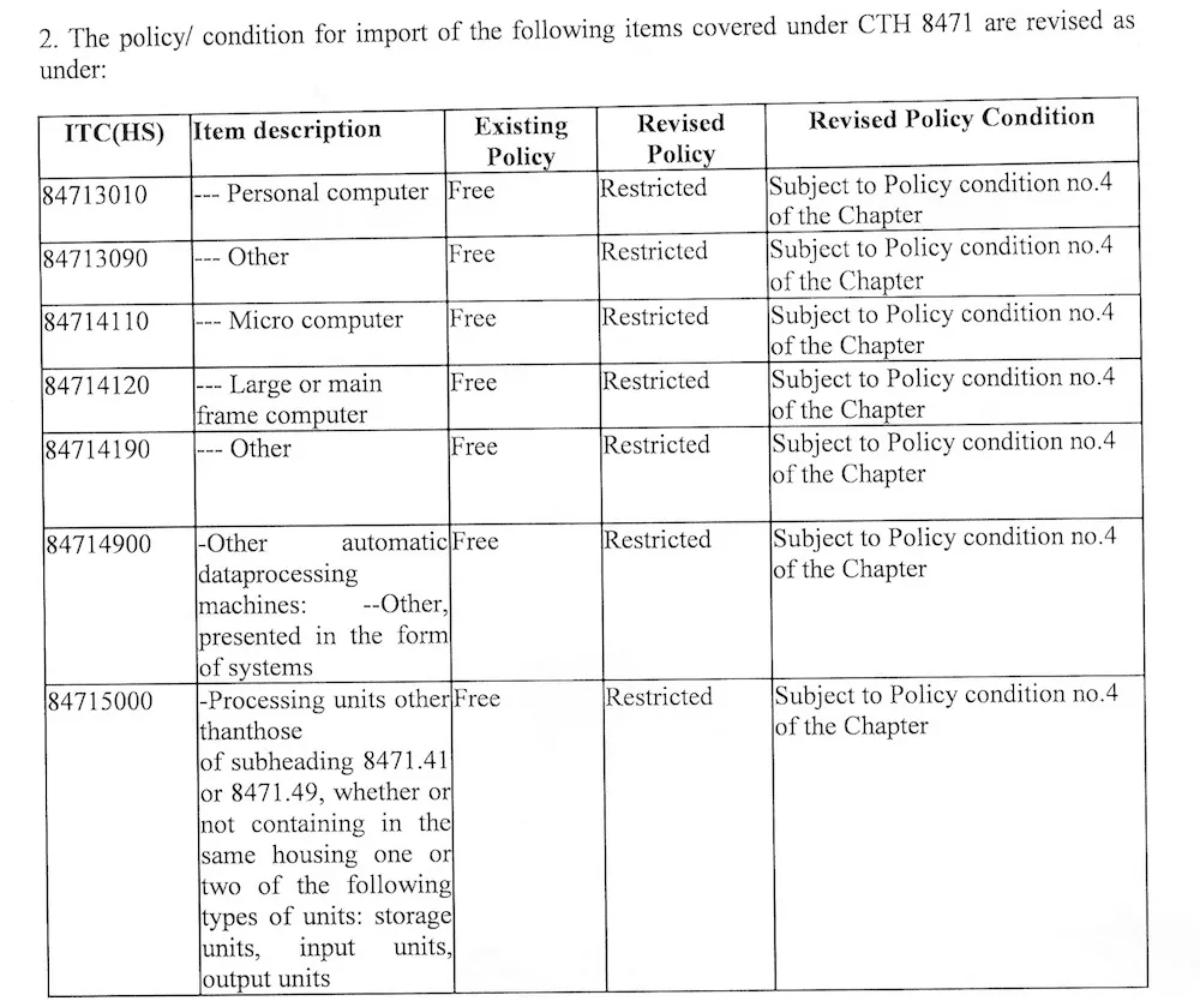
The notice stated, “Import of laptops, tablets, all-in-one personal computers, and ultra-small form factor computers and servers falling under HSN 8741 shall be restricted and their import would be allowed against a valid licence for restricted imports.”
The Ministry of Commerce and Industry informed, “The said restriction shall not be applicable to imports under baggage rules, as amended from time to time. Exemption from import licensing requirements is provided for the import of 1 laptop, tablet, all-in-one personal computer or ultra-small form factor computer, including those purchased from e-commerce portals through post or courier.”
Passengers who have the aforementioned devices in their luggage will not be subject to the restriction. The decision is likely meant to promote local manufacturing in India. The government also underlined that imports must be subject to paying any appropriate duties.
The exemption from the licensing is offered for up to 20 of certain items per consignment for R&D (Research and Development), Testing, Benchmarking and evaluation repair and re-export, and product development reasons, as specified by the administration.
The ministry added, “Given imports shall be allowed subject to the condition that the imported goods shall be used for the stated purposes only and will not be sold. Further, after the intended purpose, the products would either be destroyed beyond use or re-exported.”
India has offered multiple incentives to businesses in the last few years in an effort to increase domestic output. A wide range of smartphone manufacturers have joined the campaign and now chipmakers and semiconductor producers are starting to make in India.
The $2 billion programme was introduced in May by the Narendra Modi administration to support indigenous manufacturers of gear including laptops, PCs, servers and related edge computing equipment. The plan was an improvement on the prior initiative, for which the government was prepared to pay $892 million.
Reacting to the development, Pankaj Mohindroo, Chairman of the Indian Cellular and Electronics Association, remarked, “This policy announcement seems to be based on the premise of providing secure digital access to the burgeoning number of digital citizens in the country. We are confident that valid licenses will be provided to trusted industry partners which will enable Ease of Doing Business (EoDB) and unrestricted access to trusted brands for digital consumers.”


