Home Blog Page 7164

TMC MP indulges in insensitive whataboutery after BJP worker is found dead in Bengal

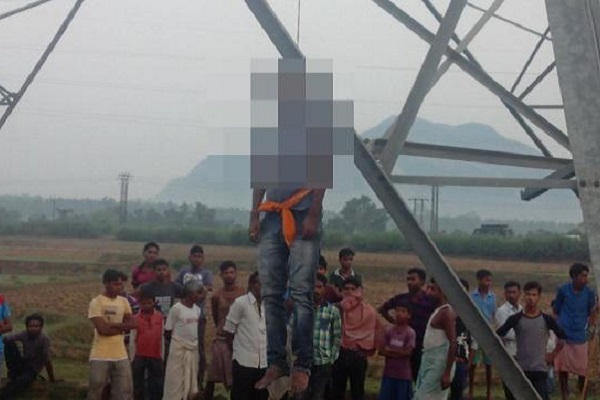
On Saturday the body of a BJP worker was found hanging in Purulia’s Balrampur, a second such incident within a week, after the nephew of state’s chief minister Mamata Banerjee had expressed his intent to make Purulia “opposition free”.

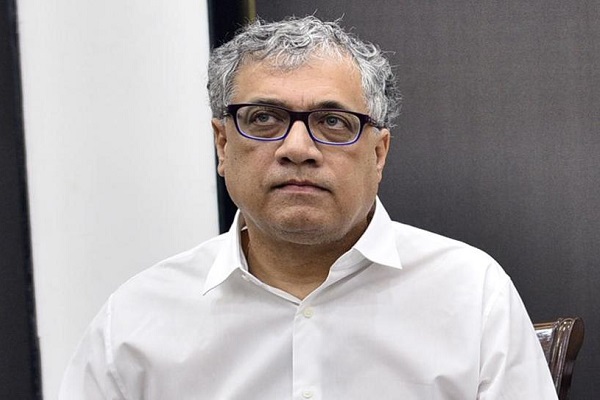
Despite the gruesomeness of the deaths, TMC’s Rajya Sabha MP Derek O’Brien was seen indulging in insensitive whataboutery in response to the news. The former quiz master who is known for defaming twitter users in the parliament took to Twitter and shockingly blamed the BJP and a Hindu group for the supposed murder:


In the tweet above, after making what looked like a token condemnation, Brien proceeds to question the role of Jharkhand border, and involvement of Maoists, BJP and Bajrang Dal elements in the crime.

It thus was unnerving to note that such a senior TMC leader was up in arms trying to pin the blame of the crime on the party whose worker was the one murdered. Such a statement by Brien rattled many twitter users:


Incidentally this isn’t the only time Derek has made such insensitive comments.

Following the massive violence during the Bengal panchayat elections which also claimed the lives of BJP workers, Derek was seen normalising the mayhem by calling the incidences as “normal”.

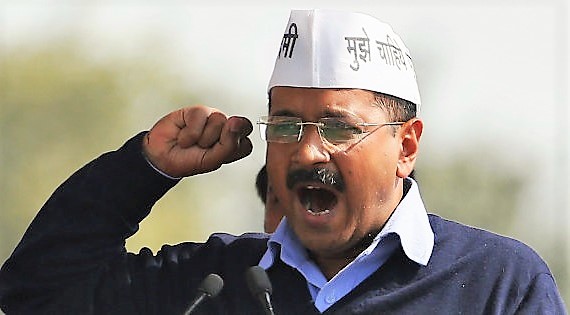
In another U-Turn, Kejriwal and Congress begin discussions to forge alliance for 2019 elections

Former Convenor of the Delhi unit of the Aam Aadmi Party, Dilip L. Pandey, has claimed that informal discussions between the Congress party and AAP have begun for a possible alliance ahead of the 2019 General Elections. He claimed that senior Congress leaders have contacted his party and sought their cooperation in Haryana, Delhi and Punjab.


Other reports have also hinted at a possible alliance between the two. ANI reports that informal discussions between the two parties began on the 24th of may with Jairam Ramesh and Ajay Maken representing the Congress. The same report mentions that the Congress has demanded 3 seats for itself in Delhi while Arvind Kejriwal’s party is willing to concede only 2. Manak Gupta, journalist with News 24, has also claimed that discussions are on between the two parties. According to him, the Congress wants the AAP to leave Punjab while the latter wants the Congress to quit Delhi.


Rebel AAP leader, Kapil Mishra, had claimed in March that Arvind Kejriwal will dump the Punjab unit of the party and ally with the Congress for the Lok Sabha elections. It will be interesting to see how Arvind Kejriwal explains the alliance with the Congress, if it materializes, to his supporters. During his rise to power, he had made a series of allegations against numerous politicians from the Congress as well as the BJP allegations for which he had to issue apologies to those concerned. In the past, Arvind Kejriwal had also promised to pursue allegations of corruption against Sheila Dikshit, former Delhi CM. Moreover, in his book, senior Congress leader, Salman Khurshid, has slammed the AAP Supremo and accused him of launching a false and malicious campaign against Dikshit and accused him of holding Delhi on ransom.

The alliance between the Congress and AAP is entirely possible and it has already happened once in the past when Arvind Kejriwal formed the government in Delhi with outside support from the Congress party. And that was after the Delhi Chief Minister had sworn by his children that he won’t take support from either the Congress or the BJP. Moreover, as the recent alliance between JD(S) and the Congress party in Karnataka and the United Opposition in Uttar Pradesh suggests, Narendra Modi’s credibility as the great Unifier is likely to receive a further boost with an alliance between the two former rivals increasingly likely.

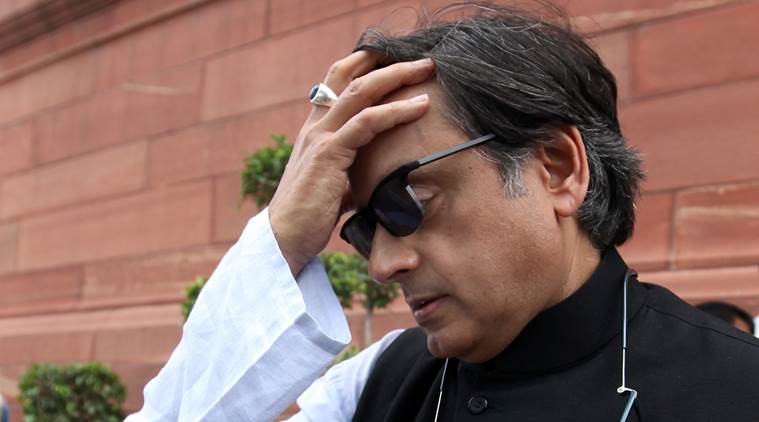
Irony died a million deaths in Shashi Tharoor’s column

0

Shashi Tharoor’s edit piece in the Indian Express on Saturday reminded me of my probation days in journalism with the Times of India in the 80s. My editor would look at my typed report, run circles in red every second line and send the paper flying towards the dustbin: “What the hell do you want to say?”

Chuckling, I set about circling Tharoor’s piece and literally ran out of ink. The man is as confused as his party, touching every base and sticking to none. “Jaana-tha-Japan-Pahunch-Gaye-Cheen-Samajh-Gaye-Naa” kind of delirium. A piece as bald as the palm of my hand. Let’s stick to a few specific ink-circles, and not all, for I can’t afford to bore and lose you, my readers.

Our attacks (on BJP) are based on our own convictions and about what is good and proper for the nation:

So using “neech” and “chaiwala” are part of his party’s convictions. A wild attack on RSS as the murderer of Mahatma Gandhi is part of Congress’ conviction. Blaming Centre for violence in “Sterlite” is part of Congress’ conviction. Blaming BJP for the murder of Gauri Lankesh’s murder, without a shred of proof, in their own governed state is based on Congress’ conviction. “Ease of doing business” and a “7.7 GDP growth” in your view is not “good and proper for the nation.” Impeachment of Chief Justice of India (CJI) is good and proper in their view.

Congress’ core belief…inclusive growth, social justice, the abolition of poverty, protection of minorities, women, dalits and adivasis:

Inclusive growth, social justice, the abolition of poverty? Are you joking Mr Tharoor? Anyone earning above Rs 33 is not poor is how Congress removed poor and poverty. Six worst communal riots happened under UPA and you call it the protection of minorities. Women? Ask Shah Bano. And remember how you had to apologize for making fun of our own Miss World 2017?  Dalits? That’s why Bhimrao Ramji Ambedkar could get Bharat Ratna only in 1990 and that too not under Congress’ regime. Further, why did your heart not beat for a murdered Dalit youth leader found hanging by a tree in Bengal? Was it because he worked for BJP? Adivasis? Then how did Maoists and Naxalites proliferate in India?

Congress is political embodiment of India’s pluralism…preservation of secularism:

Your kind of equality under “secularism” doesn’t extend to Hindus and their problems. “Secularism” ought to be equality; not appeasement of minorities. The word “secular” too is an insertion in the Constitution by your leader Indira Gandhi after suspending the Parliament and slapping the “Emergency” on the nation in the 70s. Secularism is nothing but a cloaked dagger by Congress to keep it plunged in India’s heart.

We too share Hinduism, albeit an inclusive version of the faith, rather than a bigoted one:

May we ask you, Mr Tharoor, where’s your reaction on 24 BJP/RSS workers killed in Karnataka under Congress rule? Where’s Congress’ concern for Hindu lives as they are butchered in West Bengal and Kerala? Show me one tweet where you have offered condolence to Hindu lives lost? Congress standing by Hinduism almost sounds like an abuse.

The need of Rural India represents a political opportunity to Congress (e.g)…the mounting farmers’ suicides:

So, tragic lives lost is a political opportunity to Congress? But then what else do you expect from a party which clings to a dynasty and cries democracy in the same breath?

(Congress must) Help citizens in interactions with the police…:

Now that could only happen if both citizens and police trust you with your intentions. I don’t know how policemen feel after Rahul Gandhi stormed a police station and reprimanded a policeman in uniform. As for citizens, they still speculate about an unfortunate death in a Delhi five-star hotel as you would recall. Where’s credibility of Congress and its leaders with the citizens of this country?

From housing to transport to potholes-on-roads to drinking water to education to healthcare to public parks to sanitation to waste management, Tharoor leaves little for imagination and a lot for mockery in his piece. Empty rhetoric, typical of Congress, the sound of an empty biscuit tin. Mr Tharoor, irony has died a million deaths in this juvenile piece of yours.

Second BJP worker murdered in Purulia within a week, BJP says TMC executing Mamata’s nephew’s orders

In another case of chilling political violence in the state of West Bengal, a 32-year-old BJP worker identified as Dulal Kumar was found hanging from a high tension electric pole, Zee News has reported.

This incident has been reported from Dabha village in the Balrampur region of state’s Purulia district. Dulal was reported missing since Friday and his body was eventually recovered come Saturday morning.

As per an India Today report, Dulal was a resident of Gopaldi village and following his disappearance, an FIR was registered with the local police. The police though didn’t manage to rescue him in time.

Following this incident, the Bengal BJP pinned the blame on TMC goons, whom it accused of executing the order of Mamata’s nephew Abhishek Banerjee:


To give some context, Mamata’s nephew had recently made a statement that “he would make Purulia opposition free”. Just a day later an 18-year-old BJP worker named Trilochan Mahato was found murdered in similar circumstances in Balrampur itself.

What made matters worse was the message inscribed on Trilochan’s shirt, which stated that he deserved to die for working for the BJP at such a young age.

Now follow Dulal’s murder, BJP’s National General secretary Kailash Vijayvargia too has issued a statement, where he claims that he had a long conversation with Anuj Sharma – Additional DGP law and order, where he stressed that Dulal’s life was in danger.

He thus repeatedly appealed to the senior officer to save the BJP worker, which elicited an assurance from the cop. Despite the claimed efforts of the cops, Dulal’s life could not be saved.

BJYM state secretary Aroon Shah has been seen putting the blame squarely on the Mamata led party by stating that, “The TMC has lost their foothold in the tribal districts of Purulia and Jhargram. Despite the TMC’s ‘Bondook-Bottle-Bomb’ tactics, BJP did exceptionally well in these two districts. Hence, out of fear psychosis, TMC is resorting to the politics of killing”.

Opposition hasn’t paid heed to Rajnath Singh’s words

0

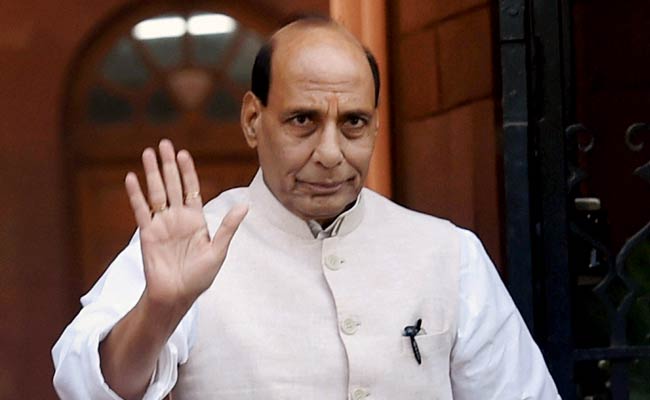
In the wake of Kairana elections and a loss in Noorpur by a whisker, Home Minister Rajnath Singh made a statement which escaped the attention of most political observers: “One has to take two steps backwards for a giant leap,” he said.

Now the delusion of this “deep state” within India, read as Lutyens Media and their ‘left-liberal’ cohorts, was understandable. After all, last four years have been a nightmare for them. The cloak of respectability has been torn off their break-India agenda. Celebrations have been few and far between. They have every right to wet beaks in their otherwise parched political landscape. But the disappointment of BJP supporters too seems to have drowned the importance of this statement by the Home Minister.

An educated guess is that Rajnath Singh through his quip was hinting at a consolidation of Hindu voters in the light of Kairana reverse. He was echoing what Sujoy Ghosh so brilliantly elucidated in OpIndia. Around 15 percent who voted in the 2014 Lok Sabha and 2017 state assembly elections, stayed away from Kairana bypoll while the margin of victory for the opposition’s Tabassum Begun was only 4.6 %. Impressively, no less than 77 percent of Hindus voted for BJP in Kairana. What happens when these missing 15% and the remaining Hindus do turn up in the 2019 General Elections? Another impressive analysis in Swarajya reasserts the impression.

Make no mistake, Hindus in Kairana would be smarting in anger. The same is the mood in Karnataka where despite 104 seats, BJP and the people of the state are watching the tragic comedy of Congress-JDS alliance. This groundswell of anger is bound to help BJP.

Rajnath Singh is known to be a man of few words. But when he says “two steps backwards,” it suggests a great strategy of Hindu consolidation being put in place by the BJP. That perhaps might also explain why Gorakhpur and Phulpur weren’t fiercely protected. The idea is for Hindus to be mindful that they could be overwhelmed in their own country in 2019. Not only BJP cadre and supporters, but even common Hindus must not lull themselves into a false sense of security. This heightened Hindu anxiety would only end up in consolidation for BJP.

It would be utterly foolish on opposition’s part to believe Modi-Shah have been cornered. Their last four years have shown, if anything, that they invest a lot of time in strategizing and ruthlessly executing their designs. They are utterly capable of winning affections of people by a dramatic measure: It could be Ram Janmabhoomi; Income or the long-pending Hindu issues of owning temples and Right To Education (RTE). Even a politically agnostic would know that Modi-Shah, in the home run to 2019 General Elections, would have an ace up their sleeves.

So while opposition has shown its card—alliance and understanding at all cost without an ideology or a Prime Ministerial candidate to project—nobody knows what aces BJP has up its sleeve. A party which went into 2014 General Elections with 4 states today has 19. In just four years such an expansion has come about because of BJP’s skin-in-the-game. The micromanagement of an election, from the local issues to booth management, nobody does better than BJP.

So when Rajnath Singh says “two steps backwards for a giant leap,” opposition must stop in their tracks and ponder. They have walked into a trap and are more discredited than ever. Their game is out in the open even as they are clueless on the next move of Modi-Shah duo. They would have nowhere to run but to their doom, come 2019 General Elections.

Murderous mob goes on a stone pelting rampage, usual elements find ways to blame the CRPF

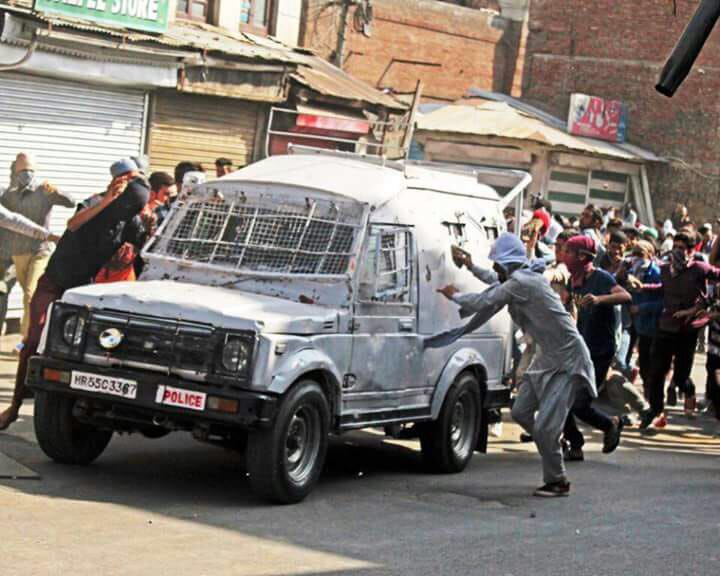
Some CRPF vehicles with soldiers were attacked by a stone pelting jihadi mob in Srinagar yesterday. In the videos and images that emerged later, it was seen that a large mob of several dozen stone pelting jihadis were attacking CRPF vehicles passing through a street in Nowhatta area in Srinagar.


Images of the brutal attack were harrowing and showed how vicious a jihadi mob can be.


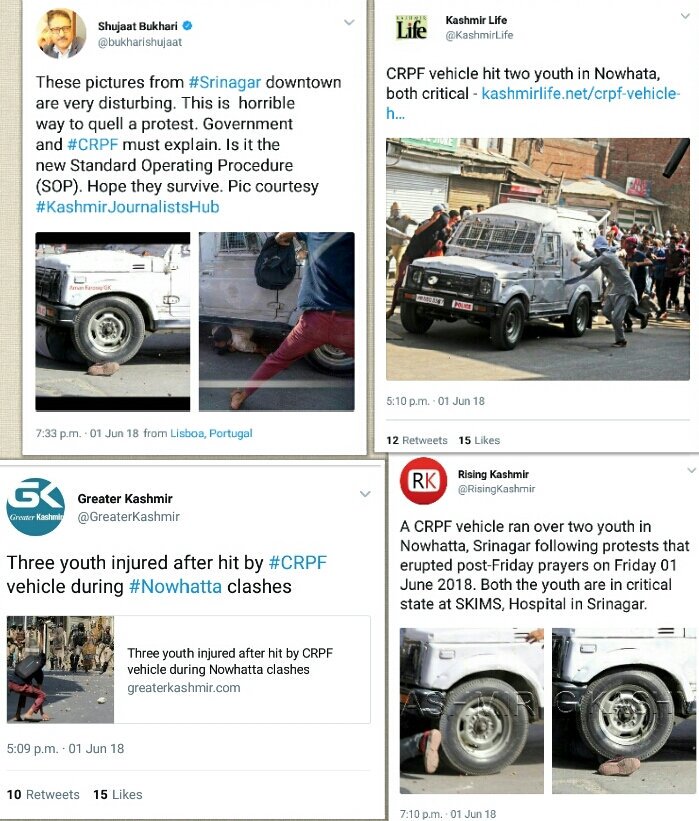
As expected by Rahul Pandita in his tweet soon other images which quite conspicuously cut out the jihad mob attacking the vehicle but showed only a person being run over by a vehicle amidst all that commotion was being peddled by apologists.

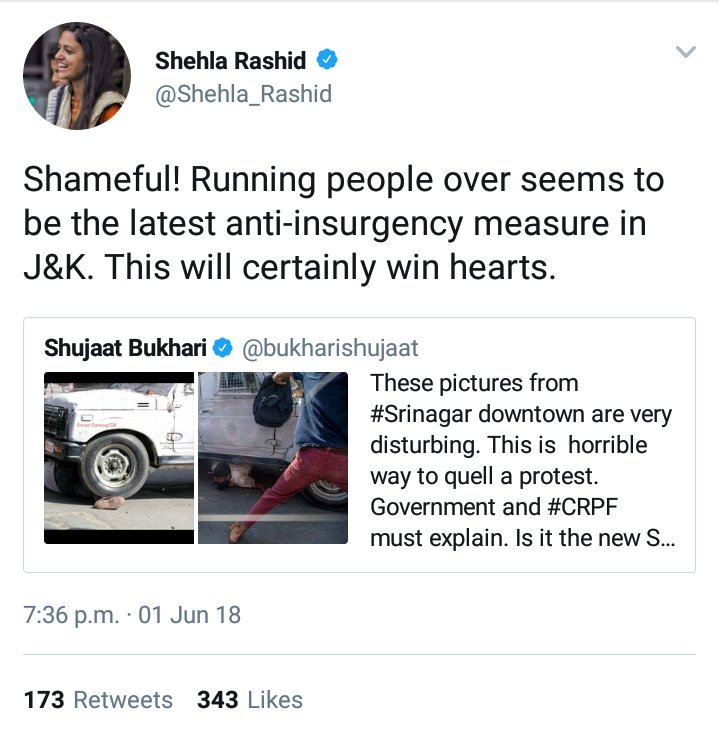
Kashmiri local news outlets and many individuals circulated zoomed, selective versions of the images and tried berated the security forces for the “shameful anti-insurgency tactics”.

courtesy: @goonereol
courtesy:@goonereol

As seen, the brutal stone pelting was painted as CRPF vehicles mowing down Kashmiri youth who were returning from Friday prayers. But as predicted, the lies and manipulation of facts were quite evident. Not being content at the mere distortion of facts, some even tried to indulged in whataboutery in their desperate attempt to exonerate the murderous, stone pelting mob, in the ‘misguided youth’ format.

The Jammu and Kashmir police also tweeted shaming the selective reportage.


If there is anything more shameful than an Islamist mob pouring over security forces vehicles with bricks and stones, it is the blatant propaganda certain elements peddle to absolve them of any wrongdoing. The way Major Gogoi was hounded and vilified by media and their cohorts after his action that led to saving a group of officials from a much larger mob ready to pelt stones was also another testimony of the extent a terror apologist mind can go. Media is always prone to fake news and misrepresentation, but there is a vast difference between misrepresentation of facts and deliberately using selective narrative to malign the security forces and totally ignoring the Islamist mobs that attack them.

The fundamental flaws of Democracy

In the past twelve months or so, Indians have witnessed social upheavals of considerable magnitude. One could perhaps attribute it to the nature of the Hindu faith that despite concerted attempts at fomenting division in society and inciting violence, our country has managed to endure the attacks on its integrity without incurring any significant damage to its social fabric.

There were the violent protests against the Bhansali movie, Padmavat, which hinted clearly at political motivations. Then there were the riots at Bhima Koregaon where an elected MLA was allegedly caught on camera fomenting a caste war. And of course, there was continued violence of epic proportions surrounding the Bengal Panchayat Elections where the ruling party was suspected, and with good reasons, one could argue, of silencing the Opposition through the tactical use of violence. One critical feature of the violence that has gripped the country is the political motivation behind it. It’s almost an open secret that in all the three cases listed above, violence was used as a means to achieve a political end. And there lies the fundamental flaw of Democracy. In any society, democracy incentivises the division of society and even makes it profitable for political players to embrace violence to ensure electoral victories.

In India, the discerning can identify a concerted attempt underway to divide the country along caste, religious, regional and even along linguistic lines. We could, of course, blame a particular political party for the attempts being made but it would be naive to ignore the fact that they are doing so only because they perceive it to beneficial interests and one could even argue, that it has indeed been beneficial for them. Thus, it’s an indictment of the political system in place that rewards attempt to foment divisions in society instead of burdening the perpetrator with heavy costs. And of course, one could blame the citizens of the country for falling prey to such ventures by political parties to further their own political interests, however, identity politics is the reality of human existence. One could even argue it’s engraved in human nature and thus, political systems must seek to transcend the reality of social identities or at least negate the limitations of it. In that endeavour, democracy fails miserably to ensure a cohesive society.

The primary goal of every elected public representative in a democracy is to ensure his or her own re-election. Everything else is secondary. One has to be utterly naive to seriously believe his goal is to serve the citizens. Of course, once in a while, a person may eventually emerge from the abyss who genuinely seeks to serve the citizens of the country. However, such men or women are an exception and an exception, rather than the norm.

Milton Friedman, the great American economist, once said, “I do not believe that the solution to our problem is simply to elect the right people. The important thing is to establish a political climate of opinion which will make it politically profitable for the wrong people to do the right thing. Unless it is politically profitable for the wrong people to do the right thing, the right people will not do the right thing either, or if they try, they will shortly be out of office.” Thus, due to the very nature of democratic politics, the goals of politicians are extremely shortsighted and the decisions are taken to benefit them in the short run and if those decisions are sure to prove problematic in the long run, it could very well be delayed long enough to be the concern of their successors. Essentially, democracy helps politicians escape the consequences of their actions unless one considers being voted out of power as punishment enough, which is, frankly speaking, a very punitive punishment considering the damage they can inflict on the country by purposefully implementing policies which substitute long-term stability for short-term gains.

One general argument against authoritarian regimes is the use of violence or censorship by the state to silence all opposition. However, it can be witnessed in democracies as well. In India itself, violence has been embraced by the ruling disposition in Bengal to strategically eliminate its political rivals. In Germany, hate speech laws ban “defamation of religions, religious and ideological associations.”  In addition, a new law has been passed which forces social media networks to remove hate speech online. “With these 24 hours and seven day deadlines – if you are a company you are going to want to avoid fines and bad public branding of your platform,” says David Kaye, the UN’s Special Rapporteur on Freedom of Expression, “If there is a complaint about a post you are just going to take it down. What is in it for you to leave it up? I think the result is likely to be greater censorship.” London Police arrested one Mathew Doyle for tweeting, “I confronted a Muslim women [sic] yesterday in Croydon. I asked her to explain Brussels. She said “Nothing to do with me” a mealy-mouthed reply.” The Communications Act 2003 defines illegal communication as “using public electronic communications network in order to cause annoyance, inconvenience or needless anxiety”. More people have been arrested in Britain for posting offensive comments online than raping children as young as eleven years old. Intriguingly, the state which has gone overboard in covering up the rape of young girls by Muslim men is coming down harshly on any criticism of Islam online. Thus, this whole idea that censorship and violence are used only by authoritarian regimes is a completely farcical notion.

An illusion of democracy is the notion that it is only the people who elect their government but it is oft forgotten that the converse is also true. For instance, the Labour party in the United Kingdom deliberately pushed the country to accept migrants to “rub the Right’s nose in diversity”. It became clear that the Labour party adopted it approach towards mass immigration for political reasons and as a consequence, the Conservatives in the United Kingdoms in the near future may find it impossible to secure a majority in the Parliament on their own as migrants tend to overwhelmingly vote for the Liberals. Even in India, political parties have long been suspected of catering to illegal immigrants from Bangladesh and securing voting rights for them to boost their own vote bank. In the United States, the Democrats openly advocate for more and more immigration into the country and some have even argued that even non-citizens be granted voting rights as it would help achieve their political goals. Thus, political parties across the world engage in creating an entire electorate, often non-citizens, who promise to be their loyal vote-banks.

Bertrand de Jouvenel in his book, “On Power, its nature and history of its growth” elucidates his political theory which can be roughly dubbed as “High and Low versus the middle”. His theory could be applied to modern day politics where the political left is a coalition between a section of elites (High) and the section of population with insignificant political rights or property (Low) while the political right could be said to be the broad coalition between another section of competing elites and the part of society which has capital, political rights or political property (Middle).

The salient feature of the political theory is that it elucidates on the existence of multiple power centres in any society and thus explains that absolute tyrannies in the pre-democratic era, as we are made to believe existed under monarchies, could not have existed. There is enough historical evidence to prove that the assertion is essentially correct as monarchies were far from absolute tyrannies but a fine balance between the various power centres prevalent in the kingdom. Democracy interferes with this balance which strives at arriving at a structure which maintains stability as the whole system incentivises chaos as mentioned above and disorder and on some occasions, as we have seen, even enables the establishment to ally themselves with illegal immigrants in a bid to retain their hold over power.

Another feature of Democracy is the high tax rates and the constant threat that the rates may rise even higher. Nearly all political parties, through taxation, seek to take away money from the rich and redistribute it to the poor, through welfare, in the hope that they will be re-elected to their office. Thus, in a way, political parties seek to retain their power through the appropriation of wealth from hardworking people and giving it away to those who do not have it in the hope that the poor will vote for them in the next election. It is, thus, another manifestation of the “High-Low versus the Middle” mechanism where money is taken from individuals who earn them through their hard-work to fund the political ambitions of politicians.

Another flaw within a democracy is how easy it is for foreign entities to subvert a democratic state. We are well aware of the many allegations of Russian interference in the US Presidential Elections. Regardless of whether the allegations are true, there have been many demonstrable instances of foreign interference in democratic elections. The USA and Russia have been accused on multiple occasions of interfering in elections of other countries to get candidates favourable to them elected to office. And of course, on many occasions, the will of the people is quite difficult to discern. For example, in the recently held Karnataka elections, it could very well be concluded that the mandate was against the ruling Congress party and yet, it appears that they are set to form the government once more in alliance with the JD(S). However, this could be attributed to a flaw unique to the Indian political system rather than the democratic set up at large. And even without political interference by foreign nations, how very easy it is for democratically elected leaders to subvert the will of the people. We all remember what Indira Gandhi did with the Emergency in the 1970s.

These days, we are constantly reminded of the use of propaganda by political entities in election campaigns. However, it is certainly not a recent phenomenon. Noam Chomsky said of the relationship between propaganda and democracy, “Propaganda is to a democracy what the bludgeon is to a totalitarian state.” Edward Bernays, the father of modern propaganda, said in his book, “Propaganda” which was originally published in 1928, “The conscious and intelligent manipulation of the organized habits and opinions of the masses is an important element in democratic society.” He defined propaganda in the following manner: “The mechanism by which ideas are disseminated on a large scale is propaganda, in the broad sense of an organized effort to spread a particular belief or doctrine.” From his definition, it becomes obvious which institutions have been burdened with the responsibility of propagandizing for the political establishment. The answer, of course, is the mainstream media. This very portal has time and again busted lies propagated by the media, however, the media has seldom, if ever, apologized for the same. Since the very goal of politicians is to ensure their election to office, brainwashing the masses to convince them of their virtue becomes imperative towards achieving their target.

Criticism of Democracy is of course not a recent phenomenon. Former Prime Minister of Britain once said of Democracy, “The best argument against democracy is a five-minute conversation with the average voter.” Elmer Theodore Peterson, born in the late 1800s, once said, “A democracy cannot exist as a permanent form of government. It can only exist until the majority discovers it can vote itself largess out of the public treasury. After that, the majority always votes for the candidate promising the most benefits with the result the democracy collapses because of the loose fiscal policy ensuing, always to be followed by a dictatorship, then a monarchy.” John Adams, one of the Founding Fathers of the United States of America, said, “Democracy has never been and never can be so durable as aristocracy or monarchy; but while it lasts, it is more bloody than either. … Remember, democracy never lasts long. It soon wastes, exhausts, and murders itself. There never was a democracy yet that did not commit suicide.” Antoine de Rivarol, a Royalist French during the Revolutionary era, said, “The absolute ruler may be a Nero, but he is sometimes a Titus or Marc Aurelius; the people is often Nero, but never Marc Aurelius.” Austrian Political Scientist, Erik von Kuehnelt-Leddihn, insinuated that democracy facilitated liberty was merely an illusion. He said, “Democratism and its allied herd movements while remaining loyal to the principle of equality and identity, will never hesitate to sacrifice liberty.” H.L. Mecknen was scathing in his indictment of Democracy, Democracy is a pathetic belief in the collective wisdom of individual ignorance. Democracy is also a form of worship. It is the worship of Jackals by Jackasses. Democracy is only a dream: it should be put in the same category as Arcadia, Santa Claus, and Heaven. Democracy is the art and science of running the circus from the monkey cage. Democracy is the theory that the common people know what they want, and deserve to get it good and hard. Every decent man is ashamed of the government he lives under. Every normal man must be tempted, at times, to spit on his hands, hoist the black flag, and begin slitting throats.”

We may choose to disagree with the assumptions and assertions of the gentlemen above, however, we cannot ignore the fact that the democratic state institutionalizes injustice by masking them under the cloak of popular will. For instance, Fascism in Nazi Germany was entirely a democratic phenomenon. It might be politically incorrect to state otherwise now but at the time Adolf Hitler did have popular mandate and it was the democratic regime that felicitated his rise to power. The manner in which political parties use taxes from honest hardworking to fund their political ambitions cannot be dubbed ethical under any parameter of morality. The concerted replacement of a population by political entities to create and nurture loyal vote banks is a slap in the face of people who perceive democracy to be a power of good.

From a philosophical perspective, democracy has led to the politicization of every facet individual life. How many people have lost friends or had terrible quarrels with members of their family as a consequence of difference over political opinions? The fact of the matter is every single aspect of our lives have been marred by the terrible touch of partisan politics. We can hardly even watch a movie these days without being reminded of the political affiliation or comments of the actors involved. Every policy or legal proposition is not judged by its merits and demerits but from the perspective of political partisanship.

When I was in my teens, one of the cousins narrated to me an interesting conversation he overheard between a few old men in his locality. One of the old men was saying to his friend, “The age of the Kings was far more just than what we have today. If the King was kind and honest and just, everything went well and the kingdom prospered. If the King wasn’t any of that, the entire Kingdom suffered. In our democracy, however, it doesn’t matter if any one politician is honest or a man of integrity, even if he is, the others will gang up on him and ensure that he cannot function efficiently enough.” And the others appeared to agree with him. In my youthful arrogance, I had dismissed the perspective of that old but wise man from one of the most backward regions of the country. However, as I grow older, I am beginning to realize there may well have been more than a bit of truth in his words. Are there truly any authentic solutions to the inherent problems with Democracy which could be implemented successfully? If there are any, they haven’t been yet discovered in the many centuries since the advent of Democracy.


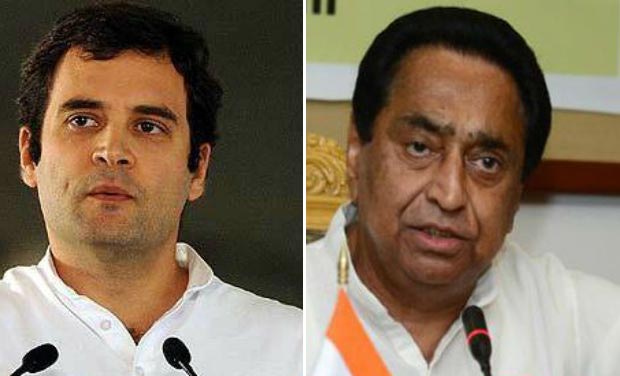
Kamal Nath’s letter to Rahul Gandhi reveals the ‘United Oppositions’ petty caste politics

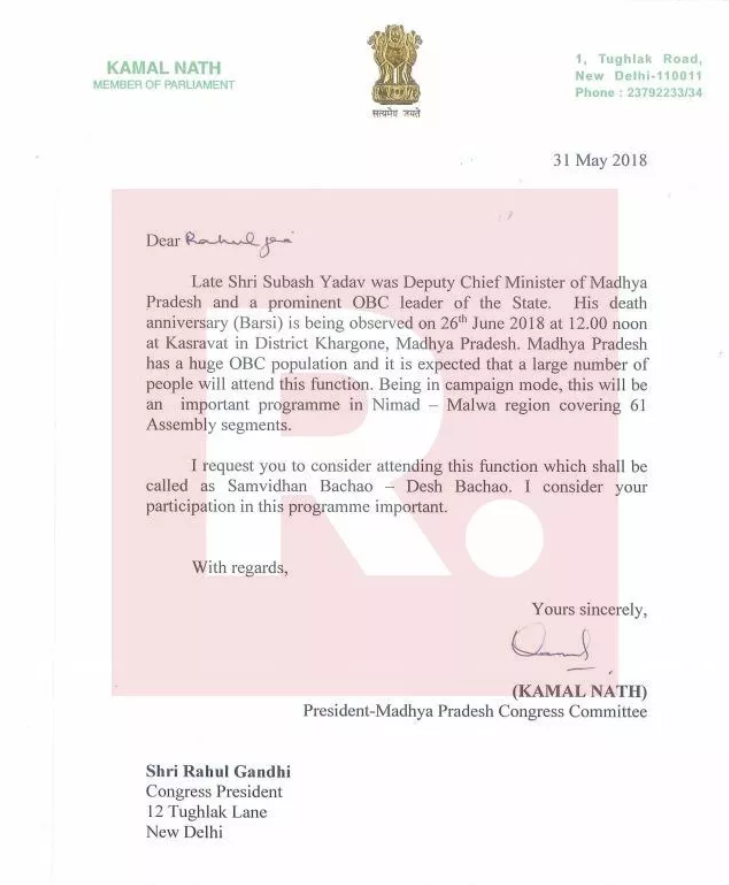
Congress leader Kamal Nath’s sordid letter, accessed by Republic, reveals how petty and deep the caste politics runs in the ‘United Opposition’. According to reports, Nath has written a letter to Congress President Rahul Gandhi to attend an event to mark the death anniversary of a prominent OBC leader to score political brownie points.

Letter by Kamal Nath to Congress President Rahul Gandhi. Courtesy: Republic

Kamal Nath, in a letter written on his official MP letterhead, invites Congress President to use the death anniversary of Subhash Yadav, an MLA from Kasrawad in Madhya Pradesh, which goes to polls in few months’ time, as a platform to address the gathering of people who would come to pay their respect to him for campaign ‘Samvidhan Bachao – Desh Bachao’. He further states that this will be an important function in Nimad-Malwa region which consists of 61 Assembly segments in Madhya Pradesh Assembly.

Rahul Gandhi is to address a rally on 6th June at Madhya Pradesh’s Mandsaur where farmers are agitating currently to mark one year of violent protests which took place last year.

Modi govt’s crackdown on NGOs continues: Online tool launched to monitor foreign funding

The Home Ministry has launched an online tool that will enable lawmakers and bureaucrats to monitor the funds received through the FCRA Act and how they are being utilized. There are around 25,000 organizations which are permitted to receive funds for social, cultural, economic, educational and religious activities.

In an official press release, the Ministry said, “This web-based tool enables decision-makers in various Departments of Government to scrutinise source of foreign funds and their actual use in India. It gives them the capacity to take data-driven and evidence-based decisions regarding the compliance of the provisions of the FCRA, 2010.  It has analytical features to conduct big data mining and data exploration.  Its dashboard will be integrated with the bank accounts of the FCRA-registered entities through the Public Financial Management System for updation of transactional data on a real-time basis.”

The government believes that the tool will help authorities to better monitor compliance with the law and regulate the usage of the funds. The statement said, “Therefore, there are hundreds of thousands of such transactions annually which can be monitored effectively through this tool.  It will, therefore, help the stakeholders in  Government to better regulate acceptance and utilisation of foreign contributions.”

We have reported in the past that the NDA government has been cracking down hard on FCRA NGOs. In 2015, the government had issued notices to over 10,300 NGOs for failing to submit their annual accounts under FCRA, 2010. The Supreme Court too had directed the Central government to enact a law which would ensure prosecution of NGOs which indulge in misappropriation of funds. As a consequence of Modi government’s crackdown on NGOs, foreign funding had dropped by 66% in 2016-17 compared to the previous year. Top Indian Universities including the JNU had also been barred from receiving foreign funds last year as they failed to submit their annual returns for five consecutive years despite several notices. Furthermore, Sonia Gandhi led Rajiv Gandhi Charitable Trust Amnesty India are also being probed for alleged FCRA violations.  Sabrang Communication and Publishing Pvt Limited, with which Teesta Setalvad is associated, was also found to be violating FCRA norms as it received $2.9 lakh from Ford Foundation without registering itself under FCRA. The license of ‘Navsarjan Trust’ was cancelled in 2016 after the MHA observed, “Navsarjan Trust has come to adverse notice for its undesirable activities aimed to affect prejudicially harmony between religious, racial, social, linguistic, regional groups, castes or communities.”

There has been much speculation that Christian evangelicals indulge in proselytization in India with funds received from abroad. Recently, Compassion International, which is alleged to have conducted religious conversions in India under the garb of social welfare, shut down its operations after facing tough restrictions related to foreign funding.

West Bengal Police seizes cache of arms, fake currency in Malda

As per Times Now report, the West Bengal Police have recovered twenty-two 9mm pistols from a rented house in Naldubi area near Malda in the state.


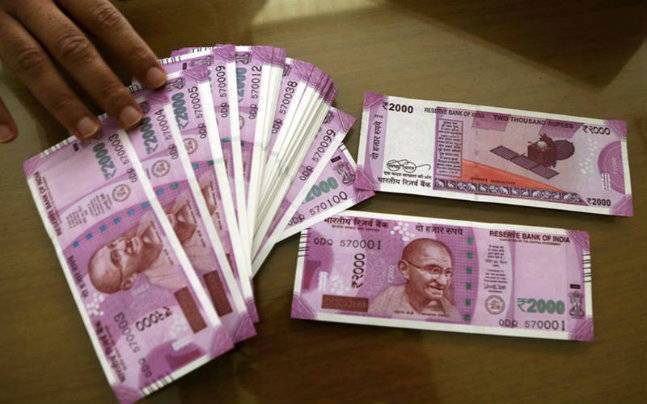
The house belongs to a resident of Bihar. The West Bengal Police have arrested nine people who hail from Munger, Bihar and unfinished pistols, six lathe machines and fake currency amounting to Rs. 80,000 were recovered from them.

This is not the first time Malda has been in the news relating to fake currency. The Bengal district, sharing a border with Bangladesh, is also known as ‘fake currency capital’.

The fake currency racketeers use the advantage of good rail and road connectivity as the supply routes for the cross-border movement of fake currency and drugs. In addition to it, Malda being closer to Bangladesh border and rising fundamentalism in the region has augmented the growth of the fake currency market in the region. In 2016, Malda had come to a standstill following the demonetisation of Rs 500 and Rs 1,000 notes by the Narendra Modi-led government

West Bengal has been very sensitive to law and order issues recently. The law and order situation in the state has deteriorated, as there has been an increase in politically motivated murders in the state. There have been instances of violence reported in Muslim majority areas against Hindu community. The people have alleged the Mamata Banerjee led government of indulging in minority appeasement and it has been the reason for the rise in violence in the state.

Recently, during Panchayat Polls in Bengal, Trinamool Congress workers reportedly resorted to extreme violence towards workers of other political parties and were accused of destroying the ballot boxes in some areas of Bengal. The Trinamool leaders are accused of promoting violence and are even caught with bombs and other weapons, alleged to be used during the Panchayat elections.