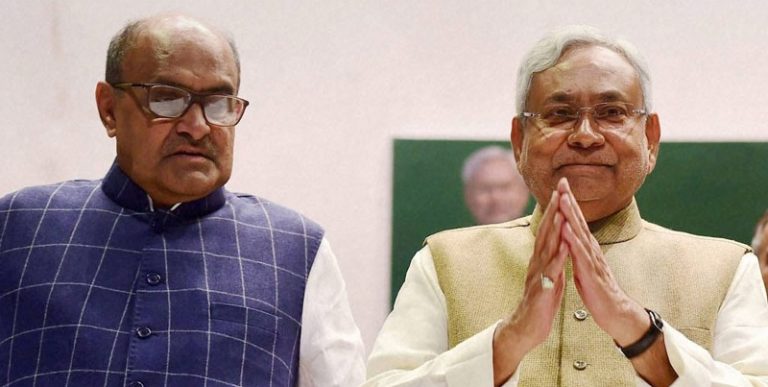
The relationship between RJD and JD-U continue to be blow-hot-blow-cold. On Tuesday, JD-U general secretary KC Tyagi said something that surely is not going to amuse RJD. Tyagi reportedly said that JD-U was much more comfortable with the BJP during their 17-year-long partnership.
“We were much more comfortable under the Atal Bihari Vajpayee regime. But we have ideological differences with the Narendra Modi government on issues like Article 370, Uniform Civil Code and Ram Janmabhoomi,” the JDU general secretary said.
It could be noted that Nitish Kumar’s JD-U had snapped its 17-year-long ties with the BJP in the run up to the 2014 general elections, after BJP announced Narendra Modi as the Prime Ministerial candidate. It subsequently joined hands with the Lalu Prasad Yadav’s RJD for the 2015 Bihar assembly elections.
But much water has flown since then. Nitish Kumar supported Prime Minister Narendra Modi over demonetisation. In return, PM Modi praised and supported the Bihar Chief Minister for his prohibition policy. Last month, Kumar had skipped Congress president Sonia Gandhi’s ‘unity lunch’ to attend a luncheon meeting with PM Modi. And now Nitish Kumar’s party has gone a step further by announcing its support to NDA’s Presidential candidate Ram Nath Kovind.
“We have made it clear that our decision to support NDA’s Presidential candidate is a one-time affair. I do not know why some ‘friendly parties’ want to make it a permanent affair,” Tyagi reportedly said, which hints at the possibility of JD-U going back to the BJP due to attitude of RJD.
Earlier RJD supremo Lalu Prasad Yadav had termed JD-U’s support to NDA nominee for the Presidential election “aetihask bhool (historical blunder)” and appealed Kumar to mend the “historic blunder” by supporting “Bihar ki Beti” Meera Kumar, who is the Opposition candidate for the Presidential election.
“We have taken this decision after thinking on all aspects. And as far as JD-U is concerned, it has always taken independent decisions,” Nitish had retorted. “There is no doubt about the result. I have great respect for ‘Bihar Ki Beti’ (Meira Kumar). But the Bihar Ki Beti has been nominated only to lose,” the Bihar Chief Minister had said.
Ever since Nitish Kumar announced support to NDA Presidential nominee Ram Nath Kovind, both Congress and the RJD have been taking swipe at Nitish Kumar. Lalu Prasad’s son and Bihar’s Deputy Chief Minister Tejashwi Yadav has launched veiled attack on Kumar calling his decision “unprincipled” and “ego-centric”.
There has been a barrage of corruption charges involving Lalu Prasad and his family members, which is not helping the mahagathbandhan either as Nitish Kumar wants a clean image for his tenure.
In the beginning of this month, the NIA had conducted raids across as many as 23 locations across Delhi, Haryana and Kashmir in connection with the Pakistani funding which the Kashmiri separatist leaders are believed to receive in order to spread terror in the valley.
The NIA in the process raided various hawala operators and traders and seized around Rs 1.5 crore from various locations in the Kashmir Valley. On top of it, the agency had also recovered a few incriminating documents.
The NIA had also conducted a raid on establishments of various prominent separatists like Shahid-ul-Islam, a prominent leader of Awami Action Committee of the All Parties Hurriyat Conference and Altaf Fantoosh who is the son-in-law of Hurriyat leader Syed Ali Shah Geelani.
Now it seems that the son-in-law of Geelani is in further trouble after it was reported that he had been detained by the NIA on Wednesday in connection with the terror funding probe. Two other Hurryat leaders named Ayaz Akbar and Mehraj ud Din Kalwal were also detained by the agency.
Fantoosh, the son-in-law of Geelani was also questioned by the NIA on 12th June with regards to his movable and immovable assets and the source of their funding. This has reportedly prompted Geelani to squeal that the NIA had crossed all limits and also claimed that there was no legal justification for such arbitrary measures.
This action by the NIA is a welcome change from the attitude of the administration, which has continued to pander to the whims and fancies of these separatists. Till date, the government continues to provide a security cover to these separatists.
Even though Geelani in particular has taken up a separatist stand, this doesn’t stop him from taking favours from the Indian government. It has been reported in 2016 about how the rules were bent to provide a government job to the grandson of Geelani under the tourism department of the J&K government.
It was also recently reported how while the schools across the valley had remained closed for 111 days due to the bandh called by the seperatists, the grand-daughter of Geelani was allowed to appear for a school exam at an indoor stadium under stringent security arrangements.
Indian National Congress, the grand old party of India, suffered its worst ever electoral defeat in May 2014. Reduced to 44 seats, it was staring at a risk of being pushed to the margins if immediate corrective steps were not taken.
The reasons for its defeat were pretty obvious – corruption charges, anti-incumbency, lackadaisical leadership of Rahul Gandhi, and ‘Modi Wave’.
However, if you think like a pragmatic and seasoned politician, especially one belonging to the Congress party, these reasons don’t warrant any “corrective” steps. They are transient in nature.
For example, Congress could simply shrug them off with the following responses, and the party won’t really be wrong:
Corruption charges: Those are over. We’ve lost the elections. Now let’s forget about it. Indian electorate too has a short memory and they will also forget about those soon.
Anti-incumbency: That’s also over. And it won’t be there in 2019. BJP will be facing it.
Rahul Gandhi: Really? If not a Gandhi, who? A Tharoor? LOL! Rahul Baba will improve. Let’s not lose hope.
Modi Wave: It will subside; just a matter of time. Nothing lasts forever.
So does that mean that Congress needed to do nothing after the 2014 loss?
What Congress was discussing immediately after its defeat (source)
No! Because we are missing one thing that the party concluded as the reason for their defeat. And it was pointed out by AK Antony, who chaired a panel to analyse the reasons for the massive drubbing in the polls.
In June 2014, barely three weeks after the loss, Antony had said that Congress was seen as “pro-minority” by an average Hindu, which could be one of the reasons party suffered electoral reverses. The party’s secularism was seen as “anti-Hindu” by many.
The statement by Antony made news back then, and many Congress leaders were reported to have said that the party will evaluate it as a senior personal like Antony won’t speak anything without proper analysis.
Soon after that, in August there were reports that Congress had decided to go for an “image makeover”. The party decided to celebrate all religious festivals in their offices. Up to that time, the only religious festival they were celebrating was Iftaar during the Muslim holy month of Ramzan.
It was clear that the statement by Antony was not one-off. The party was serious about what he had pointed out and if any “corrective step” was to be taken, it was on this front.
In December same year, it was reported that party had decided to seek feedback from its cadre if it was perceived as “anti-Hindu”. A Times of India report claimed that “in around 20 meetings with Rahul Gandhi, almost every group of leaders underlined the backlash due to Congress’s pro-minority stance”.
All this while, from June to December 2014, BJP kept winning assembly elections and Congress and its allies kept losing. Among the elections the party lost to BJP was in Maharashtra, where the incumbent Congress-NCP government had declared reservations for Muslims in government jobs and education (something BJP scrapped later after). Party must have wondered if the “pro-minority” image hurt them again.
Basically in 2014, Congress knew that it had a “pro-minority” problem and it needed to find a solution.
The solution couldn’t have been stepping away from minorities. That would be suicidal. In India, “minorities” form a big chunk of voters, and one can say it without a sense of irony. Not only that, the “intellectual” support system would have also deserted the Congress.
So becoming a little less pro-minority was not at all the solution.
In essence, the problem was – an average Hindu thinking that Congress preferred minorities, especially Muslims, at the cost of welfare of Hindus. That the party was unfairly and unreasonably obsessed with minority issues.
Keywords being “unfairly” and “unreasonably”.
Bingo! That’s where the solution lied!
The party didn’t need to shed its pro-minority stand, but all it needed to do was to convince the average Hindu that its obsession with minority issues was not “unfair” and “unreasonable”.
And there you know what to do – convince the average Hindu that the minorities in India were being unfairly and unreasonably targeted. From attacks on Churches to Muslims lynched by Hindu mobs – such narrative help the Congress find the solution.
This narrative started towards end of 2014, when we started hearing about gharwapsi and later about attacks on Churches in Delhi – events that suggested that the minorities in India were being unfairly and unreasonably targeted.
Remember, gharwapsi was not any new event, as I had pointed out last year here and here; and even the attacks on Churches were all found to be either hyped or fabricated. But they helped create a narrative.
Every stray incident needed to be magnified, every loose comment needed to be mainstreamed, and every misrepresentation needed to be reinforced.
The end message – minorities were not safe, and the majority had to do something.
Essentially, the average Hindu was sent on a guilt trip.
This works almost every time and everywhere. Two years ago, we had seen how an average European, who was not too sure about taking immigrants and refugees, was convinced that every European country should take them in after the shocking picture of the dead Syrian kid sent them on a guilt trip. They, as individuals, started believing that the poor kid died as they didn’t do enough.
An average Hindu had to similarly feel personally guilty for the man who was killed in Dadri, and recently a young man who was stabbed to death near Delhi.
The narrative pushers were not even keeping it subtle; perhaps they believe that Hindus are not “sophisticated” enough like the Europeans. They openly asked Hindus to feel guilty:
From ‘rising intolerance’ to ‘rising hate’ -the propaganda continues
The tragic irony of the above article is that it uses picture of an incident where a Muslim police officer was killed by an Islamist mob as they mistook him for being a Hindu, and yet it sends Hindus on a guilt trip.
A sense of guilt is very strong emotion and it can overpower other senses, especially the logical or rational ones.
Congress may nor may not be directly involved with shaping and pushing this narrative, but those who are doing so are known to be anti-Hindutva at best and Hinduphobic at worst. Their acts are aimed at political endgame, nothing else. Back in 2015, it appears to have worked as BJP was defeated in Delhi and later in Bihar that year. Church attacks and growing intolerance were the flavour of the year.
However, the narrative slipped thanks to some stupid students at JNU, who in early 2016 ended up making “nationalism” the dominant narrative by toeing the Kashmiri separatist line. It is not that the narrative pushers did not try the “guilt trip” strategy even though the narrative had unwittingly shifted. They tried to highlight incidents like pellet gun injuries and an “innocent” Kashmiri tied to an Army Jeep, but thanks to Islamist elements in Kashmir, who are more honest about their intentions than these narrative pushers, this guilt tripping did not really work, for the average Hindu knew that the Islamist stone pelters were anything but “innocent”.
However, when you push a narrative that a 16 years old young Muslim man was killed over beef rumours, that indeed is death of an innocent person. There are reports that the fight was never about beef, but over seat sharing in a train that later involved throwing religious slurs at the victim, but these details become secondary, and you are branded “demented” when you try to get into these details. (update: even the court observed that the young man was not killed for communal reasons).
Scientist and columnist Anand Ranganathan has been facing a deluge of abuse of late just because he cited some data that doesn’t support this narrative that ‘lynch mobs targeting Muslims have suddenly grown up alarmingly‘’. His twitter thread can be read here.
But this was expected. When data did not back the claim of “Church attacks”, a senior journalist had famously claimed that mahaul (mood, or narrative) was more important than data.
There is also attempt to back this narrative with data after people like Anand showed them the mirror. An article by an organisation called IndiaSpend does a “content analysis” in “English language media” to conclude that beef related violence increased alarmingly after Narendra Modi came to power.
Can’t you see the dishonesty here? The English language media controls the content and they decide what narrative to push. They happily ignored such incidents before Modi came to power (you can find plenty of them in regional language media), but started hyping and even manufacturing such incidents recently. What else are you supposed to get after analysing a content that is influenced by an agenda?
This is so awesome. First you build a fake narrative, and then you use that fake narrative as “raw data” to prove “scientifically” that your narrative is backed by data! The thievery is marvellous!
All these just indicate, quite loudly, that the attempt to send Hindus on a guilt trip has started again. Various “citizen protests” have been called to protest against lynch mobs today. The same people, who gave “political context” when lynch mobs were butchering RSS workers in Kerala and elsewhere, have now got their conscience back. They are sure that no one will call them out. After all, who can afford to not protest against lynch mobs? This is the power you enjoy when you control the narrative.
But one can not remain silent for the fear of being branded bigots and violent. This narrative has to be countered, else a partisan political propaganda will achieve its end objective. This article is one small counter.
And obviously, the Congress is happy. The party is telling the narrative pushers – keep up the good work, but not in my name, dress it up under the garb of activism and neutrality.
(the article was originally published on my blog in December 2015; this is a slightly modified copy)
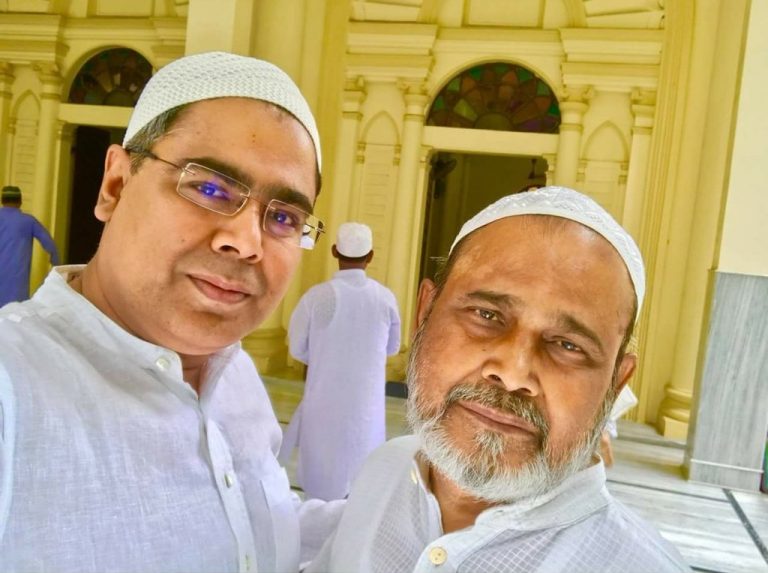
Mir Afsar Ali is an Anchor, Radio Jockey and comedian, who is well known for hosting the Bengali stand-up comedy show Mirakkel. He is active on social media too, and on the day of Eid, he decided to post a photo with his father, with a caption that read “My father… My Allah…” in Bengali:
The photo of the father and son, presumably on a Mosque premises after Eid prayers, received over 1.6 lakh reactions, most of those ‘likes’ and ‘loves’, but it also got him a lot of hate and abuse. Many Facebook users, especially from Bangladesh, took attack him because he had ended up comparing his father with Allah by writing that caption.
Although Mir did not explicitly compare his father with Allah, and it was mere an expression of love and gratitude towards a father, the caption was deemed “blasphemous” by some. It should be noted that in Islam, one is not allowed to compare any living being or even any historical figure with Allah.
Apart from hateful and abusive comments, the one that appeared to receive support involved giving religious sermons to Mir:
For those who can’t read or understand Bengali, the above comments translated in English would mean:
Faisal Ahmed Shishir: Allah is one and unmatched. Don’t compare or equate anyone with Allah. Repent it. Allah is definitely forgiving
Masud Hossain Mridha: Mir Bhai I am writing to you from Bangladesh. You belong to a Muslim family and are highly educated but its sad that in this post you compared Allah with you father. I hope that after sense dawns upon you, you would realise your mistake and will repent your actions.
Tousif Haque: After reading the comment of this F****** donkey my Eid got ruined.
Riyadh Ahosan: Mir Bhai what are you trying to say by writing “Amar Abba, Amar Allah”. And there’s no doubt about the fact that you have written a wrong statement. A Muslim can never say something like this. I hope you will realise your mistake.
Nahid Khan: Your father cannot be your Allah. Allah is the only one. He cannot be compared with anyone else.
However, Mir could get some support from other users who protested this “trolling”. Some celebrities from Bengal too, like singer Abul Bashar, too supported Mir.
This is not the first time when Mir has been targeted for his ‘weak understanding of Islam’. Last December, he had to face a similar saga because he had publicly celebrated Christmas, which was not appreciated by a similar bunch of his followers who commented as to why he did so being a Muslim.
This is also not the first time when a Muslim public figure has faced a backlash from extremist elements online for engaging in acts which according to them were against Islam.
As recently as last week, prominent Kashmiri woman leader Dr. Hina Bhat had to deal with downright obscene and sexist comments on Facebook for practicing yoga, which was termed against Islam by some. Cricketer Mohammad Kaif too was attacked on Twitter last year for posting a pic of himself doing yoga.
Earlier, cricketer Mohd Shami and his wife were at the receiving end of abuse from religious fanatics who also reminded them of the morality they needed to follow as Muslims, just because Shami had uploaded a photo of him and his wife who was wearing a sleeveless gown. An actress named Fatima Shaikh too had to face hateful comments for posting a picture in bikini in the holy month of Ramzan.
Syed Salahuddin, the supreme commander terror outfit Hizbul Mujahideen, has been designated a global terrorist by the US State Department. The development came on a day when Prime Minister Narendra Modi met US president Donald Trump at the White House on Monday.
It could be noted that Syed Salahuddin is the key mastermind on the attack on Pathankot air base in Punjab in 2016. India has been insisting at the United Nations Security Council (UNSC) to declare Salahuddin as a global terrorist.
Salahuddin has posed a significant risk of committing acts of terrorism, the US State Department said in a notification.
“Salahuddin vowed to block any peaceful resolution to the Kashmir conflict, threatened to train more Kashmiri suicide bombers, and vowed to turn the Kashmir Valley into a graveyard for Indian forces,” the US State Department said in a statement.
As a consequence of US State Department’s decision, all properties of Salahuddin subject to America’s jurisdiction and interests in those properties are now blocked.
Born in 1946, Salahuddin is a graduate from the SP College in Srinagar and a Post Graduate in Political Science from the Kashmir University in 1971. He had contested Jammu and Kashmir Assembly elections in 1987 from Amirakadal constituency on a Muslim United Front ticket but lost.
Originally named as Syed Mohammed Yusuf Shah, Salahuddin adopted his nom de guerre after the 12th-century sultan of Egypt and Syria when he took over as the chief of the Hizbul Mujahideen in 1991. His poisonous Islamic sermons have attracted several Muslim youths in Kashmir to join terrorism. As the chief of Hizbul Mujahideen, Salahuddin is responsible for masterminding several attacks in the Kashmir Valley targeting both the civilians and the security forces.
A prominent figure of Jihadi landscape, 71-year-old Salahuddin is also the head of United Jihad Council, an umbrella organisation of terror outfits – Lashkar-e-Taiba and Jaish-e-Mohammed. Salahuddin is considered be close to LeT chief Hafiz Muhammad Saeed, the mastermind of the 26/11 attacks.
Salahuddin in a video message has called for a week-long agitation to mark the first death anniversary of slain Hizbul Mujahideen commander Burhan Wani.
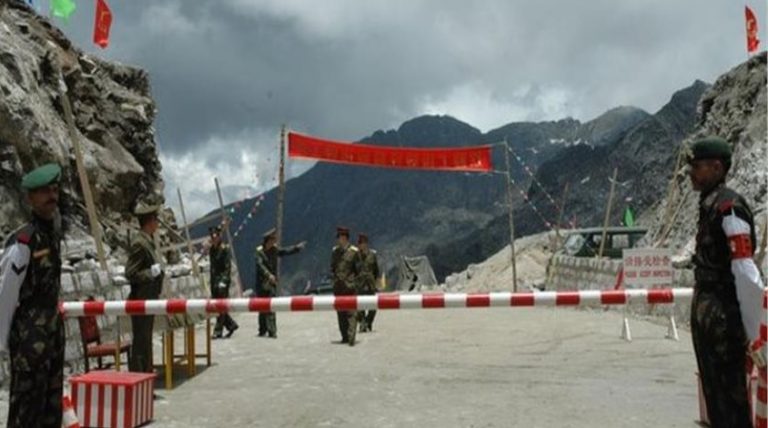
Some media reports had claimed that Chinese troops entered India in Sikkim and even destroyed two bunkers in the area around Sikkim-Bhutan-Tibet tri-junction. However, latest reports indicate that the standoff between Indian and Chinese troops might not have seen such level of aggression from the Chinese.
On the contrary, China has accused Indian troops of “provocation” and alleged that Indian Army had “entered into Chinese territory” by “crossing” Line of Actual Control (LAC) and is preventing its “road construction activity”.
“The Indian border guards crossed the boundary in the Sikkim section of the China-India border and entered the territory of China, and obstructed normal activities of Chinese frontier forces in the Donglang area recently, and the Chinese side has taken counter-measures,” Chinese Foreign Ministry spokesman Geng Shuang claimed in a statement last night.
“China urges India to immediately withdraw its border guards that have crossed the boundary and have a thorough investigation of this matter,” Shuang said.
Chinese Defence Ministry accused the Indian troops of objecting to building a road in Donglang area, which it claims as its territory.
“Indian troops crossed the border with China in an attempt to prevent a road construction by the Chinese side,” Chinese Defence Ministry said in a statement.
Defence expert Nitin Gokhale too confirmed on Twitter that the standoff was about the road construction and no Indian bunkers were destroyed.
No Indian bunkers destroyed as is being reported; in fact last night’s PLA statement speaks about India having prevented road construction
So far, there is no official comment from the Indian Army or Defence Ministry on the incident.
Tensions have been brewing between Indian Army and China’s People’s Liberation Army for quite some time, thanks to the persistent provocation by Chinese side on the Indian territory of Arunachal. A flag meeting was also held between senior Army officers of both the sides on 20 June, but the tensions still continue.
Recently China shut down the Nathu La pass entry for Indian pilgrims travelling to Kailash Mansarovar following the border standoff. This should be seen as a part of the pressure tactics by China.
The terror group Al Qaida is reported to have released a document titled Code of conduct for Mujahideen in the subcontinent, in which it details its objectives and targets and also lays out general guidelines for its members to follow.
This document reportedly seeks to wage war against all the security personnel serving in both conflict and peacetime areas for their battle against the implementation of Sharia.
The document also reportedly makes officers a priority target and places emphasis on targeting those who have the ‘blood of Kashmiri brothers on their hands’ (sic).
The document interestingly mentions a certain Maulana Asim Umar, a resident of Uttar Pradesh, to be the chief of Al Qaida in the Indian Subcontinent (AQIS). Umar hailing from Sambal in Uttar Pradesh had studied at the Darul Uloom Deoband and then is believed to have moved to Pakistan in the late 1990s.
This document comes after Zakir Musa a former Hizbul Commander floated his own terror outfit and also announced his support for Al Qaida.
In the past too Al Qaida has issued similar directives to its operatives for waging war against India. In 2016, it had asked Indian Muslims to rise up and carry out lone wolf attacks like the ones that were being carried out in Europe.
Also recently, various terror outfits have openly declared the sectarianism in Kashmir to be a direct fight for the implementation of Sharia and the Islamic state.
We had recently reported how a Hizbul Mujahideen terrorists had called Hurryat leaders, “hypocrites”, “infidels”, “followers of evil” and even threatened to chop off their heads “if they created hurdles in the path of making Kashmir an Islamic state”. He was reportedly furious at the Hurryat people as they were portraying Kashmir as a “political struggle” instead of a “religious war for the creation of Islamic state”.
Even the ISIS has recently released a document which detailed its intention to turn Kashmir into a Caliphate based on Sharia Law.
In some shocking news coming out of Meerut in Uttar Pradesh, a large mob on Monday decided to attack a local police station after the Eid prayers. According to reports, the mob took advantage over the fact that there was low police presence at the Parakshitgarh police due to their deployment around the city during the festival.
Initially the large crowd assembled in front of the police station and started sloganeering. They later took it up a notch and started pelting stones. This really blew up soon as some elements in the crowd started to fire bullets and even tried to burn down the police station. The police somehow managed to take control of the situation and chased away the crowd. This has reportedly resulted in injuries to a dozen people including policemen. A few policemen were also reportedly beaten up by the mob and their uniform too was torn.
The whole issue reportedly began when a certain Amitabh Abbasi was murdered a couple of days back and his body was thrown into a jungle near his village. Amitabh reportedly went missing on Saturday evening and his body was found by villagers later. Amitabh was a resident of Dak Pir Khajuri Street in Parakshitgarh. His relatives then lodged a complaint against Wasim and Nadeem, accusing them of the murder. Wasim was then arrested by the police.
The aides of the accused though weren’t happy about it and after offering the Eid namaz, reached the police station to demand that they be freed. During the whole exchange the mob went berserk and started vandalising the furniture present in the police station and the issue kept escalating and culminated in an arson attempt. The police now seems to have taken 6 people into custody and is tracking down the rest. The police has also deployed a large force in the area to control the situation.
Crowd at the police station: Via Patrika
The efforts of Waseem’s aides to get him off the hook in the murder case may be futile as he already seems to have confessed to have committed the crime during questioning. According to the report, Waseem and Amitabh were in a same-sex relationship and Wasim was pressurising Amitabh to leave his family. Amitabh didn’t agree to it and an enraged Waseem proceeded to murder him. A local media report though claims a conflicting motive of the crowd. It claims that it was actually the deceased’s aides who reached the police station to demand the arrest of a certain Naresh, who they claimed had hatched the whole conspiracy.
But what all reports agree that the very violent crowd started vandalism, threw stones, fired shots and even tried to burn down the police station.
What is more worrying is the fact that a few religious leaders in the city have also been making inflammatory statements that might further spur such crowds to take law into their own hands. According to a report, the Qazi of Meerut in a meeting after spotting the Eid moon, stated that people shouldn’t be afraid of either Modi or Yogi but should only be afraid of Allah. He also claimed that atrocities were being heaped on Muslims and if they continued, the government would cease to exist.
Mohammed Ayub Pandith, a Deputy Superintendent of Police (DSP) posted in the Security Wing of the Jammu & Kashmir Police, was lynched by a mob outside Jamia Masjid in Srinagar on 23 June. The officer was checking the access control outside the Jamia Masjid.
On 16 June, six policemen – including Station House Officer (SHO) Feroz Ahmad Dar – were killed by terrorists while the police party was travelling in a jeep on Anantnag-Achabal road. On 9 May, Lt Ummer Fayaz, a young officer of the Indian Army, was abducted from his relative’s house in South Kashmir’s Shopian district. Hours later his bullet riddled body was found in Harmain area in Shopian.
Those in the know of how militancy raised its head in Kashmir can recall that the first major terror attack in Srinagar took place on 18 September, 1988 when DIG AM Watali was gunned down by terrorists. Few months later, a SHO was killed by militants. Later Lassi Koul, the then station director of public broadcaster Doordarshan in Kashmir, was killed by terrorists.
Mohammed Shaban Vakil, Editor of the Urdu daily Al-Safa, was brutally lynched for his fearless writings against terrorists. Sarla Ganju, a lady teacher, was brutally raped and cut into two in a saw mill. These killings were followed by desecration of many Hindu temples and forcing out Kashmiri Pandits of the Valley. Perhaps now, with the brutal killing of DSP Mohammed Ayub Pandith, militancy in Kashmir has come full circle.
This is not to dispute that the terrorists operating in Kashmir are aligned to the Islamic Republic of Pakistan. Further, they work in tandem with Kashmiri separatists and the stone pelters. They all are stake holders in the violence in Kashmir. They want to bleed the beautiful Kashmir Valley through thousand cuts.
There are also other stake holders in the violence in Kashmiri that the mainstream media does not pronounce. In the last one decade, Wahabism has taken its routes in the Kashmir Valley. Wahhabism is a steadfastly fundamentalist interpretation of Islam founded by Muhammad ibn Abd al-Wahhab. Reports suggest that the number of mosques controlled by Wahabis has increased up to 2,000.
Struggle for Kashmir was always Islamic, but now it has taken shades of international Wahhabism, where groups like ISIS selling dreams of an Islamic caliphate become inspiration. No wonder we have seen ISIS flags in Kashmir too.
So far terrorism in the Valley has been largely confined to South Kashmir, only with around 100 terrorists operating in the area. Now, terrorism in Kashmir is taking a strategic shift. The terrorists are turning their attention to Srinagar, the summer capital of Jammu & Kashmir. The city has relatively-quieter from other parts of the Kashmir Valley in the last three decades.
According to reports, a district-wise mapping of terrorists, prepared by the Jammu & Kashmir Police, has revealed that now Srinagar district is home to more than two dozen terrorists. Intelligence inputs suggest that at least five “resident terrorist” who were previously operating out of South Kashmir have shifted their base to Srinagar.
“This is clearly an attempt to put Srinagar at par with other areas of Kashmir, which have seen a spike in militant activities,” a senior police official was quoted as saying.
“There are constant inputs about presence of militants in Srinagar,” said a security official.
Last Saturday, terrorists in Police uniform fired a volley of bullets at a CRPF patrol vehicle near the Delhi Public School (DPS) – on the outskirts of Srinagar –killing a CRPF officer. The terrorists later took refuse in the DPS. Two terrorists were killed during a 17-hour-long encounter.
Two incidents in quick succession – the brutal killing of DSP Mohammed Ayub Pandith outside Jamia Masjid and attack on CRPF patrol vehicle – in the heart of Srinagar certainly indicate worrying signals. The situation needs to tackled with an iron fist before it is too late.
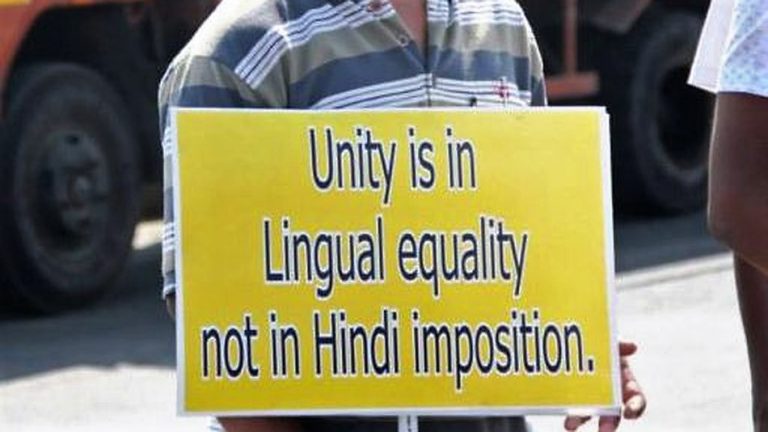
There has been much hullabaloo about the “imposition” of Hindi in non-Hindi speaking states, latest being presence of Hindi on Bengaluru Metro signboards and earlier about prolific release of government ads in Hindi in non-Hindi newspapers. There have been other objections too to steps that are mostly the outcome of implementation of recommendations of the Committee of Parliament on Official Languages by respective Ministries, after the consent of the President.
Even though some of the outraged people, especially on the social media, believe that all this is some grand conspiracy by the BJP and the RSS – who are supposed to be Hindi supporting groups – the truth is that these steps were decided when BJP was not in power and RSS was nowhere near to impacting union policies.
In fact – hold your breadth – these recommendations were proposed by a committee that was headed by a Tamil politician!
Recommendations by Committee of Parliament on Official Language signed by its head P. Chidambaram
Let us rewind a little to understand the ‘root cause’ of the problem:
Committee of Parliament on Official Languages:
First, let us look at Committee of Parliament on Official Languages. It was formed in 1976 under Indira Gandhi-led Congress government as a part of the Official Language Rules under section 4 of the Official Language Act 1963. The motive of this committee is to assess the spread of Hindi across India and to make sure that all wings of government are well equipped with Hindi, such that the colonial language English can be replaced by native Hindi. Hindi in Devanagari script was chosen because of its closeness with Sanskrit.
But why was it planned that Hindi should replace English?
When the Constitution was framed, it was decided by the writers of Constitution that Hindi and English can be the Official Languages of India for the first 15 years. And exactly on 28 January 1965, English should be removed from Official Language and Hindi shall continue to be the sole Official Language of India. A 1955 Kher Commission Report submitted to the President reiterated this. The common sentiment was that English was the language of British, and it reminds the people of colonial days and using Hindi can remove that thought.
But anti-Hindi agitations in South drove the then Nehru government to amend Official Language Act of 1963 in 1965, wherein, it was suggested that English can continue to be the Official Language of the states until the State Legislative Assembly passes a resolution to adopt Hindi as sole Official Language. So, the states that do not want Hindi can continue to use English apart from its native tongue.
However, keeping in view of the ideas of Constitution makers, the Act laid the foundation for a Committee to be created ten years after 1965 to make sure that Hindi reaches the nook and corner of India and remains the uniting language replacing English and in tandem with regional language. This active promotion of Hindi is mandated in the Article 351 of the Indian Constitution. Thus was born the Committee of Parliament on Official Language.
The Committee was headed by the Union Home Minister with 20 members of Lok Sabha and 10 members of Rajya Sabha functioning under the Minister, since Department of Official Language comes under the Home Minister. Since the issue was a matter of linguistic tension and taking into account the size of India, it was decided that the Committee would submit eight separate reports detailing the progress made in spreading Hindi to the whole of India and submitting recommendations to Ministries. This report will be sent by President to both the houses and also to all State governments. Based on the feedback from all of them, the President may make changes to the Report.
The first report was submitted in January 1987, and the eighth report was submitted in August 2005. The ninth report was more of a compilation of the past reports and final recommendation to President. The ninth report was prepared by a Committee which was headed by the then Home Minister P. Chidambaram, who is a Tamil obviously, elected from a non-Hindi state.
In total, 117 points were recommended by this Committee headed by Chidambaram for making sure that Hindi gets propagated to nook and corner of India and to replace English as the connecting language. Not only that, Congress MP from Theni of TamilNadu, Aaron Rashid had been a member of Committee. [pdf] These recommendation were forwarded to the President on 2nd June 2011.
Now let us see how the media and activists reacted to these recommendations, which incidentally are causing huge outrage these days.
There were no reports in The Hindu on these recommendations on that day and the next day. These recommendations were later tabled in Lok Sabha on 30th Aug 2011 and in Rajya Sabha on 7th Sep 2011. Again, there were no reports in The Hindu around these dates. The Times of India fared no better. While “sources” are ready to pounce upon even minor rumors in Minister circle nowadays, why wasn’t there any debate on this report back then? Why didn’t the South Indian allies of UPA take up this issues and create a debate on these tabled reports in both the Houses?
The list of recommendations by the Chidambaram-led committee is huge. But, we shall just focus on the parts that have now become outrage-worthy since BJP has come into power in 2014:
Imparting Hindi training to Central Government Employees:
The Committee had separated India into A, B, and C regions. Region ‘A’ comprises of the States of Bihar, Chhattisgarh, Uttarakhand, Jharkhand, Haryana, Himachal Pradesh, Madhya Pradesh, Rajasthan, Uttar Pradesh, Delhi and the Union Territories of Andaman Nicobar Islands; Region ‘B’ comprises of the state of Gujarat, Maharashtra, Punjab and the Union territories of Chandigarh; and Region ‘C’ comprises of the states and the Union Territories other than those included in Regions ‘A’ and ‘B’.
From 2005 to 2010, inspections were done in 2095 Central Government offices in these regions and it was recommended that newly recruited employees working in Central Government office need to be imparted training in Hindi within a year of joining (Point 3).
Point 5 recommends increasing usage of Hindi on Computers in Central government offices. Even in region C, stress was made by the Chidambaram headed committee to make sure that Central government employees do their work in Hindi on Computers. Points 9-11 talks about tracking progress made in Hindi by Central government employees in even non-Hindi speaking states.
Ministries working under Modi in June 2014 extended this recommendation to Social Media and look what happened next.
Same Chidambaram cautions Modi government of dire consequences if it spreads Hindi in non-Hindi speaking states. Much like a book writer bashing his own book.
Karunanidhi who was then part of the Central government and close ally of Chidambaram cries foul. We doubt where he was when these recommendations were done by his allies in the Centre?
The funniest part is that all the committees were set up before 2014 and recommendations were forwarded to Ministries before Modi became PM. But it was branded as Narendra Modi’s push for Hindi by the media, which somehow had failed to report earlier.
If employees can be forced to do paperwork and desktop work in Hindi in UPA rule, it was fine and it becomes outrage-worthy only when it was extended to social media in June 2014?
Town Official Language Implementation Center (TOLIC):
Apart from implementation at Ministry level, recommendations in the Congress-headed report calls for spreading Hindi at town levels by enhancing the activities of Town Official Language Implementation Center, which was formed in 1976 in towns that have more than 10 Central Government offices. As of now, there had been TOLICs in 72 towns in South India and 10 TOLICs in Tamil Nadu and had been functioning for a long time before BJP came to power in Delhi.
Why was it not shut down? When milestones in Hindi were tarnished by Tamil activists, why did they not lobby to close TOLICs in Chennai or Cuddalore or Madurai? Did they implicitly allow spread of Hindi in their backyard till 2014? Or did “Tamilness” increase only after 2014?
Hindi on the Internet:
Point 28 of the UPA-led Committee’s Recommendation to President stressed that contents provided to National Information Centre for any website needs to in Hindi along with English or else it will be rejected.
We have not seen outrage on this yet, so after this article is published, I hope that propaganda blogs like Scroll and Wire should outrage why government websites are forced to be in Hindi too and not in any other Indian language.
Hindi in Education:
Point 33 of the Recommendations tabled by Chidambaram headed committee talks about compulsory Hindi in all CBSE and Kendriya Vidyalaya schools up to 10th even in non-Hindi speaking areas.
While reporting this, Huffington Post softly removes phrases like ‘committee formed in 2011’ or any reference that gives away that it was done in the UPA time. The report says that President gave his approval for recommendations submitted, but it was not mentioned recommendations by whom and when?
Apart from this, options for Hindi in papers and to start Hindi departments in universities in non-Hindi speaking states were also recommended. Outrage for this is pending. I hope someone from Huffington Post is reading this. Go, write.
Point 47 had asked for compulsory Hindi education across India. Thankfully, this recommendation is modified by President to include this only in A regions.
Hindi in Advertisements:
Points 48-51 calls for more Hindi and less English in advertisements issued by the Central Government in print and media alongside English in non-Hindi speaking states. Supporters of Modi government have often blamed babus (bureaucrats) for failing to understand local sentiments and issue Hindi ads. But babus too were just following rules, which were not outraged upon in 2011.
Hindi in books and booklets:
Point 52 calls for minimum 50% allocation of library budget for buying Hindi books in Central government offices. Expecting an outrage on this soon…
Point 57-58 calls for magazines and time tables published by Air India to be in Hindi and English. Outrage pending! I have given ideas for 4 articles already!
Hindi in Railways:
Point 65 of the recommendations tabled by Committee headed by a Tamil minister called for compulsory announcement of train arrivals and departures in Hindi alongside English and regional languages in stations situated in ‘C’ regions, like Karnataka, Tamil Nadu, Kerala.
We could see linguist warriors noticing this and going hyper over this on Twitter only in past one year. Why could a DMK ally and Tamil Minister not cut down this recommendation and urge for only regional and English announcement in stations in South India? No support for Tamil even from Tamil ministers?
Point 69 calls for only Hindi and English printings in train tickets, while silently avoiding regional language. Remember how images of railway tickets from South India recently went viral on Internet?
Point 70 calls for Hindi and English in all posters within and outside trains. Why could strong members of South India in UPA not lobby the then Home ministry in 2010 and urge for regional languages in tickets and posters in trains?
Hindi in Foreign Affairs:
Recommendation No.72 urges MEA to make sure that Hindi is added as the 7th language in United Nations. High voltage outrage assured when current Ministry takes this up.
Now comes our hero no. 73, which calls for the passport to be printed in Hindi. This is the latest outrage when I began writing this article. But this is not all.
Points 75-79 calls for maximum Hindi usage in offices of External Affairs located overseas.
Point 80 calls for maximum Hindi in Air India tickets and Pawan Hans helicopters. When is the outrage coming on this? Ideas for 2 more articles are here, grab it media!
Hindi in Films:
Point 94 and 95 calls for compulsory Hindi dubbing and subtitling of all films produced by NFDC and shown at film festivals. Bollywood and liberalism. Someone tell this to Anurag Kashyap, and of course, to the new ‘liberal’ websites. 7 article ideas by now.
If you had reserved your outrage till here, now is the time to unfurl your anger and make a scathing attack on BJP, because two BJP MPs in this Committee had made the following recommendations, which were happily accepted by the Congress regime and forwarded to the President.
The role of BJP in Hindi Imposition:
In Point 105 provided by BJP MP Shrigopal Vyas, it has been recommended that President and Ministers who can read and speak Hindi should be allowed to talk in Hindi in Parliament. But, he makes a U-Turn from alleged RSS agenda of Hindi imposition and in point 107 calls for de-recognition of schools that run as English medium instead of Hindi or regional language as the medium. How dare an alleged British agent RSS call for the removal of English and promotion of regional languages as school mediums? Again, in a huge blow to BJP, President has not accepted these recommendations.
In Point 113 provided by BJP MP Hukumdev Narayan Yadav, it has been suggested to undertake airplane announcement in Hindi followed by English. Recommendation was forwarded to the aviation ministry. Why did non-Hindi members of the committee not object?
Point 115 by same BJP MP calls for usage of Hindi alongside English in nameplates and name boards of all public places. This was approved by President and was suggested to be implemented.
Regional parties in limbo?
Even if the President has rejected some of these recommendations now, what were the suggestions provided by State Governments of non-Hindi speaking states to the Committee? Were they sleeping back then?
What were linguistic activists doing in 2011 when these recommendations were tabled? What were allies of UPA from South India doing when these recommendations were tabled? Does this mean that the South Indian regional parties were not having a voice in the UPA government? Or, were they controlled by UPA? Was DMK controlled by UPA similar to how they complain now that ADMK is now being controlled by the BJP?
Pluralism? Mosaic?
UPA and its prime head Congress, which boasts of pluralism, mosaic culture and languages of India, had sat for seven reports in this Commission and tabled the final report with 104 points talking about spreading Hindi into non-Hindi speaking states. How can this be upholding unity in diversity? If their excuse is that the Indian constitution mandates it, why attack Narendra Modi government for following the constitution?
If Modi and BJP can be blamed for destroying other languages, just because Ministries under them have implemented the recommendations, imagine the magnitude of blame that lies with Congress and its allies that were espousing anti-Hindi agitations in South India while tabling reports after reports suggesting Hindi in every sphere of public government in non-Hindi speaking states.
How is it that the pluralism and Idea of India champions like Congress, DMK, CPI(M) et al. recommend for replacing English by Hindi and also come out as anti-Hindi warriors at the same time?
One thing is for sure, they are a library to learn politics from.