Home Blog Page 833

Himachal Pradesh: Congress minister raises the issue of illegal construction in Shimla mosque, says love jihad is serious issue, faces backlash from party MLAs

The controversy around the construction of a mosque in Sanjauli, the capital of Himachal Pradesh, is growing intense every day. On 4th September, the Himachal Pradesh Assembly also witnessed a heated argument as members engaged in a verbal sparring session regarding the building of the mosque. The Shimla Municipal Corporation (MC Shimla) has also come under fire in this case for implementing the construction codes selectively. The matter has led to a dispute amongst leaders of the ruling Congress and heightened communal tension in the state’s capital.

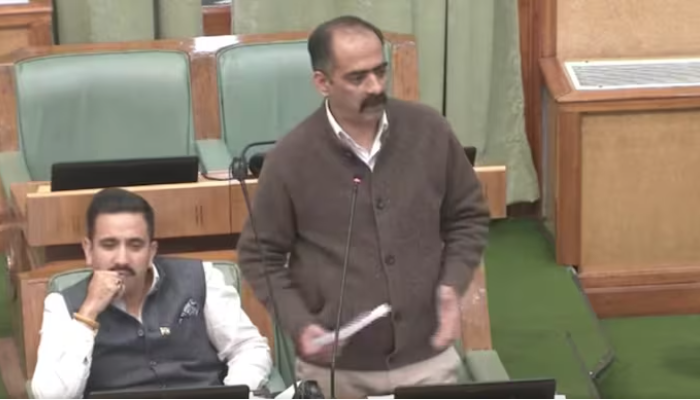
Congress MLA Harish Janartha moved the motion and claimed that there was no tension in the area. He alleged that the mosque was built before 1960 and in 2010 three stories were erected unlawfully on land owned by the Waqf Board. He added that illegally built restrooms were dismantled and that not only outsiders but local Muslims were also staying in the mosque. He alleged that some elements were stirring the situation.

Rural Development and Panchayati Raj Minister in Chief Minister Sukhvinder Singh Sukhu’s cabinet, Anirudh Singh, however, refuted the claims that the mosque was constructed in the 1950s and questioned if permission was taken from the administration to build the mosque. “I am not against any community but they started work in 2010 without permission. Afterwards, unauthorised construction of 2500 square feet was completed. A hearing was again held on the matter in 2012, however, these people didn’t comply. There were four more illegally built floors by 2019. How was the four-story building constructed by 2019 when the lawsuit was still pending in 2010? Where was the administration sleeping,” he asked in the house.

He accused that these works went on unnoticed for almost ten years, right in front of MC Shimla. He added that 6357 square feet of illegal construction has been carried out till now. The minister highlighted, “There’s another surprising detail, the government of Himachal Pradesh owns the land (where the mosque is built). Our administration does not oppose anyone. However, I would ask the chief minister to ascertain the origins of every person involved in this. Women now find it challenging to go around the Sanjauli market. Objectionalibale comments are passed. I have personally witnessed it.” He further stressed, “They have a habit of engaging in illegal activities. They built a 5-storey mosque. This entire matter should be investigated.”

Anirudh Singh asserted that there are 1900 Muslim Tehbazari and the authorization to practice Tehbazari (license to hawk) should only be granted to citizens of Himachal Pradesh. He urged that the permission allotted to outsiders should be revoked. He reported to know a few Bangladeshi nationals and sought confirmation of their identity. In response to the motion, Urban Development Minister Vikramaditya Singh stated that action would be executed as soon as the case was resolved.

“The hearing (in the mosque case) is on 7th September. I want to inform the administration that fourteen years have passed. There have been 44 hearings thus far. They do not even know whose land it is. How can a map be approved on government land? If it belongs to the occupier, then first of all the map should be cancelled. Action should be taken against illegal construction,” he voiced.

The matter has been pending in the Municipal Corporation Commissioner’s court since 2010. He urged both sides to act in tolerance and preserve peace within the community. Communal harmony has been negatively impacted by the tension surrounding the mosque. “We must proceed with caution on this issue. We respect everyone’s sentiments and will act with justice. The government will take action per the law. Our state is Devbhoomi (Land of the Gods). Politics should not be played in the name of religion. Let the law take its course,” Vikramaditya Singh conveyed. 44 hearings have been held about the illegal building, but no decision has been made as of yet.

“I don’t have much information. If someone has done illegal construction, then strict action will be taken,” claimed Jagat Singh Negi Horticulture, Revenue and Tribal Minister of the state who seemed to steer clear of the dispute

The debate was started by Balbir Verma of the Bharatiya Janata Party (BJP), who urged that the mosque’s four illegal floors be dismantled and all operations beneath it cease to protect the sentiments of the local community’s Muslims. He explained that the people of Sanjauli had protested against the unauthorized development inside the mosque. On 1st September, a sizable Hindu crowd gathered in Sanjauli to demonstrate against the construction and demand that the unapproved edifice be demolished.

Anirudh Singh also expressed concern over love jihad and noted that robberies in the Sanjauli market area were on the rise. “It has become difficult for women to walk in the Sanjauli market, and thefts are occurring. Love Jihad is another serious issue that needs attention and is dangerous for our country and state. Fights are taking place. Did our local people start the violence? This too has to be probed. I request that the chief minister verify everyone who comes to Himachal Pradesh for employment.”

What triggered the matter

On the night of 30th August, 37-year-old businessman Vikram Singh was seriously injured in an altercation that took place in the Malyana region by half a dozen people belonging to the minority community who attacked him with rods and sticks and also injured four other traders. The perpetrators, including two minors, were swiftly taken into custody by the police, who are currently looking into the situation. The accused sought sanctuary within the mosque to elude the police, which sparked protests outside the building and further fueled the charges that the mosque was illegal. The mosque’s demolition has been advocated by several locals and Hindu organizations.

Sanjeev Kumar Gandhi, the superintendent of police in Shimla, implored the demonstrators to keep the peace and stated that the case involving the attack on the businessman would fall under the category of attempted murder. He mentioned that an officer of Deputy Superintendent of Police (DSP) rank had taken over the case’s investigation and that immigrants from other states would required to be registered.

Almost five hundred individuals from various areas of the city took part in the protest, voicing their worries about the growing number of migrants from the minority group in Shimla. They also called for the police to verify and register these “outsiders.” Senior district administration representatives arrived at the scene to calm the protestors. The officials acknowledged that a part of the structure built on Waqf Board’s land was “illegal.”

A conflict has also emerged between MLA Harish Janartha, who is advocating for the mosque and Anirudh Singh who stands by the protests. The comments made by the minister prompted a heated debate in the assembly and garnered support from BJP Lawmakers as it also threw light on the corporation’s negligence in enforcing construction laws.
‘We kept begging to see the body of our daughter, everyone was moving around crime scene freely’: Parents of RG Kar victim say they were forced to cremate in a hurry

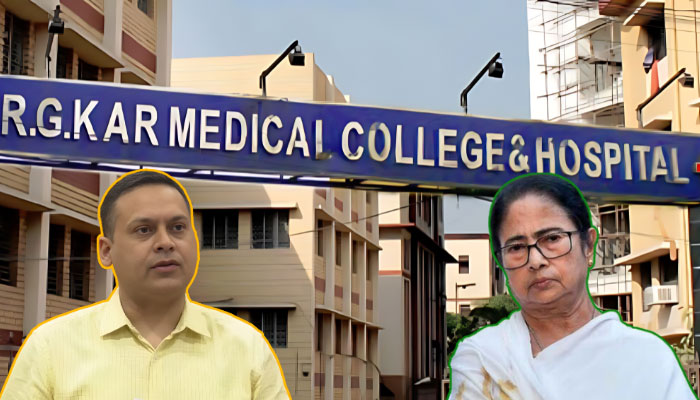
On 5th September, Bharatiya Janata Party’s IT Cell Chief Amit Malviya called for the immediate resignation of West Bengal Chief Minister Mamata Banerjee and Kolkata Police Commissioner Vineet Goyal, alleging gross mishandling of the rape and murder case at RG Kar Medical College and Hospital. In a post on social media platform X (formerly Twitter), he accused the West Bengal administration of forcing the family to cremate the victim’s body without their consent and failing to conduct a transparent investigation.

Notably, the matter has been transferred to the Central Bureau of Investigation (CBI).

Malviya shared two videos of the victim’s family, where they expressed their grievances, highlighting several issues with the police and hospital authorities. According to the victim’s father, the police coerced the family into cremating the body against their wishes, and they were made to wait for hours outside the crime scene while others moved in and out freely. He stated, “My wife kept begging to the authorities to let her in, she wanted to see her daughter, but she was not allowed to go in.”

In his statement, the victim’s father said that despite filing a complaint for an FIR between 6-7 pm, the police delayed registering the FIR until 11:45 pm. This contradicts the claims made by Kapil Sibal, counsel for the West Bengal Government, in the Supreme Court. Sibal had suggested that the victim’s father was responsible for the delay in filing the FIR; however, the father’s statement raises doubts about Sibal’s remarks in the apex court.

The victim’s father further alleged that DC North offered him money to withdraw the case, raising questions about the involvement and motives of higher authorities. The family also reported being unaware of who financed the cremation of their daughter. Malviya pointed out the presence of a TMC MLA and two councillors at the crematorium during the last rites, which he described as suspicious.

The victim’s father also criticised the remorseless attitude of Kolkata police officers while addressing the press, accusing them of lying about the case details. He questioned why the authorities initially declared it a suicide even before examining the body and why the police registered an unnatural death case without proper investigation. He said, “We had to wait for three-and-a-half hours to see our daughter’s face. Her mother fell on their feet to let us see her. Why was autopsy delayed? Why did police file an unnatural death case? I filed the complaint at Tala Police Station around 7 pm. Why then was FIR registered at 11.45?”

Malviya suggested that a fair investigation is impossible unless CM Banerjee and Goyal step down, alleging that much of the evidence has already been tampered with. He demanded that the call records of both the Chief Minister and the police official from the 72 hours following the crime be made public and investigated. He also called for a polygraph test for both Mamata Banerjee and Vineet Goyal to uncover the truth.

Rape and murder of woman doctor at RG Kar Medical College

On 9th August, the woman doctor’s body was found in the seminar hall of RG Kar Medical College in Kolkata, with subsequent examinations confirming that she had been raped. Her body bore 16 external and 9 internal injuries, and there were signs of bleeding from her eyes and private parts, indicating the brutal nature of the assault.

The rape and murder case of the 31-year-old trainee female doctor in Kolkata’s RG Kar Hospital has sparked nationwide protests to seek justice for the deceased victim. Hospital administration, Police, and the West Bengal government led by Mamata Banerjee have been facing massive public ire over the initial handling of the case and the subsequent ‘transfer’ of the controversial Hospital principal, Sandip Ghosh. Both the Calcutta High Court and the Supreme Court made several scathing remarks about the developments in the case, particularly ones revolving around Sandip Ghosh.

Indian para athletes shine at Paris Paralympics, script history: Here’s how PM Modi has been encouraging them

0

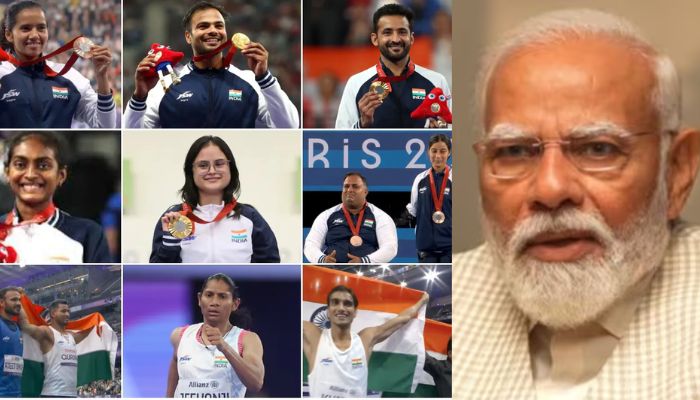
Indian Paralympic athletes are scripting history in the 2024 Paris Paralympics registering India’s best-ever showing in the event surpassing previous records, both in terms of the number of medals won as well as the overall impact. The Indian athletes showed outstanding skill, perseverance, and showcased their indomitable spirit, earning their highest medal total in Paralympic history. On day 8 of the event, Indian archer Harvinder Singh won the country its first gold medal in an archery event at the Paralympics.

“The thing that was in my mind was, ‘I have done it for India’ because at the last Paralympics, I just won bronze. I had to change the colour and perform well, and these are the things that I have done. Then finally, I took a long breath and said, Oh, I finally got the gold,” a triumphant Harvinder Singh said.

In an X post, Prime Minister Narendra Modi congratulated Harvinder on his achievement and said, “A very special Gold in Para Archery! Congratulations to Harvinder Singh for winning the Gold medal in the Men’s Individual Recurve Open at the #Paralympics2024! His precision, focus and unwavering spirit are outstanding. India is very happy with his accomplishment.”

Notably, India, so far, has won 24 medals at the Paris Paralympics 2024 with 5 golds, 9 silvers and 10 bronze. India had won 19 medals at Tokyo 2020 with 5 golds, 8 silvers and 6 bronze.

Lauding the historic achievement of Indian paralympic athletes, PM Modi said: “India is proud and delighted! Our incredible Paralympic contingent has set a record for the highest-ever medals for our country in any Paralympics. This shows the dedication, passion and determination of our athletes. Congrats to each and every player.”

Dharambir and Pranav Soorma: The “Soormas” of the men’s club throw F51 event

With Dharambir winning gold and Pranav Soorma bagging silver in the men’s club throw F51 event, India’s Paralympics medal tally has reached 24 taking the nation to 13th rank among all participant countries.

“When we left India, we promised that we would come back with 25 medals, and these two medals have brought us very close – to 24. So they are the most crucial of the entire campaign. Don’t have words to explain the joy and emotions that are going through me right now,” Dharambir said after winning gold in his event.

Hailing from Haryana, Dharambir had a life-threatening accident while diving into a canal in his village. Misjudging the depth of the water, he hit with the rocks below, paralysing him from the waist down.

Notably, Dharambir’s victory at the Stade de France stadium marked his first big competition gold medal. He ranked ninth in Rio 2016 and eighth in Tokyo 2020, with a bronze medal at the Para World Championships in Japan earlier this year. Last year, in the Asian Para Games, he finished second to Pranav Soorma after losing the gold medal.

Taking to X, PM Modi congratulated Dharambir on his historic win and said: “The exceptional Dharambir creates history as he wins India’s first ever Paralympic Gold in Men’s Club Throw F51 event at the #Paralympics2024! This incredible achievement is because of his unstoppable spirit. India is overjoyed by this feat.”

Silver medalist Pranav Soorma’s life took a devastating turn when he was 16, as a cement sheet fell on his head, resulting in a serious spinal cord injury that rendered him paraplegic. Doctors warned him he would never walk again, and he spent six months in the hospital. While it took much time for Pranav to accept life with a wheelchair, once he did, sports became his passion and now his passion has elevated him as a national hero.

Congratulating Pranav Soorma, PM Modi said on , “Congratulations to Pranav Soorma for winning the Silver medal in the Men’s Club Throw F51 at the #Paralympics2024! His success will motivate countless youngsters. His perseverance and tenacity are admirable. #Cheer4Bharat.”

Mechanical engineer to Paralympics silver medalist, meet the two-time reigning champion Sachin Khilari

On the 4th of September, World champion Sachin Sarjerao Khilari won silver in the men’s shot put F46 event at the Paris 2024 Paralympics. Khilari won the silver medal with an Asian record of 16.32m on his second attempt.

Sachin Khilari, who was born into a farmer’s family in Sangli, Maharashtra, became handicapped with a crippled left hand after falling off a bicycle in school. In addition to being a paraathlete, Sachin is a mechanical engineer who helps students prepare for state (MPSC) and national (UPSC) public service commission exams.

Calling Sachin’s performance a “remarkable display of strength and determination”, PM Modi said that “India is proud of him”.

“Congratulations to Sachin Khilari for his incredible achievement at the #Paralympics2024! In a remarkable display of strength and determination, he has won a Silver medal in the Men’s Shotput F46 event. India is proud of him,” the Prime Minster posted.

Sharad Kumar and Mariyappan Thangavelu stun the world with their “high jump” of success

Adding more medals to the Indian tally on Tuesday, our para athletes Sharad Kumar and Mariyappan Thangavelu won the silver and bronze medals, respectively, in the men’s high jump T63 class at the Paris 2024 Paralympics. Notably, Sharad was infected with polio at the age of two.

Sharad Kumar, 32, soared to a height of 1.88m in the final but lost gold to Ezra Frech of the United States, who cleared 1.94m for a new Paralympic record. This was Sharad Kumar’s second Paralympic medal. He earned the bronze medal in Tokyo 2020 with a height of 1.83 meters.

“That was an amazing competition. All the athletes pushed each other to perform to the best, especially Ezra and myself. This was the toughest competition I have faced in my life. It was the greatest event I have ever attended,” Sharad said after winning silver.

Taking to X, PM Modi conveyed the nation’s greetings to Sharad and said: “Sharad Kumar wins Silver in Men’s High Jump T63 at #Paralympics2024! He is admired for his consistency and excellence. Congrats to him. He inspires the entire nation.”

Meanwhile, Mariyappan Thangavelu who won the bronze medal at the same event, had a bus run over him in a road accident, leaving him permanently disabled in the right leg at the age of five.

“Mariyappan Thangavelu, with a height of 1.85m, won the bronze medal. He also achieved the historic feat of becoming the first Indian para-athlete to win medals at three consecutive Games. He won the gold medal at Rio 2016 with a jump of 1.89m and silver at Tokyo 2020 with a 1.86m attempt,” an Olympics website article reads.

“Congratulations to Mariyappan Thangavelu on winning the Bronze medal in the Men’s High Jump T63 event. It is commendable that he has won medals in three consecutive editions of the Paralympics. His skills, consistency and determination are exceptional,” PM Modi said.

Sumit Antil: The first male Indian para-athlete to defend the title, wins gold

On Monday, Sumit Antil won the gold medal in the men’s javelin throw F64 class at the 2024 Paris Paralympics. The 26-year-old para-athlete became the first Indian male para-athlete to defend his title in the Paralympics. He achieved the feat with a new Paralympic record of 70.59m at the Stade de France breaking his previous record.

Prime Minister Narendra Modi held a telephonic conversation with Paris Paralympics medal winners Sumit Antil and others including Yogesh Kathuniya, Sheetal Devi and Rakesh Kumar. He congratulated them on their victory.

In a first, Avani Lekhara wins two gold medals at Paralympics  

On the 30th of August, defending champion Avani Lekhara won gold in women’s 10m air rifle shooting. With this, Lekhara became the first Indian woman to win two gold medals in the Games’ history. The star para shooter scored 249.7 in the final – creating a new Paralympic record and also shattering the previous record of 249.6, set by her exactly three years ago on her Games debut at Tokyo games.

In a telephonic conversation with Lekhara, Prime Minister Modi congratulated her while Lekhara said that PM Modi’s words of motivation helped her negate the pressure during her event.

“Avani, many congratulations to you. You are constantly performing well and keep working hard,” PM Modi said.

To this, Avani replied, “This is my second Paralympics. I was a bit nervous. But you said that don’t play under the pressure of expectations and I followed it accordingly.”

Notably, PM Modi has congratulated several other athletes over the telephone after their wins. On 1st September, PM Modi held a telephonic conversation with the Indian medal winners in the Paris Paralympics till then. These included Mona Agarwal, Preethi Pal, Manish Narwal, and Rubina Francis. He congratulated each of the winners and said they had made the country proud with their performances.

PM Modi also spoke to Preethi Pal who became the first Indian woman to win two Paralympic medals in track and field events, having bagged a bronze in the women’s 200 T35 class at Paris Paralympics 2024 on Sunday.

Modi government’s efforts to support athletes

As discussed above, PM Modi has personally interacted with Paralympic athletes and congratulated them on their wins. Following significant victories, he regularly publishes on social media to acknowledge their accomplishments and recognise their hard work and commitment to their sport. PM Modi’s appreciation boosts the morale of the athletes and also provides them with wider recognition across the nation.

The Modi government has also launched key support programs and increased funding for Olympics and Paralympic athletes. Under the Modi government, programs like the Target Olympic Podium Scheme (TOPS) have expanded to include Paralympic athletes. These efforts offer financial assistance, international-level coaching, physiotherapists, and dieticians to athletes preparing for worldwide events.

The government has significantly enhanced the training facilities and resources offered to Paralympic athletes. Modi’s administration has also sought to improve access to sports infrastructure for para-athletes, allowing them to train under better conditions.

Back in 2021 at the Tokyo Paralympics, Indian para-athletes scripted history by winning 19 medals in total, a tremendous jump from 4 medals in 2016. Back then, OpIndia reported about the 4 medalists praising the Modi government for ensuring that the sportspersons got whatever support they needed for their participation in the competition. Sharad Kumar, who won a bronze medal in the High Jump T63 event at the Tokyo Games, revealed that even athletes from the USA complimented the efforts the Indian government has made to provide support to para-athletes. He said such recognition and effort that the government has made is much bigger than any medal for the athletes.

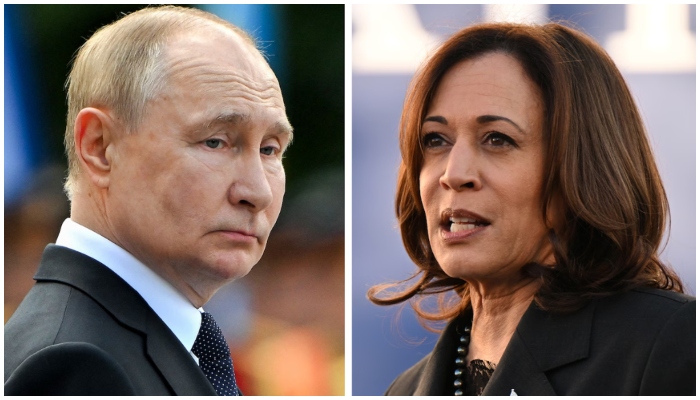
Putin sarcastically backs Kamala Harris in US Elections, cites her ‘Infectious Laughter’ saying she would refrain from further sanctions against Russia

On Thursday, 5th September, Russian President Vladimir Putin said that Russia would support Kamala Harris in the upcoming US presidential elections. Putin said that his country desired to see Democratic party’s presidential candidate Harris win. Notably, the remarks were made in an apparent satirical statement, citing her “infectious” laugh as a reason to favour her over Republican candidate Donald Trump.

This is a day after the US Justice Department indicted two Russian media executives with an alleged criminal conspiracy to influence the November election with pro-Russian propaganda.

The Kremlin leader had stated earlier this year, before President Joe Biden withdrew from the campaign, with obvious sarcasm, that he preferred him over Trump because Biden was a more predictable ‘old school’ politician.

When asked how he saw the election now, Putin while addressing an Eastern Economic Forum in Russia’s far eastern city of Vladivostok, said it was the choice of the American people. However, he went on to say that, as Biden had advised his followers to support Harris, “We will do the same, we will support her.”

The comments drew applause from the audience, while Putin and the moderator smiled.

“She laughs so expressively and infectiously that it means that everything is fine with her,” Putin was quoted as saying. He added also that maybe this meant she would refrain from further sanctions against Russia. Putin added that President Trump had introduced more sanctions against Russia than anyone in the White House before him.

Notably, the Democrats had claimed after the 2016 presidential elections that Russia ran a disinformation campaign to boost Trump’s campaign against Hillary Clinton. However, later the allegations were found to be false.

Meanwhile, as per the reports, US intelligence agencies believe Russia wants Trump to win because he is less devoted to supporting Ukraine in the conflict against Russia. But now Putin has claimed that Trump has imposed more sanctions against Russia than any previous president.

As Congress tries to attack BJP for being ‘soft on terror’ using Netflix propaganda series IC 814, its old sins are still haunting the nation

Amidst the raging controversy over the newly released propaganda series IC 814 for absolving Pakistan and ISI over the Kandahar hijacking, the Congress party has trained its guns on the BJP, alleging it to be ‘soft on terror’ over the release of three terrorists by the then Atal Bihari Vajpayee-led NDA government in 1999. Several Congress leaders spearheaded by the party’s National Spokesperson Supriya Shrinate and its regional units have alleged that while Congress caught dreaded terrorists, the BJP government set them free.

Taking to X, Supriya Shrinate lauded the Netflix mini-series, IC814, claiming that it has shown the truth. According to the Congress leader, the series has rightfully shown the truth that the BJP released the terrorists who were caught by the Congress party. While targeting the BJP, she also shared an old picture of the then IB Chief Ajit Doval which was taken at the time of the IC814 negotiation. 

In her long post, Shrinate alleged, “There is a ruckus on the OTT show of IC814 because the truth is bitter…Congress caught terrorists and BJP released them – this is true. And no matter how difficult it is to digest the truth, but the truth is the truth”.

She further alleged, “The flight stopped for 45 minutes in Punjab – where the BJP’s coalition government was in power – but no action was taken there, after which it reached Kandahar.” 

Additionally, her media bites alleging the same have been widely shared by Congress supporters as well as by party’s local units and seva dal.

Quoting the then RA&W Chief Dulat who admitted that there were some shortcomings after the flight was hijacked, Congress leader Pawan Khera wrote, “A courageous and honest officer came and told the truth. It is true that the country paid the price for the mysterious inaction of the then BJP government.”

While the Congress leader has been targeting the BJP-led NDA government for its so-called soft stance against terrorism, and lauding the Netflix series, IC814, it has been in the eye of the storm for being a PR job for Pakistan’s ISI, absolving the notorious spy agency of its sins, humanising dreaded terrorists and portraying India’s security and political apparatus as meek. 

Netflix’s web series “IC814: The Kandhar Hijack” has stirred controversy as it has been alleged that the makers of the series did not disclose the real names of the terrorists and used pseudo-Hindu names that the terrorists had used. It also brazenly tried to peddle that ISI was not involved at all in this hijacking by Pakistani-terrorists rather it was all Osama Bin Laden’s brainchild alone. Following the controversy, the Ministry of Information & Broadcasting summoned Netflix India’s content head who promised not only to update the disclaimer but also to moderate content in the future.

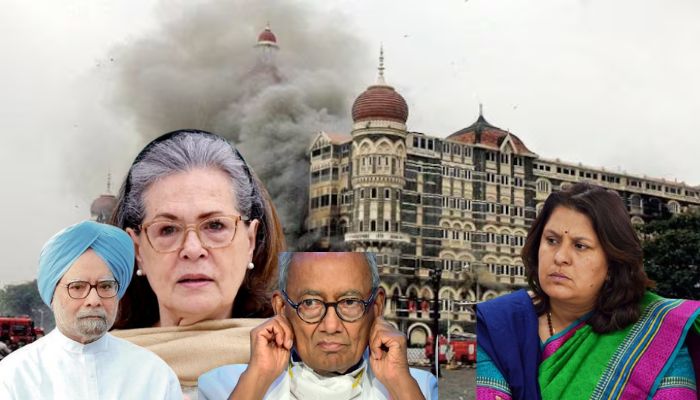
While the Congress party is targeting the BJP over the release of three dreaded terrorists when guns were virtually lurking over the heads of 176 innocent Indian civilians in the aftermath of a flight hijacking, it has seemingly forgotten its inglorious past. Ironically, when it not only followed soft policy on Pakistan-sponsored terror industry, and let go dastardly terror attacks like 2008 Mumbai attack unpunished, it had also freed dreaded terrorists in peacetime as “goodwill gesture”. The Congress also didn’t adapt a strict stand on Jihadi groups like PFI in time, allowing them to spread tentacles throughout the country.

Ironically, in its efforts to corner the BJP government for releasing 3 terrorists to secure the lives of 176 Indians, the Congress party has conveniently overlooked that the UPA government released terrorists in 2010 as a “goodwill gesture” to mollycoddle Pakistan. Terrorists who were incidentally on the “wish list” of Jaish-e-Mohammad and were not released by the Atal Bihari Vajpayee government even in the grave scare of hijack. 

Here are glaring instances when the Congress party faced public ire for its meek policy against terrorism and going “soft on terror and terrorists” —-

  1. “Goodwill gesture”: In 2010, UPA freed 25 terrorists including JeM terrorist Shahid Latif who was on the ‘wish list’ of IC814 hijackers and was later responsible for the Pathankot attack

According to 2016 media reports, one of the UPA government’s goodwill gestures boomeranged and cost dearly for the country as the terrorist it freed in 2010 went on to inflict terror on India. As per the TOI report, on 28th May 2010, the UPA government freed 25 terrorists belonging to Lashkar-e-Taiba, Hizb-ul-Mujahideen, and JeM as part of its special outreach to our hostile neighbor, Pakistan. 

Jaish-e-Muhammed (JeM) terrorist Shahid Latif, who was languishing in an Indian jail for 11 years for acts of terrorism, was one of those terrorists. Interestingly, the IC814 hijackers had also sought his release. His name was also on the list of 35-odd terrorists whom the hijackers wanted to be released in exchange for passengers of the hijacked flight. 

His release cost dearly as JeM terrorist Shahid Latif went on to become the chief handler of the fidayeen squad that attacked the Pathankot airbase in January 2016. He also acted as the main handler of JeM terrorists in India. 

Incidentally, in October 2023, the Pathankot attack mastermind Shahid Latif was neutralised by unknown gunmen outside a mosque in Pakistan. While foreign media outlets have alleged that the Modi government has let loose its Intelligence agents to kill anti-India elements and terrorists on foreign soil, there is no official confirmation for this assertion. However, it had resulted in a reduction in terror attacks on India. 

  1. Dropping serious cases against members of Jihadi outfits and not nipping PFI-like Jihadi organisation in the bud

In 2013, the Congress government dropped criminal cases against several members of the SDPI and Popular Front of India (PFI). It was later banned under UAPA for anti-India and terror activities by the NDA govrernment. They were accused of being involved in creating communal disturbances in the state. These cases were related to protests and communal flare-ups in Shivamogga (114 cases from 2015), Mysuru (40 cases from 2009), Hassan (21 cases from 2010), and Karwar (1 case in 2017).

According to R Ashoka, who was Revenue Minister during BJP’s government in the state, the Congress government withdrew 175 cases against 1,600 PFI and Karnataka Forum of Dignity (KFD) members in 2015, despite a dissent note by the law department and police. It is said that this ultimately helped the Jihadi outfit to spread its tentacles throughout the country from its erstwhile stronghold, Congress-ruled Karnataka. 

  1. Terror attacks went unpunished and terrorists carried out recee in the guise of cricket fans 

It has been widely reported how Sajid Mir who conspired to execute the dastardly Mumbai 26/11 attacks had carried out recee in India in the guise of a Pakistani cricket fan. Alarmingly, he clandestinely travelled across India for 15 days. According to Indian investigators, Mir was part of an operation: spying, terrorist scouting, or both involving a dozen Pakistani “cricket fans” who went missing after crossing the border. After turning to his Pakistani-American agent David Headley, they masterminded the Mumbai terrorist attack.

Again, coincidentally, it was reported in December 2023 that some unknown person had poisoned Sajid Mir in Pakistan jail after which he went on ventilator support. Several such incidents of anti-India terrorists dying under mysterious circumstances have occurred in the last few years under the Modi government. 

Not only Congress regimes faced a spate of terror attacks, but also the government under MMS, was shockingly pusillanimous in retaliating against the 26/11 terror attack in which hundreds of civilians and India’s financial centre were held hostage by 10 Pakistani terrorists for over 4 days killing 166 and injuring over 300.

Former IAF chief BS Dhanoa had categorically pointed out that the Congress-led UPA government had rejected a proposal of the air force to strike Pakistani terrorist camps after 26/11. 

  1. Vicious campaign against anti-terror laws and operations 

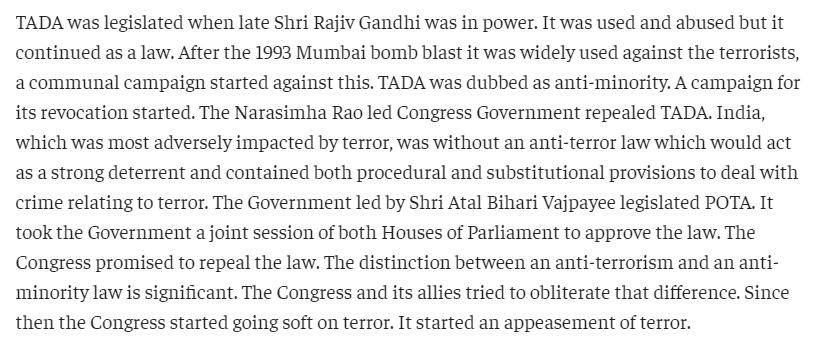
Further, in a comprehensive article titled ‘Congress & its friends have weakened the battle against extremism & terror’ BJP stalwart late Arun Jaitley wrote in 2019 how stringent anti-terror laws like TADA and POTA were diluted or annulled as the battle against terrorism and insurgency got blurred because of vote bank consideration. 

(Excerpt from Arjun Jaitley’s The Print article on how Congress & its friends have weakened the battle against extremism & terror)

In the article, he categorically noted that Congress governments had launched vicious campaigns against TADA and POTA as it was not only going “soft on terror” but also was following “appeasement of terror”. 

Similarly, several Congress leaders have created hindrances in the fight against terrorism by either floating the boogie of Hindu/saffron terror or painting anti-terror operations with communal colour, providing a moral shield to the Overground workers (OGWs), sleeper cells, and underground terrorists. Infamously, the Congress party leader and Former Union Law and Foreign Affairs Minister Salman Khurshid once stated that Sonia Gandhi was weeping in her office when the Batla House operation was carried out. 

Kanhaiya Lal beheading by Islamists: Rajasthan High Court grants bail to Mohammed Javed who informed the killers about his whereabouts

On Thursday, September 5, Rajasthan High Court granted bail to Mohammed Javed in the Kanhaiya Lal murder case. Kanhaiya Lal was slaughtered by 2 rabid Islamists in Udaipur just because he posted a social media message in support of Nupur Sharma, former BJP spokesperson.

The division bench of Justice Pankaj Bhandari and Justice Praveen Bhatnagar approved the bail on a bond of Rs 2 lakh and an additional surety of Rs 1 lakh.

The National Investigation Agency (NIA) had arrested Mohammed Javed from Udaipur, Rajasthan, on July 22, 2022, 20 days after the brutal beheading of Kanhaiya Lal.

Javed reportedly played a role in the conspiracy, informing one of the killers Riyaz Attari about Kanhaiya Lal’s presence at his shop prior to the beheading.

Kanhaiya Lal murder

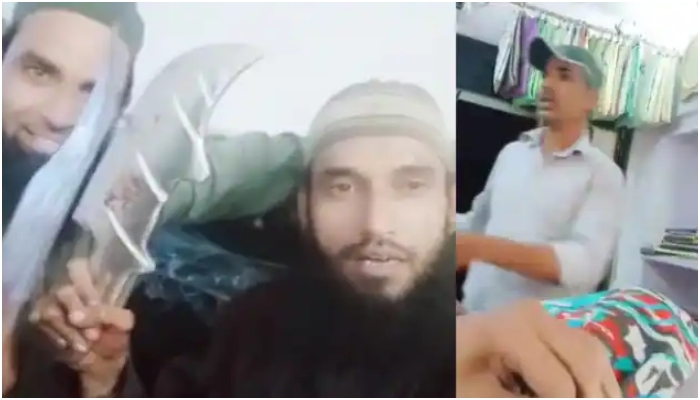
Kanhaiya Lal was murdered on June 29, 2022, by two radical Islamists named Riyaz and Ghous Mohammed. The duo disguised as customers and entered the tailoring shop of the deceased. While Kanhaiya Lal was busy taking the cloth measurements, one of the accused attacked him with a long sharp knife. According to the post-mortem report, he was stabbed 26 times on his body from his neck to shoulder. Kanhaiya Lal was killed for uploading a social media post in support of ex-BJP spokesperson Nupur Sharma.

The eight-year-old son of the deceased victim Kanhaiya Lal had shared a social media post in support of Nupur Sharma from his mobile. However, after this, Kanhaiyalal was arrested by the Dhanmandi police station officials. He continued receiving death threats over the post after his release.

Scared of the threats, Kanhaiya Lal had appealed to then Congress government in Rajasthan for protection but the police did not take him seriously.

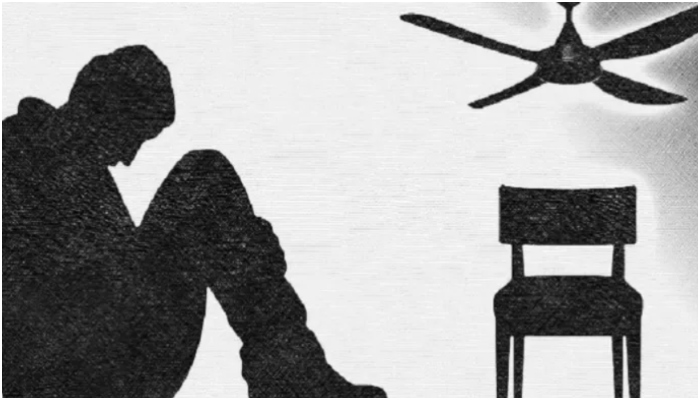
Yet another suicide by a student in Kota: Mathura student preparing for medical entrance exam found hanging from the ceiling

0

A student who was preparing for medical entrance exam, was found hanging inside his rented apartment in Rajasthan’s Kota, police said on Thursday.

According to officials, the deceased has been identified as Parshuram, a resident of Uttar Pradesh’s Mathura. He had come to Kota a week ago to prepare for the medical entrance exam.

On Wednesday night, the student was found hanging from the ceiling by the owner of his rented accommodation.

Jawahar Lal, an ASI with Jawahar Nagar Police, said, “Prima facie, it appears that the student died by suicide. The body has been sent for post mortem examination and we are further looking into the incident to ascertain the exact reason behind him taking the extreme step of ending his life.”

“The deceased’s father has made serious allegations against the coaching institute. We are further looking into it” he added.

More details are awaited.

(This news report is published from a syndicated feed. Except for the headline, the content has not been written or edited by OpIndia staff)

India and Singapore sign MoU to cooperate in development of the semiconductor ecosystem during PM Modi’s visit

India and Singapore agreed to cooperate in the development of the semiconductor ecosystem, the Ministry of Trade and Industry of Singapore said in a release on Thursday.

Both countries signed a Memorandum of Understanding (MoU) for cooperation in the sector. The MOU was exchanged in the presence of India’s Prime Minister Narendra Modi and Prime Minister Lawrence Wong during Prime Minister Modi’s Official Visit to Singapore.

The MoU aims to support India’s growing semiconductor industry while facilitating Singapore’s ecosystem of semiconductor companies and related supply chains to participate in the fast-growing Indian market, the statement added.

Under the MOU, Singapore and India will leverage complementary strengths in their semiconductor ecosystems and tap into opportunities to build resilience in their semiconductor supply chains. This will include government policy exchanges on ecosystem development, supply chain resilience, and workforce development.

The Ministry of Trade and Industry (MTI) and India’s Ministry of Electronics and Information Technology (MeitY) will establish a Policy Dialogue to facilitate discussions, oversee the implementation of the areas of collaboration, and exchange best practices.

A parallel business-to-business Cooperation Forum will be established and led by Enterprise Singapore and the India Semiconductor Mission (ISM) to encourage and catalyze more private-sector partnerships between both countries.

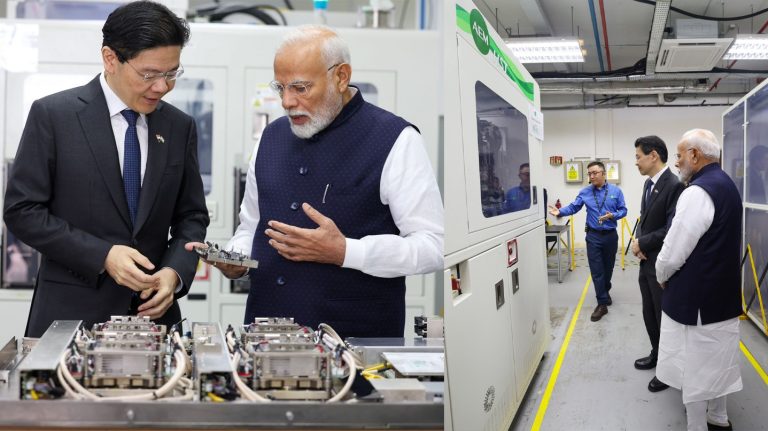
PM Modi, who is on a two-day visit to Singapore, visited the semiconductor facility of AEM Holdings Ltd. Singapore’s PM Lawrence Wong accompanied PM Modi during his visit to the semiconductor facility.

The visit comprised a sharing led by the Singapore Semiconductor Industry Association (SSIA) on the development of Singapore’s semiconductor industry opportunities for mutual collaboration between Singapore and India partners, and a tour of AEM’s facilities.

Prime Minister Modi also engaged with ecosystem players and institutions such as APP Systems, Century Water, Ecsal Technologies, NexGen Wafer Systems, PEP Innovation, and Temasek Polytechnic.

Deputy Prime Minister and Minister for Trade and Industry Gan Kim Yong said, “This MOU signals India’s and Singapore’s commitment to work together in the field of semiconductors to address the demand from industries around the world. This will also strengthen semiconductor supply chain resilience and create new markets and opportunities for businesses in our countries.”


(This news report is published from a syndicated feed. Except for the headline, the content has not been written or edited by OpIndia staff)

‘Caste-based library access rules’: Viral post about library rules against general students opens a flood of personal experiences, raises question on equity vs exclusion

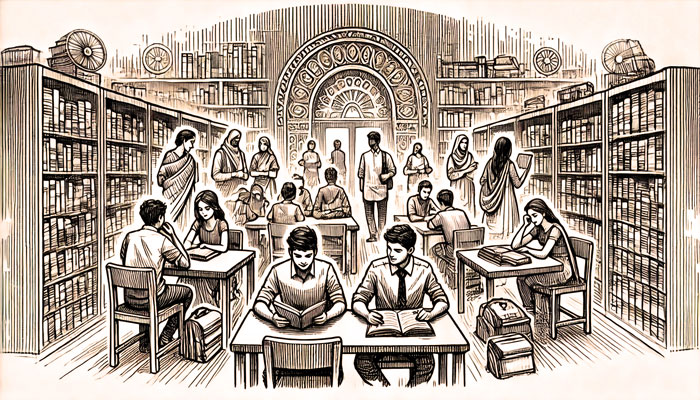
On 4th September, X (Twitter) user Anuradha Tiwari sparked a discussion on social media about caste-based policies in educational institutions, with a particular focus on access to library books. In her post, she shared a notice from the National Institute of Technology (NIT), Hamirpur, dated 1st August 2024, which outlined a schedule for accessing the book bank in the library.

According to the notice, students were prioritised by caste and income categories. For example, one day was reserved solely for SC/ST students, while another was split into two parts: the first half for General Category students with a family income of less than Rs 1 lakh, and the second half for those with a family income exceeding Rs 5 lakh. The third day was open to all students.

Tiwari in her post said, “There’s #Reservation even in NITs’ college libraries. They claim that Brahmins kept knowledge to themselves for centuries. So now, they’ll deny Brahmins and General Category even access to books? This isn’t social justice; it’s pure revenge. Brahmins & GCs are the new Dalits.” The post went viral on social media, prompting many users to share their personal experiences with similar rules in their colleges or universities.

The intention behind such rules might be to support marginalised groups, but it has raised questions about whether it inadvertently sidelines other students, especially those from general categories, by limiting their access to essential academic resources. There has been discussion on social media about whether this is confined to affirmative action or if it has crossed into the territory of exclusion for some groups. In an attempt to address historical disparities, is it right to restrict students’ access to library materials, potentially compromising their futures?

A surge of personal stories: shared experiences of exclusion

Following Tiwari’s post on social media, a flood of personal stories surfaced, where several users recounted feelings of marginalisation within their own academic environments. These students or ex-students were not from “marginalised” communities but faced disparities in policies due to their so-called upper caste status. Access to critical study material, which is often only available in institutes’ libraries and not even to middle or upper-middle-class families, is crucial. However, with such policies in place, can one be certain that access to these resources will be free of disparities and restrictions?

X user WillmooreK_OK pointed out that such policies are not new. He recalled that when he was at IIT Kharagpur over 20 years ago, SC/ST students were allowed more books, with reserved sections for them, and they could borrow books from libraries for longer periods.

X user OnlyNakedTruth wrote a long post about it. He said that when he was at NIT Trichy, there was a Book Bank where SC/ST students had the right to pick books for the first three days. Only after that, the book bank would open to General Category students on the basis of merit. He mentioned there were two copies of Oppenheimer’s Signals and Systems in the library, and as the class topper, he wanted one of them.

However, both copies were taken by his classmates from the SC/ST quota. He said, “But both copies were picked up by my classmates from SC/ST quota who refused to even use them and just let the books keep collecting dust in their rooms for the entire semester. That day I felt terribly cheated. Now I don’t feel the same rage. But the reservations are being cornered among SC/ST by those who don’t need any reservation while the actual needy ones are being shut away.”

For context, the current price of the said book is around USD 84 or Rs 4,899 (for hardcover) and Rs 1,799 (for paperback). It is not feasible for everyone to buy the book, making institute libraries the only source of such expensive books for students. In many cases, several books are not even available in India, and the institutes import them for their libraries. Such policies make it nearly impossible for deserving students, irrespective of their caste, to access these books.

Another X user, a_srinidhi, wrote, “It existed in my college as well. We could borrow like 3 books and they could borrow 5-6 books. There was SC-ST library, others can’t access those books. Even in my school, fees were lesser for them when compared to General students.”

X user Jayaraj Alavelli wrote, “IITM alumnus here. It happens in IITs too. Sometimes, we didn’t get some books as all the copies of the books have been issued already!! Friends used to share books for the entire semester!!”

The way forward: balancing support with equity

There is a need to find a balance between affirmative support and equitable access for all. As many users mentioned, this policy has existed for decades, seemingly introduced to redress “historical disadvantages.” But such policies should have been removed or at least modified over time, considering changing perceptions. There is a growing call for more inclusive measures that do not segregate students into separate access categories but instead address the core issue of resource availability.

To move forward, institutions and policymakers should consider reforms that uphold the principles of inclusivity and fairness. It is their responsibility to ensure that library collections are sufficiently stocked, borrowing hours are extended, and access rules are equitable so that all students can access the books. Universities could even seek grants and donations from business houses to stockpile books, ensuring equal opportunities for everyone. In this digital age, institutions should also procure digital copies of the books which could be made available to all the students without any restriction.

Everyone deserves the best possible education. It is understandable that reservation is still required in India for various reasons, including political ones. However, policymakers and universities need to develop a better system where there is no room for discrimination of any kind among students.

If you don’t like India, don’t work here, we will ask government to block Wikipedia: Delhi High Court issues contempt order in ANI case against Wikipedia

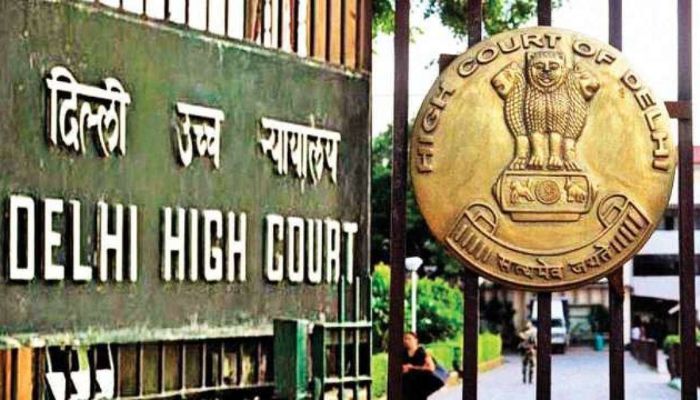
On Thursday, 5th September, the Delhi High Court sent a notice in response to a contempt petition brought by ANI Media Private Limited. The petition asserted that Wikipedia had failed to comply with a court order seeking information about the individuals who had altered the media entity’s Wikipedia page. Wikipedia’s attorney claimed that because the organization was not based in India, it took longer for them to appear in court. However, Justice Navin Chawla strongly objected to this argument.

If the platform did not abide by the court’s orders, he warned he will ask the government to ban it in addition to imposing contempt. “I will impose contempt. It is not a question of Defendant No. 1 (Wikipedia) not being an entity in India. We will close your business transactions here. We will ask the government to block Wikipedia. Earlier also you people have taken this argument. If you don’t like India, please don’t work in India,” the court came down heavily on Wikipedia.

During the next hearing on 25th October, the Court mandated that an authorised Wikipedia representative appear in person. Wikipedia is being sued by ANI for slander. According to the news organisation, Wikipedia permitted defamatory alterations on its page that labelled ANI the current government’s “propaganda tool.” Wikipedia was previously summoned by the high court to provide details regarding the three individuals who altered the ANI Wikipedia page.

Wikipedia appeared before the court on 20th August in response to the summons. ANI emphasised that Wikipedia failed to refute the fact that the three parties named as defendants in the defamation lawsuit were not its administrators. The court ordered Wikipedia to provide ANI with the subscriber data of the three people who had access to it within two weeks of receiving the aforementioned request. ANI contended that the injunction had not been followed in a contempt application that it filed with the high court on 5th September.

ANI has attempted to prevent Wikipedia from posting anything that was purportedly derogatory on the news agency’s page on the platform. It has also asked for the content to be taken down. ANI has also demanded damages from Wikipedia to the amount of Rs. 2 crores. According to its Wikipedia entry, ANI “has been criticized for misreporting events and serving as a propaganda tool for the incumbent central government by distributing materials from a vast network of fake news websites.”

ANI stated in its lawsuit against the Wikimedia Foundation (parent company of Wikipedia) and its officials that the latter has purposefully discredited the news agency’s goodwill and tarnished its reputation by publishing stuff that is blatantly false and defamatory. Wikimedia officials, according to ANI, have taken a proactive role in deleting the edits to reverse the content. “Thus, the conduct of Defendant No. 1 has resulted in a loss of its safe-harbour protection under section 79(1) of the Act, and made it liable for hosting and publishing defamatory content,” the suit pointed out.

The lawyer for Wikipedia informed the court that as the website is not based in India, they had to provide specific documents in relation to the court’s decision, and their appearance before the court took longer than expected. However, the court expressed that the claim had been put forth by Wikipedia previously and was already dismissed. It issued a caution and warned to hold the platform in contempt of court.