On Thursday (July 27), the Karnataka government decided to hike milk prices in the state by Rs 3 per litre effective August 1, following demands from milk producers’ unions.
A week after granting initial approval in a meeting with representatives from the Karnataka Milk Federation (KMF), the Cabinet provided post-facto approval for the hike. The decision came after KMF explained that the lower procurement resulted from private players offering higher prices to farmers.
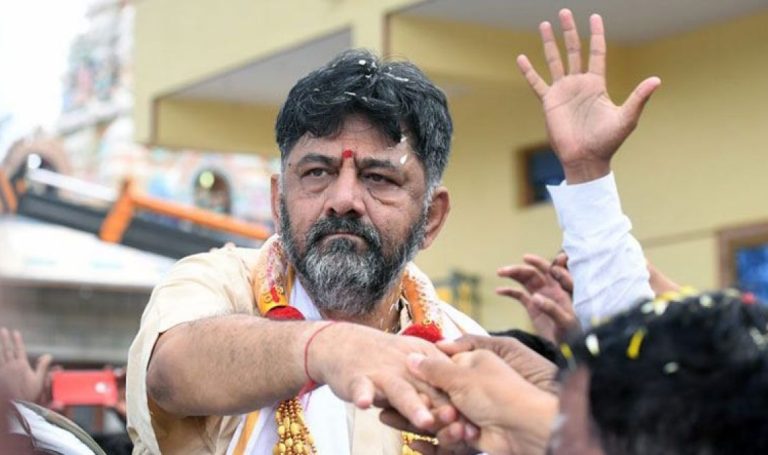
Later, Deputy Chief Minister DK Shivakumar defended the move saying they wanted to “help farmers” by hiking the milk prices by Rs 3 per litre.
“We have to give money to the farmers. Throughout the country, the milk price is Rs 50-56, and in our state, the price is very low. So, we want to help the farmers by increasing Rs 3,” DK Shivakumar said.
#WATCH | Bengaluru: "We have to give money to the farmers. Entire country, the price of milk is Rs 50-56, and in our state, the price is very less. So, we want to help the farmers by increasing Rs 3", says Karnataka Dy CM DK Shivakumar on hike of milk price in the state pic.twitter.com/tVs4CXqgEe
Pertinently, the move comes months after Congress and the opposition parties stoked the Amul vs Nandini row in the run-up to the state assembly elections in Karnataka, lashing out at the BJP government for allowing Amul to sell fresh milk and curd in Bengaluru, asserting that it would hurt the business of the local brand Nandini, owned by Karnataka Milk Federation.
However, the milk price hike has not been taken kindly by the people of Karnataka, many of whom have taken to social media to express their displeasure over the rate increase in the essential commodity. Criticising the government, they claim charging extra for milk is how they are going to fund their freebie promises made during the election campaign.
It is worth noting that Congress has been outraging over the ‘rising inflation’ in the country, even though it was at a 25-month low in May 2023. With the hike in milk prices, the cost of other essential commodities in Karnataka is bound to go up in the days to come.
DK Shivakumar says Karnataka govt has ‘no money for development’ this year as priority is to fulfil election promises
Earlier this week, DK Shivakumar admitted that the Karnataka government was suffering from a paucity of funds to bankroll development projects this year as they had budgeted Rs 40,000 crores for implementing the five election guarantees.
Shivakumar made these comments in response to inquiries regarding the discontent expressed by certain Congress MLAs who have requested funds for the development of their respective constituencies. The Congress legislature party (CLP) has scheduled a meeting this evening to address the concerns of these MLAs who are disappointed that their constituencies have not received adequate development funds.
Following DK Shivakumar’s comments on the lack of funds, Parliamentary Affairs Minister Pralhad Joshi said the Congress party was driven by a thirst for power and lacked the necessary funds to fulfil its promises and support development initiatives. He pointed out that the Deputy Chief Minister’s admission highlights the government’s lack of vision and responsibility.
A priest of Ujjain’s Mahakaleshwar temple has demanded the deletion of scenes from the upcoming film ‘Oh My God 2’ that were filmed at the shrine.
The Central Board of Film Certification (CBFC) cleared the film for release earlier, with an ‘A certificate’. Speaking to ANI, Mahesh Sharma, a priest of the Mahakaleshwar temple, said, “The censor board has given ‘A’ certificate to the film ‘Oh My God 2’. This certification is reserved for films that have adult content. We demand that some scenes, which were filmed at the Mahakal temple, be removed as they might offend the religious sentiments of viewers.”
“If our demand isn’t met, we will launch protests across the country,” Sharma added.
Actor Akshay Kumar, who leads the film’s cast, had shot for the film at the Mahakal temple.
(This news report is published from a syndicated feed. Except for the headline, the content has not been written or edited by OpIndia staff)
An explosion in a district to the south of Damascus in Syria resulted in at least six fatalities and 46 injuries on 27 July. A device concealed in a motorbike that was close to a taxicab was remotely detonated on al-Sudan Street in the neighbourhood of al-Sayeda Zainab mausoleum.
Update on the explosion in Damascus:
An explosive device that was placed in a taxi exploded in the Sayeda Zeinab area.
Sayeda Zeinab was the granddaughter of Prophet Mohammed and the daughter of Imam Ali, a founding figure of Shia Islam. It is the country’s most visited Shia shrine also known as the Shiite pilgrimage site.
The deadly blast came ahead of the annual commemoration of Ashura, when Shia Muslims remember the death of Imam Hussein, grandson of the Prophet Mohammed, in the seventh-century battle of Karbala.
Syrian Health Minister Hassan Al-Ghabbash informed that 20 of the injured were treated on the spot for minor wounds while the others were transferred to hospitals. He further mentioned that 11 ambulances arrived at the scene shortly after the blast.
Shia Muslims, primarily from Iran, frequently travel to the predominately Shia area in Syria to make pilgrimages to revered Shia shrines. There is also a presence of the Hezbollah organisation from Lebanon in the region. The explosive device reportedly detonated close to a military station operated by rebels with support from Iran, according to the war monitor Syrian Observatory for Human Rights.
A source at the nearby Al-Sadr hospital stated that 10 wounded individuals had been transported there following a car bombing close to the site. State television disclosed that the explosion was caused by a bomb placed in a taxi by unidentified people.
A 39-year-old civil servant Ibrahim said, “We heard a huge blast and people began to run. Then ambulances arrived and security forces cordoned off the area. The explosion took place near a security building around 600 metres (yards) from the mausoleum of Sayeda Zeinab.”
For the 10-day Ashura celebration, which is the most significant in Shia Islam, the authorities have strengthened security measures surrounding the mausoleum. However, it was the second attack this week at the shrine. A booby-trapped motorcycle blast wounded two people on 25 July. It is high season for the shrine as Shia Muslims flock there to mark the mourning period of Ashura.
Sunni Muslim terrorists of the Islamic State routinely attack Shia shrines, not just in the country but also in adjacent Iraq. Multiple devastating explosions targeted the Sayeda Zeinab tomb when a civil war broke out in 2011 in Syria. Shia militiamen, largely from Lebanon and Iraq, as well as the army have since been defending the mosque complex.
Attacks have decreased recently despite some security measures being dropped. A double suicide assault that took place in February 2016 about 400 metres from the mausoleum and resulted in the deaths of 134 individuals, including more than 90 civilians, was owned by the IS.
The extremist outfit had also taken responsibility for a triple blast that occurred a few weeks earlier close to the sanctuary and claimed at least 70 victims.
Damascus has remained comparatively calm ever since the Army drove the rebel group out of the Eastern Ghouta area in May 2018. However, intermittent explosions that seem to target random places still occur.
On Wednesday (July 26), a Chinese woman travelled to Pakistan to meet her lover, whom she befriended on social media.
As per reports, the woman was identified as 21-year-old Gao Feng. She arrived in Islamabad from China by road via Pakistan-Occupied Kashmir (PoK). Later, the woman travelled to Khyber Pakhtunkhwa province to meet her 18-year-old lover Javed.
Javed is a resident of the Bajaur district of Khyber Pakhtunkhwa. Feng befriended him on Snapchat and has now come to Pakistan on a three-month visa.
Reportedly, Javed took his Chinese lover to Samarbagh tehsil in the Lower District of Kyber Pakhtunkhwa, keeping in mind the volatile security situation in his hometown.
The duo had known each other for the past 3 years. According to the district police officer (Lower Dir) Ziauddin, Gao Feng has been provided security cover but her movement is restricted due to Muharram and other security concerns.
He added that the Chinese woman is yet to perform ‘Nikkah’ with Javed, adding that her travel documents are in order. The travel documents of the woman are in order, police said, adding that she has not yet performed the ‘nikah’ with Javed.
Married Indian woman travels to Pakistan to be with her ‘lover’ Nasrullah
On 24th July, a case similar to Seema Haider, a woman from Pakistan who came to India with her four kids to meet her lover, came to the fore but with a twist. In this case, the woman is from India and has gone to Pakistan to meet her lover.
The woman, identified as 35-year-old Anju from Bhiwadi, Rajasthan, had left last Sunday on the pretext of visiting Jaipur. However, her husband Arvind learned the shocking reality that her wife had gone to Pakistan when their son got sick, and he called Anju to ask when she would be back.
Anju informed him that she was in Pakistan and would be back soon. As per reports, Anju is originally from Kailor, Uttar Pradesh. As per reports, Anju claimed she was going to Jaipur to meet a friend. However, on Sunday, she called and informed her husband that she was in Lahore.
Arvind was unaware why she went to Lahore and how she got a visa. Arvind claimed the matter differed from Seema Haider’s as Anju had valid documents, and his wife told him she would be back in 2-3 days; hence he did not file a complaint with the police.
Arvind is in utter shock and has left it to his children whether they want to live with Anju. According to him, this is the first time Anju has gone somewhere without informing her family. Arvind feels Anju has cheated him. He wants to have a family meeting with Anju’s parents to decide the next course of action.
Arvind has requested from the authorities that if Anju has all the valid documents, she should be allowed to come back. He told BBC Hindi that they got married in 2007 and have a 15-year-old daughter and 7-year-old son. “I never checked her phone as I trusted her,” said Arvind.
On Sunday, 23rd July 2023, the Darbhanga district in Bihar was gripped by communal clashes after some members of the Muslim community created a ruckus and stopped the last rites of a Hindu villager named Shrikant Paswan. The incident occurred in the Hariharpur tola- Malpatti village under Kamtaul police station limits on Sunday evening.
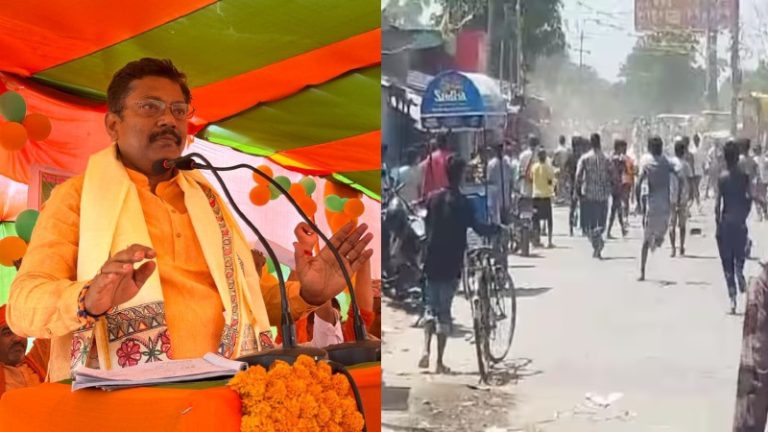
Madhubani MP Ashok Yadav spoke to OpIndia about the ruckus created by Muslims at the funeral of veteran Mahadalit person Shrikant Paswan. The incident took place in Dharampur-Malpatti village under the Kamtaul police station area of Darbhanga district. But this area falls under Ashok Yadav’s parliamentary constituency. Darbhanga district has witnessed several communal incidents in recent days.
MP Ashok Yadav told OpIndia, “Be it Madhubani or Darbhanga, Kishanganj or Araria, in any area of Mithila region where the population of Muslims is high, Hindus have become a minority, they are not even allowed to worship. The Katha of Shri Satyanarayan Bhagwan is not allowed. Muslims oppose the drums played in a Hindu wedding ceremony. They do not allow the procession to pass by a mosque.”
On July 21, there was a dispute over the installation of the Moharram flag in the Birol police station area. Then on July 23, tension arose at Shivdhara Chowk in the Mabbi police station area late at night. On July 23, there was an incident of stone-pelting and arson during the cremation of Shrikant Paswan. On July 24, there was an incident in Bariaul village under the Kamtaul police station area where a loud DJ was playing in a Muharram procession. On July 25, the incident took place in Ijarhata village under the Manigachhi police station area. On July 26, there was a dispute over the Moharram flag in Banoli village under the Simri police station area. On July 27, there was a controversy over the installation of the Muharram flag but it was thwarted because of the active response by the Bhawanipur Bhapura administration and local public representatives of the Singhwara police station area.
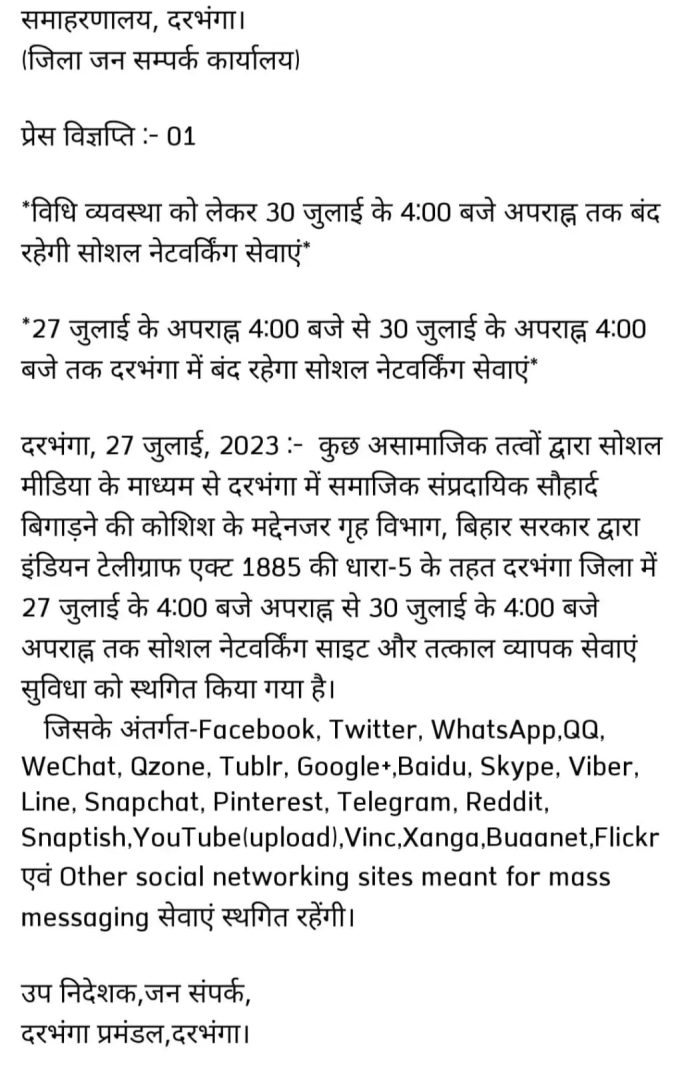
Darbhanga police are presenting these controversies as if these are everyday incidents. In this effort, social media sites have now been closed in Darbhanga district. In a statement issued to the press, the Deputy Director of Public Relations has said that due to law and order, social networking services will be closed from the evening of July 27 to the evening of July 30, 2023.
It said that some anti-social elements are trying to disturb communal harmony in Darbhanga through social media. In view of this, it has been decided to suspend these services on the instructions of the State Home Department. This restriction is applicable to all social networking services including uploading videos on Facebook, Twitter, WhatsApp, and YouTube.
Despite the Darbhanga administration justifying the ban as a measure to maintain communal harmony and curb anti-social elements, recent events in the district shed light on the underlying issues that led to this decision and the people responsible for this situation. Regrettably, these incidents have not received significant coverage in the national media. Of even greater concern are allegations against the local police and administration for acting unilaterally, putting pressure on the victims, and subjecting even those who intervened to torture.
Darbhanga administration issued a statement in the media regarding the ban on social media sites.
MP Ashok Yadav mentions Hindu houses set on fire and clashes over ownership of cremation ground
Referring to the incident during Shrikant Paswan’s cremation, MP Ashok Yadav told OpIndia, “Hindus have been performing cremation on the cremation ground which was opposed by people of the Muslim community, who claim ownership on the land. Due to the grounds of the crematorium remaining at a lower level, water logging issues surfaced there. Soil filling and leveling works were done at that place with MNREGA.”
He said, “The body was treated indecently and inhumanly. Such an incident has never happened before. The corpse was thrown away. It was attacked with sticks and other inhuman treatment. Hindu houses were burnt. The local village chief’s motorcycle was set on fire. The violence was carried out by cutting electricity from the transformer.”
According to the MP, the entire incident happened in front of the police administration. Police personnel were also injured. The police should have taken action against the culprits. But the administration dragged village chief Ajay Jha, who went to the spot to intervene, in this case. He was sent to jail. He was humiliated by bringing him to the police station. Derogatory words were used for him.
He further told OpIndia, “The Bihar government should immediately mark the land boundaries of the crematorium and hand it over to the Hindus. The Bihar government should take action against the culprits so that such an incident does not happen in the future. If the administration does not take action against the culprits, then such an incident can happen again.”
What happened with Shrikant Paswan’s dead body?
The death of 62-year-old Shrikant Paswan from Dharampur village, who was battling cancer, led to funeral proceedings at the adjacent crematorium just outside of the Malpatti village on 23rd July 2023. However, the Muslims residing in Malpatti village protested the cremation, asserting their claim over the cremation land. The situation escalated, with reported incidents of stone-pelting and attacks on houses. Some media reports even mentioned disturbing actions, including throwing away a burning cremation pyre and urinating on the dead body. Nevertheless, the Bihar Police refuted these claims, stating that it was a dispute between two communities over the funeral arrangements.
The Station House Officer of Kamtaul told OpIndia that the claims of inhumanly treating the dead body are false. When the police reached the spot after getting information about the dispute, the dead body was kept on the pyre by digging a pit. The last rites were performed in the presence of the administration. The victim’s family has also not mentioned any indecency with the dead body in their complaint, he added. He also added that three policemen were injured during the disturbances.
According to the locals, after getting information about the dispute, village chief Ajay Jha reached the spot along with the police administration. But later, under pressure from Muslims, he was also implicated in this case and arrested. An organization called All India Muslim Bedari Karwaan had written a letter to Chief Minister Nitish Kumar on July 24 in this regard. Accusing Ajay Kumar Jha of conspiring, the letter said that Ajay Jha’s men and the police entered more than two dozen houses of Muslims in Malpatti and beat them up.
‘Bihar also needs UP’s bulldozer model’
Similarly, in other recent incidents, the police are being accused of working under pressure from Muslims and also implicating Hindus in these cases. MP Ashok Yadav calls it the result of appeasement of the Bihar government. He said, “Lalu Prasad Yadav had nothing to do with development right from the beginning. He has been doing politics of appeasement and the M-Y (Muslim-Yadav) equation. Nitish Kumar has also had this policy. When the BJP was in alliance with Nitish Kumar, he could not openly appease. But now after joining hands with Lalu Yadav, he is also openly engaged in appeasement and creating a vote bank. This is why Islamic fundamentalists and terrorists in Bihar also feel safe. The BJP government in Uttar Pradesh has shown how this problem can be treated. If such an incident had happened in UP, the bulldozer would have gone to demolish by now. Now there is a need for a similar government in Bihar.”
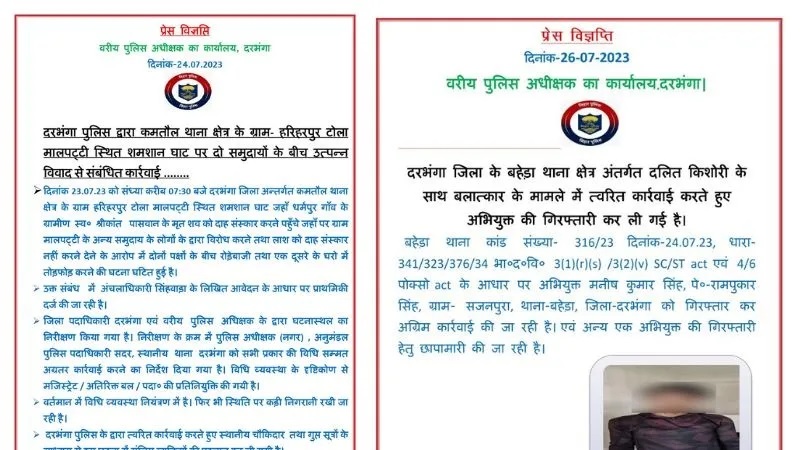
Interestingly, the appeasement at the government and administrative level that Ashok Yadav is talking about is also visible on the Twitter handle of Darbhanga Police. The police have not revealed the names of those who created a ruckus over the funeral of Mahadalit Shrikant Paswan. The protesters have been identified on social media as “particular communities”. But the same police have released the name, address, and picture of Manish Kumar Singh, accused of raping a Dalit girl in the Bahera police station area, on social media.
In one case, the name and address of the accused are all mentioned, but in the other case, only “other communities” is mentioned.
There are speculations about whether the decision to ban social networking sites is an attempt to conceal the appeasement in recent events. However, the Darbhanga police and administration, despite being asked, have not provided a satisfactory response to address these concerns.
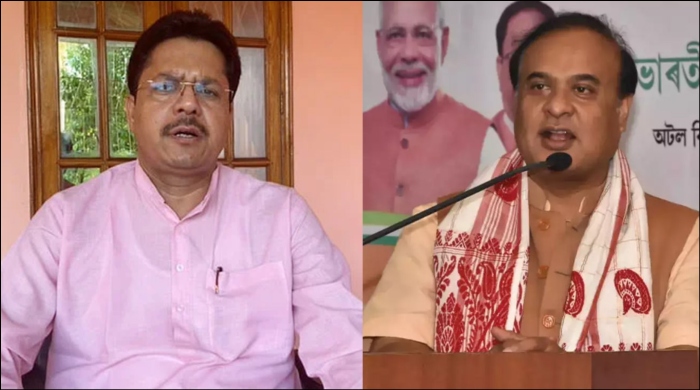
On Friday, July 27, Assam Pradesh Congress Committee (APCC) president Bhupen Borah sought forgiveness from the people of Assam for brazenly equating Lord Krishna and Rukmini’s relationship as Love Jihad, saying that his ancestors reprimanded him in his dreams.
“Last night, I had a vision in my sleep. My ancestors came to me in my dream and made me realise my mistake over the comments. They told me to visit a Namghar and pray,” the Congress leader told reporters here in Guwahati.
The apology came soon after Assam CM Himanta Biswa Sarma tore into the Congress leader for passing the highly objectionable remark. The Assam CM lambasted Congress by saying that there will come a time when Congress leaders will not be able to find a place to stay other than a mosque or madarsa. He pledged that the government would take legal action against Borah if a complaint was filed against him.
Explaining what the phenomena of love jihad is, the Assam CM said, “It is not proper to justify Love Jihad. Congress leaders will see a time when except Mosque or Madrassa they won’t find a place to stay. If they remain cut off from Hindus in this way their only address will be a mosque or Madarsa, where at times All India United Democratic Front (AIUDF) will come and chase them out. I ask the Congress not to be anti-Hindu.”
He added that the incidents in Mahabharat were love and not love jihad. He clarified that love jihad means forcing someone to change through religion, and neither Gandhari nor Rukmini was forced to change religion.
He added that earlier it was only love, but now love jihad happens and that’s why murders take place. “There was love between Krishna and Rukmini, there was no change of religion, there was no Jihad,” he added.
‘Lord Krishna and Dhritarashtra also did love jihad’, claims Assam Congress chief Bhupen Borah
Talking to reporters, the Congress state president Bhupen Borah had said on Thursday, July 28, that when Dhritarashtra married Gandhari and Krishna married Rukmini, they had indulged in love jihad.
Bhupen Borah made the comments objecting to Assam CM describing the recent incident of the triple murder in Golaghat as a case of love jihad. In the horrific incident, one Nazibur Rahman Bora killed his Hindu wife and her parents by stabbing them with a knife. The woman Sanghamitra Ghosh had married him ignoring the opposition of her parents, and later marital discords led to the murders. Himanta Biswa Sarma visited the family on Wednesday and said that the case was the result of love jihad.
Responding to the comments, state Congress chief Bhupen Borah said that love jihad is going on for ages, and it took place even during the Mahabharata times. He claimed that Dhritarashtra had married Gandhari against the wishes of her family, and had even got her brothers imprisoned for objecting to the marriage. He also claimed that Gandhari had blindfolded herself so that she does not have to look at Dhritarashtra.
Bhupen Borah further claimed that Lord Krishna also married Rukmini against the wishes of her family, and thus it was also love jihad. He claimed that Krishna had changed his name to marry Rukmini, and Arjun had posed as a woman while accompanying Krishna.
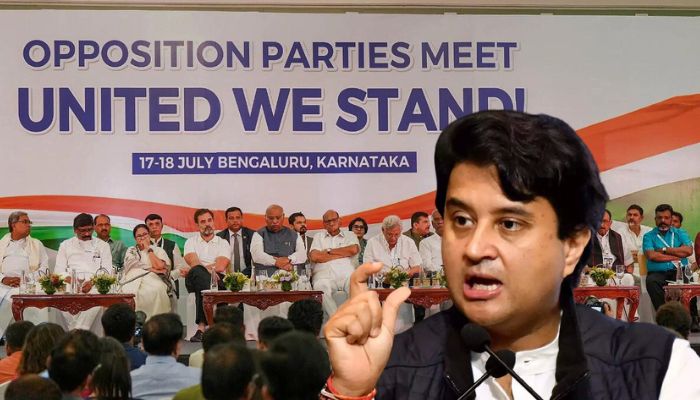
Hitting out at the opposition’s I.N.D.I.A. alliance, Union Civil Aviation Minister Jyotiraditya Scindia said that parties “who used to hate each other” are now coming together “like a family.”
“Under the leadership of PM Modi, the country is touching new heights of development. The ideology of the Bharatiya Janata Party is based on Jan Seva (service of people), Jan Kalyan (upliftment of people), and Gareeb Kalyan (upliftment of the poor). Opposition is upset and that’s why those parties who used to hate each other and couldn’t face each other, are now coming together like a family,” he said while speaking to reporters here on Thursday.
He said the people of the country have faith in PM Modi and the BJP. “I am surprised that the ideology which was rejected by the people of India several times is being touted again and again by the opposition”, said Scidia hitting out at the opposition.
Further, the Union Minister said, “I am confident that the country will elect the BJP again” in the 2024 Lok Sabha elections. The statement came following the I.N.D.I.A. alliance’s protest in the parliament on Thursday. Opposition MPs of the alliance arrived at the Parliament wearing black clothes as a mark of protest against the Manipur violence. They have been insisting that Prime Minister Narendra Modi make a statement on Manipur violence.
However, the Government has accused the Opposition of disrupting the proceedings of both houses of the Parliament and reiterated that it is ready to hold a discussion on the issue. Meanwhile, the leader of the Opposition in the Rajya Sabha Mallikarjun Kharge accused Prime Minister Narendra Modi of “disrespecting” the Parliament with his absence from the House and instead making political speeches in poll-bound Rajasthan.
Speaking to reporters outside the Parliament, Kharge said, “The House is functioning. We are demanding that the Prime Minister come there (Parliament) and make a statement. But he is giving political speeches and campaigning in Rajasthan. When he can go there, can’t he come to the House for half an hour and make a statement?”. Notably, PM Modi on Thursday inaugurated various development projects worth crores in poll-bound Rajasthan.
(This news report is published from a syndicated feed. Except for the headline, the content has not been written or edited by OpIndia staff)
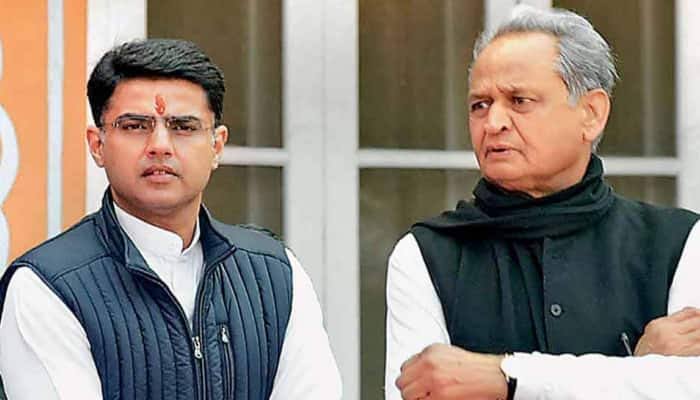
Congress leader and former Rajasthan Deputy Chief Minister Sachin Pilot on Thursday criticized Prime Minister Narendra Modi, alleging that the central govt is “working in a biased manner.”
“Even today he (PM) did not make any announcement on ERCP (Eastern Rajasthan Canal Project ). He is not raising the issues of people…No Confidence Motion is being brought by the Opposition but he has kept ‘Maun vrat’ on the issue of Manipur. We all want that there should be a discussion on this… The central govt is working in a biased manner.”
Pilot added, “As elections are approaching, there will be more such political speeches rather than talking about development works,” said Pilot. Notably, Prime Minister Modi on Thursday laid the foundation stone and dedicated a series of transformative development projects in Sikar, Rajasthan. The projects unveiled encompassed diverse sectors, aimed at empowering farmers, bolstering agriculture, advancing medical infrastructure and preserving Rajasthan’s rich cultural heritage.
Furthermore, speaking on the BJP’s demand to unveil the ‘red diary’, Pilot said, “BJP has no issue left to talk about. They failed at the Centre. They failed in Rajasthan as the opposition. They are involved in quarrels. I believe that the Congress will form governments in Rajasthan, Chhattisgarh, Telangana, and Madhya Pradesh”.
Significantly, the Rajasthan government on Friday sacked its minister of state Rajendra Singh Gudha hours after he criticized his own government over the crimes against women in the state.
On Monday, he was seen carrying a red diary to the assembly which, according to him, contains details that can ‘expose’ Chief Minister Ashok Gehlot.
On the other hand, the BJP is saying that the people of Rajasthan want to know what secrets the diary contains. “This government has told numerous lies. People of Rajasthan want to know what is this ‘Red Diary’ and which secrets it contains and why has it got the CM and advisors worried?”, said Satish Poonia, deputy leader of the opposition in Rajasthan assembly.
(This news report is published from a syndicated feed. Except for the headline, the content has not been written or edited by OpIndia staff)
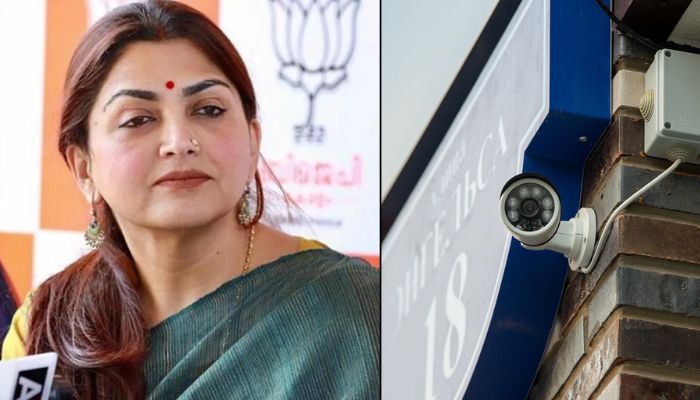
On Thursday (July 27), the National Commission of Women (NCW) member Khushbu Sundar visited the Netra Jyoti College in the Udupi district of Karnataka, where female Hindu students were secretly recorded in the washroom by their Muslim classmates.
While speaking to the reporters, Sundar refused to divulge details about the case and emphasised that the investigation into the matter was underway. On being pressed by a reporter about the presence of ‘hidden cameras’ inside the restrooms, she dismissed the claims as ‘rumours.
“Madam, is there any hidden camera in the toilet?” a reporter asked the NCW member. She promptly responded, “No, there is not. Absolutely not. That is why I said that if there are rumours of hidden cameras in the toilet, please understand there is nil.”
Khushbu Sundar added, “There is a rumour which is going around and there are false videos which are being going around that there are hidden cameras. It is an institution and there cannot be any hidden cameras. Please do not follow these kinds of stories.”
It must be mentioned that the NCW member was specifically asked a question about hidden cameras in the toilet of Netra Jyoti College, a claim which was refuted by Sundar in the presence of media.
She however did not deny the secret recording of Hindu women by their Muslim classmates while they were using the washroom. As a matter of fact, the accused have been suspended from the college and also booked by the Udupi police in connection to their heinous crime.
However, her short news byte gave ammunition to the left-liberal propagandists who then used it to give clean chit to the three Muslim women who recorded their classmates and dub the entire incident as a ‘communal ploy’ by the BJP.
Propagandists distort news byte to refute secret recording
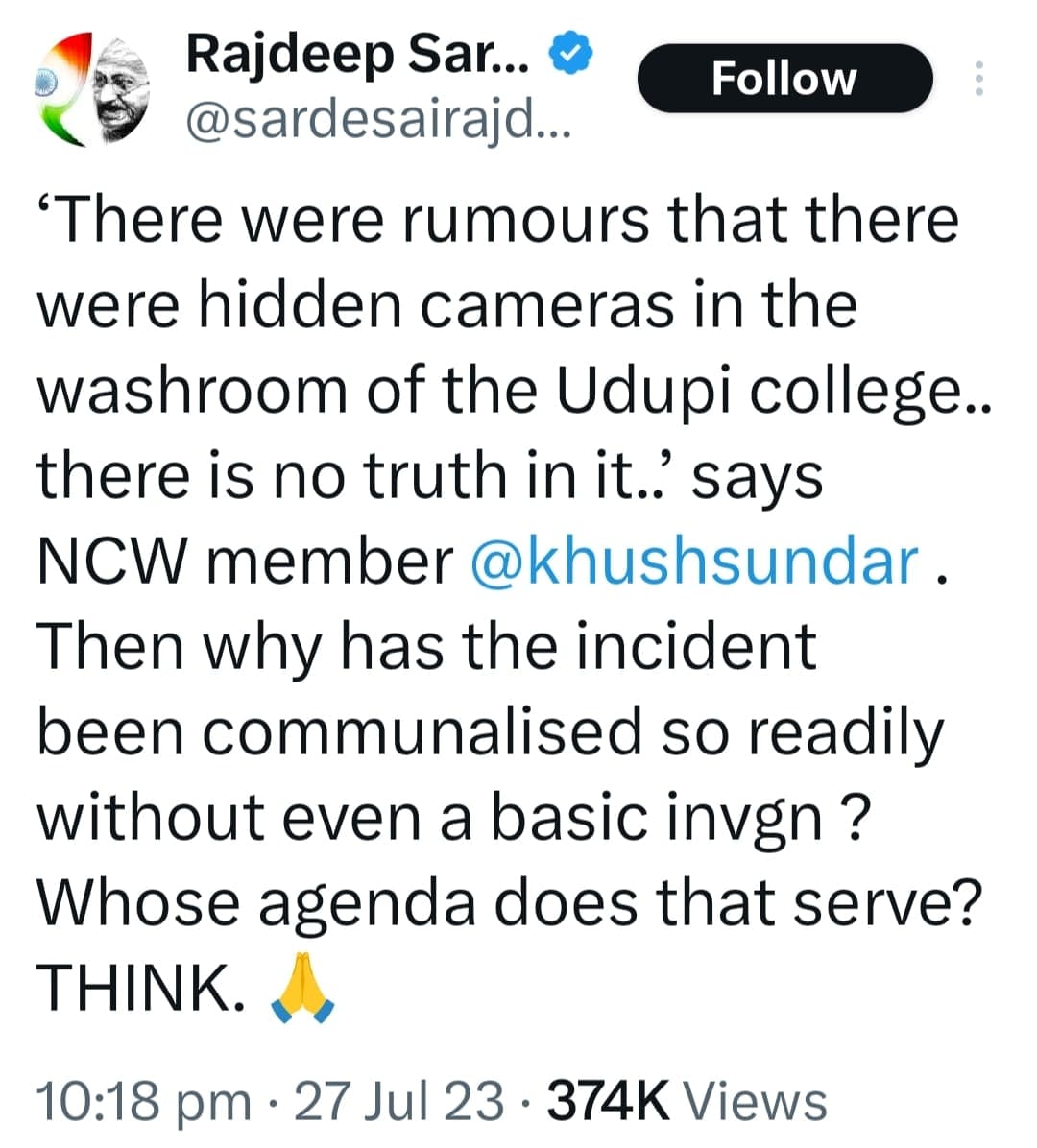
Veteran ‘journalist’ Rajdeep Sardesai sought to exploit the opportunity for his political agenda. He claimed, “There were rumours that there were hidden cameras in the washroom of the Udupi college.. there is no truth in it..’ says NCW member Khushbu Sundar.”
“Then why has the incident been communalised so readily without even a basic invgn ? Whose agenda does that serve? THINK,” Sardesai brazened it out.
Screengrab of the tweet by Rajdeep Sardesai
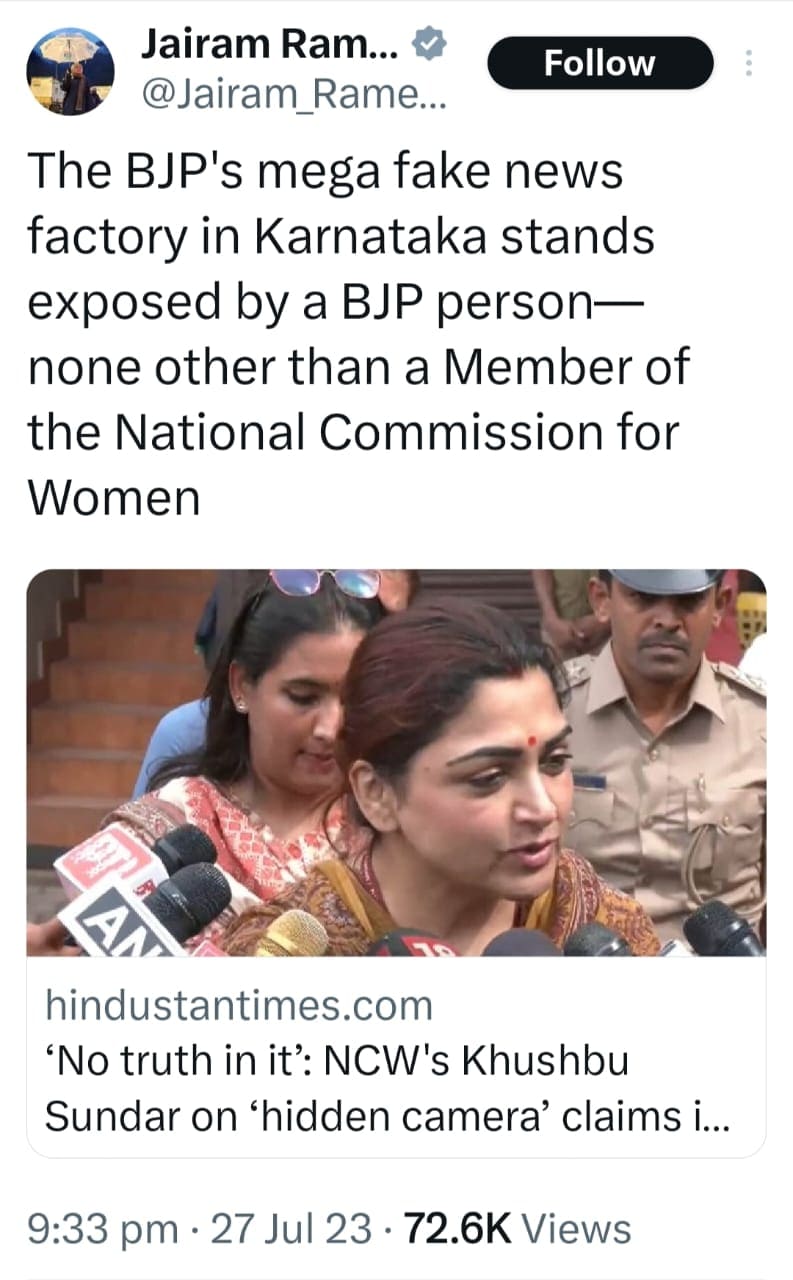
In a tweet, Congress leader Jairam Ramesh claimed, “The BJP’s mega fake news factory in Karnataka stands exposed by a BJP person—none other than a Member of the National Commission for Women.”
Screengrab of the tweet by Jairam Ramesh
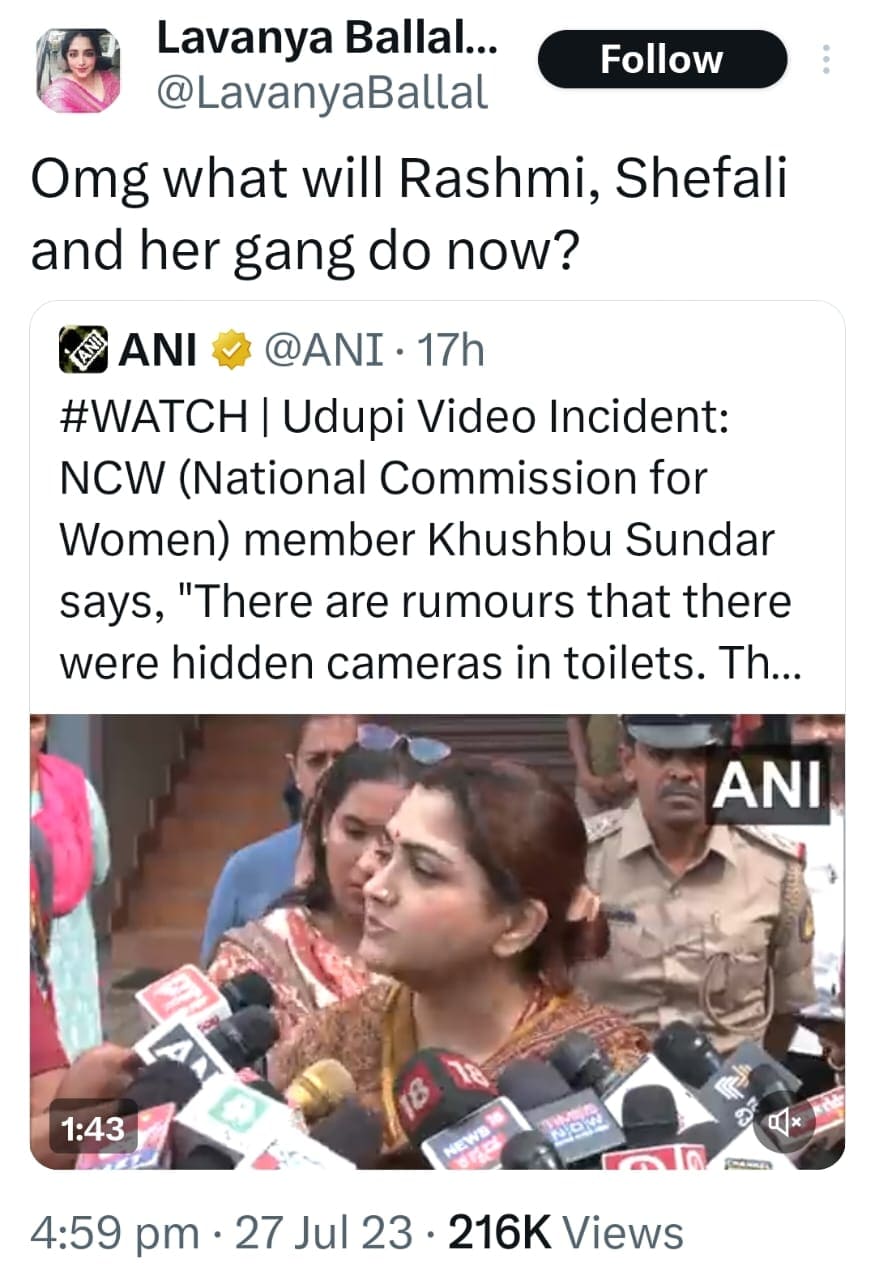
“Omg what will Rashmi, Shefali and her gang do now?” Congress leader Lavanya Ballal Jain remarked.
Screengrab of the tweet by Lavanya Ballal Jain
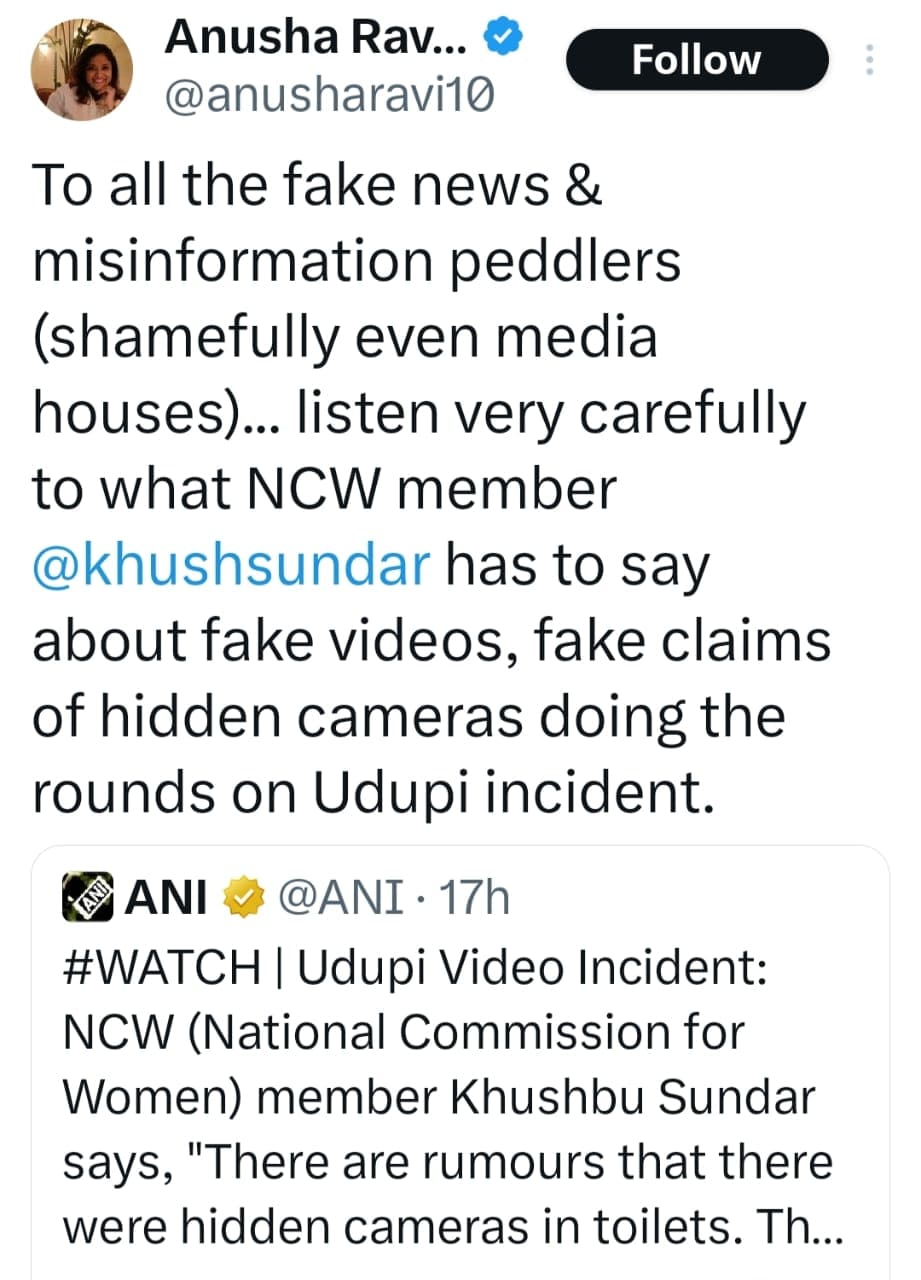
‘Journalist’ Anusha Ravi Sood, who had earlier dubbed the secret recording of Hindu women in washrooms by Muslim classmates as ‘mean’ and ‘prank’, claimed, “To all the fake news and misinformation peddlers (shamefully even media houses)…listen very carefully to what NCW member Khushbu Sundar has to say about fake videos, fake claims of hidden cameras doing the rounds n the Udupi incident.”
Screengrab of the tweet by Anusha
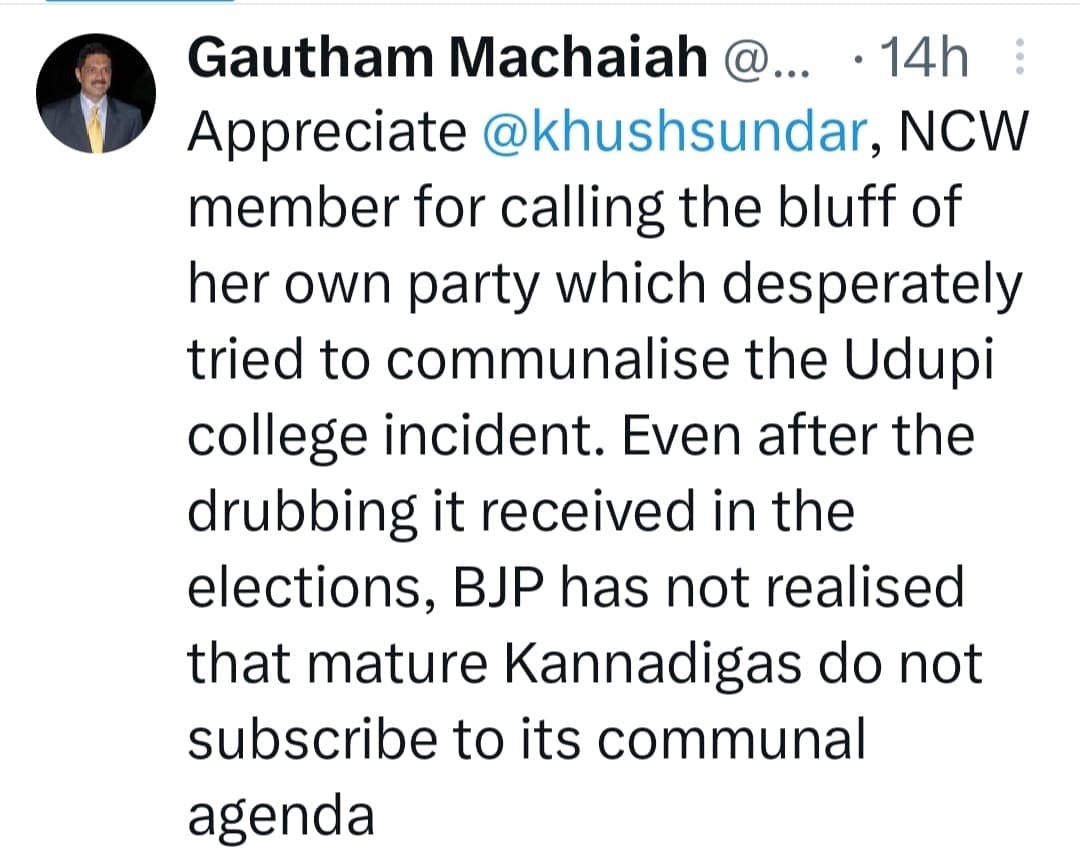
Veteran ‘journalist’ Gautam Machahiah wrote, “Appreciate @khushsundar , NCW member for calling the bluff of her own party which desperately tried to communalise the Udupi college incident. Even after the drubbing it received in the elections, BJP has not realised that mature Kannadigas do not subscribe to its communal agenda.”
Screengrab of the tweet by Gautam Machaiah
Khushbu Sundar issues clarification
After the usual suspects attempted to trivialise the Udupi incident based on their skewed understanding of the news byte of Khushbu Sundar, the NCW member took to Twitter to clarify the matter.
In a tweet on Friday (July 28), she wrote, “And no one said the incident was a rumour. We haven’t even closed the case. Investigations have just begun. Phones have been sent to forensic department.”
“But people like you very conveniently do not read that. Anything can be said or action taken only after the reports. If guilty, accused will surely be punished. And pls educate yourself a bit. No complaint was registered by the victim or the management,” she emphasised.
And no one said the incident was a rumour. We haven’t even closed the case. Investigations have just begun. Phones have been sent to forensic department. But people like you very conveniently do not read that. Anything can be said or action taken only after the reports. If… https://t.co/2GfYupMVtD
“It is very unfortunate to see some like you again speak on hearsay. Was at the spot with police, met the admin, faculty and the victim and spoke to them for more than 7 hours. Sitting in an AC room with a phone and a judgmental mind will not change anything, (but) rather harm the investigations. Do not be the police. Allow them & us to do our job. Do not add fuel to fire,” Khushbu Sundar said.
It is very unfortunate to see some like you to again speak on hearsay. Was at the spot with police, met the admin, faculty and the victim and spoke to them for more than 7 hours. Sitting in an ac room with a phone and a judgmental mind will not change anything, rather harm the… https://t.co/2GfYupMVtD
On 21st July, a Karnataka-based organisation, All College Student Power (ACSP), wrote the Superintendent of Police, district Udupi, about this crime at Netra Jyoti College where three female students of the Muslim community secretly made a video of Hindu female students and shared the mobile phone. As per the letter sent by ACSP, students at Netra Jyoti College learned about it on the 20th of July and protested against it.
The college took up the matter, and three students responsible for recording the videos were suspended effective immediately, pending internal investigation. Though the victim(s) did not wish to file an official complaint in the matter, the college went ahead and informed the police keeping in mind the sensitivity of the matter.
After social media outrage, the police filed an FIR against the 3 Muslim women who were indulging in the criminal activity and the college administration for not only destroying evidence but also for not providing information and documents during the course of the investigation.
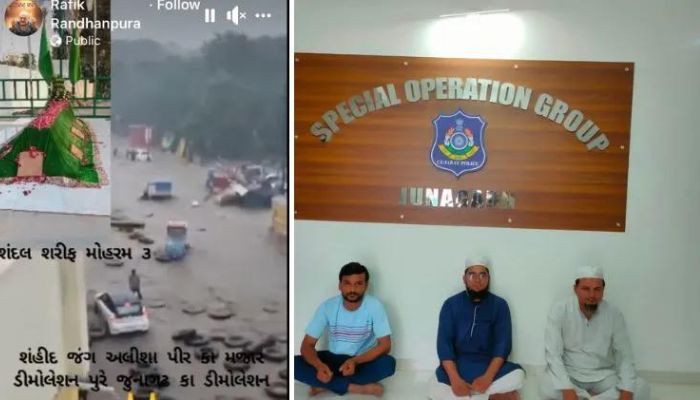
Four persons were arrested for disseminating inflammatory and hateful content on social media following a severe flood situation in Junagadh. The individuals shared videos of the floods and insinuated that Allah had unleashed the calamity upon the city as a consequence of an illegal Dargah’s demolition in Junagadh.
Kajal Hindustani, a Hindu activist, shared some of those videos on Twitter and demanded action from the Gujarat Police. On the basis of this, an FIR was filed at Junagadh B Division Police Station on Tuesday (July 25, 2023). A copy of this FIR is available with OpIndia.
The FIR was registered on the basis of a complaint by a constable on duty with the cyber crime cell. In this complaint, he said that while he was keeping a watch on social media, a tweet from a user named Kajal Hindustani came to his notice. In this post, she tagged the Gujarat Police and the DGP and wrote in the Hindi language, “While Gujarat’s Junagadh is facing flood on one side, some anti-social elements of the city are posting such videos and having the audacity to disturb the peaceful atmosphere of the city and create chaos. Due to such anti-social elements, mutual harmony in the society deteriorates, so you are requested to take immediate action against such radical, separatist people keeping in mind the public sentiments and religious sentiments of Junagadh.”
गुजरात का #जूनागढ़ जहा एक तरफ़ बाढ़ का सामना कर रहा है वही कुछ शहर के असामाजिक तत्व इस तरह के विडियो पोस्ट कर रहे है और शहर का शांतिप्रिय वातावरण बिगाड़ने और अराजकता उत्पन्न करने की धृष्टता कर रहे है। ऐसे असामाजिक तत्वों के कारण ही समाज में आपसी… pic.twitter.com/IA4d4gSV7h
Kajal Hindustani shared a sample video depicting the aftermath of heavy rains causing flooding in Junagadh, resulting in significant disruption to public life. This video included provocative statements like ‘Allahu Akbar’ and ‘Shaheed Jung Ali Shah Pir Ka Mazar Demolition, Poore Junagadh Ka Demolition’, insinuating a connection between the flood situation and the demolition of the dargah.
The tweet included a screenshot of a Facebook post by a man named Mohammad Peerzada, where he wrote, “Junagadh mein Ali Shah Pir ki dargah ka demolition kiya gaya tha, aaj Allah ne Junagadh ka hi demolition kar diya,” (meaning: Ali shah Pir’s dargah was demolished in Junagadh, today Allah demolished the entire Junagadh as a punishment) implying that the flood situation in the city is the ‘punishment’ from Allah for the city administration demolishing an illegally built Dargah.
A person named Sheikh Sabir had posted inflammatory words in a Facebook group called ‘Jai Ho Junagadh’. He wrote, “Ali Shah Pir’s dargah in Junagadh was demolished and then the entire Junagadh was cleaned in a few days.” Simultaneously, he asserted that cyclone Biparjoy had unleashed devastation in Jamnagar and Dwarka shortly after the demolition of Mazars and mosques there and the alleged forced eviction of Muslims from Himachal Pradesh. In the end, he wrote, “Would all this have happened according to circumstances or would it be a mysterious sign of nature?”
जुनागढ़ में बाढ़ से हुई तबाही के मंजर का लाभ उठाते हुए तबाही के विडियो के साथ सोशियल मीडिया मे आपत्तिजनक टिप्पणी करके लोगो की भावनाएं भड़काने की कोशिश करनेवाले चारों आरोपियों को पुलिस ने गिरफ्तार कर लिया है
Junagadh police had lodged an FIR taking cognizance of such inflammatory posts. “These users took advantage of such a sensitive atmosphere to mislead the people to protest and disturb the legal action of the administration and made objectionable posts viral on social media with the intention of disturbing national unity and public peace,” it said.
The police had registered a case against all of them under IPC sections 153A (spreading enmity between two communities), 153B (speaking against national unity) and 505(2) (spreading falsehood with intent to cause enmity between different communities). Four persons were arrested today. They have been identified as Shah Rukh, Rafiq, Mohammad Mian Sayyed, and Mohammad Sabir Sheikh. At present, all of them have been arrested and further action is being taken.