Home Blog Page 5603

Lucknow: Fresh FIR registered against anti-CAA protesters for damaging Ghanta Ghar and raising ‘inciting slogans’

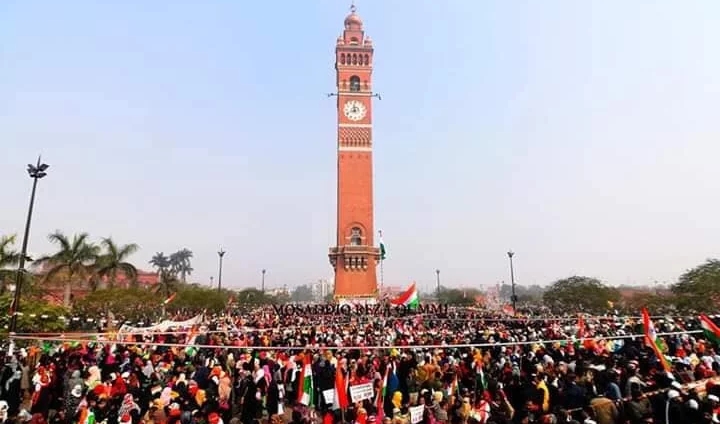
Lucknow police registered a fresh FIR against 22 people and 100-150 unidentified persons on Monday for allegedly rioting, damaging Ghanta Ghar (Clock Tower) monument and raising “inciting slogans” against the police and administration in connection with the Lucknow anti-CAA riots in December last year.

The FIR read that several women defaced and damaged the historical Ghanta Ghar monument and organised an illegal protest against the Citizenship Amendment Act (CAA) and the National Register of Citizens (NRC) at the spot on January 17, 2020.

According to the FIR, two persons who were out on bail in connection with the December 19 arson and rioting in the state were felicitated by the protestors at Ghanta Ghar on Saturday.

On March 14 (Saturday), two of the 57 people, whose photographs have been plastered across the city by the administration for recovery of money for the damage to public properties, were felicitated by the protesters at Ghanta Ghar.

“An illegal protest against CAA and NRC is going on by some women and women’s organisations at Lucknow’s Ghanta Ghar, which is in a heritage zone. These people are damaging the beauty of the monument by hijacking the stairs there and by putting nails in the walls there for their posters and banners. Encouraged by these women, several men are also raising inciting slogans against police and the government. These acts are affecting the parks and environment around Ghanta Ghar. There are a lot of tourist spots and religious places near Ghanta Ghar and several tourists from the country and outside come there. We have also received complaints from tourists of misbehaviour, fights and looting by those protesting. The complaints are under investigation,” the FIR registered on a complaint of Pramod Kumar Mishra, Station House Officer of Thakurganj police station stated.

Police said that two accused named in the FIR registered on Monday, Ebad Khan and Nitin Raj, have been arrested. In the last seven days, Uttar Pradesh police have arrested 23 people involved in the Lucknow anti-CAA riots perpetrated in December last year. Moreover, action against 27 people has been taken under the Gangster Act.

The Lucknow police on March 14 imposed the the “Gangster Act” against those arrested for violence during the protests against the Citizenship Amendment Act (CAA) in Lucknow, Uttar Pradesh on December 19 last year.

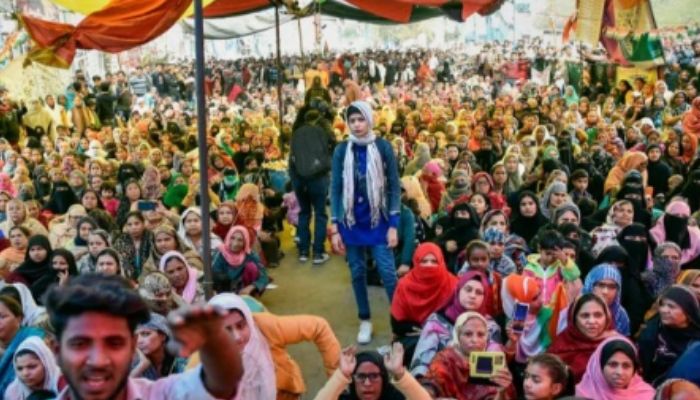
On lines of Delhi’s Shaheen Bagh, groups of Muslim women with children had squatted near the Ghanta Ghar (Clock Tower) in Lucknow’s old quarters protesting against CAA, NRC on December 19, last year. Despite efforts by the police, the women have refused to budge from the site.

Besides Delhi, protests had unfolded in several parts of the country over the Citizenship Amendment Law since it was passed on December 11 and has led to clashes at several places including Uttar Pradesh.

Fight, fight, fight! ‘Journalist’ Swati Chaturvedi attacks Islamist Rana Ayyub, calls her ‘vile person’ and ‘leper journalist’

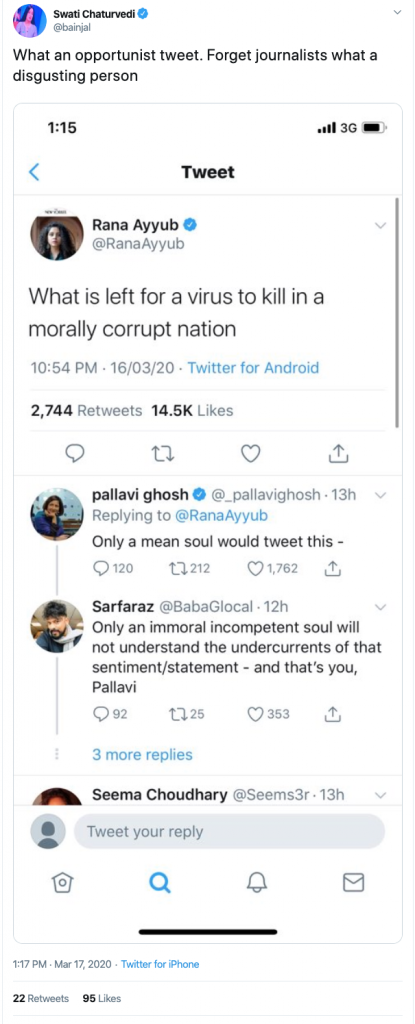
In a strange turn of events, ‘journalist’ Swati Chaturvedi today attacked Islamist Rana Ayyub for her insensitive tweet on the coronavirus outbreak in India.

On 16th March, Ayyub took to Twitter to say out aloud that everyone in India is so ‘dead’ from inside because of being morally corrupt, what can a virus kill. As many as 126 people including foreign nationals have been tested positive in India for the COVID-19 coronavirus. This has resulted in three deaths till now. States have been taking precautionary measures to contain the spread of the disease. The bizarre rant as the world battles the pandemic made people call out her hate.

Shockingly, she was also called out by other people who have in the past themselves displayed their abusive and hateful behaviour.

Swati Chaturvedi calling Rana Ayyub ‘disgusting person’

Swati Chaturvedi, an abusive troll herself masquerading as a journalist, called Ayyub a ‘disgusting person’.

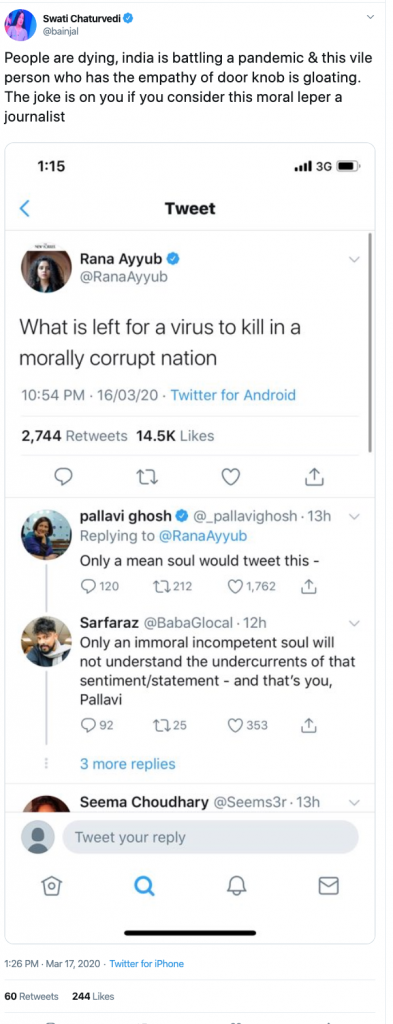
Rana Ayyub ‘vile person’

She tweeted another tweet referring to Ayyub as as person having empathy of a doorknob and called her a vile person. Furthering her attack on Ayyub, Chaturvedi said she feels sorry for those who consider her a ‘journalist’.

Amusingly, tables seems to have turned recently as till few years back, she thought quite highly of Ayyub.

Oops. Clearly, the feelings were mutual.

But then it seems Chaturvedi pointed out Ayyub that she was factually incorrect somewhere after which Ayyub blocked her.

Now that friends have turned foes, we leave it to our readers to tell us who won this fight.

World Health Organisation lauds India’s efforts to contain Coronavirus, says the commitment of govt and PMO is enormous, very impressive

The World Health Organisation (WHO) has praised India’s efforts in containing the spread of coronavirus that has claimed around 7000 lives and infected 1.82 lac people worldwide. The virus that originated from Wuhan, China has affected 125 people in India, leading to 3 casualties so far.

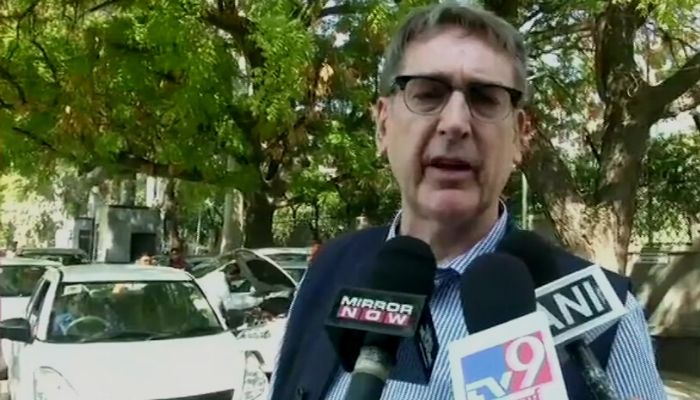
The representative of WHO to India, Henk Bekedam said, “The commitment from the Indian government and the Prime Minister’s Office has been enormous, very impressive. It is one of the reasons why India is still doing quite well. I am very impressed that everyone has been mobilised.”

He added, “We have very good research capacity in India and especially at the Indian Council of Medical Research (ICMR) and department of health research. They have been able to identify the virus. Now India will continue to be part of the research community.”

“We have a simple message to all countries – test, test, test. All countries should be able to test all suspected cases, they cannot fight this pandemic blindfolded.” WHO director-general Tedros Adhanom Ghebreyesus had said earlier.

India had become the fifth country in the world after Japan, Thailand, USA and China to successfully isolate the life-threatening Covid-19 strain. The feat was achieved by the scientists at the National Institute of Virology (NIV) in Pune where 11 strains of the Covid-19 were isolated from a patient.

“The strains are the prerequisite for conducting any research related to viruses,” said Raman R. Gangakhedkar, head of the epidemiology and communicable diseases division of the Indian Council of Medical Research. This is hailed as the first step towards the development of drugs and vaccines against the pandemic by the Indian Council of Medical Research (ICMR).

According to reports, the isolated strain has a 99.98% match with the virus in China’s Wuhan. This significant medical breakthrough will help India in developing a vaccine for the deadly Coronavirus. Although it will still take one and a half to two years to develop a vaccine, even if the trial procedures are expedited.

From dead infants to circumventing Delhi govt directions on coronavirus, Shaheen Bagh ‘protestors’ have zero respect for public safety

Following the passage of Citizenship Amendment Act (CAA), which speeds up Indian citizenship for persecuted religious minorities of the three neighbouring Islamic countries, Pakistan, Afghanistan and Bangladesh, violent protests had erupted in the national capital and other parts of the country. Following a call of Sharjeel Imam, the radical Islamist and JNU student who is currently arrested on charges of sedition, few women belonging to Muslim community sat on a protest at Shaheen Bagh. They blocked a bus stop and a main road causing severe problems to the public of Delhi. For about three months now, these so-called ‘protesters’ in Shaheen Bagh have blocked one of the busiest thoroughfares in the national capital in protest against the enactment of the Citizenship Amendment Act.

Even as the Delhi Chief Minister Arvind Kejriwal has called off all religious, family, social, political or cultural gathering in the wake of threat due to Coronavirus in the national Capital, the iconic Shaheen Bagh ‘protest’ site is not going to get empty anytime soon. The ‘protestors’ have refused to follow the containment orders and decided not to curl off their protest. 

The Muslim women sitting there, carrying on the feigned peaceful protest to supposedly save the constitutional rights of the (so-called) minorities in the country by shouting pro-Pakistan and Hinduphobic slogans like “Jinnah Wali Azadi”, demanding another partition of the country, have said blatantly that the protest will go on undeterred and that they will not comply with the Delhi government’s orders.

From what is coming across, the ‘protestors’ present at Shaheen Bagh have made this demonstration more into an ego tussle. As days pass, it is panning out to be indeed not the “right to dissent”, as initially claimed, but an attempt to tyrannize their views on others, which is indeed anti-India and blatantly Hindophobic in nature. And to do so, these protestors are ready to go to any extreme lengths. Even the death of an infant has not deterred these people from carrying out the diabolic agenda.

In one of the most heart-wrenching of recent times, four-month-old infant Mohammed Jahan lost his life after suffering from severe cold and congestion during anti-CAA protests in Shaheen Bagh. However, Nazia, the mother of the four-month-old infant Mohammad Jahan, has been unapologetic about her son’s death. Instead, she had chosen to ignore his death and rejoin the ‘protests’ at the Shaheen Bagh.

A shocking video had also gone viral across social media platforms in which kids are seen holding posters of the four-month-old infant Mohammed Jahan who died at Shaheen Bagh. One of the protestors in the background had claimed that the death of the four-month-old kid was nothing but a ‘Qurbani’ or sacrifice for the anti-CAA movement. They have used small kids, who seem to have no idea regarding the Citizenship Amendment Act, as ‘props’ at these protests.

These unsympathetic and hard-hearted ‘protestors’ seem to have zero respect for public safety and human life. The selfish ‘protestors’ do not care whether their own children are dying. And now, amidst coronavirus outbreak, they will sit in for protests in groups of 45 people to circumvent the Delhi government order prohibiting gathering of 50 or more people. This just goes out to show that they do not care for public health and safety either.

This more so when their protests are misplaced. Their protest against the CAA is not to protect themselves because CAA is not applicable to Indians, Muslims or otherwise. The women are protesting because they do not want the persecuted religious minorities of neighbouring Islamic countries to get faster Indian citizenship. And now after the deaths of the infants, they don’t care whether their selfish ‘protests’ are creating a health hazard.

Supreme court grants permanent commission of women in Navy, says objecting will be stereotyping

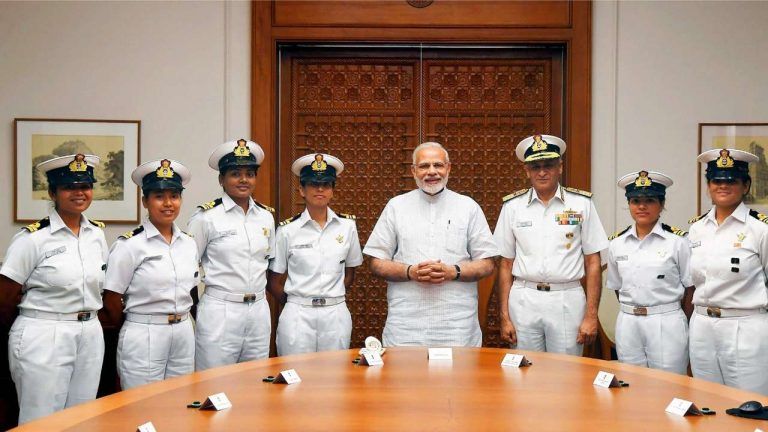
In a progressive development, the Supreme Court on Tuesday paved the way for the Grant of Permanent Commission for women officers in the Indian Navy. The top court said that objecting to a permanent commission for women in the Indian Navy will be gender stereotyping and that there should be no discrimination between men and women on the issue of grant of permanent commission in the Navy.

The Bench headed by Justice D Y Chandrachud upheld the Delhi High Court order of granting permanent commission to women officers and rejected the Union government’s plea referring to the physiological limitations of women officers in granting a permanent commission marking it as a reflection of gender stereotyping on the part of the government.

The bench ruled that “women officers can sail with the same efficiency as their male counterparts and there should be no discrimination. Denying women officers an opportunity for the permanent commission would result in a serious miscarriage of justice to those SSC women officers who have served the nation.”

The court ruled that the application of permanent commission-based will be considered based on the availability of vacancies and recommendations of Chief of naval staff.

The women officers whose Short Service Commission (SSC) came to an end before 2008 would be deemed to have been considered for Permanent Commission as a one-time measure. Rest, all the service of women officers who are not in service and those who are denied permanent commission shall be deemed pensionable service.

The Bench added that women officers in the Commodore position shall be entitled pensionary benefits and Rs 25 lakh compensation each.

The Court order came as a result of the petition of Union Government against the Delhi High court 2015 order of granting the permanent commission to women officers.

In February this year, the top court had ordered the centre to grant permanent commission to women in the Army and directed to comply with the ruling within three months.

A Permanent Commission entitles an officer to serve in Navy/Army till he/she retires unlike Short Service Commissions (SSC) which is currently of 10 years and will be extended to four more years.

Bengal based Telegraph displays hate for Dalits, equates President Kovind to coronavirus

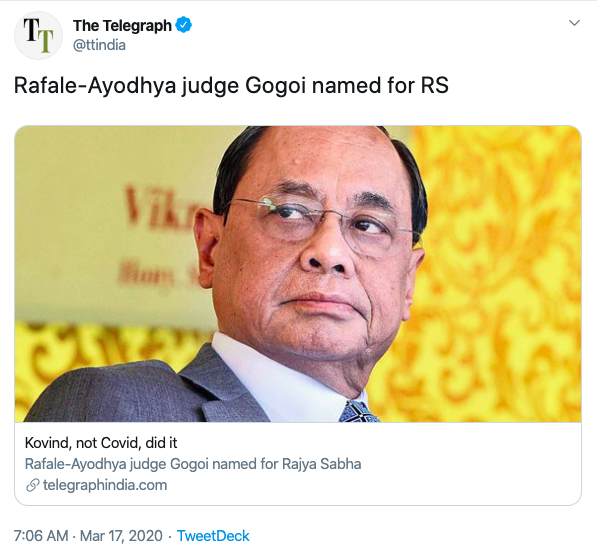
Bengal-based media house The Telegraph, in full display of casteism, has shown its hate for the Dalits. In an article on ex-CJI Ranjan Gogoi’s nomination to Rajya Sabha by the President, The Telegraph compared him to ‘covid’.

The Telegraph’s article on ex-CJI Gogoi

“Kovind, not Covid, did it’, the headline read. Covid-19 is a pandemic, a coronavirus disease which has impacted lakhs of people globally as of this moment. In its bid to make a wordplay on President’s name by comparing it to the deadly virus, The Telegraph just hit a new low.

Read: Model-actress and cancer survivor Lisa Ray exposes Telegraph for inherent sexism

Netizens pointed out how President Ramnath Kovind is a Dalit by caste and comparing him to the virus would be an insult to the Dalits who have been facing years of oppression in India. They expressed disappointment at the way the President was targeted.

Even as twitterati expressed shock at the horrifying insult to the President, there were others who deemed the headline which insults Dalits ‘brilliant’. Faulty ‘fact-checker’ AltNews Director Nirjari Sinha thought this insult to the Dalits is ‘bold and brilliant’.

Aam Aadmi Party leader Prithvi Reddy too called President Kovind a ‘virus’ which is ‘more dangerous’.

The Telegraph takes pride in ‘in your face’ headlines except when it comes to reporting on things happening in its own backyard in West Bengal. The Telegraph is more of an advocacy group than an actual media organization. During the elections, its editor had claimed in an article removing Narendra Modi from power was the only hope for India’s redemption. This is not how a news organization functions or is supposed to function.

If The Telegraph concerned itself more with journalistic integrity and chose to ally itself more with truth instead of the Trinamool Congress (TMC), its standards will without a doubt improve drastically. But it appears the editors of the newspaper will be more willing to accompany Frodo Baggins to Mordor than that. In the meantime, journalism will continue to suffer. Perhaps, The Telegraph can find its spine in Mamata Banerjee’s purse.

Former CJI Ranjan Gogoi’s nomination to the Rajya Sabha is not ‘unprecedented’ – Here’s why

The nomination of former Chief Justice of India, Ranjan Gogoi, to the Upper House of the Parliament by the president has sparked a controversy with the left-liberal jamaat engaging in character assassination and casting aspersions about his “objectivity” in the Ram Janambhoomi case. While such a meltdown was not unexpected from the vicious group, Gogoi’s appointment to the Rajya Sabha is not “unprecedented” for two primary reasons.

First, while the Indian Constitution (Article 220) restricts a retired Judge from practising law in the same Court in which he was a judge, there are no restrictions that bar him from seeking employment, joining a political party or getting elected/nominated to the Indian Parliament. It is important to mention that there is no minimum time-limit (commonly referred to as the “cooling period”) before a Judge can ride the political bandwagon, following his retirement.

However, this is not the case with everyone. The “cooling period” applies to Group “A” Government officers who cannot seek commercial employment within 2 years, post their retirement, without the permission of the government. It must be clear by now that there are no legal hurdles that can prevent the nomination of Ranjan Gogoi to the Rajya Sabha.

Second, India has a long history of judges becoming governors, contesting on the tickets of political parties, becoming Vice President and so on. For instance, the 9th Chief Justice of India, Koka Subba Rao who was at the helm of safeguarding the Fundamental Rights of citizens from the Legislature in the infamous Golaknath Vs State of Punjab case resigned 3 months before his scheduled retirement on July 14, 1967, to contest for the post of President. He was backed by the leader of the Opposition, Minoo Masani and secured 44% votes.

Mohammed Hidayatullah, the 11th Chief Justice of India, served as the Acting President from 20 July 1969 to 24 August 1969 and from 6 October 1982 to 31 October 1982. He also served as the Vice President of India between 1979 to 1984, despite having turned down requests for Presidential candidacy on three occasions.

Justice Kawdoor Sadananda Hegde served as a member of the Rajya Sabha prior to his joining the Madras High Court. He was sworn into the Supreme Court in 1967 where he became a part of the majority judgement that laid down the “basic structure doctrine” in the Kesavananda Bharati vs the State Of Kerala case.

The judgement in the case asserted that any amendment that is directed to alter the basic structure of the Constitution can be nullified by the apex court. An agitated Indira Gandhi thus superseded him to make AN Ray the Chief Justice. Hegde resigned during the Emergency and contested from a Janata Party ticket to defeat Congress candidate from North Bangalore in 1977 Lok Sabha elections.

Rangnath Mishra, the 21st Chief Justice of India, who gave a clean chit to the Congress party in the 1984 Anti-Sikh riots served as a Member of Parliament in the Rajya Sabha from the Congress Party between 1998 and 2004.

Justice Baharul Islam was a member of the Rajya Sabha from the Congress Party between 1962 to 1972. Following his resignation, he became a judge in the Guwahati High Court. After his retirement from the High Court, he was appointed to the Supreme Court by Indira Gandhi in 1980. He then resigned in 1983 to become a Rajya Sabha member again from the Congress party.

Justice Abhay Thipsay, who heard cases such as Sohrabuddin fake encounter case and retired in 2017, announced his decision to join the Congress party in 2018. Justice Thipsay was the same judge who convicted 9 out of the 17 accused in the Best Bakery case. Justice Thipsay claimed that the Hindus carried out the 2008 Malegaon blasts. There was absolutely no need for him to say so when nothing has been proven in this case yet, and Islamic radicals were initially suspected to have carried out the 2008 blasts. Thipsay said that we should accept that Hindu organizations carry out bomb blasts.

Other examples include that of Palanisamy Sathasivam, the 40th Chief Justice of India, who was appointed the Governor of Kerala by the BJP Government in September 2014. When the Congress made a hullabaloo over the issue, Manish Tewari publicly acknowledged that there was “no constitutional or legal bar” on a former Chief Justice of India to accept the position of a governor. Vijay Bahuguna who became the 6th Chief Minister of Uttarakhand from a BJP ticket also served as a Judge in Allahabad High Court and Bombay High Court.

In his last week of tenure as the CJI, Ranjan Gogoi passed a slew of key landmark judgments pertaining to government matters, religion, politics, and the applicability of the law to his own office. He etched his name in the annals history when a five-judge bench headed by him on November 9, 2019, brought an end to the Ayodhya land dispute, which dates back to even before the Supreme Court came into existence in 1950.

Ranjan Gogoi also headed a bench which, by a majority 3-2 verdict, referred to a larger seven-judge bench the pleas seeking review of the apex court’s historic 2018 judgement allowing women and girls of all ages to enter Kerala’s Sabarimala temple.

Justice Gogoi’s name will also be remembered for heading a bench which gave a clean chit to the Modi government twice — first on the writ petition and then on the pleas seeking review of the December 14, 2018 verdict, in the Rafale fighter jet deal with French firm Dassault Aviation. It also censured Congress leader Rahul Gandhi for wrongfully attributing the “Chowkidar chor hai” remark against Prime Minister Narendra Modi to the top court.

Although Congress party and others are accusing quid-pro-quo citing the Ayodhya and Rafale judgements, it is important to note that these judgments were not delivered by CJI Gogoi alone. The Ayodhya verdict was given by a 5 judge bench, and the bench that heard the Rafale petition had 3 judges. Therefore, it is an insult to the other judges of those benches to allege quid-pro-quo.

Another important point to be noted is, while the previous judges were elected to the legislature by the Congress party, Ranjan Gogoi has been nominated to the Rajya Sabha by the president, as one of the 12 nominated members of the upper house. He has neither joined the BJP, nor BJP voted for him an election. Although it will be argued that it is still a political decision as the President acts on the advice of the Council of ministers, there is a crucial difference between elected and nominated members. Those who are elected to a house from a party are subject to whip of that party. They are bound to vote the way the party directs them, and in general, they can’t criticise the party and the govt if the party is in power. On the other hand, a nominated member is an independent member, not subject to any party whip. Therefore, if Ranjan Gogoi speaks against the BJP government in the Rajya Sabha, the government or the BJP will be able to do nothing to him.


#NoToSavarkar: JNU ‘students’ deface V D Savarkar Marg signboard, put up ‘Mohammad Ali Jinnah Marg’ poster

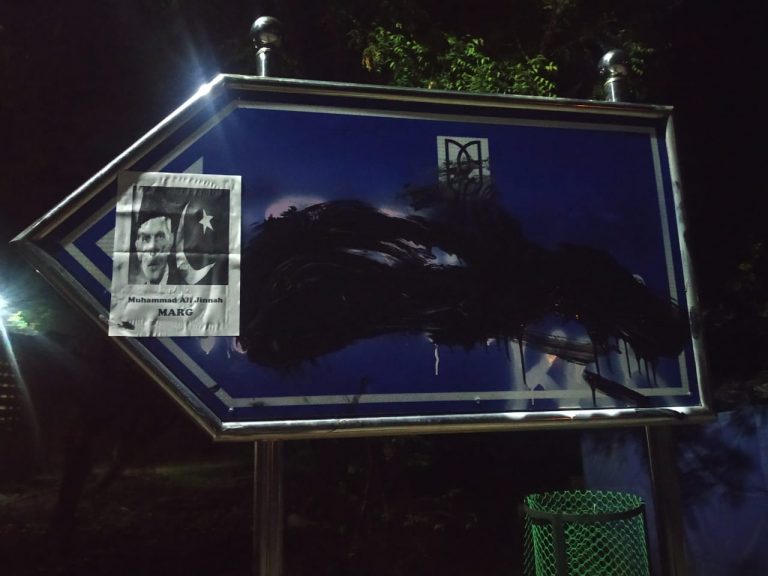
Jawaharlal Nehru University (JNU) ‘students’ allegedly defaced the newly put up V D Savarkar Marg signboard on campus and put up a poster calling it ‘Mohammad Ali Jinnah Marg’. JNUSU President elect Aishe Ghosh took to Facebook last night to show that the defaced signboard was changed to ‘B R Ambedkar Marg’.

“We can never ever accept apologists and stooges of the British who undermined our secular fabric. Let’s respect those who gave us our constitution,” She posted. However, later even the B R Ambedkar Marg signboard seems to have been defaced. A poster calling it ‘Mohammad Ali Jinnah Marg’ has now been stuck next to it.

Read: Read Indira Gandhi’s letter referring to Veer Savarkar as ‘remarkable son of India’

The decision to name the road on campus as ‘VD Savarkar Marg’ was taken in November last year.

“When Allah has given so many halal animals, why eat bats and spread virus?” Watch Pakistani cricketer Shoaib Akhtar blame the Chinese on coronavirus

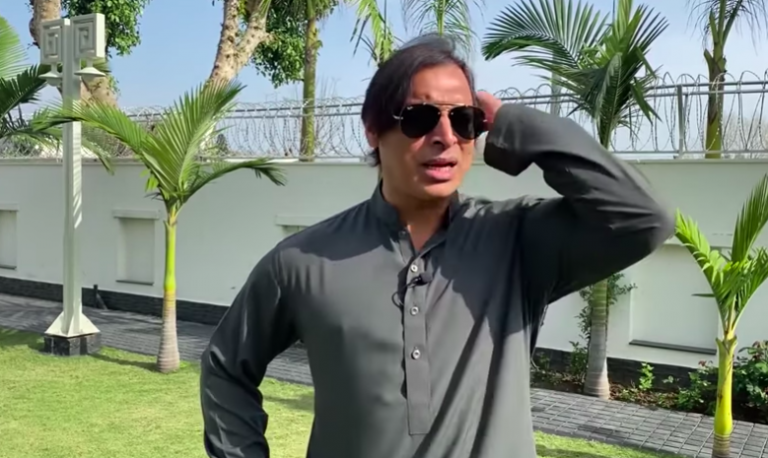
Pakistani cricketer Shoaib Akhtar has been having a total breakdown over coronavirus outbreak. Recently, Akhtar took to his YouTube channel to question the Chinese for eating non-halal animals like bats and then spreading the virus across the globe.

While he has edited the original video uploaded on his channel to remove the criticism of Chinese eating habits, the longer version of the video shows Akhtar talk about the Chinese eating the bats. “Mujhe samajh nahin aa rahi, ki Allah ne halal jaanwar banaye hai, to halal jaanwar kha lo. Zaruri hai chamkadar hi khaane hai? Unki urine peena hai, unka khoon peena hai aur poore duniya mein virus phaila dena hai. Main Chinese ki baat kar raha hoon. Mujhe samajh nahin aati jab itna Allah ne livestock diya hai halal maal mein se, woh kha lo. Kaunsa kha rahe hai? Chamkadar, kutte, billiyan kha rahe hai. Mujhe samajh nahin aa rahi poori duniya ko at stake mein le aaye hai Chinese. (I do not understand that when Allah has given halal animals, then eat halal animals. Is it necessary to eat bats? Drink their urine, their blood and then spread the virus across the world? I am talking about the Chinese. I don’t understand when Allah has given so much halal meat in livestock, eat that. Instead what are they eating? Bats, dogs, cats. I don’t understand how the Chinese have put the entire world at stake),” Akhtar said in his now edited rant.

He again reiterates how eating halal animals never led to such a problem but then the Chinese had to eat the bats and dogs. This outburst against the Chinese eating habits was followed by his raking up the Kashmir issue amidst the pandemic.

With coronavirus outbreak, nations across the globe are taking precautionary measures to contain the spread of virus including self-imposed quarantine and lockdown. Pakistan, which refused to evacuate its own citizens from Wuhan when the crisis first hit, has been acting quite salty over the pandemic.

Day after the Pakistani representative in the SAARC nation video conference to combat coronavirus raked up Kashmir issue and politicised healthcare, Pakistani cricketer Shoaib Akhtar took to Twitter to compare coronavirus related preventive lockdown to the lockdown in Kashmir for internal security reasons.

Netizens were quick to point out one of the major reasons for lockdown in Kashmir has been Pakistan-sponsored terrorism in the valley.

Some even pointed out how Kashmir and Kashmiris are safe and asked about the Pakistanis stuck in China.

Kashmiris also expressed their anger for being the victim of Pakistani-sponsored terrorism for decades.

Meanwhile, Pakistan Prime Minister Imran Khan chose to stay away from the video conference of SAARC leaders initiated by PM Modi to combat coronavirus. Moreover, Khan’s representative in the meeting, Dr Zafar Mirza, who also raked up Kashmir issue in the video conference, is now himself under probe over allegations of smuggling 20 million face masks out of Pakistan.

The Rawalpindi Express may do himself good to introspect before leaving the station in a hurry.

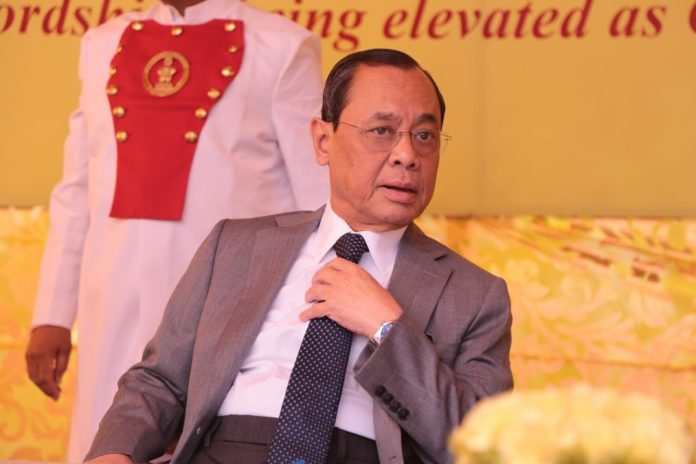
President Kovind nominates ex-CJI Ranjan Gogoi to Rajya Sabha and ‘liberals’ and Congressis can’t keep calm

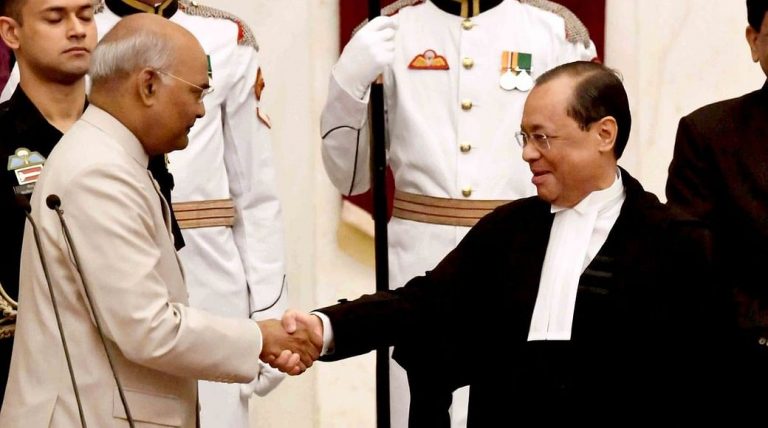
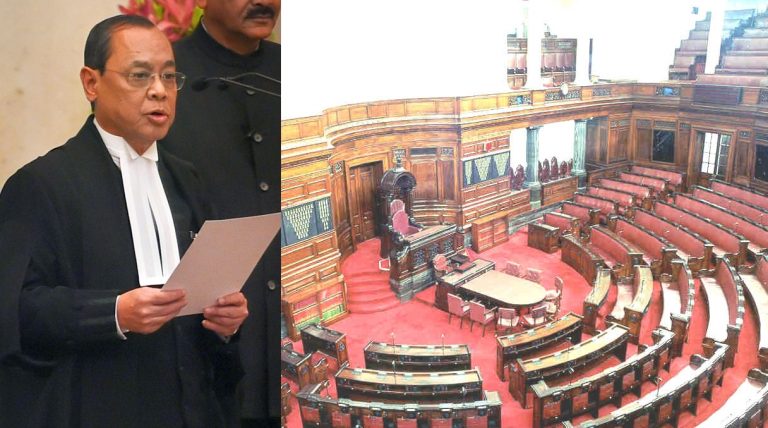
On Monday, President Ramnath Kovind nominated former Chief Justice of India Ranjan Gogoi to Rajya Sabha. Former CJI Ranjan Gogoi, the 46th Chief Justice of India, who was credited for many landmark verdicts on diverse topics like the decades-old politically and religiously sensitive Ayodhya land dispute, had retired as the chief justice of India last year on November 17. President of India nominates twelve members to the Upper House of the Parliament for a period of six years for their contribution in art, literature, science, law and social service.

His nomination to the Rajya Sabha led to a prolonged meltdown of the ‘liberals’ on social media. Aspersions were cast on the independence of judiciary.

Congress leaders also implied that the judgements were passed ‘in favour’ of the government as quid pro quo.

Gogoi’s father, Kesab Chandra Gogoi was a Congress leader and served as Chief Minister of Assam for two months in 1982.

‘Journalists’ also alleged that the nomination to Rajya Sabha is as a ‘bribe’ to Gogoi.

Congress workers were also quite ‘liberal’ fictionalising facts to sensationalise the news.

The Ayodhya verdict was delivered by a Supreme Court bench which also had justice Bobde (current CJI), justice Chandrachud (next in line to be CJI), justice Ashok Bhushan and justice S. Abdul Nazeer. The verdict was unanimous. Similarly, Rafale, too, was a three-judge bench verdict. But why let facts get in the way of a viral tweet?

Irony blatantly fawned over a politician on social media ahead of state assembly elections and got fired.

And here, irony really needs to stalk talking to the voices in her head.

In his last week of tenure as the CJI, Gogoi passed a slew of key landmark judgments pertaining to government matters, religion, politics, and the applicability of the law to his own office. He etched his name in the annals history when a five-judge bench headed by him on November 9, 2019, brought an end to the Ayodhya land dispute, which dates back to even before the Supreme Court came into existence in 1950.

The CJI also headed a bench which, by a majority 3-2 verdict, referred to a larger seven-judge bench the pleas seeking review of the apex court’s historic 2018 judgement allowing women and girls of all ages to enter Kerala’s Sabarimala temple.

Justice Gogoi’s name will also be remembered for heading a bench which gave a clean chit to the Modi government twice — first on the writ petition and then on the pleas seeking review of the December 14, 2018 verdict, in the Rafale fighter jet deal with French firm Dassault Aviation. It also censured Congress leader Rahul Gandhi for wrongfully attributing the “Chowkidar chor hai” remark against Prime Minister Narendra Modi to the top court.

The Supreme Court Bench of CJI Gogoi has also reserved its judgement on pleas challenging the constitutional validity of the Finance Act, 2017 on the ground that it was passed by Parliament as a Money Bill.

On November 13, a five-judge constitution bench, headed by Gogoi, wherein a 3:2 majority verdict, the apex court referred the broader question of whether all provisions of the Finance Act 2017 could be construed as being part of Money Bill and hence didn’t need Rajya Sabha’s approval. The Supreme Court held that a larger bench should look into the correctness of the Aadhaar judgment since the Aadhaar Act was also passed as a Money Bill.

Justice Gogoi, who was sworn on October 3, 2018, as the 46th CJI, had the tenure of a little over 13 months. On his last date at office, Gogoi circulated a parting note to journalists covering the Supreme Court, refusing one-on-one interviews. He said, “bitter truth must remain in memory.”