Home Blog Page 5602

The people with a rare gift of wisdom: The unsung heroes of Nagaland

by Dr Raktim Patar

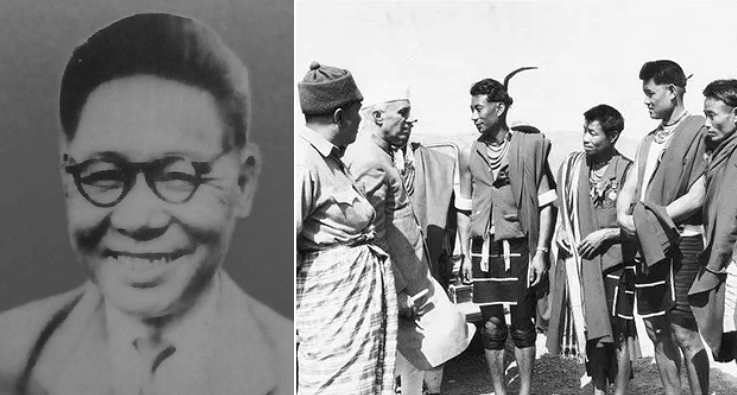
On 26th February 2020, I had a god-sent opportunity to witness an event perhaps one of the rarest of the rare in the history of Nagaland. That day, the Governor of Nagaland R.N. Ravi dedicated the Durbar Hall of the Raj Bhavan in Kohima in presence of Chief Minister Mr Neiphiu Rio and host of other dignitaries to Dr Imkongliba Ao, in honour and recognition of his contribution towards building of peaceful and developed Nagaland. Besides, the Governor also handed over letters of commendation to Padmabhushan Dr S.C. Jamir, the former Governor of Maharashtra, Goa, Orissa and the former Chief Minister of Nagaland and other 20 visionary Naga leaders belonging to Major tribes of Nagaland in recognition of their profound courage and love for peace and prosperity of fellow Naga people and patriotism who signed the 16 point agreement that paved the way for the creation of the state of Nagaland. During the function, I heard the emotional voices of some of the family members of the leaders which made me realised that the real heroes of Nagaland were never given their due recognition, rather they were blamed as traitors of Naga people by those who are enjoying the sweet fruits of the sacrifices made by them.

Nagaland came into existence as the 16th state of Indian union on 1st December 1963. It had experienced insurgency and bloodshed for quite a long time before attending statehood. The painstaking and dangerous journey towards attaining a separate identity within the constitution of India with a unique name and special provision of 371(A) was a history of sacrifices and courage of some patriotic Naga leaders that has been deliberately omitted in the history of modern Nagaland. In the contemporary history of Northeast of India in general and Nagaland, in particular, one can find the names of the militant leaders like British citizen Phizo and others and their unjustified violence for a so-called separate Nagalim or Greater Nagaland but the persons who had braved the dangers of losing their lives for the cause of the Naga people has never been given due recognition. On the contrary, they have treated with utmost disrespect and sometimes blamed as agents of India for their timely and futuristic decision to settle the Naga issue through debate and discussion and a settlement within the ambit of the Indian constitution.

Since the Indian independence in 1947, there was a demand for a separate Nagaland for which a group of Naga youth started China-backed armed conflict with the Indian government. As a result, thousands of people were killed, the villages were dislocated/destroyed, educational institutions were closed down, the economy plunged into the depth of sea, starvation and famine become a common phenomenon in the life of the Naga. Poverty and underdevelopment almost pushed the Naga people into primitive age. At this juncture, a group of courageous people under the leadership of Dr Imkongliba Ao decided to hold the first Naga Peoples’ Convention to discuss the future of the Naga people. Amid the sea of violence and bloodshed they toured the length and breadths of Naga inhabited area and convinced all the 16 major Naga tribes to send their representative for the convention that was held at Kohima from 22nd to 26th August in 1957. In this convention, more than 1735 representatives of all the major tribes of the Nagas, particularly Naga hill and Tuensang area of erstwhile North-East Frontier Agency along with 2000 observers from other Naga areas such as Manipur, Burma, actively deliberated the issue for a respectable and peaceful political solution of the Naga problem.

Due to the efforts of Dr Imkongliba Ao and leaders like him, the convention resolved to solve the Naga problem through satisfactory political settlement within the union of India and appealed the Naga people to give up the cult of violence for the greater peace and prosperity. It marked the beginning of a new era in the history of Nagaland. With the prompt response from the Indian government, the Naga leaders decided to go ahead with the resolution adopted by the Naga Peoples’ Convention and discussed with the then Prime Minister Jawaharlal Nehru in September 1957. On the eve of their journey to New Delhi, Dr Ao, a visionary and a profound lover of peace, stated that they believed neither in violence nor in the creation of an independent Naga state and what they wanted was a modification into the existing administrative set up so that they could share the fruits of India’s independence and develop following their own economic, social and religious beliefs.

After a fruitful discussion, the government of India decided to amend the sixth schedule of the Indian constitution and created an administrative unit separate from Assam by the name Naga Hills Tuensang Area on 1st December 1957. It was the first milestone in the way of the creation of the autonomous state of Nagaland within the framework of the Indian Union. As a result, 3000 Naga underground rebels came out voluntarily including Phizo’s son and daughter saying that they were unable to bear the hardships of life in the jungles. While the hostile forces denounced the settlement, the peace-loving Naga held it as the dawn of the new era in Nagaland. However, hostilities continued in Nagaland. The rebels continued their plunder, attack and killing of the innocent Nagas.

Nevertheless, the peace-loving Naga organised a second Naga Peoples’ Convention in May 1958, as encouraged by the success of the first Naga Peoples’ Convention held in August 1957. Despite the protest and threat of the hostile Nagas, the second convention was held at Ungma village in Mokokchung district from 21st to 23rd May 1958. It was attended by more than 2,705 delegates representing various Naga tribes. It reaffirmed the decision taken in the first Naga Peoples Convention and expressed their satisfaction over the improved law and order situation in the Naga Hill. The convention strongly condemned all sorts of violence, dacoity, theft, intimidation false impersonation and propaganda, the imposition of fines and closing down of schools in certain areas.

Further, the convention formed a liaison committee under the leadership of Dr Imkongliba Ao and 7 other members to explore the possibilities for an agreed solution to the Naga problems and to convince and bring the underground Naga into the peace process. It was a horrendous task to contact and convince the politically motivated Naga underground leaders. Nevertheless, they risked their lives and made contact with them in the deep jungles but failed to convince them to fall in line with the Naga Peoples’ Convention. Subsequently, a drafting committee was formed which formulated a 16-point proposal. The sixteen-point proposal envisaged the formation of a new state to be known as Nagaland within the Indian Union comprising the territories hitherto known as the Naga Hills Tuensang Area (NHTA).

The sixteen-point proposal was placed before the third Naga Peoples’ Convention which met at Mokokchung from 22nd to 26th October in 1959. It approved the proposal to be placed before the government of India and requested the underground Nagas to come overground and to give up the path of violence and to participate in the running of the new government of Nagaland. Dr Imkongliba Ao, who was instrumental in the drafting of the 16 point proposal, in his letter dated 26th July 1960 to the Prime Minister of India clearly stated, “It is only in a separate homeland of our own, we will fully play our part in the development of the country as a whole and running of our popular government according to our culture and traditions. Finally, the sixteen-point agreement was concluded between the 21 representatives under the chairmanship of Dr Imkongliba Ao and the government of India on 30 July 1960. They were leaders and nation builders of post-colonial India!

Read- The 21 leaders of Naga People’s Convention: Heroes of Nagaland that the nation forgot

Following the agreement, an Interim Body comprising of 42 members and Dr Imkongliba Ao as its Chairman was inaugurated in presence of thousands of peace-loving Naga people by Gen. Shri Nagesh, the governor of Assam, on 18th February 1961 at Kohima. The members of the interim body expressed their allegiance to the constitution of India and committed themselves to work for the upliftment and general welfare of the people. Dr Ao appealed to the hostile Nagas to abandon the path of violence and not to sabotage the final decision of the Naga people who wanted to have no more bloodshed, suffering and miseries. However, the Rebels turned a deaf ear to the appeal and continued their hostile activities against the government and the Naga people. Out of frustration, they assassinated Dr Imkongliba Ao at Mukokchung on 22 August 1961, while he was returning at night from his dispensary after serving the sick and needy.

The person who wanted to create a peaceful and developed Nagaland to compete with the rest of the world came to an end. In contemporary history, Dr Ao and his colleagues’ contributions were forgotten. After 58 years of silence in the hills of Nagaland, Dr Imkongliba Ao and his visionary friends are now being honoured. It is indeed a humble but incomparable gesture by the Governor of Nagaland. Dr Ao and his men never thought of their aggrandisement or self-benefit, what they did were out of their devotion and love for the people of Nagaland. They deserve more than what the people of Nagaland should give to them. Unfortunately, Naga rebels denigrated them and the rest of the country forgot them!

Contributions of Leaders of Naga People’s Convention is not only towards building a peaceful and prosperous Nagaland but also sowing the seeds of a peaceful North East of India and stabilising our nation’s eastern frontier!

(Author is Dr Raktim Patar, academician, historian, thinker and writer. He is a research scholar at North East Centre, New Delhi)
Karni Sena disrupts shooting of Akshay Kumar starrer ‘Prithviraj’

Bollywood actor Akshay Kumar starrer Prithviraj, which is slated to release in November 2020 has run into trouble with Karni Sena. This comes soon after the political drama surrounding the Sanjay Leela Bhansali movie Padmaavat and Kangana Ranaut’s Manikarnika finally fizzled out. Karni Sena has disrupted shooting of the film threatening that ‘no tampering of facts’ will be tolerated.

Members of the outfit, led by its national president Mahipal Singh Makrana, staged a protest at the shooting of the film in Jaipur’s Jamwaramgarh village, Saturday and asked the director, Chandra Prakash, to stop the shooting. Despite the assurance from the makers that the film’s script does not tamper with any historic facts, the organisation was not convinced and have demanded a written assurance from the team.

“We held discussions with the director, Chandra Prakash, regarding the film’s script today. We told him that no tampering with historic facts will be tolerated,” Makrana said on Monday. “Prithviraj Chauhan should not be portrayed as a lover in the film. The director has assured us that there is no such thing in the movie but we want a written assurance,” he said.

Prior to this, Karni Sena had protested against Kangana Ranaut’s Manikarnika: The Queen of Jhansi. They claimed that it had distorted history and will not let the film release unless their terms are met. They were reported to be upset as they believed that the film showed a relationship between Laxmibai and a British officer. They had also claimed that the film showed the queen dancing to a special number, which is against their tradition. 

Prior to that, a controversy over Bollywood movie ‘Padmaavat’ had brought the Rajput Karni Sena to national prominence, albeit for the wrong reasons. It had offered a bounty of Rs 5 crore to chop off the nose of Deepika Padukone, who had essayed the role of Rani Padmini and also vandalised property at a Madhya Pradesh school where students were performing on “Ghoomar”, a song from the movie. The period drama set in the 14th-century had enraged the Rajput group who demanded that the film be banned for allegedly “disrespecting the sentiments of the community”. Their agitation had forced its makers to change its name from ‘Padmavati’ to ‘Padmaavat’.

The Congress, whose favoured political tactics has always been appeasement, had encashed the opportunity and played a clever double game over the protests, bearing in mind the elections in Rajasthan later that year.

It was reported by us how Digvijay Singh came out in support of the Anti-Padmaavat protests and claimed that movies, which ‘hurt sentiments of any religion or caste should not be made’. That year in December, the Congress returned to power in Rajasthan 2018 after defeating the BJP.

In 2008, Asutosh Gowarikar’s period drama Jodhaa Akbar, too, faced the wrath of the Senas. Alleging that the movie had distorted history, the activists claimed that the portrayal of Jodha Bai in the movie was not true to facts, Jodha Bai, a princess of Jodhpur, was not married to Akbar, they said.

After the release of the movie, they wrote letters in blood and sent it to theatre owners of the state against screening the movie. Eventually, the movie was not released in Rajasthan. The Sena leaders also urged the Rajput organisations in other states not to screen the movie.

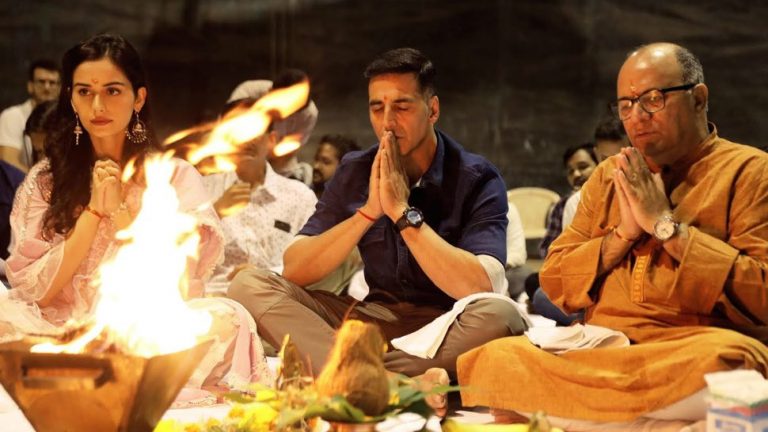
Prithviraj is an upcoming 2020 Bollywood Hindi historical action drama film, directed by Chandraprakash Dwivedi and produced by Aditya Chopra under his production house Yash Raj Films. It is about the life of Chahamana king Prithviraj Chauhan and stars Akshay Kumar in the lead role of Chauhan, while Manushi Chhillar (in her film debut) plays his wife Samyukta. The film was officially announced on 9 September 2019 and it will probably be theatrically released in India on 13 November 2020 during the Diwali festival.

Union Government defends CAA in affidavit filed in Supreme Court, says there is narrow scope of judicial review

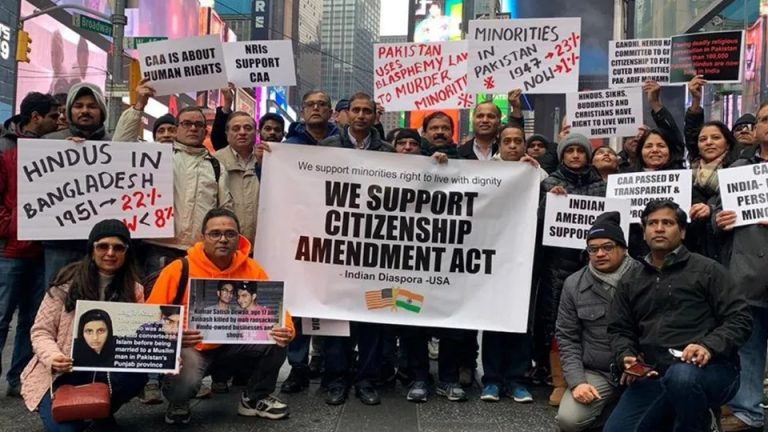
In a 129-page affidavit, the Union Government has defended the Citizenship Amendment Act (CAA) before the Supreme Court of India. Emphasising on the powers vested in the Parliament to legislate on the subject of citizenship, it argued that CAA “may not be within the scope of judicial review.”

The affidavit was filed after a 3-Judge Bench of the Supreme Court in January granted the Union Government 4 weeks time to respond to the petitions contesting the legality of the Citizenship Amendment Act. The apex court had refused to put a stay on the implementation of the humanitarian law.

The affidavit read, “CAA is a benign piece of legislation which seeks to provide relaxation, in the nature of an amnesty, to specific communities from the specified countries with a clear cut-off date.” The government further argued, “CAA does not impinge upon any existing right that may have existed prior to the enactment of the amendment and further, in no manner whatsoever, seeks to affect the legal, democratic or secular rights of any of the Indian citizens.”

The decision of the Government to make “reasonable classification” between the religious minorities (Hindus, Sikhs, Jains, Parsis, Christians and Buddhists) and the majority (Muslims) had drawn the ire of the left-liberal ecosystem in the country. The Centre has justified the classification as a “necessity” for the purpose of special legislation.

Highlighting the narrow scope of judicial review and the plight of religious minorities in India’s neighbourhood, the affidavit stated, “The constitutionality of such a legislative measure ought to be tested within that legislative domain and cannot be conflated to extend beyond that object and the reasons behind the Parliamentary cognizance of the issue by which the competent Legislature has, in its wisdom, devised a legislative policy to deal with the acknowledged problem of persecution of the particular communities in the specified countries who are, by their very Constitutions, theocratic countries.”

CAA which embraces the idea of India is aimed to speed up the citizenship process of minorities from neighbouring Islamic Republics of Bangladesh, Afghanistan and Pakistan who had to India before December 31, 2014, owing to religious persecution. Several petitions have been filed at the apex court against the legislation. A petition filed by Indian Union Muslim League (IUML) alleges that it violates the fundamental Right to Equality and intends to grant citizenship to a section of illegal immigrants by making an exclusion on the basis of religion. IUML says that CAA us against the basic structure of the Constitution and intended to explicitly discriminate against Muslims.

Lawyer of Nirbhaya rape and murder convicts approaches NHRC seeking to stay the execution

0

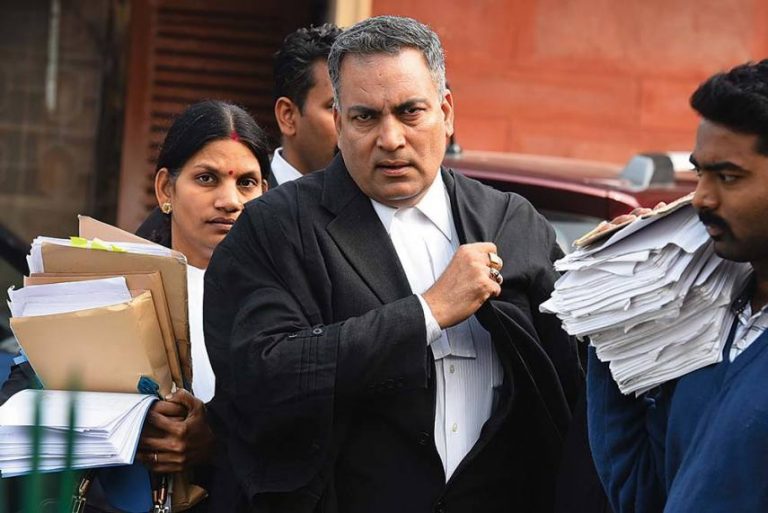
The lawyer of rape and murder convicts in the Nirbhaya case, AP Singh said on Tuesday said that he has approached the National Human Rights Commission (NHRC) for seeking a stay on the execution of four convicts.

AP Singh told the reporters, “We have appealed the NHRC to stay the March 20 death warrant, which is a miscarriage of justice. The basis for the appeal is that Ram Singh, who is believed to have committed suicide in Tihar jail, has a 70-year old mother and a 10-year-old son.”

AP Singh alleged that Ram Singh was lynched in jail and his brother Mukesh Singh, another convict is the sole witness of the incident, therefore, he should be kept alive. “At that time it was suspected that Ram Singh had committed suicide. Now that the Book ‘Black Warrant’ has come out, it is clear that Ram Singh was lynched and jail officials were involved in it,” said AP Singh.

AP Singh alleged that the probe into Ram Singh’s death was biased and no compensation has been paid to his family. He said, “The probe into the alleged suicide was biased. Yet compensation has not been given to the family of the deceased. Mukesh is the only witness to the incident. If he is executed in a hurry, it will be a miscarriage of justice and violation of human rights.”

Singh urged the Human Rights Commission to stay the execution, seek records in the matter and give compensation to the family of Ram Singh.

Earlier on Tuesday, Mukesh Singh, who is one of the convicts in Nirbhaya’s rape and murder approached a Delhi court seeking repeal of the death penalty with a claim that he was not present in Delhi when the gruesome act of crime was committed. But the court dismissed his plea. The court also sent the matter to the Bar Council of India (BCI) asking them to give appropriate sensitisation exercise to Singh’s counsel.

The four convicts in the Nirbhaya rape and murder case- Mukesh Singh, Akshay Thakur, Pawan Gupta, and Vinay Sharma are scheduled to be hanged on 20 March at 5:30 am.

Karnataka Doctor who had treated India’s first causality in the coronavirus outbreak tests positive for the virus

0

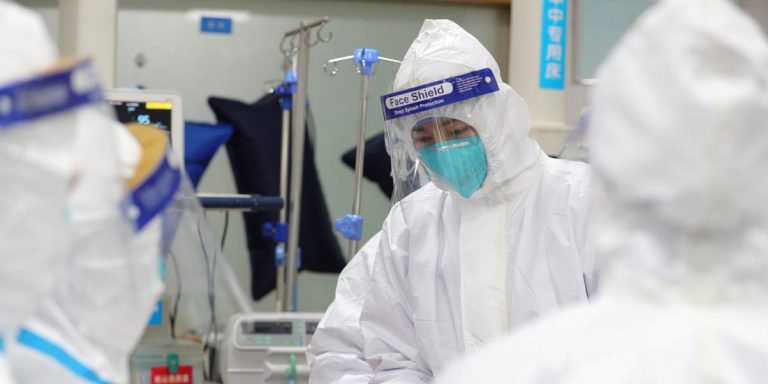
A Doctor who had treated the 76-year-old patient who succumbed to the Covid-19 infection in Karnataka’s Kalaburgi has now tested positive for the virus. The 76-year-old person was the first person to die in India due to the outbreak. The senior citizen who had returned from Saudi Arabia was reported dead while in isolation on March 10.

While speaking to ANI, Deputy Commissioner of Kalaburgi Sharat B said, “The Doctor who treated the 76-year-old is tested positive. He along with his family have been kept in-home quarantine at his home. He will be sent to the isolation ward today.” The Karnataka health officials are notifying patients and staff who came into contact with the doctor.

The 63-year-old doctor is among the two latest cases reported by the state of Karnataka today taking the toll of infected patients up to 10 in the state.

The health Minister of Karnataka B Srirammulu informed on twitter on Tuesday that Two more cases have been reported in Karnataka, one is of a 20-year-old female who travelled from the UK and another contact of P6 (Kalaburgi deceased patient). Both are admitted to designated isolation hospitals.

Earlier, Chief Minister of Karnataka BS Yediyurappa announced the closure of Malls, cinema halls, pubs, schools, colleges, summer camps, exhibitions, and other events that approaches mass gatherings across the state in order to prevent the vastly spreading threat of coronavirus.

Coronavirus: Despite Delhi Police’s request to Shaheen Bagh ‘protestors’ to vacate the area, they refuse to budge

Following the Delhi Chief Minister Arvind Kejriwal’s order to call off all religious, family, social, political or cultural gathering in the wake of threat due to Coronavirus in the national capital, the Delhi police have reached the protest site.

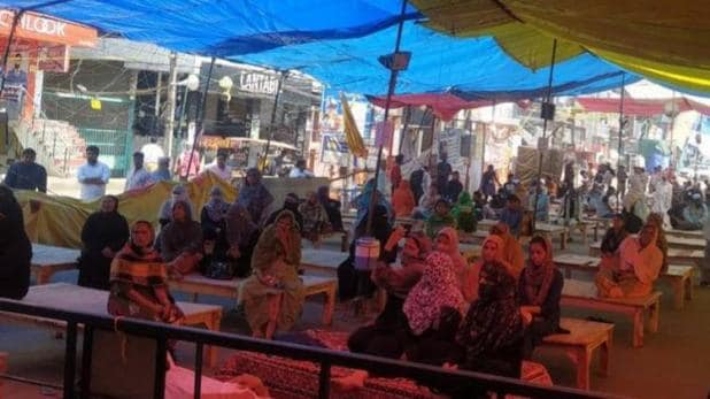
According to reports, the police along with Resident Welfare Association members Tuesday afternoon spoke to the protesters and requested them to call off their protest. The protestors have, however, not considered paying heed to the repeated requests to vacate the place. In the wake of the Novel Coronavirus outbreak, the Delhi Chief Minister Arvind Kejriwal on Monday invoked the Epidemic Diseases Act of 1897 and declared a new set of bans to limit the spread of the highly contagious disease.

In the press release, the AAP supremo announced a complete ban on social, religious and political gatherings of more than 50 people in the national capital. The ban, effective immediately, will also be applicable on Shaheen Bagh ‘protest’ site where Muslim women have been sitting on a ‘protest’ against the amended Citizenship Law for the past three months now.

However, the Muslim women sitting there, carrying on the feigned peaceful protest have said blatantly that the protest will go on undeterred and that they will not comply with the Delhi government’s orders. They have apparently been praying and reading the Quran at the protest site, believing that praying to Allah would safeguard them from the coronavirus crisis. 

Besides, wooden benches have been laid down at the protest site and instructions have been given that not more than two protestors will sit on one bench. As a precaution, the elders have put on masks and children have been kept away from the protest site, but they somehow are not willing to end the overplayed protest.

These unsympathetic and hard-hearted ‘protestors’ seem to have zero respect for public safety and human life. These selfish ‘protestors’ said they would sit in for protests in groups of 45 people to circumvent the Delhi government order prohibiting gathering of 50 or more people. This just goes out to show that they do not care for public health and safety either.

The national capital has reported seven confirmed coronavirus cases so far. India had reported its second casualty due to coronavirus, with the health ministry confirming on March 14 that a 68-year-old woman died in Delhi. India has 126 confirmed cases of COVID-19 coronavirus as on March 17, 2020, at 11.52 AM and three people have as of now died with the infection.

Madhya Pradesh: SC agrees to hear BJP’s plea seeking urgent floor test tomorrow, issues notice to Kamal Nath Government

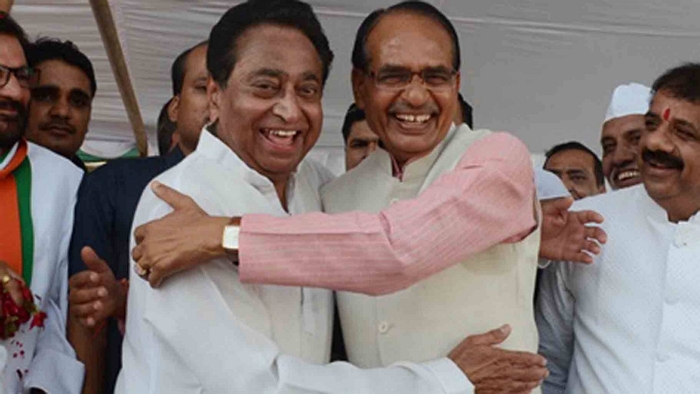
The Supreme Court on Tuesday served notice to the Madhya Pradesh state government seeking a response from Kamal Nath government by Wednesday on the plea of former chief minister Shivraj Singh Chouhan seeking a direction to conduct an immediate floor test on the floor of the assembly. The notice was also served to the Speaker, Principal Secretary of assembly and the Governor. The matter will be listed on Wednesday at 10.30 AM.

In the plea, BJP had stated that the Congress Government in Madhya Pradesh led by Kamal Nath has “lack of confidence” and his government has been “reduced to a minority.” “It has no moral, legal, democratic or constitutional right to remain in power even for a single day. All possible attempts are being made by the Hon’ble Chief Minister to convert his minority government into the majority by giving all possible threats, allurements to the members of the Madhya Pradesh Vidhan Sabha. The horsetrading is at its peak. Therefore, it is essential that floor test is conducted on 16.3.2020 itself as already directed by Hon’ble Governor, so that it becomes absolutely clear as to whether the Hon’ble Chief Minister continues to enjoy the confidence of the majority of the Madhya Pradesh Vidhan Sabha,” the plea stated.

Meanwhile, former CM and BJP stalwart Shivraj Singh Chauhan accused the Kamal Nath government of employing “pressure and allurement” tactics to save it from falling.​ Chouhan’s statement came hours after the apex court asked the state government to give by Wednesday its response to his plea seeking a direction for an immediate floor test.

On Monday, soon after the Speaker of the Madhya Pradesh Assembly, NP Prajapati, adjourned the assembly in view of coronavirus outbreak, without ordering a floor test and reportedly defying the directions of Governor Lalji Tandon, BJP had moved Supreme Court against the decision. 

On 16th March, Madhya Pradesh Governor Lalji Tandon wrote to the Chief Minister of MP, Kamal Nath, ordering a floor test to prove majority on 17th March 2020. In a strongly worded letter, the Governor rebuked Kamal Nath and said that despite asking him to prove majority on the floor on 16th, it was not done.

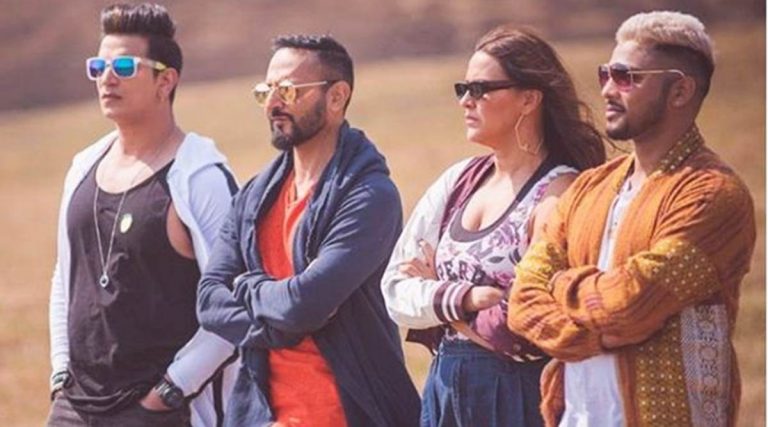
The paradox of MTV Roadies: Jury members lay claim to higher standards of propriety but their conduct betrays their moral bankruptcy

Every year, thousands of enthusiastic Indians queue up to be a part of MTV Roadies, a reality TV show involving travel, drama, adventure and a touch of voyeurism. The selection of the candidates hinges upon the discretion of a set of sanctimonious jury members who evaluate the contestants based on their moral uprightness, integrity, skills, capabilities and other unique characteristics.

The contestants, in their bid to appear distinct from the horde and brighten their prospects of selection, embellish their responses to jury’s questions with either scandalising choices or stark admissions about specific incidents in their lives or when asked about their reaction on a particular scenario.

In one such incident recently, one of the contestant raised the heckles of the jury members when he claimed of hitting his girlfriend for her disloyalty. The contestant remorselessly claimed that in the fit of anger he slapped his ex-girlfriend after he came to know that she dated 5 other men simultaneously along with him. Flustered by this admission, one of the jury members and gang leader Neha Dhupia hectored the Roadies contestant for apparently hitting his former girlfriend for cheating on him behind his back.

The candid admission by the contestant did not sit well with Neha Dhupia who lost her cool on the contestant for resorting to violence against his ex-girlfriend for her infidelity. Defending the girl, Dhupia blasted at the contestant saying, “What you are saying that she went out with not one but 5 other boys, listen to me, it’s her choice. Maybe the problem lies with you. Nobody gives you a right to slap a girl.”

Soon after Neha’s video of outburst against the contestant went viral, she was at the receiving end of criticism by many social media users who accused Dhupia of being a hypocrite and highlighted her tranquil behaviour when a female contestant in one of the previous editions of the Roadies show proudly claimed that she had hit 4 men. Netizens were unsparing in calling out Neha’s duplicity, calling her a “fake feminist” who outrages over a man hitting a woman but discreetly accedes to a woman hitting a man.

In addition, social media users were also merciless in pointing out to an earlier video in which Dhupia had evidently acknowledged having cheated on her boyfriend.

In the Roadies audition when Neha Dhupia rebukes the contestant for slapping his unfaithful girlfriend, another jury member, Nikhil Chinapa, joins in Dhupia to lambast the contestant for his violent demeanour against the girl. When the contestant attempts to explain his actions, an apoplectic Chinapa walks up to him hurling abuses at him. The contestant tries to defend himself saying that if he’s loyal to someone, he would expect the same from his partner as well. But, Nikhil tries to provoke him asking him to mirror his anger in front of him.

While Chinapa passed moralising sermons against the use of violence to express one’s disappointment, Twitter users promptly dredged up an old video from obscurity where he was seen slapping a Roadies contestant to remind Chinapa to practice what he preaches before mouthing off platitudes to others. Just as abuse in relationship, physical or emotional, is wrong, so is bullying and public humiliation to make a point.

This incident added fuel to the fire as the Twitter users appeared more infuriated than impressed with the jury members’ selective display of conniption against the contestants’ perceived immoral behaviour. Users drew out the contrast between the jury members’ disposition towards abusing and deriding a contestant for resorting to violence and maintaining a stoic silence over the incidents of violence exhibited by the fellow members of the jury.

Roadies show has a long and unremitting tradition of hurling expletives and abuses against the contestants by Roadie judges. This morally depraved tradition was pioneered by none other than the founder of the Roadies TV show Raghu Ram, for whom it was a habit to vent his spleen by abusing contestants whose views did not conform with his blinkered worldview. There have been umpteen instances when Raghu had subjected the contestants to relentless abuses and ignominy along with manhandling. However, his associate jury members simply watched over the whimsical Raghu on his meltdown.

In another incident, Roadies judge Prince Narula had gotten embroiled in a heated argument with one of the contestants, following which he slapped him. However, none of the judges-Neha Dhupia, Nikhil Chinapa or others hauled Narula over the coals for his blatant act of aggression.

In one of the episodes of previous editions of Roadies, then judge Karan Kamra was seen landing a resounding slap on a contestant’s cheek after he seemed perturbed by the contestant’s response. However, not one of the remaining judges raised their objection to Kundra’s act of violence. While Neha watched Kundra thwacking the contestant, Rannvijay Singh was seen silently appreciating Kundra’s action.

From being an adventure reality TV show, Roadies has now devolved into a pitiable cringe-worthy show whose jury members have a bloated sense of entitlement, believing themselves to be a cut above the world and a false sense of notion that they are exempted from being evaluated by the same token as the contestants. While they sermonise others on having strong moral probity and subject contestants to higher standards of propriety, their own conduct hardly conforms to the virtuous ideals they put the contestants through.

Old photo of Baba Ramdev in hospital circulated with false claim that he fell ill after overdosing on cow urine to prevent Coronavirus

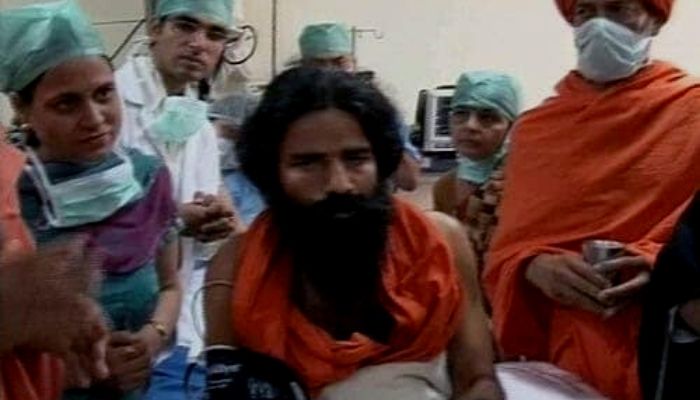
A photograph of Baba Ramdev admitted in a hospital is being circulated on social media with the claim that the yoga guru had to be hospitalised after he overdosed on cow urine. But no such thing has happened, and an old photograph is being circulated to mock Baba Ramdev using the cow urine drink jibe, which is a favourite tool used by Jihadi terrorists and Islamic fundamentalists to mock Hindus.

The photo shows a weak-looking Baba Ramdev in a hospital, surrounded by several people including doctors. A Twitter user (@rehman_5) shared the photo claiming that he drank “too much cow urine to show resistance power to corona virus”.

Similar claims were made by many other users, including users named ‘Areba Noor Wazir’ and ‘Bleed Green’ who identify themselves on Twitter as a Pakistani Muslims.

What’s the Truth?

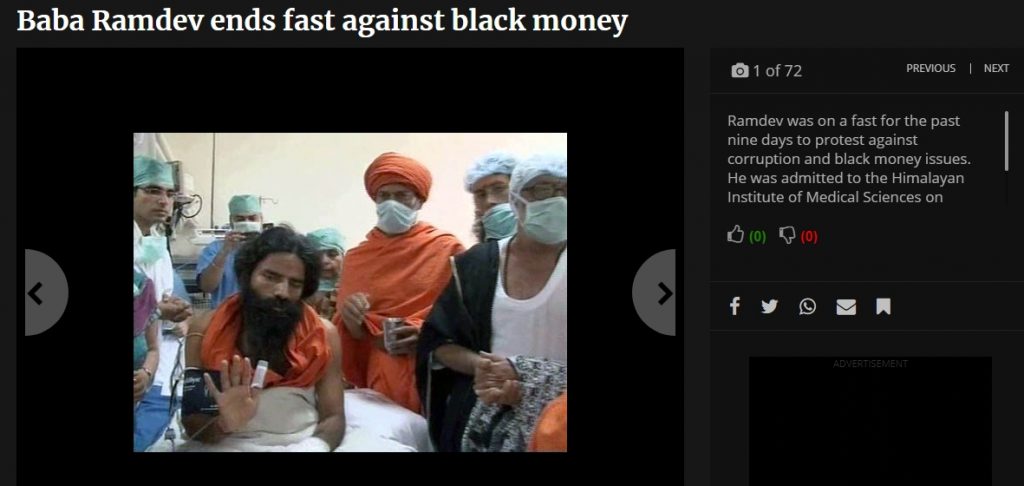
Using the photograph to do a reverse image search on the Internet shows that the photograph is from 2011, when the health of Baba Ramdev had deteriorated following a hunger strike. The photograph was published by India Today in June 2011, which says that Baba Ramdev was admitted to the Himalayan Institute of Medical Sciences on Friday after his condition deteriorated at his ashram in Haridwar. He was on a fast for nine days to protest against corruption and black money issues, after which he was hospitalised.

The Photograph was taken on June 12, 2011, when Baba Ramdev had broken the fast after staying two days at the hospital. He had broken the fast on the appeal of spiritual leaders.

Debunking the misleading claims on March 5, the official spokesperson of Baba Ramdev, Tijarawala SK, said, “This is stupid and shameful. He (Ramdev) is perfectly healthy. He has been interviewed by several news channels in the past 2 days. Today he is travelling to Bangalore.”

Therefore, the claim that Baba Ramdev has been hospitalised recently for overdosing on cow urine is false.

The spiritual leader has often been the target of fake news. Earlier, an activist doctor had posted a confidential medical report of a private individual to falsely claim that the associate of Baba Ramdev consumes ganja (Marijuana). Dr Anand Rai, who is known as a whistleblower of the Vyapam scam in Madhya Pradesh, posted the copy of a medical test report on his verified Twitter handle making the claim.

Dr Rai is close to senior Congress leaders, who wanted to contest Madhya Pradesh assembly elections in 2018 on a congress ticket. In the medical report that he posted on Twitter, the name of the patient is mentioned as Acharya Balgovind Ji, and the report indicates that urine test of the person is positive THC (Tetrahydrocannabinol), which is an active ingredient of Marijuana.

Viral tweets and social media frenzy: The unjust hype behind ex-CJI Gogoi’s Rajya Sabha nomination

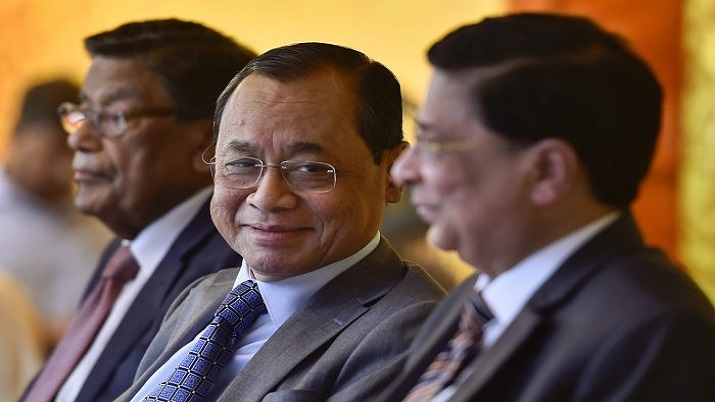
Many former judges have joined politics post their retirement. That is nothing new. So, why are we hyping the nomination of former Chief Justice Ranjan Gogoi to the Rajya Sabha and calling his judgments partial?

Yesterday, President Kovind nominated former Chief Justice Ranjan Gogoi to the Rajya Sabha. Ranjan Gogoi was the 46th Chief Justice of India who is credited for passing many a fearless judgment. He is also the one who helped us solve the centuries-old political and religious dispute of the Ram Janmabhoomi before he retired! He also was responsible for allowing women to enter Kerala’s Sabrimala temple. 

Before I address the social media frenzy over the appointment of former Chief Justice Ranjan Gogoi to the Rajya Sabha, we need to understand the role and importance of the nominated members in the Rajya Sabha. Article 80 (1)(a) when read with Article 80 (3) of the Constitution of India provides that the President can nominate 12 members to the upper house of the parliament i.e. Rajya Sabha, that has 250 members in all. These members shall be from amongst persons who have special knowledge or practical experience in respect of such matters as literature, science, art, and social service.

The reason behind these nominations is that distinguished people who have the experience and have prospered in their respective fields can serve the country without having to undergo the grueling election process. Nomination to the Rajya Sabha is not just a recognition of their merit but it also will help the parliament in terms of adding knowledge and diversity during the debates and discussions. If I may quote our first Prime Minister Jawaharlal Nehru in one of his addresses in Lok Sabha on the 13th of May 1953, “They do not represent political parties or anything, but they represent really the high watermark of literature or art or culture or whatever it may be”.

Read: Former CJI Ranjan Gogoi’s nomination to the Rajya Sabha is not ‘unprecedented’ – Here’s why

Former Chief Justice Ranjan Gogoi’s appointment to the Rajya Sabha has caused quite a furor on social media who have now questioned the independence of the judiciary. The opposition leaders have also hinted that all the “judgments” passed by former Chief Justice Ranjan Gogoi in favor of the government were done in exchange for this Rajya Sabha seat. But, I think they forgot that the father of Ranjan Gogoi is Kesab Chandra Gogoi who was a Congress leader and he had also served as the Chief Minister of Assam for two months in the year 1982. As of the Ayodhya verdict, wasn’t it a unanimous verdict of a 5 judge bench which consisted of Justice Bobde (our present Chief Justice of India), Justice Chandrachud (Our future Chief justice of India), Justice Ashok Bhushan and Justice S. Abdul Nazeer? Similarly, wasn’t Rafale a verdict of a three-judge bench?

No judge in a judicial bench can determine the judgment alone. Also, none of the judgments can be politically motivated or be done to one’s whims and fancies. All judgments are the courts’ decision of the rights and liabilities of the party in a legal action or proceeding. The judgments also need to include the reason for a particular decision being taken. It gives you all the reasons as to how the judicial bench came to the final conclusion. And to say the least, all of the judgments should uphold our law of the land, the Constitution of India. So, to say that our judgments are partial is basically disregarding the Constitution of India. Just because a judicial bench delivers an unpopular judgement doesn’t make them partial. All those judgments are legally and constitutionally viable and will be added to precedents for the future!

Read: Bengal based Telegraph displays hate for Dalits, equates President Kovind to coronavirus

As for former judges being a part of the political system doesn’t violate any legal or constitutional provisions. Actually, there are no provisions for the same. And before our oppositions point fingers at us, there have been many ex-judges who have joined political parties in the past, including their own party. We have seen Retired judge Justice Abhay Thipsay join the Indian National Congress in 2018. There are many more such cases in the past like Chief Justices of India Ranganath Misra and P Sathasivam, Justices Baharul Islam, KS Hegde, Vijay Bahuguna and M Rama Jois who have joined different parties across the spectrum post their tenures as judges.

If I may remind my readers of another incident. It is the infamous story of Justice Baharul Islam. He was first elected to the Rajya Sabha as a member of the Indian National Congress in 1972. Then he resigned from the Rajya Sabha to become a judge in the Gauhati High Court. After he retired as the Chief Justice of the Gauhati High Court, he was made a judge in the Supreme Court! This was absolutely unprecedented! He had passed a judgement absolving the then Congress Bihar Chief Minister Jagannath Mishra in the urban cooperative bank scandal. He then resigned from the Supreme Court and contested elections as a Congress candidate and was elected as a member of the Rajya Sabha. I think this incident got buried as history was being written by the biased historians!

But here, Justice Gogoi hasn’t even joined a party. He just is a nominated member of the Rajya Sabha. So, I guess it is just unnecessary sensationalization of the appointment of former Chief Justice Ranjan Gogoi to the Rajya Sabha just to win a few viral posts and some social-media hype!