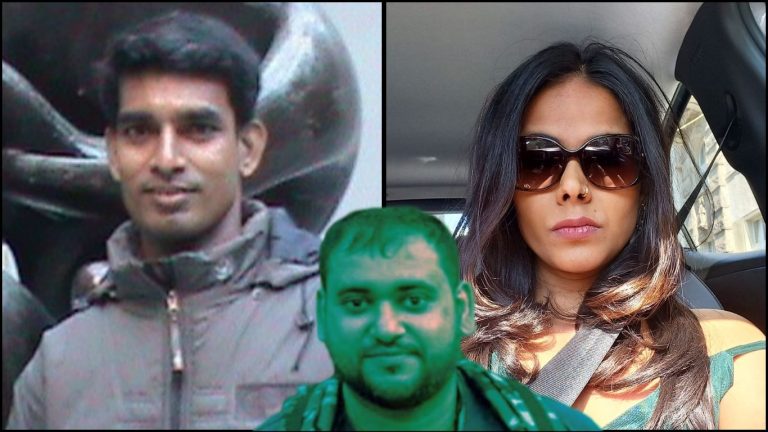
On 15th January, Surat Police arrested a Muslim man named Musibul Sheikh for using forged documents to live with a Hindu girl in a live-in relationship.
According to media reports, Sheikh assumed the identity of Pradeep Kshetrapal and started living with a Hindu girl in a live-in relationship in Surat, Gujarat.
He had lured the Hindu girl from Mumbai into a relationship and brought her to Surat. Surat SOG arrested him and handed him over to the Rander Police for further investigation.
The Surat police launched an operation after receiving a tip-off about a suspicious person living in the Rander area using forged documents.
Teams from the Surat SOG were deployed to apprehend the suspect. After arresting the accused, 26-year-old Musibul alias Raj alias Pradeep Makbul Sheikh, he was handed over to the Rander Police for further investigation.
Media reports suggest that he was living in Swicon Wings, located at Canal Road, Jahangirabad, in Rander, Surat. He had been working at various spas for the past 14 years.
Around 1.5 years ago, he met a Hindu girl in Mumbai. He sought a rented house in a Hindu locality to live with her in a live-in relationship. However, because of his Muslim identity, he could not secure a house.
Reportedly, he then forged documents on his mobile phone using an application and created a fake Aadhaar card under a false name. He started living in a Hindu locality around five months ago.
During the search, police recovered two Aadhaar cards with different names, one PAN card, one RC book, a mobile phone, and ₹15,000 in cash.
OpIndia accessed the FIR filed in the case.
Content of the FIR
The FIR has been registered at the Rander Police Station based on a complaint filed by ASI Jalubhai Maganbhai of SOG Surat City under Sections 319, 336(2), 336(3), and 338 of the Bharatiya Nyaya Sanhita (BNS).
According to his complaint, ASI Maganbhai and his colleagues acted on a tip-off from a confidential source about a suspicious individual.
The source informed the police that a person named Musibul alias Raj alias Pradeep Makbul Sheikh was living in Swicon Wings, located at Canal Road in Jahangirabad, Rander, Surat, under false pretences by creating fake documents in different names.
Surat SOG, along with two independent witnesses, reached the specified location as informed by the source and apprehended the accused.
Upon questioning, the accused informed the police that he originally hails from Navdeep Village, Purbasthali Taluka, Bardhaman District, West Bengal.
During a search in the presence of the witnesses, the police recovered two Aadhaar cards, one in the name of Musibul Makbul Sheikh and another in the name of Pradeep Sujay Kshetrapal.
The police also recovered a PAN card in his original name. Furthermore, the police recovered an RC book and a mobile phone with two SIM cards.
The accused told the police that he had created the fabricated Aadhaar card using mobile applications as he was residing in a Hindu area and had assumed the identity of a Hindu man to maintain a live-in relationship with a Hindu girl.
On 17th January, the Bharatiya Janata Party (BJP) sharply criticised Congress for submitting a plea in the Supreme Court in support of the Places of Worship (Special Provisions) Act, 1991. The BJP has accused the Congress party of declaring “open war against Hindus”. In a post on the social media platform X, BJP’s IT Cell Chief Amit Malviya likened Congress to the “new Muslim League”.
In his post, Malviya said, “The Congress consented to India’s partition along religious lines. Following this, it introduced the Waqf law, enabling Muslims to claim properties at will and establish mini-Pakistans across the country. It later enacted the Places of Worship Act, 1991, effectively denying Hindus the right to reclaim their historical and religious sites. Now, the Congress has approached the Supreme Court, seeking to deny Hindus their fundamental constitutional right to legal remedies for addressing historical injustices. It has urged the top court to dismiss petitions challenging the Places of Worship Act, 1991, under the pretext of ‘safeguarding secularism’. The Congress has declared open war against Hindus. It is the new Muslim League.”
The Congress consented to India’s partition along religious lines.
Following this, it introduced the Waqf law, enabling Muslims to claim properties at will and establish mini-Pakistans across the country.
It later enacted the Places of Worship Act, 1991, effectively denying…
Notably, the BJP has historically opposed the Places of Worship Act since it was enacted by the then-Narasimha Rao government amidst the Ram Janmabhoomi movement. The Act states that the character of places of worship as they existed on 15th August 1947 is to be frozen, except for the Ram Janmabhoomi site in Ayodhya. Malviya said that the plea submitted by Congress in the apex court denies Hindus their “fundamental constitutional right to legal remedies for addressing historical injustices.” He further accused Congress of pushing its agenda under the guise of “safeguarding secularism”.
The petitions against the Act
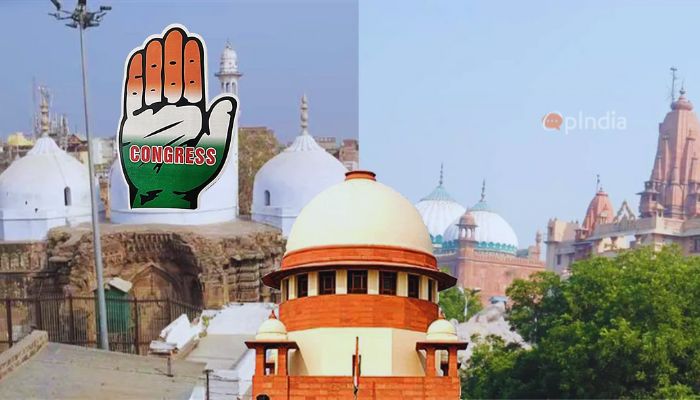
The Supreme Court is hearing petitions challenging the Act. The petitions argue that the Act violates constitutional rights, including Articles 14, 15, 25, 26, and 29. Furthermore, the petitioners have contended that sites like Gyanvapi in Varanasi, Shahi Eidgah in Mathura, and others were built over Hindu religious sites, namely the Kashi Vishwanath Mandir and Lord Krishna’s birthplace, respectively. The petitions have the support of the Sangh Parivar (Rashtriya Swayamsevak Sangh or the RSS).
Congress, however, insisted in its plea that the Act is vital to preserving secularism and ensuring communal harmony. The grand old party has claimed that if the Act is repealed, it could lead to social unrest.
The BJP openly opposing Congress’s move to save the Act marks a significant reiteration of the BJP’s opposition to the legislation. Interestingly, the party has taken this stance against the Act at a time when RSS chief Mohan Bhagwat has faced severe criticism after he cautioned against “looking for temples under every mosque”. His views were in stark contrast to the stance taken by prominent Hindu leaders.
Malviya linked Congress’s current stance on the Act to its historical actions and accused the party of enabling the Partition of the country along religious lines, introducing Waqf laws, and enacting legislation that prioritised Muslim interests over those of Hindus.
Congress claims the Act is essential for ‘secularism’
In the intervention plea filed by Congress leader KC Venugopal on 6th January 2025, the party sought strict implementation of one of the provisions of the Places of Worship Act (POWA) which prohibits lawsuits to reclaim a place of worship or to change its character from what it was on 15th August 1947. The party claimed that the enactment of the Places of Worship Act in 1991 reflected the mandate of the Indian voters as it was envisaged in the Congress party’s election manifesto.
The party further contended that the Places of Worship Act safeguards ‘secularism’ in India and that the challenge to its constitutional validity is a “malicious attempt” to undermine secularism. “The POWA is essential to safeguard secularism in India and the present challenge appears to be a motivated and malicious attempt to undermine established principles of secularism,” Congress said in its intervention plea.
The Sessions Court in Ferozpur district in Punjab has issued arrest warrants against 25 farmers belonging to the Bharti Kisan Union (Krantikari) and Krantikari Pendu Mazdoor Union.
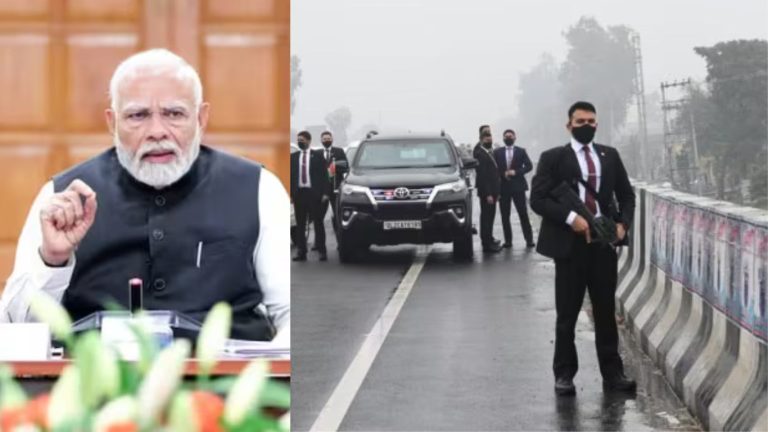
The arrest warrants have been issued in connection with a case of security breach that happened during PM Modi’s visit to Ferozpur on January 5, 2022. P
M Modi was going to address a public rally in Ferozpur when his safety was jeopardised after his cavalcade got struck on a flyover for over an hour because of farmers blocking the road.
Sessions Judge, Virinder Aggarwal, issued the arrest warrants under the provisions of the Bharatiya Nyaya Sanhita (BNSS) and the National Highways Act.
Initially, an FIR was lodged regarding the incident on January 6, 2022, against unknown persons under section 283 (obstruction in public way) of the India Penal Code.
However, following protests from BJP leaders over filing a weak FIR, a three-member SIT was formed. Additional charges under sections 307 (attempt to murder), 353 (assault on a public servant), 341 (wrongful restraint), 186 (obstruction of duty), 149 (unlawful assembly) and 8-B of the National Highway Act were added based on the investigation of the SIT.
A total of 26 persons were named in the FIR, including Baldev Singh Zira, general secretary of BKU Krantikari along with others. One of the accused named Major Singh passed away leaving the total number of accused 25.
Directives of the court
No arrests have been made in the case so far. The court issued the arrest warrants on January 3 after the accused persons failed to appear before the court despite multiple summons and warrants.
The court directed SHO Kulgarhi police station to arrest the accused persons and produce them in the court by January 22.
The court rejected the application filed by one Kamaljeet Singh seeking anticipatory bail on the ground that he was not named in the FIR as it was lodged against unknown persons.
The bail order accessed by OpIndia mentioned that the accused was named among 25 persons found involved in road blocking during the investigation of the SIT.
The court said, “The allegations contained in the FIR are serious in nature as the Prime Minister of the country, who was coming to Ferozpur to attend a public program, was obstructed for a period of more than one hour thereby jeopardising his security”.
Details of the case
On March 21, 2023, Chief Minister Bhagwant Mann directed the initiation of disciplinary proceedings for the major penalty against Sidharth Chattopadhyay, the then DGP Punjab, Inderbir Singh, the then DIG, Ferozepur Range and Harmandeep Singh Hans, the then SSP Ferozepur over the Prime Minister Narendra Modi’s security breach in Punjab.
In a major lapse and seemingly deliberate act to endanger the Prime Minister’s security, the Punjab government has today allowed political protestors to block the Prime Minister’s convoy on January 5, 2022. The PM’s convoy was blocked for over 20 minutes by protestors at a flyover about 30 km away from Hussainiwala.
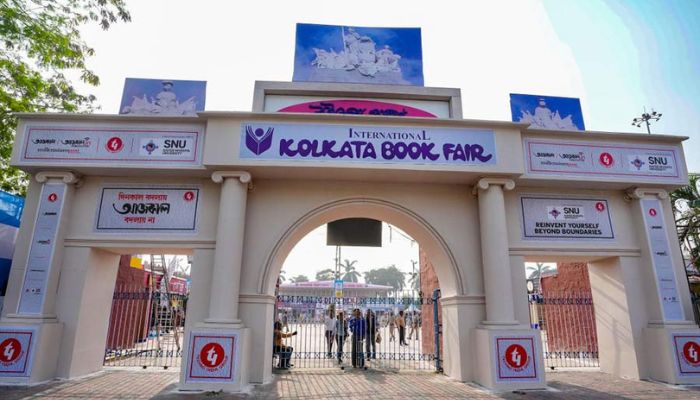
On Friday (17th January), the Vishwa Hindu Parishad (VHP) moved the Calcutta High Court after being denied a stall at the 48th International Kolkata Book Fair.
The Hindu rights organisation applied for a stall with the Publishers & Booksellers Guild in October last year. In their application, VHP mentioned that it had participated in the book fair for several years and wanted a designated stall this time around as well.
“The application was kept pending,” it noted. Despite the VHP’s representation, no response was received from the Publishers & Booksellers Guild.
The Guild is now claiming that the application submitted by the VHP for the stall is ‘not in form’ and was therefore rejected. It also alleged that the Hindu rights organisation did not ‘qualify the conditions’ required for participating in the event.
During the hearing, the lawyer representing the Guild claimed, “The books published by the Parishad are sensitive and controversial. The books can spread disturbance.”
He further stated, “The guild does not want any such disturbances. So it has decided against allotting a stall to VHP at this year’s fair.”
Justice Amrita Sinha inquired, “Is the Guild aware that VHP possesses its publications? The guild had allotted stalls to VHP on previous occasions. What happened suddenly, that the Guild has started to feel that the publications by the VHP are so sensitive and controversial that they may create trouble?”
It must be mentioned that the 48th International Kolkata Book Fair is scheduled to start on 28th January 2025. The writ petition will be listed for consideration on Monday (20th January).
Congress party has a history of trying to legally handcuff the Hindu community’s rights while patting itself on the back maintaining ‘communal harmony’ by appeasing the Muslim community. The grand old party’s legacy has been of turning ‘secularism’ into a synonym for silencing Hindu voices, all while passing it off as its endeavours to uphold “Aman and Bhaichara” while in reality, it’s all about pandering for Muslim votes. In its yet another attempt to uphold ‘secularism’ by crushing Hindu rights, the Congress party has filed an intervention petition in the Supreme Court demanding strict implementation of the contentious Places of Worship Act 1991 as the top court begins hearing on the Act’s constitutional validity.
In the intervention plea filed by Congress leader KC Venugopal on 6th January 2025, the party sought strict implementation of one of the provisions of the Places of Worship Act (POWA) which prohibits lawsuits to reclaim a place of worship or to change its character from what it was on August 15, 1947.
The party claimed that the enactment of the Places of Worship Act in 1991 reflected the mandate of the Indian voters as it was envisaged in the Congress party’s election manifesto.
“It may be relevant to mention that at the time of the passing of the POWA, it was the Applicant along with the Janata Dal party that were in the majority in the legislature for the 10th Lok Sabha. The Applicant humbly submits that the POWA was enacted by the Parliament, as it reflected the mandate of the Indian populace. The POWA had been envisaged before the year 1991 and the same was made a part of the Applicant’s then Election Manifesto for the Parliamentary elections,” the Congress party said.
The party further contended that the Places of Worship Act safeguards ‘secularism’ in India and that the challenge to its constitutional validity is a “malicious attempt” to undermine secularism.
“The POWA is essential to safeguard secularism in India and the present challenge appears to be a motivated and malicious attempt to undermine established principles of secularism,” Congress said in its intervention plea.
The party went on to emphasise how any alteration in the Places of Worship Act would “jeopardise” communal harmony and the secular fabric of India. Congress stressed that making any alteration in POWA would threaten the sovereignty and integrity of India.
“The Applicant seeks to intervene in this matter to emphasize the constitutional and societal significance of the POWA, as it apprehends that any alterations to it could jeopardize India’s communal harmony and secular fabric thereby threatening the sovereignty and integrity of the nation,” the plea reads.
The leitmotif of Congress’s intervention plea is a supposed threat to ‘secularism’ and how it is paramount to strictly implement the Places of Worship Act, thus barring the Hindu community from approaching courts to reclaim its places of worship destroyed and/or encroached by the Muslim or any other community, to prevent the country from descending into communal anarchy.
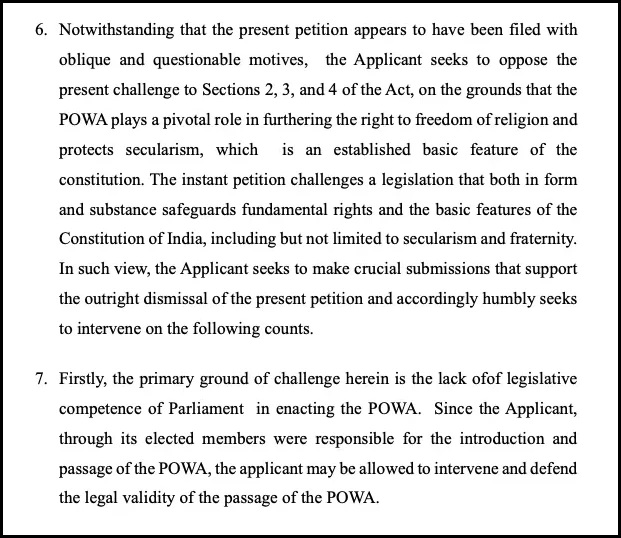
Accusing the petitioners who challenged the validity of POWA, Congress said that it “seeks to oppose the present challenge to Sections 2, 3, and 4 of the Act, because the POWA plays a pivotal role in furthering the right to freedom of religion and protects secularism, which is an established basic feature of the constitution.”
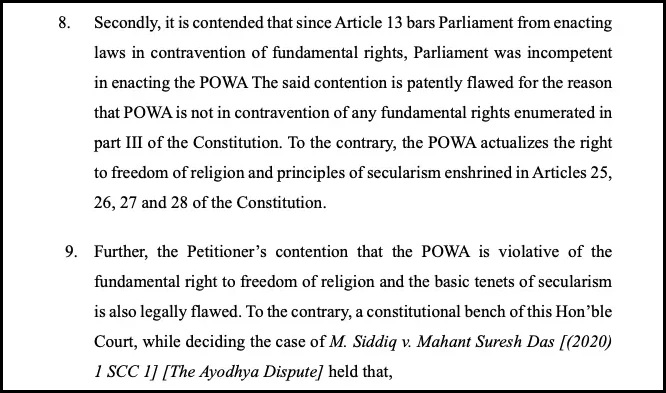
Disputing the arguments of petitioner Ashwini Upadhyaya that since Article 13 bars Parliament from enacting laws in contravention of fundamental rights, Parliament was incompetent in enacting the POWA, Congress contended that the Act is not in contravention rather “actualizes the right to freedom of religion and principles of secularism enshrined in Articles 25,26, 27 and 28 of the Constitution.” The Congress party argued that since the Act was introduced and passed in the Parliament, it should be allowed to intervene and defend the Act’s constitutional validity.
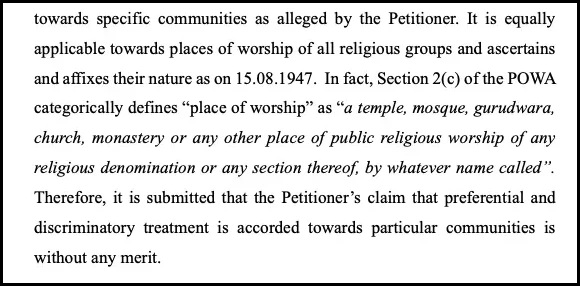
In response to the contention that the Places of Worship Act is discriminatory towards Hindu, Sikh, Jain and Buddhist communities, the Congress party argued that the Act promotes “equality” and does not accord special treatment towards any specific community (read Muslims).
The Congress party said that POWA “is equally applicable towards places of worship of all religious groups and ascertains and affixes their nature as on 15.08.1947” and that POWA’s section 2(c) defines “places of worship” as a temple, mosque, gurudwara, church, monastery or any other place of public religious worship, to advance its insinuation that it somehow stops Muslims also from challenging religious character of Hindu places of worship, it failed to mention one case wherein Hindus or erstwhile Hindu rulers in the pre-independence era have on any occasion arbitrarily demolished a mosque to erect Hindu temples or are encroaching any property that was originally an Islamic place of worship.
Further, the Congress party presented its arguments to support its position that the Parliament somehow had complete authority and legitimacy to enact the POWA.
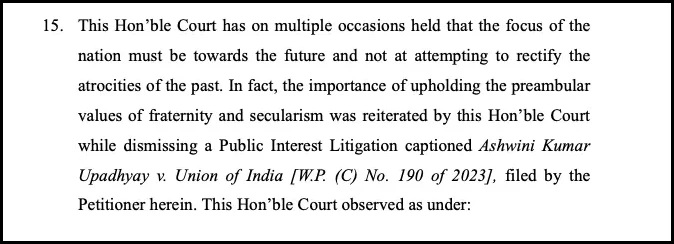
It submitted that the POWA is “essential” to allow for ‘communal harmony’ and to promote cordial relations amongst all communities in the country. The Congress party threw its weight behind the Supreme Court to put forth the hackneyed argument that the focus of the nation must be towards the future and not on attempting to rectify the atrocities of the past.
The Congress party emphasized on the importance of upholding preambular values of fraternity and secularism, however, the party failed to elaborate on why it opines that Hindus seeking legal remedy to reclaim their places of worship would jeopardise fraternity and secularism but the Muslim community deliberately encroaching places of worship which originally had a Hindu character does not harm the holier than thou preambular values. Why does the imperative to serve the supposed higher purpose of upholding secularism and communal harmony fall on the shoulders of the Hindu majority and hardly on the second-largest majority?
Excerpts taken from Congress intervention plea
In its plea filed to Advocate Abhishek Jebaraj, the Congress party prayed that it be allowed to intervene in the writ petition challenging the validity of the Places of Worship Act and file written submissions and adduce arguments as and when required by the Supreme Court.
Congress and its legacy of attacking the Hindu faith and undermining Hindu rights to appease its Muslim vote bank
Congress party evoking “preambular values” like fraternity, secularism, communal harmony and so on to stop Hindus from exercising their fundamental right for the sake of Muslim appeasement is not a new phenomenon. Rather, the party has historically intervened to hinder the Hindu struggle to legally and constitutionally reclaim its places of worship. To better understand how the Congress party has historically denied Hindus the right to reclaim its religious sites, one must recall how the Congress-led UPA 1 filed an affidavit in the Supreme Court in 2007 denying the existence of Lord Ram saying that there is no historical proof of Bhagwan Ram’s existence.
An affidavit filed by the Congress-led government read, “Valmiki Ramayana and Ramcharitmanas admittedly form an important part of ancient Indian literature, but these cannot be said to be historical records to incontrovertibly prove the existence of the characters and occurrences of events depicted therein.” The affidavit was filed to register the UPA government’s opposition to the demand to scrap the Sethusamudram project as it would damage the Ram Setu. Congress-led government’s affidavit was a clear attempt at delegitimising the Hindu beliefs since if Ram didn’t exist, there is no question of the existence of a Ram Setu, thus it should not be a problem to damage the Ram Setu for the said project.
Not to forget, Congress’s affidavit denying the existence of Lord Ram came at a time when the Ayodhya case was ongoing. Fast forward to 2024, Rahul Gandhi openly boasted of having defeated the Ram Janmbhoomi Movement of Hindus in Ayodhya as Samajwadi Party candidate Awadhesh Prasad won from Faizabad Lok Sabha seat which included Ayodhya.
Similarly, senior Congress leader of the time, Kapil Sibal fought the Ram Janmabhoomi case for the Sunni Waqf Board opposing the building of a magnificent Ram temple at the disputed site in Ayodhya. He also employed dilatory tactics and asked the apex court to delay the decision in the Ram Janmabhoomi case till the 2019 elections. Another eminent Congress leader Shashi Tharoor had earlier claimed that no ‘good Hindu’ would want a Ram Mandir at the Babri site. Tharoor urged that one should have the Ram Mandir in one’s heart.
Basically, Congress’s position was that Hindus should believe that either Bhagwan Ram does not exist or even if they want to believe he does, they should keep him in their hearts and not demand Ram Mandir at the birthplace of Lord Ram and let ‘Babri’ of secularism remain untouched.
Now Congress’s intervention plea on the Places of Worship Act falls in line with this trend of denying Hindus the fundamental right to approach courts to reclaim their places of worship implying that the grievances of the Hindu community can easily be sacrificed for the sake of preserving the Congress party’s distorted idea of peace, communal harmony, secularism and brotherhood.
Places of Worship Act itself is violative of the principles of natural justice
Back in 1991, the PV Narasimha Rao-led Congress regime passed the Places of Worship Act to protect the religious character of places of worship as they existed in 1947, except the Ram Janmabhoomi-Babri Masjid issue, which was already in court. It also provided for the preservation of the religious character of such a place of worship on that particular day.
As per this Act, a site of worship’s religious character must remain the same as it was on August 15, 1947. The law also says that nobody ever shall translate any religious denomination’s holy site into one of a distinct denomination or section. In addition, the law asserts that every lawsuit, appeal, or other proceedings about changing the character of the area of worship pending before any court or authority on August 15, 1947, will be terminated as soon as the legislation becomes effective, meaning there cannot be any further legal proceedings. Furthermore, the act also imposes a positive obligation on the state to maintain the religious character of every place of worship as it existed at the time of independence. The Act has an exemption under which legal proceedings can be initiated under the Places of Worship Act of 1991 if the change of status occurred after the August 15, 1947 deadline.
Incidentally, the introduction and enactment of the Places of Worship Act in 1991, which the Congress party boasted in its intervention appeal as some sort of achievement, itself demonstrates that the grand old party can go to any lengths to appease the Muslim community even at the expense of depriving the Hindu community the fundamental right to seek legal restitution for its lost/destroyed or encroached places of worship.
Places of Worship Act was passed when the illegal Babri Mosque was still standing on top of Ram Janmabhoomi although the Hindu demand for reclamation of the Ram Janmbhoomi site where the illegal structure stood was at its peak. Moreover, the arbitrary deadline of 15th August 1947 was Congress’s way of telling the Hindus that your time to seek justice was before independence, now in independent India, you have to bear the burden of secularism and brotherhood for the sake of those whose co-religionists already carved out a separate Islamic nation on the corpses of Hindus, Sikhs and other non-Muslim communities.
A question that comes to one’s mind is why the Congress party backs the Places of Worship Act even though it is predominantly anti-Hindu. To answer this, one needs to understand the mindset of Congress leaders, particularly, those who held important positions at the time of the passage of this contentious Act.
While passing the act in 1991, the then Union Home Minister S B Chavan said, “It is considered necessary to adopt these measures in view of the controversies arising from time to time about the conversion of places of worship which tend to vitiate the communal atmosphere… Adoption of this Bill will effectively prevent any new controversies from arising in respect of conversion of any place of worship…”.
Unbelievable isn’t it? The country’s Home Minister stands on the floor of Lok Sabha and tells Hindus that they should accept injustice to preserve ‘peace’ and ‘secularism’ that too at a time when advocacy and activism for restoration of Ram Mandir at the Ram Janmbhoomi site in Ayodhya where the Babri structure stood was at the peak. The timing of the Act’s passage indicates, that more than being a law for ‘social justice’, POWA was a political Act brought by the Narasimha Rao government to empower the Muslim community to continue occupying the places of worship which originally had Hindu character, who in exchange would function as Congress’s vote bank. This was also a time when the Bhartiya Janata Party registered its meteoric rise from 2 seats in 1984 to 120 seats in the general elections of 1991.
Besides S B Chavan, the views of Congress motormouth Mani Shankar Aiyar who was a Lok Sabha MP when the POWA was passed, also give an insight into why Congress not only takes pride in bringing a fundamentally anti-Hindu legislation like POWA but also defends it. Mani Shankar Aiyar once admitted that he sees the Gyanvapi Masjid structure in Kashi as a “symbol of secularism”.
When a debate on the Places of Worship Act was going on in the Lok Sabha, the BJP which traditionally has been supportive of the Hindu cause, vehemently opposed the POWA. Then BJP MP Uma Bharti had said that peace cannot be attained by outrightly dismissing Hindu sentiments.
During her speech, the BJP MP said, “Owners of bullock carts in villages, create a wound on the back of the ox and when they want their bullock carts to move faster they strike at the wound. Similarly, these disputes are wounds and marks of slavery on our ‘Bharat Mata’. So long as ‘Gyan Vapi’ continues in its present condition at Banaras and a grave remains in a temple at Pavagarh, it will remind us of the atrocities perpetrated by Aurangzeb including his efforts to convert Hindus to Islam and this would be very painful.”
Back then, Congress MP Mani Shankar Aiyar called the Gyanvapi structure a “symbol of secularism” and downplayed the fact that those broken walls of the erstwhile Hindu temple attached to Gyanvapi ‘mosque’ do not symbolise secularism as the temple and mosque did not come together as a result of some mutual understanding but through the violence against Hindus and destruction of the Hindu temple by Islamic invaders.
“Uma Bharti told us that when she had visited Varanasi and saw a temple and a mosque together, a feeling came to her that the temple had been demolished. She considered it to be a disgrace to Hinduism. According to her, a Muslim king had built a mosque there. There is only one difference between her and myself, what she thinks is a sign of servility, I take that thing as a symbol of secularism. The difference between Bhartiya Janata Party and myself is that it understands the last thousand years were the years of slavery, but I think that in these thousand years a new culture, a new religion, new feelings and new ideas have entered into our These influenced and attracted us. I say that if India is the first Hindu country in the world, I also say that India is the second Muslim country in the world. After Indonesia, the Muslim population in our country is far more than their population in any other country which includes all the Gulf..” Aiyar said.
Why does Cong back Place of Worship Act, 1991 that is predominantly anti-Hindu? That's because for Cong Gyanvapi Mosque built by demolishing a temple is a "symbol of secularism"! Unbelievable, but true. Read below: This is admitted by then Cong MP Mani Shankar Aiyar's in LS,… pic.twitter.com/zKIzL9yS6q
What better can be expected from a political party whose lawmakers not only justify the destruction of Hindu temples but also glorify the act and Islamic invaders who killed and raped the native Hindu and other non-Muslim communities, forcibly converted Hindus and others to Islam, plundered their wealth and destroyed their temples to establish Islamic supremacy. The Places of Worship Act was a result of the desperation of the Congress party to legally justify the misdeeds of Islamic invaders like Babur and Aurangzeb of breaking temples and building mosques over them to suppress the Hindu efforts to reclaim their temples which are the heart of Hindu spirituality. In doing so, Congress denied Hindus their right to identity, right to justice, freedom of religion, and right to equality all in the name of preserving communal harmony and secularism.
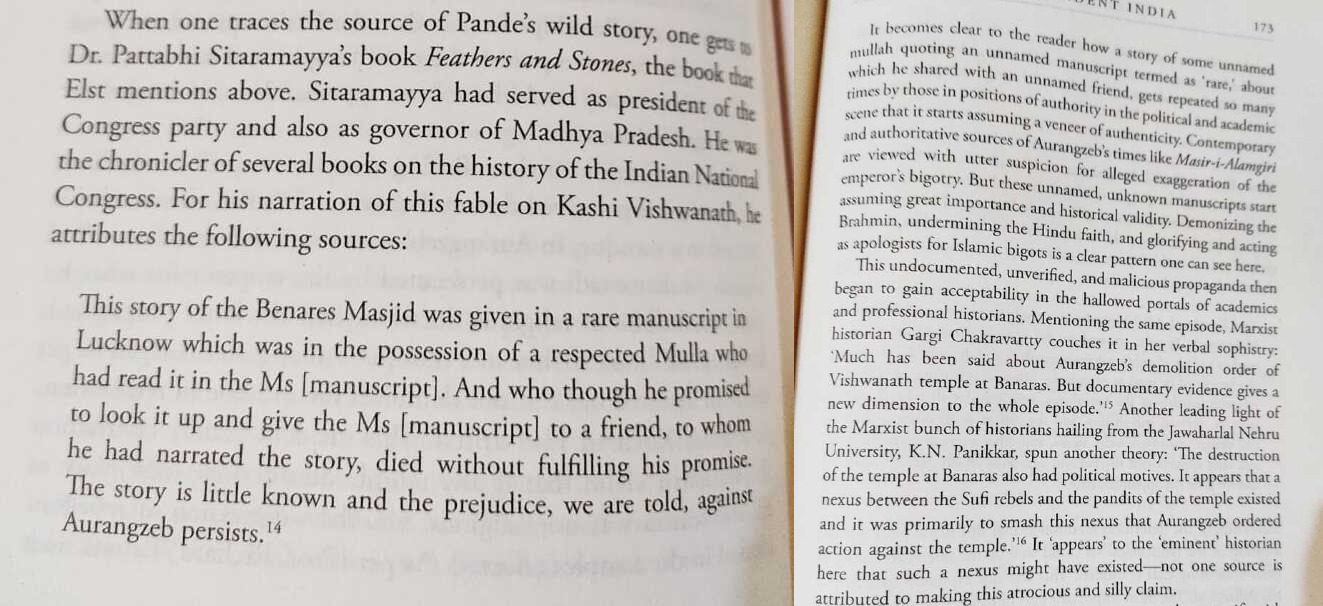
Other Mani Shankar Aiyar, Congress leader Pattabhi Sitharamayya and Bishambar Nath Pande were also among those who justified Islamic fanatic Aurangzeb’s barbarity in demolishing the Kashi Vishwanath temple. In fact, Sitharamayya went as far as to concoct an absolutely fake story based on the ‘rare’ manuscript provided by a ‘respected Mulla’ to justify the destruction of Kashi Vishwanath Temple. Pande furthered a false story that Aurangzeb ordered the demolition of the Kashi Vishwanath Temple because the Brahmin priests used to loot wealthy pilgrims as claimed by a Rani of Kutch. In his book Waiting for Shiva, historian Vikram Sampath uncovered the source of these false stories fabricated by Congress leaders Sitharamayya and. Bishambar Nath Pande. It was found that the story Pattabhi Sitharamayya fabricated was based on an unnamed mullah acquaintance of Sitharamayya quoted an unnamed manuscript termed as ‘rare’ to suggest that Aurangzeb was a man of golden-heart who destroyed Kashi Vishwanath temple for ‘social justice’.
Source: Waiting for Shiva: Unearthing The Truth of Kashi’s Gyanvapi by Vikram Sampath pg no. 172-173
Congress’s opposition to any attempt of the Hindu community to rectify atrocities of the past, particularly when it comes to Hindu temples does not begin with the Places of Worship Act. In fact, Congress stalwart and India’s first Prime Minister Jawaharlal Nehru had vehemently opposed the reconstruction of Somnath Temple in Gujarat which endured numerous attacks until the final the final destruction in 1665 CE when it was converted into a mosque on the instructions of Aurangzeb. While Sardar Patel advocated for the restoration of Somnath Temple, Nehru dubbed it as a sign of “Hindu revivalism”.
Amusingly, while Congress often accuses the BJP of mixing religion with politics, the Congress party itself has a history of pandering to the Muslim community for electoral and ideological benefits. The Waqf law brought by the Congress government exemplifies the same. The Act brought by the Congress party made the Waqf Board powerful beyond imagination. So much so that the Waqf Board arbitrarily makes ownership claims over the lands, properties, colleges, Hindu-majority villages and even temples of Hindus. Waqf Board managed to keep Hindus away from Ayodhya Ram Janmbhoomi for decades. Even in the Kashi Vishwanath Temple case, the Sunni Waqf Board out of nowhere claimed that the temple land was a Waqf property.
Unsurprisingly, when the BJP government brought the Waqf Amendment Bill last year, the Congress party vehemently opposed it citing concerns over the ‘religious freedom’ of the Muslim community. Here the Congress party won’t urge the Waqf Boards to stop randomly claiming ownership of lands and properties for communal harmony and secularism since doing so would upset its coveted Muslim votebank.
Communal Violence Bill: Congress’s attempt to label blame Hindus as rioters even when they would be the victims
Just as Congress leaders justified and even glorified the destruction of a centuries-old Hindu temple citing the imaginary magnanimity of Islamic tyrant Aurangzeb’s heart and impetus to protect people from “wicked brahmins”, they justify their own suppression of Hindu rights to the supposed higher purpose of upholding communal harmony and secularism. Similar to the way some Congress leaders and Marxist historians blamed Hindus only for the destruction of the Kashi Vishwanath temple and thus should not seek its reclamation, the Congress party also has always expected Hindus to maintain harmony even when being massacred.
Congress exemplified this mindset in its contentious Communal Violence Bill. In 2005, UPA1 introduced a communal violence bill. In 2011, under the guidance of the NAC, UPA2 introduced a revised draft of the same. Although the bill had to be dropped in 2014, the grounds for its withdrawal were primarily due to concerns about overlap with the powers of the State government.
In the 2005 version of the bill, any “group” that has become a victim of communal attacks could seek redressal. However, in 2011, a new definition of the “group” which is protected, was introduced. “Group means a religious or linguistic minority, in any State in the Union of India, or Scheduled Castes and Scheduled Tribes within the meaning of clauses (24) and (25) of Article 366 of the Constitution of India”. This meant that only minorities and SCs/STs could be “victims” and the perpetrators of communal violence would always be the majority, which is Hindus. The definition of “offences” itself was so wide — any sort of crime could be brought under the ambit of this Act.
While the Congress party claims that it is backing the Places of Worship Act to safeguard ‘secularism’, it must answer how its Waqf Act safeguards secularism, how its decision to gift 123 properties to the Delhi Waqf Board in 2014 ahead of elections safeguarded secularism. The Congress party should enlighten Hindus as to how to align with DMK, a political party that has a history of spreading hatred against Brahmins and whose leaders describe Sanatan Dharma as dengue and malaria and call for its eradication, safeguard secularism, preserve peace in the country.
Conclusion
Congress party and its supportive ecosystem have long been guilt-tripping Hindus for having fought the legal battle for the reclamation of Ram Mandir in Ayodhya. In the name of maintaining communal harmony, secularism and ‘bhaichara’, the Muslim-appeasing party believes that Hindus should let go of Gyanvapi-Kashi Vishwanath temple, Shri Krishna Janmbhoomi in Mathura, Harihar Mandir in Sambhal to all such places of worship which stand on the ruins of Hindu temples. Beyond the Muslim appeasement politics, Congress’s deliberate reluctance to comprehend the fact that communal harmony cannot be built on the denial of justice to one community stems from the fact it does not really believe that Hindus have faced any injustice to an extent that it would support the undoing of the injustice committed against Hindus.
Be it Digvijay Singh who heaped praises on Mughals or Mani Shankar Aiyar who declared Mughal tyrants Babur and Humayun as patriots, when a party has leaders who celebrate and glorify the oppressors of their country’s majority community and peddle victimhood of a specific community due to their capability to consolidate their votes, how will they be able to relate to the Hindu community’s quest to undo the historical wrongs not establish religious supremacy over any particular community or to humiliate them but simply because it is their fundamental right to approach the courts and seek legal and constitutional remedy for reclamation of their temples. By invoking communal harmony and secularism, the Congress party expects Hindus to bear the burden of peace even when they are being denied their basic rights. The Congress party’s intervention plea is not merely about preserving the status quo, it is about continuing a historical pattern of denying Hindus their right to justice for the sake of political expediency. But then, it must not be forgotten that Congress once betrayed Muslim women and overturned the Supreme Court ruling in the Shah Bano case to appease Islamists.
Congress’s intervention petition filed before the Supreme Court repeatedly emphasises how strict implementation of the Places of Worship Act is necessary to preserve secularism and peace, however, what it actually is trying to preserve is nothing but a temporary truce before the “nizam” changes. True secularism and brotherhood beyond religious lines, although both of these concepts are alien to the Islamists, would only be when the Muslim community voluntarily returns all the Hindu temples destroyed or converted into mosques by Islamic invaders without the need to approach courts. Hindus are not randomly claiming ownership of any property or looking for Shiv Lingam beneath the mosques, Hindus do not have a Waqf Board-like body for that, but only are using the legal and constitutional methods at hand to reclaim their lost temples for which they claim to have historical and archaeological evidence, however, Congress wants to strip Hindus of that right as well, in fact, it already stripped Hindus of this right with the enactment of Places of Worship Act, now its fight is to perpetuate the denial of fundamental rights of Hindus and travesty of justice.
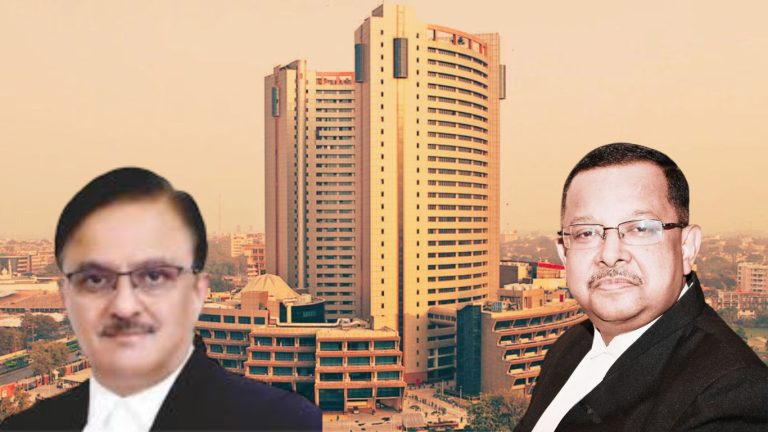
The Apex Court pulled up the Aam Aadmi Party-controlled Municipal Corporation of Delhi (MCD) on Friday for not paying attention to the problem of untreated solid waste in the national capital. Highlighting that over 3000 tonnes of solid waste remain untreated daily, a bench of Justices Abhay S Oka and Ujjal Bhuyan expressed astonishment over MCD’s plan to clear the waste by December 2027. The court’s remarks came during the hearing of a case filed against air pollution in the national capital.
On an earlier occasion, the court asked the Delhi government to submit an affidavit by January 15, 2025, outlining measures to prevent fires and mitigate environmental harm at these sites. While going through the affidavit today, the court asked the MCD as to where it was dumping the 3000 tonnes of waste daily. Questioning the claims of the MCD to get rid of all the waste by 20277, the court said, “You don’t say where the 3000 tonnes of untreated solid waste goes. You have made a tall promise that by 2027 it will be cleared, and you have not accounted for 3000 tonnes of dumping. You must file an affidavit stating where you’re dumping 3000 tonnes of solid waste every day because the affidavit is completely silent. Just see the brazen manner in which the affidavit is filed”.
Senior Advocate Menaka Guruswamy, appearing for MCD, referred to a judgment passed by a bench led by Justice Gavai regarding the solid waste management to which, she assured, the Delhi government would comply by December 2027. Guruswamy highlighted that the present matter is related to the issue of fires occurring at dump sites. She said that the Delhi government would answer the issue relating to solid waste management on January 27 when the issue will come up for hearing.
The court also criticised the central government, represented by Addl. Solicitor General Aishwarya Bhati, asking it ‘not to shut its eyes’ towards the serious issue. “How can the Union of India remain silent? What action does it want to take? The Union of India can’t close its eyes. they should take action against whosoever is not performing. In the capital city, this is happening. What we propose to do is that we will pass an order putting restrictions on new constructions”, the court remarked. Highlighting the urgency of the matter, the court said, “Such issues will have to be dealt with in drastic manner only. Construction will create more waste that cannot be dealt with. So the 3000 tonnes will go up to 5000 tonnes within no time”.
Senior Advocate Aparajita Singh, amicus curiae, informed the court that the Union and the Delhi governments were not coordinating, to which the court said, “We will make them coordinate”. Senior Advocate Singh also suggested that the MCD should take on multiple agencies, instead of just one, to clear the 45 metric tonnes of legacy waste as soon as possible.
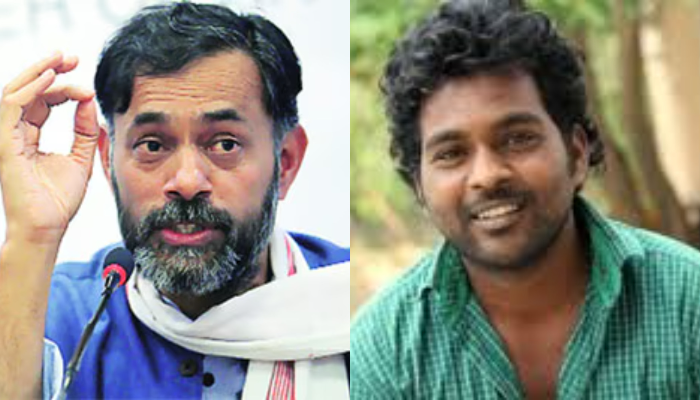
Seasoned propagandist and occasional political worker, Yogendra Yadav, recently took to X to exploit the death of Rohith Vemula, peddling disinformation forged by the opposition to attack the Centre.
“My birth is a fatal accident – these words of Rohith Vemula represent not just an individual agony, but the structural reality of caste discrimination in our educational institutions. If universities are centres of knowledge, reason and freedom, why was Rohith Vemula forced to get tired of his identity politics? Where are the roots of this injustice? What are these forces that fear the idea of equality in society and institutionalise the politics of division? This question must be answered in honour of Rohit’s memory,” Yogendra Yadav tweeted on X.
“मेरा जन्म एक घातक दुर्घटना है”—रोहित वेमुला के ये शब्द केवल एक व्यक्तिगत पीड़ा नहीं, बल्कि हमारे शैक्षणिक संस्थानों में जातिगत भेदभाव की संरचनात्मक सच्चाई हैं।
अगर विश्वविद्यालय ज्ञान, तर्क और स्वतंत्रता के केंद्र हैं, तो फिर रोहित वेमुला को अपनी पहचान की राजनीति से “थकने” पर… pic.twitter.com/5kigtq9Drw
Disregarding factual information about Vemula’s death, Yadav resorted to spreading fake news—a reflection of desperation that has taken hold among the Leftists after Modi’s return to the centre for the third time in a row.
Rohith Vemula‘s 2016 suicide escalated into a massive political controversy within the country, with the unfortunate event being exploited to launch attacks against the ruling Bharatiya Janata Party and to further perpetrate casteist agenda by the opposition and their left-liberal ecosystem. However, on 3rd May of last year, the Telangana Police presented a closure report to the Telangana High Court which indicated that Rohith Vemula did not fall under the Scheduled Caste (SC) category. He was a doctoral student at the University of Hyderabad.
It informed, “There is no evidence of any fact or circumstance available on the record which dragged him to commit suicide and no one is responsible for his death.” The report further clarified that he ended his life because “he had his own problems and was not happy with worldly affairs. If he had been angry with the decision of the university, certainly he would have written in specific words or would have indicated in this regard. But he did not do the same. It shows that the circumstances prevailing in the university at the time were not the reason for Rohith’s death.”
The authorities had exonerated former Secunderabad MP Bandaru Dattatreya, former Legislative Council Member N Ramachander Rao, former Vice Chancellor Appa Rao Podile, members of the ABVP (Akhil Bharatiya Vidyarthi Parishad), and former Union Minister Smriti Irani who was the HRD (Minister of Human Resource Development) at the time and faced severe backlash after the incident.
The report also indicated that Rohith Vemula was aware that he did not belong to the Scheduled Caste and acquired the SC certificate from his mother. It posited that the truth might have been a relentless source of apprehension for him because if revealed it could have led to the revocation of his academic degrees and possibly legal action.
Nonetheless, akin to Yogendra Yadav’s ideological allies such as the Congress party, who have exploited the situation to launch attacks against the saffron party and have tried to keep the issue alive despite the report, he is following suit. Shortly after the development, the Director General of Police (DGP) for Telangana declared that they had opted to pursue additional inquiry into the case. “As some doubts have been expressed by the mother and others of the deceased, Rohit Vemula, on the investigation conducted, it has been decided to conduct further investigation into the case. A petition will be filed in the court concerned requesting the Hon’ble Magistrate to permit further investigation into the case,” he informed.
Yogendra Yadav is now also attempting to rekindle the quelled tensions so that the issue stays prominent and continues to foster wedges in society.
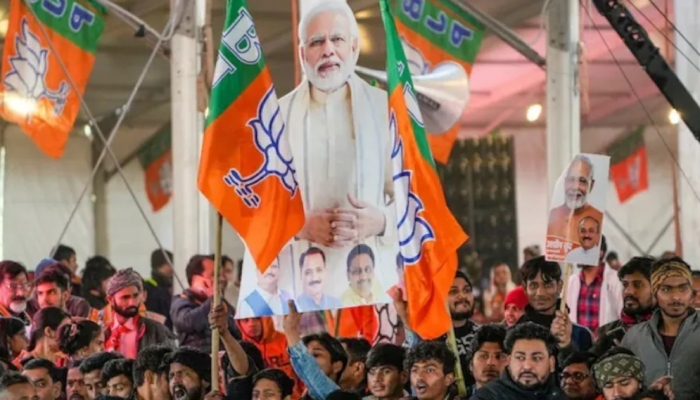
On Friday, 17th January, the BJP ahead of the Delhi Assembly Elections 2025 made public its Sankalp Patra to announce several schemes for the women. Party President J P Nadda said that the party manifesto was the foundation for developed Delhi.
Giving a tough fight to the ruling AAP in Delhi, the BJP said that the party would provide maximum benefits to the women after coming to power. The BJP in its manifesto said that it would offer Rs 21,000 to every pregnant woman, and will also provide 6 nutritional kits ensuring the good health of the would-be-mother.
“BJP’s resolution for the people of Delhi… Every pregnant woman will get financial assistance of Rs 21,000 and 6 nutrition kits,” the party said.
In addition to this, the BJP said that the pension of senior citizens will be increased from Rs 2000 to Rs 2500. “Pension for senior citizens of 70+ years, widows, destitute and abandoned women will be increased from Rs 2,500 to Rs 3,000 per month,” the party said.
दिल्ली के लोगों के लिए भाजपा का संकल्प…
वरिष्ठ नागरिकों की पेंशन ₹2,000 से बढ़ाकर प्रतिमाह ₹2,500 की जाएगी।
70+ वर्ष के वरिष्ठ नागरिकों, विधवाओं, बेसहारा एवं परित्यक्त महिलाओं की पेंशन ₹2,500 से बढ़ाकर प्रतिमाह ₹3,000 की जाएगी।#BJPKeSankalppic.twitter.com/0LAVJqG2FF
In addition to Rs 21000 to pregnant women and Rs 2500 per month for every poor woman, the party has also promised to give cooking gas cylinders for Rs 500 to every poor family in the state. Apart from this, one cylinder will be given free on the festivals of Holi and Diwali.
दिल्ली के लोगों के लिए भाजपा का संकल्प…
हर गरीब परिवार की महिला को ₹500 में दिया जाएगा गैस सिलेंडर।
The party further has said that the Ayushman Bharat scheme will be implemented in the first cabinet after the BJP comes to power in the state after the February 5th elections. Also, additional free treatment up to Rs 5 lakh will be provided by the state government, the party manifesto read.
“If BJP forms government in Delhi, not only will the existing welfare schemes continue but they will also be made more effective and corruption-free,” party president JP Nadda said at the party manifesto launch event.
Meanwhile, the BJP slammed the AAP for its failed Moholla clinic scheme and said that it will provide free treatment up to Rs 10 lakh, and free OPD medical and diagnostics services to all senior citizens. It also said that the nutrition needs of the citizens will be taken care of by providing them with nutrition-rich and fiber-rich food only for Rs 5.
इनका (AAP का) मोहल्ला क्लीनिक भ्रष्टाचार का अड्डा और लोगों की आंखों में धूल झोंकने वाला कार्यक्रम है।
इनके मोहल्ला क्लीनिक में फ्रॉड लैब टेस्ट हुए हैं और 300 करोड़ रुपये का स्कैम हुआ है।
हमारी सरकार आने पर इन सबकी पूरी तरह से जांच की जाएगी।
“In 2015, AAP had decided to launch and operate Aam Aadmi Canteens at 100 places, for which the poor people of Delhi are waiting till date. We should keep in mind how they have made fun of the poor people and cheated them,” Nadda added.
“Under the Pradhan Mantri Garib Kalyan Anna Yojana, for the last 4 years, we have been providing 5 kg wheat/rice and 1 kg pulses per month to 80 crore people. Our Haryana government and Rajasthan government have made arrangements to provide full meals to poor people for Rs 5. We have decided that we will make arrangements to provide a full meal at Rs 5 in all slum clusters here in Delhi through Atal Canteen. For this we will launch the Atal Canteen Scheme,” he added.
It is crucial to note that the AAP in December had made a promise to offer free medical and healthcare services to citizens aged above 60. Former AAP CM Arvind Kejriwal while announcing the scheme stated that the citizens would be able to avail the benefits of the scheme at private and government hospitals.
It also promised Rs 2100 per month to every woman under the Mukhyamantri Mahila Samman Yojana. For this, the party members had begun collecting data from the women claiming that they would get money based on the forms filled. On 25th December, the AAP revealed that around 1.15 million people had already signed up for the said schemes and that around 1,50,000 among them who are senior citizens had signed up for free health care.
However, later the fraud of the AAP leaders was exposed after the Health and Family Welfare Department of the Government of the National Capital Territory of Delhi and the Women and Child Development Department, of the Delhi Government said that no such schemes were announced by the state and that no persons were authorized to collect the data for the schemes.
Issuing an official notification the Women and Child Development Department of the Delhi Government said, “It is emphasized that since no such Scheme is in existence, the question of acceptance of the form/application for registration under this non-existent Scheme does not arise. Any private person/political party who is collecting forms/applications or collecting information from applicants in the name of this scheme is committing fraud and has no authority.”
केजरीवाल कितना बड़ा फ्रॉड कर रहें है दिल्ली की बहनों के साथ
एक तरफ़ केजरीवाल महिलाओं के फॉर्म भरवा रहें है दूसरी तरफ़ दिल्ली सरकार का आज के अखबारों में नोटिस देखिए
दिल्ली सरकार ख़ुद विज्ञापन दे रहीं हैं कि ऐसी कोई योजना नहीं और ये फॉर्म फ़र्ज़ी हैं
It warned the women citizens of Delhi to stop sharing personal information through fraudulent forms. It added that the data could be leaked posing a threat to the identities of women applicants. “No official authority has been ordered to collect personal data of the citizens in the name of the fraudulent schemes,” it added.
Kejriwal has a huge history of making fake promises and telling lies to the citizens of Delhi for the political benefit of the party. Be it during the COVID spread or free ration scheme or regarding the cleanliness of the Yamuna River, AAP’s promises and boasts somehow almost always end up in hot air. OpIndia has time and again exposed Kejriwal for making fraudulent promises to the public. All such reports can be read here.
Notably, AAP during the Punjab elections had also promised to provide a monthly financial aid of Rs 1,000 to women in the state. This promise too remained unfulfilled forcing the Punjab women to protest against the government. “Why hasn’t Kejriwal kept the promises made to us three years ago? When will he fulfil them? We filled out a form for Rs 1,000 three years ago. It’s been more than three years, but we still haven’t received any money,” the women yelled as they protested outside the residence of AAP Convenor Arvind Kejriwal on January 4th.
Punjab women protesting
On the other side, the BJP has time and again fulfilled its promises made to the people. Recently, ahead of the Maharashtra state assembly elections, the alliance led by the party had promised Rs 1500 per month to every woman facing financial problems under the ‘Ladki Bahin Yojana’. The BJP eventually fulfilled the promises forcing the women to laud the government ruled by Devendra Fadnavis.
Interestingly, the BJP has highlighted in the current case that it will make Delhi corruption-free after coming to power and end all the misconduct happening in the name of Moholla Clinic and other health schemes. It has been said that the old schemes will be effectively implemented and no citizen will be given a chance to complain.
“All existing welfare schemes currently operational in Delhi will continue to be implemented even after the BJP forms the government. These schemes will be executed more effectively and further strengthened to benefit the people. Additionally, we are committed to eradicating every avenue of corruption, which has been a hallmark of the AAP-led administration,” Nadda said.
Dr Gunasekharan Dharmaraja, former husband of anti-Brahmin Dalit activist Meena Kandasamy, has written an open letter sharing his ordeal as he fought a 13-year-long battle against false allegations levelled by his ex-wife. Dharmaraja addressed his open letter to Atul Subhash, a 34-year AI engineer who tragically took his own life last year after being subjected to unbearable harassment and extortion by his wife and her family. Himself a victim of false allegations of dowry harassment and physical and sexual violence levelled by his ex-wife, Dharmaraja acknowledged that justice was not done to Atul Subhash.
Dharmaraja’s 13-year-long legal battle began in 2012 when his ex-wife Meena Kandasamy filed a false case against him under sections 498A (domestic violence) and 506 (criminal intimidation) of the IPC. He was acquitted by the court on September 30, 2024. However, he suffered some irreparable losses, including his mother committing suicide, as he went through years of trauma, only to be absolved later. Dharmaraja puts his heart out in his open letter while remembering and paying tribute to Atul Subhash.
Crafting victimhood by pseudo feminism
In his open letter, Dharmraja called out the fake feminist women who misuse the legal system for personal gain. “People often say ‘All is well that ends well’. But this ordeal taught me otherwise. It revealed how some masquerading feminists manipulate public opinion and weaponise the legal system for personal gain”, he wrote. He broke down the ‘tactics’ used by such women to garner public sympathy and misuse the legal system in two stages: the first stage- Crafting victimhood and the second stage- Exploiting for material gain.
Explaining the first stage (Crafting victimhood), Dharmaraja wrote how his Dalit activist ex-wife portrayed herself as ‘oppressed’ and levelled some ‘absurd’ and ‘grotesque’ allegations against him including the claim that he had relations with 64 women including his mother. She later amended the claim replacing ‘his mother’ with ‘her mother’. “This strategy exploits the progressive state the society has carved for women to share their experiences. Women like her tarnish this progress, eroding trust in genuine survivors”, he wrote. Dharmaraja also blamed the media for being complicit in amplifying this imbalance. He accused many media outlets of being biased and refusing to publish his side of the story while ‘eagerly promoting hers’. “Such bias shifts the focus from the truth to ideological affiliations, further muddying the waters”, he added.
Exploitation for personal material gain
Moving on to the second stage (Exploiting for material gain), Dharmaraja wrote how his ex-wife and her father tried to extort from him during the proceedings of his case. He told how they ostracised him and led to his mother, who was ‘his staunchest supporter’, committing suicide a day after he collected the chargesheet in the case. Giving credit to his friends who supported him and advocates who gave him pro bono services, Dharmaraja said that he could not have made it through without their support.
“Despite the overwhelming odds, I fought back, thanks to friends who shielded me during my lowest moments, advocates who argued my case pro bono and well-wishers who restored my faith in justice. Their support prevented me from succumbing to despair”, he wrote.
Message for those stuck in similar situations
Refusing to blame Atul Subhash for taking the extreme step, Dharmaraja called him a victim of his circumstances. “To others who suffer institutional abuse, I say: hold on. Truth may be slow but it does prevail”, he said. Dharmajara said that he did not believe in life after death but urged Subhash to convey his message to his mother if he met her in the afterlife.
“Mr Atul Subhash, I don’t believe in life after death, but if you ever get a chance to meet my mother, let her know this: a son of an army jawan father and an illiterate mother, hailing from a remote village, born into a lower-middle-class backward community family, a first-generation graduate, and most importantly, a man who had no prior exposure to the legal system, was able to defeat the daughter of an IIT professor, an influential member of the media mafia, the self-claimed ex-lover of a sitting member of Parliament, a proud secret member of an upper-caste casteist lobby, and a woman who could share breakfast with the sitting Minister of the ruling party,” wrote Dharmaraja.
Dharmaraja dedicated his legal victory to all those ‘who persevere against all odds’. “Women like Ms. Kandasamy, who hide behind false feminism, may deceive the world for a while, but the truth ultimately unmasks them”, he said. Dharmaraja also revealed that he was well-advised by a friend not to come suicide and give in to her tactics as that was what she wanted. He concluded his letter by wishing Subhash peace promising to carry his fight forward. “Take your rest, brother, we will carry the fight forward,” he wrote.
Meena Kandasamy went about character-assassinating her former husband on social media while their case was sub judice. In December 2020, Dharmaraja made a sensational disclosure in a press release stating that Kandasamy had faked her ‘Dalit’ credentials not only to the world but also to his own husband. He said, however, as per official records, the mother of Kandasamy belonged to the forward community while her father was an OBC.
The Malayalam expression “pulayadi mone,” which translates as “son of a prostitute,” is not considered a casteist slur that carries criminal penalties under the Scheduled Castes & Scheduled Tribes (Prevention of Atrocities) Act, 1989.
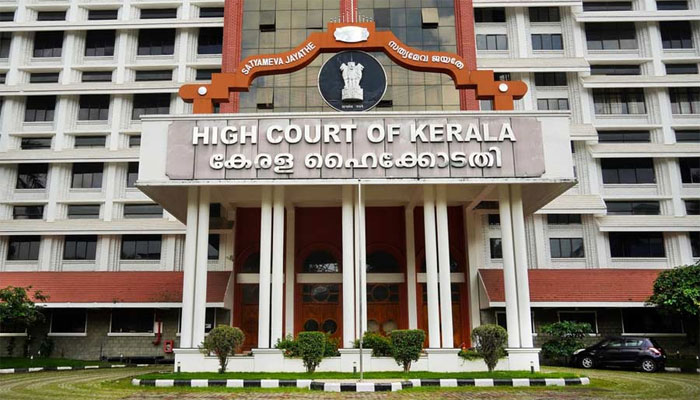
On 14th January the order was pronounced [pdf] by the Kerala High Court which granted pre-arrest bail to a man accused of hurling caste-based remarks. “Going by the dictionary meaning, the word means son of a prostitute. That being so, the learned counsel for the appellant/A3 is right in saying that the same is not a casteist slur,” the single-bench judge of Justice C.S. Sudha stated.
The petitioner who is also the third accused in the case had appealed the dismissal of his plea under Section 482 of BNSS (Bharatiya Nagarik Suraksha Sanhita) seeking pre-arrest bail under Section 14A of the SC/ST Act. “An offence under the Act is not established merely on the fact that the informant is a member of the scheduled caste unless there is an intention to humiliate a member of scheduled caste or scheduled tribe for the reason that the victim belongs to such caste,” the bench clarified.
The investigation also asserted that the offence under Section 3(1)(r) had been committed, however, the bench countered that a violation under Section 3(1)(r) of the Act would specify the elements of deliberate intimidation and insult with the goal of degrading a member of a scheduled tribe or caste. It further pointed out that any form of abuse or intimidation directed towards an individual shall not be considered a breach under the Act unless such actions are motivated by the victim’s affiliation with a scheduled caste or scheduled tribe community.
The court observed that “in the FIR the prosecution has no case of commission of an offence punishable under Section 3(1)(r) or(s) of the Act. The offence under Section 3(1)(r) of the Act would indicate the ingredients of intentional insult and intimidation with an intent to humiliate a member of a scheduled caste or a scheduled tribe.”
“All insults or intimidation to a person will not be an offence under the Act unless such insult or intimidation is on account of the victim belonging to the scheduled caste or scheduled tribe. The object of the Act is to improve the socio-economic conditions of the scheduled castes and the scheduled tribes as they are denied a number of civil rights. Thus, an offence under the Act would be made out when a member of the vulnerable section of the society is subjected to indignities, humiliations and harassment,” the court conveyed.
It also expressed that the prosecution’s case attracting a charge under Section 3(1)(s) or (r) of the Act is not mentioned in the FIR and added, “Further, to attract the offence under Section 3(1)(r), the abuse should have taken place in public view. Going by the allegations in FIS (First Information Statement), it appears that the nearby residents gathered on hearing the cries of the informant and Abiraj. When A1 is alleged to have abused the informant and Abiraj, nobody else seems to have been present there. Therefore, if at all the aforesaid word is taken as a casteist slur, it does not seem to have been done in public view.”
The court highlighted that “a reading of the FIS shows that the incident happened due to a dispute relating to the vehicle of Abiraj and not because the informant and Abiraj belong to the scheduled caste community.” It stated that conflicts unrelated to caste identification cannot automatically invoke the provisions of the SC/ST Act, citing Hitesh Verma v. State of Uttarakhand and Khuman Singh v. State of Madhya Pradesh. Hence, the judge established that a vehicle disagreement was the cause of the conflict between the complainants and the accused. “Therefore, prima facie it is doubtful whether the offence under Section 3(1)(r) of the Act will be made out,” the court concluded.
Accordingly, it noted that there isn’t any initial evidence to support an offence under Section 3(1)(s) or (r) of the Act and granted the accused’s request for pre-arrest bail. The judge ruled that there was no need to question the accused in custody, nevertheless, informed that the observations applied only to the bail proceedings and would not have an impact on the trial.
Background of the case
The incident transpired on 12th November 2024 at Perumbavoor. The three accused (A1, A2 and A3) subjected him and his brother-in-law Abiraj to abuse and intentionally hurt them. A1 an A3 are his neighbours and also acquainted with Abiraj. A2 is A1’s father. They are aware that he is a member of the Pulaya community. Arun, his relative, was thrown down and beaten by A1 a few days ago while riding Abiraj’s motorcycle. The vehicle sustained damage in the attack. They insisted that A1 restore the two-wheeler, but he refused leading to an altercation between him and Abiraj.
Abiraj and A1 and A3 got into an argument at 9:50 am on the day of the instance which resulted in a scuffle. Upon hearing this, the informant went to the scene, however, Abiraj had already returned home. Later, at around 10:05 pm, the duo were standing on his car porch and talking about the matter when A2 entered the residence’s courtyard. He asked as to who had beaten A1 and then spat obscenities at them. When he and Abiraj told him to leave and stated that the issue could be discussed the following morning, A2 punched him on the left side of his face and gave him a bleeding wound on his lip.
He also did the same to Abiraj on his neck. A1 and A3 also showed up at the courtyard as they attempted to send A2 away. A1 then questioned Abiraj’s presence there after which he abused him and beat him on his head and neck. Abiraj was pulled onto the road in front of the home by A1 and A3. A1 also stabbed him in the left shoulder with scissors, causing bleeding. He again injured him by striking him above the left side of his lip. Afterwards, they absconded when people hurried to the site as they heard the cries. A1 deliberately struck Abiraj because he wanted to know why the former had damaged his vehicle.
The informant claimed that A1 and A2 attacked and humiliated them since they were sure that no one would question their actions because the latter were members of the scheduled caste community. According to the FIR (First Information Report), A1 through A3 are charged with committing the offences specified in Sections 329(3), 115(2), and 118(1), as well as 3(5) of the BNS (Bharatiya Nyaya Sanhita) and 3(2)(va) of the Act. The trial court had earlier denied the pre-arrest bail request, concluding that the Act’s Sections 18 and 18A are applicable.