The US Presidential candidate Bernie Sanders suffered a heart attack three days ago, his campaign confirmed on Friday. The Vermont senator and Democratic presidential candidate was released from the hospital.
The 78-year-old Senator was at a campaign event in Nevada on Tuesday when he experienced chest discomfort and was rushed to a hospital. He was transferred to Desert Springs hospital medical centre where he was diagnosed with blocked artery leading to a heart stroke.
“Sen. Sanders was diagnosed with myocardial infarction,” his doctors said in the statement on Friday, using the medical term for a heart attack. “Two stents were placed in a blocked coronary artery in a timely fashion. All other arteries were normal. His hospital course was uneventful with good expected progress,” furthered his doctors.
Soon after his discharge, Bernie took to Twitter to thank all his well-wishers and confirmed that “he felt great”.
“After two and a half days in the hospital, I feel great, and after taking a short time off, I look forward to getting back to work,” he said.
Hello everybody! We’re in Las Vegas. I’m feeling so much better.
Thank you for all of the love and warm wishes that you sent me.
He is expected to return to Vermont and has said he plans to appear at the next Democratic debate, on 15 October.
Vermont Senator Bernie Sanders is running for the President 2020 of the United States as a Democratic candidate. Americans will elect the next president of the United States on November 3, 2020. Twenty-three notable elected officials and public figures, 19 Democrats and four Republicans, are running for president. The most popular amongst the Democrats being Tulsi Gabbard and Donald Trump from the Republic.
Recently, he had issued a statement on Kashmir where he had castigated the Indian government for the restrictions on communication and claimed that India’s actions were “unacceptable”. The Vermont Senator, Bernie Sanders further called for a “UN-backed peaceful resolution that respects the will of the people of Kashmir.”
The event where Sanders spoke was organized by the Islamic Society of North America (ISNA), which was listed as a co-conspirator in the Holy Land Foundation (HLF) Case by the US Government. The HLF and five of its prominent members were convicted by a Texas jury in 2008 for securing funds for the terrorist group Hamas.
The Far-Left Communist’s stance on Kashmir, where he appears to be toeing the line of the Jihadist state of Pakistan, ought not to surprise anyone. In the past, he has praised several violent dictatorships. In the 1980s, the praised Fidel Castro for his inhumane crimes, for which he was slammed by Hillary Clinton in the 2016 Democrat Primaries.
In another bizarre incident, an environmental activist group ‘Extinction Rebellion’ activists on Thursday brought an old fire engine filled with 1800 litres of ‘fake blood’ with an intention to spray the 100-year-old building of British Finance ministry. The fire engine had a giant banner reading ‘Stop Funding Climate Death’.
They wanted to convey that the UK treasury has ‘blood on its hands’ for, as Greta Thunberg says, ‘not doing enough’.
However, the ‘Extinction Rebellion’ activists were perhaps unprepared for the challenges a giant hose would possess for untrained hands. As soon as they tried to spray the building, the force of the spray made the hose slip out of the hands of the clueless eco-warrior and instead of painting the building, it started going ROFL, yes, it literally started rolling on the floor.
?♂️? I love the way he keeps talking like it wasn’t a total failure. They can’t operate a machine, can’t plan an operation, didn’t think to practice first. Its almost like these people have never had a proper job ? pic.twitter.com/uXrsNH3L1i
— The James O’Brien Parody Account (@JamesOBonkers) October 3, 2019
As seen in the video above, one eco-warrior did try again to tame the hose but it seemed to have a mind of its own and the climate-change denier hose refused to pay attention to the activist.
The sight of the menacing building in central London being drenched in blood might have made an impressive sight and would probably have filled cover pages and social media timelines all over the world for the next few days, but sadly, the violent hose manufactured by evil corporates had other plans.
The result was a central London street filled with hundreds of litres of ‘fake blood’. The Metropolitan Police eventually seized the engine and had it removed from the scene. They have arrested 8 Extinction Rebellion activists, five men and three women. One of the arrested activists is an 83-year-old man named Phil Kingston, who said, “I fight with all my being for my four grandchildren in this situation of existential danger. Kingston has been arrested 6 times for his environmental activism.
The group was live-streaming the demonstration on Facebook. One of their demands was for the UKEF(UK Export Finance) work towards zero emissions globally by 2050.
The group is planning an ‘International Rebellion’ in four days. It is a two-week-long climate action protests that Extinction Rebellion says it has coordinated with allied movements across 60 global cities to “rebel against the world’s governments for their criminal inaction on the Climate and Ecological Crisis.”
The ‘Extinction Rebellion’ has been known for similar unique protest stunts. Last month, they had members covered in fancy clothes and masks who had held a ‘funeral’ at the London Fashion Week. They had held an elaborate funeral march with coffins and fancy costumes. Ironically, they were demanding for the fashion industry to ‘change everything it does’ because the clothing industry is a major factor in the climate crisis.
“Not to die for.”
Extinction Rebellion @boycottfashion Funeral Procession heads down The Strand to London Fashion Week. #LFW.
Environmental activists have long been coming up with creative ideas to make their point. While it is unclear as to whether they work to make their protests ‘zero-emission’ or think about the waste they are going to generate, but they sure hog a lot of limelight.
Bombay High Court dismissed pleas against BMC decision to cut trees to make way for metro car shed
Which is very good, because the original “crusaders” were a bunch of religious zealots anyway. The environmental activists who are “crusading” for Aarey Colony are just as brainwashed.
How foolish do you have to be to protest against the construction of a mass transit system, that too in a city like Mumbai? When you build the metro, you are allowing literally lakhs of people to switch from polluting autos, cars and two-wheelers to a clean, environment friendly form of transport. You are stopping a whole lot of CO2 from being pumped into the atmosphere.
In terms of the environment, mass transit is always better than private vehicles. On top of that, the Metro runs on electricity. As yet, we do not have a sustainable means of producing electricity from renewable sources, but electricity is a much better bet than others. Most renewable sources: solar, wind, tidal, etc all produce energy in terms of electricity.
And for what it’s worth, the Metro Authority is also planting forests elsewhere. It is not ideal to cut down trees. But the facts are completely clear: building a Metro is a net positive for the environment, even if you have to cut down a tiny part of the forest in order to do it.
But the “activists” who are protesting refuse to understand. Because they are no longer activists at all. Actually, News18 used the term correctly. They are crusaders, with a quasi-religious motive and a level of reasoning that is indistinguishable from religion.
You will notice that the “activists” are not talking numbers or facts. They only talk of cutting down an “ecosystem.” The pitch is based on emotion, not calculation. They are humanizing the birds and animals and even the trees of the forest. They are demanding that we should preserve those exact trees in their exact spots out of some religious sense of duty.
The environment is a practical concern. We cannot survive as a species if we can no longer breathe the air or if we can no longer drink the water. Or if climate change sends most of our cities under water. To stave off disaster, we all need to cooperate with each other.
By turning this practical concern into a quasi-religious form of bigotry, the left (and glamor seeking celebrities) are only enhancing the danger to the environment. The theatrics is only turning people against real concerns over the environment. Who would miss the optics of BMW hopping elites telling common folks they can’t have a metro?
There we have it. An issue that should have united everyone becomes a wedge issue. It becomes all about X vs Y. And the thing we know about wedge issues is that they get stuck in the crossfire between egos on all sides. The problem is that the environment is an issue on which we cannot afford to get stuck.
So everybody loses. Well, except for some celebrities who are looking for fifteen minutes of fame.
This is what the left has done to the environmental movement across the board. What did Greta Thunberg’s speech at the UN actually achieve? It probably pissed off many more people than it won over. So what, the leftists ask? Didn’t Greta Thunberg mobilize millions of people to become conscious about the climate crisis?
It is a fallacy that a cause can succeed simply when there are more people supporting it. You have to account for how many people are arrayed against you and take the difference. This is simple to understand : suppose there are two people pushing a car. Would it be easier to move the car if there were 10 people pushing it in one direction and then 9 others pushing back in the other direction?
So that’s what Greta Thunberg did: she polarized the issue of climate change even further. Getting just as many people to push the car backwards as forwards. And that’s what Aarey “activists” are doing, getting people to hate them. How much longer before we all start fighting over our individual egos, political biases, rich vs poor and all that? Recipe for stalemate.
Within hours of getting the go ahead from Bombay High Court to cut trees in Aarey colony in Mumbai for proposed Mumbai metro car shed, the Mumbai Metro Rail Corporation Limited (MMRCL) swung into action.
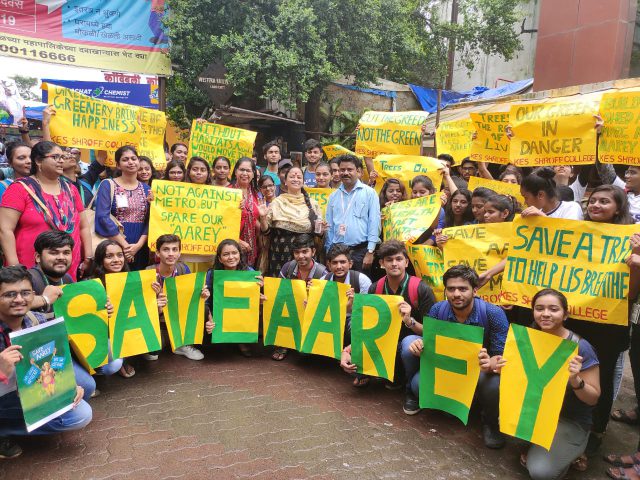
Activists and citizens gathered on the spot to protest against the felling of trees. Some even took to Twitter to spread falsehood that there is a 15-day wait period before the authorities cut the trees.
There is supposed to be a 15 day waiting period after permission is granted and notice has been uploaded on official website. But there is no waiting here. Our trees are being cut as citizens desperately plead to STOP this! @moefcc@PrakashJavdekar#Aareyhttps://t.co/nmVP7WllI7
These claims, however, are incorrect. Although it is true that the Tree Authority did impose a waiting period of 15 days, that period is already over. Activists are saying that the waiting period starts from the date of upload, which is completely false, because the waiting period starts from the date the order was issued.
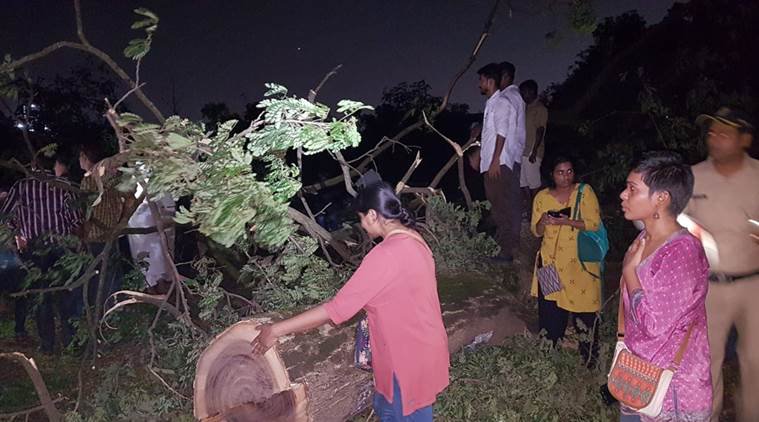
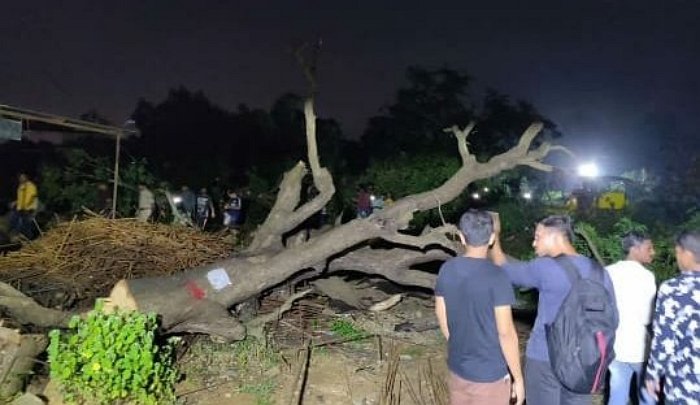
At around 9 PM last night, despite the protests, the Mumbai metro authorities started cutting the trees. Soon, the ‘activists’ started getting rough with the authorities and removed the barricades put up by them. As per latest reports over 800 out of about 2100 trees have been cut by the authorities through the night. About 500 trees will be transplated (uprooting and replanting elsewhere).
The police have blocked roads leading to the proposed site for metro car shed and no one is allowed within 3 km radius. As per reports, around 100 activists have been detained and taken to different police stations.
On Friday, the Bombay High Court dismissed all petitions against the Bombay Municipal Corporation decision to cut 2,700 trees in the Aarey Colony to make way for the Mumbai Metro car shed. The Bombay HC also dismissed the plea to declare Aarey an ‘ecologically sensitive zone and floodplain’.
Mumbai Metro is an ambitious infrastructure project which attempts to connect every nook and corner of the city. A city clogged with traffic and people this comes as a mode of quick, safe and cheap transit. By reducing vehicular traffic the metro de-clogs the roads and an independent UNFCC study points to the fact that it shall reduce CO2emission by 2.6 lakh metric tons every year.
Aarey is spread over 1278 hectares of land, out which, the metro car shed will be only built on 30 Hectare of Aarey land and even within that, 5 Hectare has been kept intact for greenery. So in a nutshell, only 2% area of the entire Aarey Colony will be utilized for the proposed metro car shed.
The proposed metro shed had triggered widespread protests, where assorted NGOs and film stars joined hands to oppose the shed. The protestors argue that the present government is killing the lungs of the city and destroying forests and that the move is anti-environment. However, the fact is that Aarey is not a forest but ‘grazing land’.
The campaign against the Metro project has been ridden with several lies and inaccuracies. It has almost become the professional demand of certain NGOs to stall development work by citing ‘environmental reasons’. Recently, Mumbai High Court imposed a fine of rupees one lakh on an NGO for filing a frivolous petition to stall development project in Navi Mumbai. The court noted that the PIL filed by Abhivyakti, the NGO, was motivated to somehow stall development work in Navi Mumbai.
Hours after Bombay High Court dismissed all petitions against cutting trees in Aarey Colony to clear space for the car shed of Mumbai Metro’s phase 3, authorities started cutting the trees late in the evening on Friday.
The moment the news of the same appeared, activists protesting against the project arrived at the spot to try and stop the felling of trees. While those could arrive at Aarey Colony, others stated urging people on social media to rush to the spot to save the trees.
While doing so, the activists used the tool they have using to try and scuttle the project, the use of lies. Many activists started spreading a rumour that this action by the government is illegal, as according to them, trees can’t be cut for 15 days after the order for the same is uploaded on the website.
Bollywood actress and anti-metro rail activist Dia Mirza tweeted that “there is supposed to be a 15 day waiting period after permission is granted and notice has been uploaded on official website”.
There is supposed to be a 15 day waiting period after permission is granted and notice has been uploaded on official website. But there is no waiting here. Our trees are being cut as citizens desperately plead to STOP this! @moefcc@PrakashJavdekar#Aareyhttps://t.co/nmVP7WllI7
The argument was given by many activists, saying that the government was violating rules by cutting without waiting for 15 days, hence the operation was illegal. Some of them also posted a screenshot of BMC website showing that the order issued by Tree Authority of The Municipal Corporation of Greater Mumbai was uploaded on 4th October, hence the authorities can’t cut trees for 15 days as per the order.
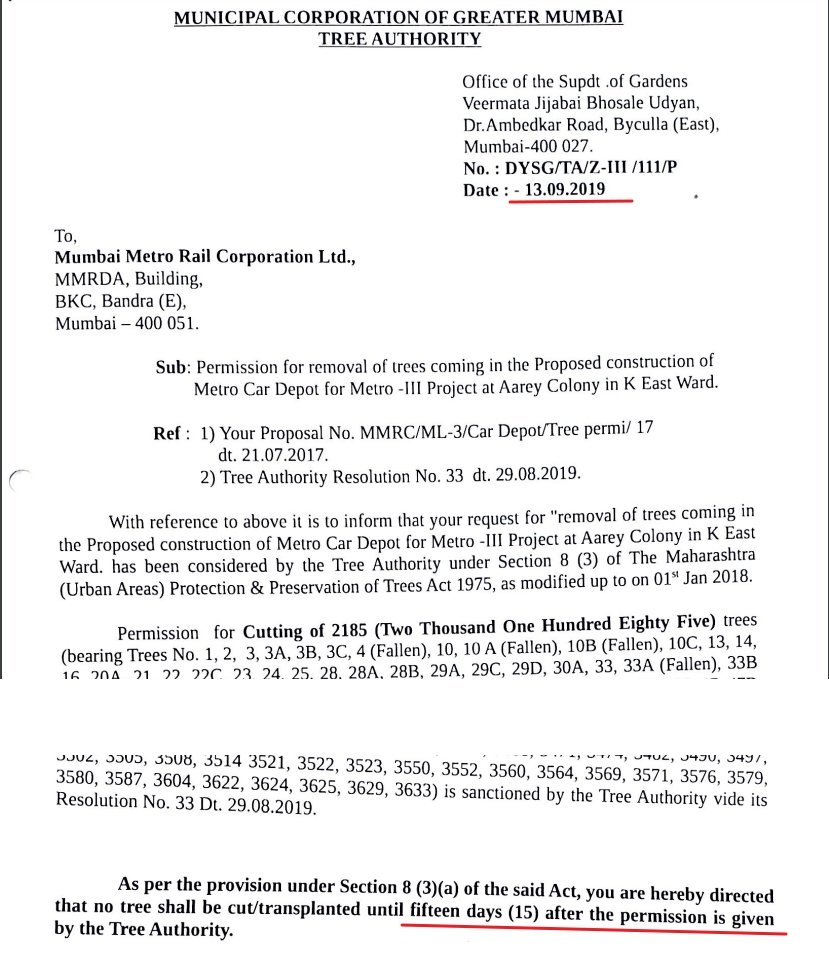
But this is a false and misleading claim, as although it is true that the Tree Authority did impose a waiting period of 15 days, that period is already over. Activists are saying that the waiting period starts from the date of upload, which is completely false, because the waiting period starts from the date the order was issued, and the order to cut 2185 trees and transplant 461 trees was issued by the authority on 13th September. The order says “Permission for Cutting of 2185 trees (bearing Trees No. ***) and Transplanting of 461 trees (bearing Trees No. ***) is sanctioned by the Tree Authority vide its Resolution No. 33 dated 29.08.2019.
Tree Authority order
It further states, “As per the provision under Section 8 (3)(a) of the said Act, you are hereby directed that no tree shall be cut/transplanted until fifteen days after the permission is given by the Tree Authority. The tree authority also orders the Metro authorities to plant 13,110 trees within 30 days.
This clearly means that the Tree Authority had decided to allow cutting and transplanting of trees on 29th August, and it had issued the order to the Mumbai Metro Rail Corporation Ltd on 13th September. Therefore, the waiting period of 15 days is already over on 29th September, as it starts from the day the order was issued, not when it was uploaded on the BMC website. As the High Court dismissed all petitions against the order, this means the Tree Authority order remains valid, along with its issue date and the waiting period. The date of uploading the same on the website is not relevant in this case, as claimed by the activists.
The order may be uploaded on 4th October, but it was already on public domain. The petitions were filed in the Bombay High Court against this order only, therefore the activists can’t even claim that they were not aware of the order before it was uploaded.
The Uttar Pradesh police arrested a Maulana (priest) of Momin Masjid in Baghpat, Uttar Pradesh, for sexually assaulting and blackmailing a head female constable for over a year on the pretext of healing her son.
In a statement, the Bhagpat police confirmed the incident and said that the accused has been arrested and a complaint has been registered against him.
The head female constable posted in the Bhagpat police station was allegedly raped and blackmailed for over a year by a Maulana in the pretext of her son’s treatment. The Maulvi coerced the victim to give him lakhs of rupees for the healing of her son and for maintaining peace at her house.
According to reports, after the death of her husband in the year 2006, a woman resident of Bijnor got a posting as a constable in the dependent quota who later went on to become the head constable in the Bhagpat police station. On June 29 last year, the younger son of the female constable was injured in a road accident. The son also underwent treatment in ICU for several months. Fearing that her son is possessed by a jinn or evil spirit (a superstition making the possibility of spirits inhabiting human bodies, a fairly universal belief across cultures), she reached out to Maulana Zubair of the city’s Momin mosque on July 30, 2018, for the treatment of her son.
The Maulana, in turn, took advantage of her superstition and convinced the victim that her son was possessed by her dead husband. He then started forcing her to make a physical relationship with him assuring her to treat the son. He continued to scare the female head constable by warning her of his son’s death if she does not have physical relationship with him. Not only that, he also extracted lakhs of rupees from the woman.
Fed up by the mental and physical torture which lasted for almost a year, the head constable lodged a complaint at the Baghpat police station, after which the Maulana was arrested by police. Police has registered a case against the Maulana under relevant sections of IPC including section 376. The SC/ST Act also has been invoked as the woman belongs to Dalit community.
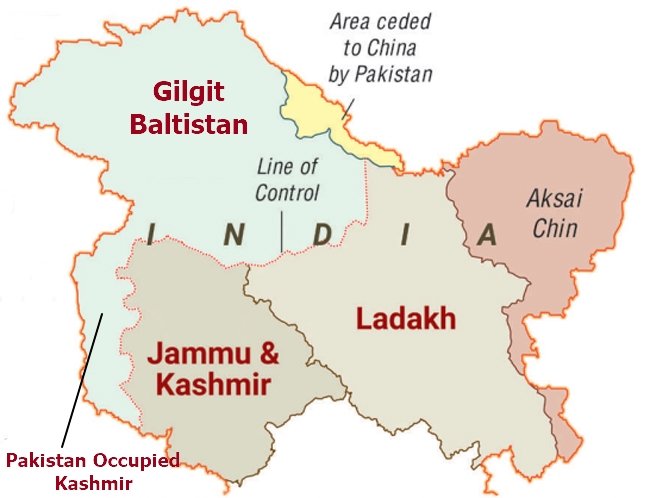
The highly mountainous region of Gilgit Baltistan (GB) covers an area of 72,971 square km with an estimated population of over 1.8 million (as of 2015 records). The region is an extremely fragile and significant one with three of world’s powerful ornery and daedalian powers along with a conflict-ridden nation encircling it. Originally belonging to and part of India, Gilgit Baltistan is surrounded by Afghanistan’s Wakhan Corridor to the north, China’s Xinjiang Uighur autonomous region to the north-west, Ladakh to east and Kashmir to south. Geographic tri-junction of Himalaya, Hindu Kush and Pamir, Gilgit Baltistan possesses the most startling views of natural beauty. Apart from several high-altitude lakes, the region is also home to three of world’s longest glaciers outside of the polar region, including the world’s highest war field, the Siachen glacier.
But apart from its mountains, glaciers and green plains, the region has something else of superfluous significance and prudence: its strategic points. GB is home to some of the world’s most important and contentious strategic points capable of creating unremitting embroilments and fracases. The region holds extreme volatility and if gets subjected to desuetude can cause a ruckus in the entire regions of South Asia, Central Asia and China, ultimately affecting the entire world. The mountain province consists of 3 core divisions: Gilgit, Baltistan and Diamer, which in turn is further divided into 10 districts along with its Shaksgam valley – which was gifted to China by occupier Pakistan in 1963 border agreement – of 5,180 square km. The recent developments in the Jammu and Kashmir region with the removal of Article 370 and Indian minister’s statements on PoK has again bought the region of Gilgit Baltistan into limelight from being drowned in the darkness. Which makes it exceedingly important for us to understand the strategic importance of the region of Gilgit Baltistan.
Geographic location
The region’s trijunctionality, both in terms of political and geographical boundaries, makes it one of the world’s most significant geostrategic points. Situated between Hindu Kush, Karakoram and Pamir mountains, the high positioned GB oversees the entire regions of Khyber Pakhtunkhawa, Kashmir, Ladakh, Xinjiang and Wakhan Corridor; making it a powerful game-changing military high point. Gilgit Baltistan is, uniquely, an introspection point of West, Central and South Asia along with China. It has passage to four nations, two of them (India and China) being Asia’s biggest powers. GB possess direct links for connecting all four regions which, if held to desuetude by loony wanton forces, has the potential of causing serious geostrategic conflicts.
Gilgit Baltistan Map
Gilgit Baltistan’s geo-strategic importance is multi-folded, in case of a two-front war against India, to become the most critical point of the war, capable of drastically affecting and determining the outcome. An advanced Air Force base in GB can devastate the enemy’s confidence and steer the movement of conflict to India’s side. High altitude points are still tremendously important aspects of warfare which can prove to be, if accessed properly, the big game changers.
Apart from warfare, the region of Gilgit Baltistan has the potential of completely destroying Pakistan’s Kashmir dream. The region is a comfy hotbed and safe haven of every major terror outfit gunged with religious radicalisation – which are sponsored, protected and fostered by Pakistan’s ISI and military for the pernicious purpose of attacking India – from Jaish-e-Mohammad (JeM) to Hizbul mujahideen. The region acts as a protective shield, the first line of defence, for the ‘original’ Pakistan of Punjabis and Pakhtuns and the first front of aggression against India. Under Pakistani control, the province has been morphed into a military-cum-terror state fundamentally designed to further the malicious agenda of annexing Kashmir. Controlling the first line of defence – the first and most powerful launchpad of aggression – can be a strategic boon for India.
Gilgit Baltistan is the sole, and most significant, the connection of Pakistan to China. Pakistan’s Khyber province, its otherwise northernmost part, has absolutely no access to Chinese soil and hence making GB the very string of China-Pakistan necklace. Losing GB will be a catastrophic and calamitous situation for Pakistan cutting the socioeconomic ties with Beijing. China’s ‘all-weather friendship’ with Pakistan is entirely based upon the geo-strategic significance of Gilgit Baltistan as it holds the pass to Pakistan and eventually to the Arabian Sea. India controlling Gilgit Baltistan will be an overarching knock-out punch to China Pakistan’s two front and ‘iron brotherhood’. Without China’s assistance, Pakistan will be left with no ‘godfather’ to feel protected both economically and militarily.
Economic Potential
Home to valuable earthy resources, GB is rich in minerals deposits. These include metallic, non-metallic, energy minerals, precious stones and different rocks of industrial use. The southern areas of this region have substantial deposits of nickel, lead, copper and zircon. In its northern regions, it contains deposits of iron, silver, gold, garnet and topaz. Almost all of its mining potential is untapped and capable of generating ample wealth.
Gateway to Afghanistan, Tajikistan and rest of the Central and West Asia, the region of Gilgit Baltistan is a potential economic epicentre of trade. The Uzbekistan, Turkmenistan, Tajikistan, Kazakhstan and Kyrgyzstan contain large deposits of mineral resources, many of which still remain unexplored. Its unexploited oil and gas reserves are conservatively estimated at 4% each of the total global reserves. This untapped potential has attracted China too and it acted fast. In 2000, China’s trade with Central Asian Republics (CARs) was US $1 billion and over the next ten years, it leapt 30 times to reach US $30 billion. By 2013, the two-way trade reached US $50 bn and with that, China replaced Russia as Central Asia‟s largest trading partner.
Apart from China; US, Russia, Iran, Turkey, Saudi and India all eyes for the natural resources of Central Asia. India, being the most likely beneficiary from Central Asian reserves, is conscientiously working to access and establish trade routes to Central Asia for securing domestic and military energy demands along with ensconcing greater muscle power in the region. With China becoming the galloping horse in race to capture Central Asia, it is of paramount significance for India to have a land connection with Afghanistan and Central Asia. Gilgit Baltistan can be the wanton sabre in this war of wooden knives, providing strong land linkage and sociocultural connections to Central Asia for India.
The economic significance of Gilgit Baltistan is also embedded in its vast hydroelectric potential. Home to Indus and its 6 tributaries, hundreds of glaciers and lakes, including world’s second and third longest glaciers outside of polar regions, the rich water resource region has the potential of generating 40,000 MW of hydroelectricity. It consists of about 27% glaciers and snow deposits, the biggest in the world outside polar region. Proper management and harnessing of hydroelectric power potential of Gilgit Baltistan can generate US $21 billion per annum in revenues.
China’s nightmare
Anyone who looks at the map closely will notice the unprecedented significance of Gilgit Baltistan region to China. Part of the former ‘silk route’, Gilgit Baltistan is the ladder for China to reach its ambitious target of accessing the Arabian Sea. China envisages a mega infrastructure project connecting China’s Kashgar in Xinjiang to Balochistan’s Gawadar port. The project named China-Pakistan Economic Corridor (CPEC) – which is part of China’s larger Belt and Road Initiative (BRI), an attempt to bring back the ancient silk route to life – is a US $60+ billion programme which consists of constructing infrastructure connecting the two ends. For China, CPEC is a means to increase its strategic presence in Pakistan and CPEC is part of a grand plan for enhancing influence through rail, road and pipeline connectivity to Central and West Asia while linking Gwadar to Xinjiang through Gilgit. Besides, Xinjiang is only 2500 km from the Arabian coast but is 4500 km from the Pacific coast. The flow of goods and fuel from Strait of Hormuz, the Arabian Sea through Gwadar, Gilgit and eventually to Kashgar, the CPEC project provides a shorter, stronger and more direct link to the fulfilment of China’s increasing energy hunger. China plans to create a byzantine network of gas pipelines, road and rail in order to secure its energy demands and establish an authoritarian control over Pakistan.
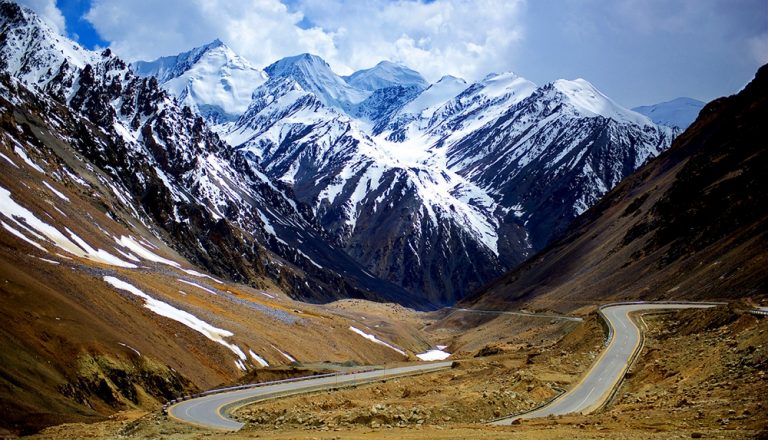
Karakoram Highway (KKH) is another mega infrastructure project of China in Pakistan, a 1,300 km national highway project extending from Hasan Abdal in Punjab in Pakistan, Khanjerab Pass in Gilgit Baltistan to Kashgar of Xinjiang in China. The highway at points reaches an extremely close point to borders of Afghanistan, China and India, hence making it a critical geo-strategic region.
Both CPEC and KKH are tremendously significant strategic projects of China in Pakistan, the connection between China ambitions and Pakistan’s dreams. CPEC is also the backbone of China’s flagship BRI project and supposed economic renaissance of Pakistan. Both the projects pass through the Gilgit Baltistan making it the most fragile and volatile region for both China and Pakistan. Gilgit Baltistan is the key to the destruction of Chinese influence in South Asia; the string of China-Pakistan’s pearl necklace and also the Brahmastra for India against China. India controlling GB can turn out to be the worst nightmare for China and eventually for Pakistan too.
The region of Gilgit Baltistan is a marvellous throne of immense geostrategic importance adorned with the diamonds of its geographical location, economic potential and essentiality. The nation who coronates the throne becomes the king.
A special investigation team (SIT) of the Economic Offences Wing (EOW) of Mumbai Police arrested absconding former MD of PMC Bank Joy Thomas today. They had been on the lookout for Joy Thomas and the bank’s former chairman Waryam Singh who were absconding ever since EOW arrested the HDIL chairman and managing director Rakesh Wadhawan and his son Sarang, co-accused in the Punjab Maharashtra Cooperative (PMC) Bank scam on Thursday.
Earlier in the day, the EOW also produced Rakesh Wadhawan and his son Sarang before a local court, which in turn, sent the duo to police custody till October 9.
Bandra office and residential properties of Sarang and Rakesh Wadhawan were searched and property of Rs 3,500 crore belonging to the company was seized by the EOW during the investigation.
Bandra office & residential properties of Sarang & Rakesh Wadhawan being searched. Also searching for Joy Thomas & Waryam Singh. At present, Joy Thomas & Waryam Singh untraceable. Recording statement of some #PMCBank officials: EOW Sources #probe#PMCBankFraud#PMCBankFraud#PMChttps://t.co/OD9F67jabv
The Economic Offences Wing (EOW) of the Mumbai Police had filed an FIR on September 30 (Monday) against HDIL and Punjab & Maharashtra Cooperative (PMC) Bank officials in the PMC bank fraud case. The persons named in the FIR include PMC bank’s former chairman Waryam Singh, former Managing Director Joy Joseph Thomas, Housing Development and Infrastructure Limited (HDIL) group promoters Sarang Wadhawan and Rakesh Wadhawan.
The EOW has filed cases under Sections 409 (Criminal breach of trust), 420 (Cheating and dishonestly), 465 (forgery), 466 (Forgery of record ), 471 (using forged document as genuine) and 120B (criminal conspiracy) of the Indian Penal Code. EOW has also formed a Special Investigation Team (SIT) to probe the case. The FIR says that irregularities worth ₹4,355.46 crores have been committed in the case, although the amount can go up during the course of the investigation.
The Enforcement Directorate (ED) has also initiated an investigation by registering a case of money laundering, another official said. ED officials raided six places in the city and suburbs and collected some important documents related to the case, he said.
The RBI has already dismissed the board of governors of PMC bank and has appointed an administrator. The bank has been put the bank under restrictions, putting a limit of ₹1000 withdrawal by depositors initially, which was later raised to ₹10000 and ₹25000. The bank is also not allowed to give any loan without the prior approval of RBI. The restrictions have been put for six months after RBI was informed about the PMC Bank fraud by a whistleblower inside the bank.
An official of the had EOW said that “the manager has lodged a complaint on the behest of the RBI appointed administrator. His complaint is the starting point of the probe”. He also said that although the police believe the scam amount to be above ₹6000 crores, the amount of ₹4,355.46 crores was mentioned by the complainant and the same has been mentioned in the FIR.
Borge Brende, President of the prestigious World Economic Forum, has showered praises on Indian Prime Minister Narendra Modi as he said that India now has a significantly enlarged global profile steered by decisive leadership.
He further added that India was a young economy with a lot of potentials and has shown remarkable strength and resilience amidst global slowdown.
Sharing his opinion on Prime Minister Narendra Modi’s website, Brende wrote that the stage was set for the country to realize its vision of becoming a five-trillion dollar economy in the next five years and 10-trillion dollar economy in the next decade-and-a-half.
India’s has been a dramatic rise, deserving of the global attention that it has commanded, the WEF chief said. He further added that India, steered by a decisive leadership, is rising to the occasion through a significantly enlarged global profile.
“India’s commitment to renewable energy through voluntary and ambitious renewable power capacity targets, a lead role in the Paris Climate Agreement negotiations and the International Solar Alliance shows its aspiration of becoming a leader in environmental security and climate change mitigation,” said Brende.
He pointed out that India has also expanded its global stature in space exploration through widely celebrated breakthroughs such as its recent lunar mission and its distinction of becoming the fourth country worldwide to shoot down a low-orbit satellite with a missile.
Recognising India’s leadership role in the region, Brende said that India is also more involved in global humanitarian efforts and development initiatives, including infrastructure development in Afghanistan, the International North-South Transport Corridor, the Ashgabat Agreement, the Chabahar port and the India-Myanmar-Thailand highway.
In his article, Brende has mentioned the rise of India’s rank in Global Innovation Index to 52nd spot this year stating that India is one of the few countries to have consecutively improved its rank for nine years. He also appreciated India’s leadership under PM Modi for undertaken groundbreaking structural reforms reflecting its growth ambitions and development priorities.
He wrote, “In the past decade, India has witnessed a mushrooming of start-ups, innovating across domains such as digital payments, online retail, education and software. The number of Indian unicorns has also risen every year.”
“Initiatives aimed at revamping India’s restrictive business regulations have already borne fruit. India’s 65-place leap in the World Bank’s Ease of Doing Business rankings demonstrates an improved business climate and expounded investor confidence,” wrote WEF president.
Borge Brende also stated that initiatives such as the Ayushman Bharat for universal health coverage in India, the world’s largest LED programme to improve energy efficiency, a sweeping rural electrification drive and a strong push towards broad-based energy access and security through the Ujjwala and Saubhagya schemes, among others, showed India’s ability to devise and implement a reform agenda which balances global aspirations with critical development imperatives at home.
Later speaking at the Indian Economic Summit on Wednesday, Borge Brende, the top most official of World Economic Forum (WEF) said that India can play a crucial role in the development of South Asia and sustainability of global economic growth.
The WEF, which organises the India Economic Summit in partnership with the Confederation of Indian Industry (CII), engages the foremost political, business and other leaders of society to shape global, regional and industry agendas.
“India is one of the fastest-growing large economies in the world. The country is also a young economy with a lot of potential and has shown a lot of strength and resilience amid an economic slowdown globally,” Brende said.
He further added that the rise of advanced technologies has the potential to create economic and social value and it can boost the country’s goal of maintaining its growth momentum while attaining greater social inclusion and regional cooperation.
India is very advanced from many developed economies when it comes to the information technology sector, but there is a lot of scope for development in terms of infrastructure, Borge Brende added.
The not-for-profit organization which is committed to improving the state of the world entity by engaging different stakeholders is organising its 33rd India Economic Summit in New Delhi on October 3-4 under the theme — ‘Innovating for India: Strengthening South Asia, Impacting the World’.
More than 800 leaders from 40 countries comprising senior public figures and leading representatives from civil society, arts and culture, science, business and academia is expected to participate in the event.
During the event, artificial intelligence and drones, start-up unicorns, infrastructure, environmental reforms, gender parity, education and South Asia’s economic outlook will be on top of the agenda. The programme will also underline the importance of South Asia’s relationship with the Association of Southeast Asian Nations (ASEAN) and highlight how the two regions, defined by their demographic and digital dividends, will shape the world’s collective future.
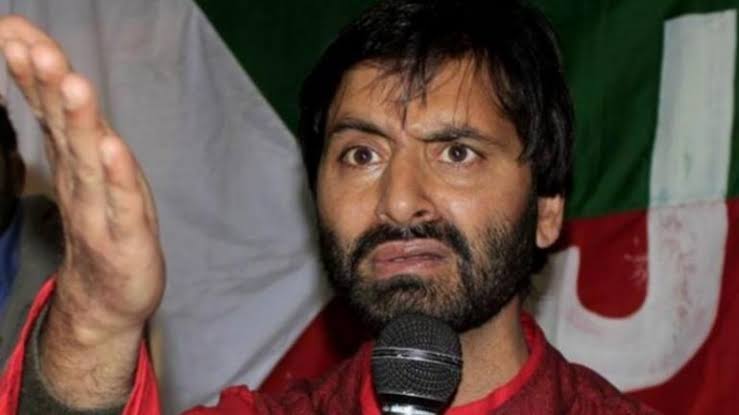
The National Investigating Agency today filed a supplementary charge sheet against Kashmiri separatist leader Yasin Malik alleging that the JKLF chairman had relations with Pakistan based terrorists Hafiz Saeed and Syed Salahuddin.
Malik was today presented in a Delhi court in connection with the terror funding case of 2017. The NIA filed a supplementary charge sheet which included names of Yasin Malik, Shabir Shah, Asiya Andrabi, Masarat Alam and Rashid Engineer. The charge sheet was filed under Sections 18/20/38/16 of the UAPA act. Extending Malik’s custody till October 23, Additional sessions judge Rakesh Syal put up the matter for hearing on the same day.
According to NIA, in the light of fresh evidence in the form of social media interactions, call records, oral and documentary proofs, the charge-sheeted accused are said to have close ties with the cross border terror masterminds Hafiz Saeed & Syed Salahuddin.
The National Investigation Agency (NIA) had registered a case against Pakistan-based terrorists and sympathisers including 7 top separatists, 2 hawala conduits and some stone pelters in the Jammu and Kashmir terror funding case of 2017.
The NIA had on April 2019 arrested the infamous JKLF chief Yasin Malik in custody for 12 days in the terror funding case. As per NIA sources, Yasin Malik had then admitted that he was instrumental in bringing together the disparate factions of Hurriyat Conference and formed the Joint Resistance Leadership (JRL), which spearheaded the violent agitations in 2016 in Kashmir Valley, by issuing “Protest Calendars” leading to economic shutdown for over four months.
Recently, after being dormant for a long time, a high-profile case involving the murder of four IAF personnel in Kashmir by terrorists, purportedly led by Yasin Malik, finally saw some movement after remaining stuck for almost three decades. Two charge sheets were filed by the investigative agencies mentioning Yasin Malik’s alleged role in the murder of IAF personnel in Jammu and Kashmir.