Home Blog Page 7289

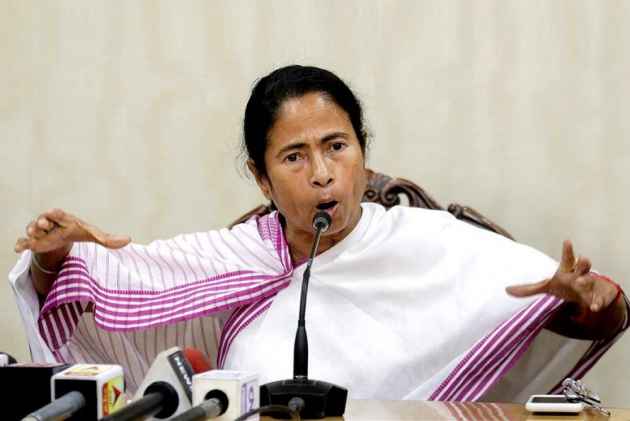
In Mamata’s Bengal, police is issuing rape threats, Gorkha activists claim

0

A voice clip has been doing the rounds on social media where a policeman is alleged to be threatening a person with dire consequences. In the clip, a police officer from Darjeeling region as alleged can be heard threatening the person that his house will be set on fire, and when the victim said that the policeman was talking like a goon, the officer threatened to rape his mother and sister.

The policeman accused is Soumyajit Roy, who is an Inspector of Police at the Sadar Police Station in the Sadar subdivision of the Darjeeling Police.

The tweet below contains the voice clip; strong language disclaimers apply:


Last year, protests had rocked the hilly regions of West Bengal over the demand for a separate Gorkhaland after the West Bengal government proposed making Bengali mandatory in schools and the place has been in turmoil ever since.

The Gorkha Janamukti Morcha (GJM), which led the stir, had alleged last year that the police had shot dead 3 people and the Darjeeling Toy Train and Trinamool offices were targeted by the protesters. The region was shut down for months over the demand by the protesters and the region has been limping towards normalcy ever since.

Now, Gorkha organisations have taken up this latest instance of state police’s high-handedness and atrocities against Gorkhas.

According to The Darjeeling Chronicle, GJM Chief Bimal Gurung has also issued a press statement that reads as follows :

He condoled the death of democracy in the Hill, Terai and Dooars region. He said that the audio recording that has gone viral today, provides a very small glimpse into how those loyal to Gorkhaland cause are being treated in West Bengal.  In a state run by a woman Chief Minister, her police have the audacity and brazenness to threaten someone’s mother and sister with rape.

He also demanded a CBI and NIA enquiry and said, “I strongly believe in our national motto – Satyameva Jayate. I have faith that the truth will always triumph, and despite all attempts at muddying the water, the real face of West Bengal government and their police force has been exposed.

Organisation named the Kalimpong Krishak Kalyan Sangathan had written to the MP from Darjeeling, Shri SS Alhuwalia, Smt Sarita Rai, MLA from Kalimpong and the District Magistrates of Darjeeling and Kalimpong demanding a Judicial probe into the matter by a sitting Supreme Court Judge against the said policeman and his immediate suspension failing which the KKKS will launch a protest march and Chakka Jam from the 14th of March in Kalimpong and Darjeeling districts.

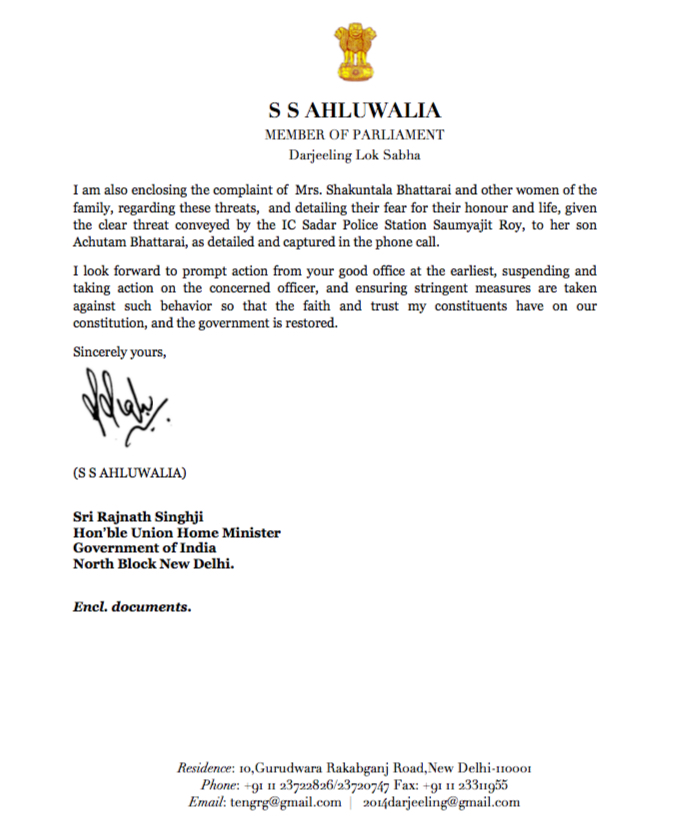
After that, Shri SS Alhuwalia has now written a letter to Home Minister Rajnath Singh detailing the “blatant human rights abuse” and that his intervention is urgently needed. He begins his letter by drawing the Home Minister’s attention to the alleged threats made by the Inspector.
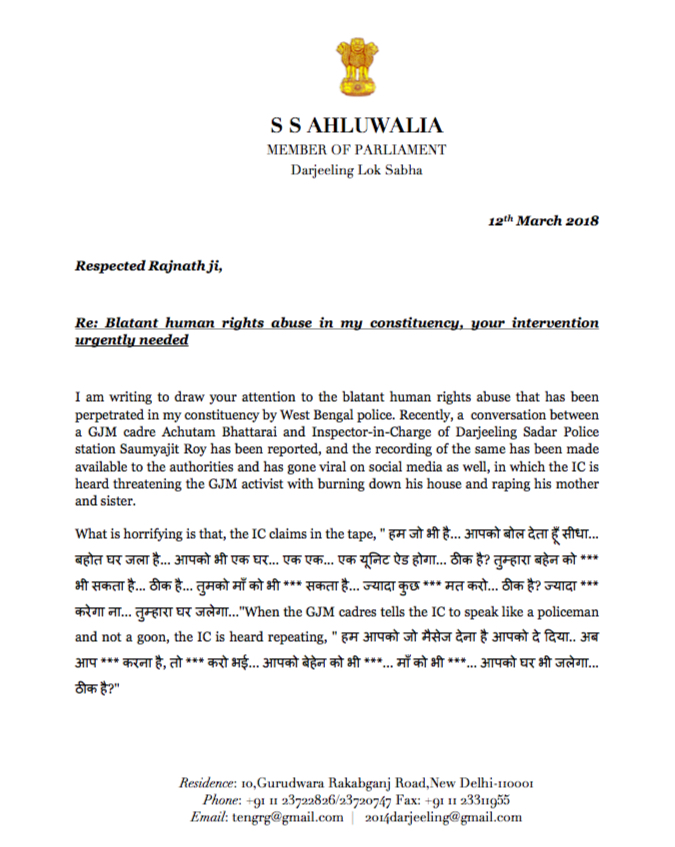
Page 1 of the letter by SS Ahluwalia

The second page of the letter says that Alhuwalia has got various requests that the Government of India should take up this matter with the Government of West Bengal at the earliest and legal procedures should be started against the police officer concerned immediately. He mentions how GJM Chief Bimal Gurung and hundreds of his followers have been booked under UAPA. The FIR also includes 5000-7000 unnamed others which facilitate the police to arbitrarily include anyone’s name. In the light of this, and the phone recording, he requested that these should be investigated by an independent agency like the NIA.

He also requested that the NIA should take suo moto cognisance of IC Saumyajit Roy’s threatening call.
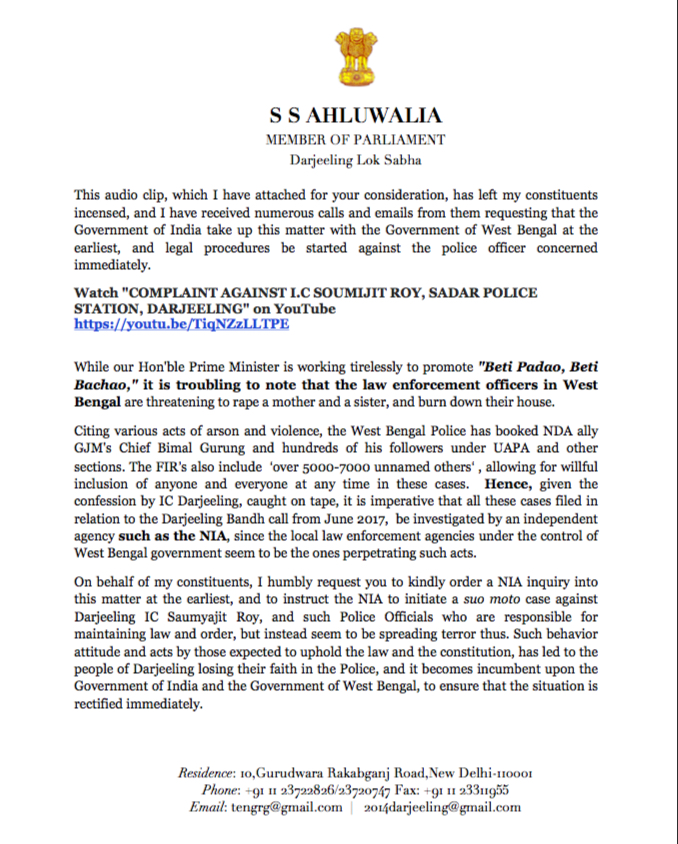
Page 2 of the letter written by SS Alhuwalia

The letter also enclosed the complaints of Mrs Shankuntala Bhattarai and other women of Achutam Bhattarai’s family.
The New Indian Express has quoted a top police official as saying, “[it’s a ] social media hullabaloo… People are investigating the case on Facebook.” On similar lines, Darjeeling SP was quoted by Indian Express as having said, “The audio clip is being spread through social media. We have not received any complaint.”

However, the family members of Achutam Bhattarai family has alleged that the Darjeeling Police has refused to accept their FIR.

OpIndia talked to the police officer in question and the officer has explicitly denied the allegations and called the voice clip “fake”. When asked if he will press for defamation charges if the clip was fake, he said that he ‘will do what seniors suggest’.

One can only hope that the Chief Minister of West Bengal, who is a woman herself, will look into the matter in her own personal capacity and take appropriate action after evaluating the facts of the matter.
PNB-Nirav Modi Scam Impact: RBI Discontinues LoUs for Trade credit

0

In the continuing aftermath of the PNB Nirav Modi scam, RBI today announced that it had scrapped Letters of Undertaking (LoUs) and Letters of Comfort (LoCs) for Trade Credits. The RBI has said that on review of the guidelines in force for the use of LoUs and LoCs, it has decided to discontinue the practice of issuance of LoUs/ LoCs for Trade Credits for imports into India by AD Category –I banks with immediate effect.

The notification further mentions that while Letters of Undertaking (LoUs) and Letters of Comfort (LoCs) have been discontinued, Letters of Credit and Bank Guarantees for Trade Credits for imports into India may continue to be issued subject to compliance with the provisions existing in the RBI circulars.

It may be noted that the genesis of the PNB Nirav Modi scam was in the fraudulent  Letters of Undertaking (LoUs)  issued by the Indian branch of PNB at Mumbai, which were relied upon by foreign bank branches, to extend credit facilities to firms owned by Nirav Modi.

This move by RBI may impact many businesses but it seems to be a calculated move taken in order to minimise damage through fraudulent or incorrect LoUs.

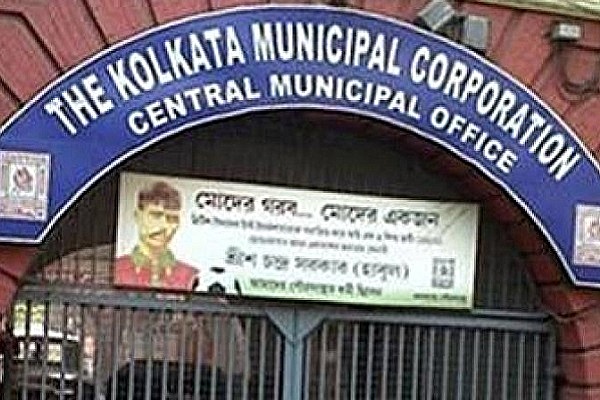
Kolkata Municipal Corporation seeks only Muslim candidates for a Health Department job, later ‘corrects’ it

0

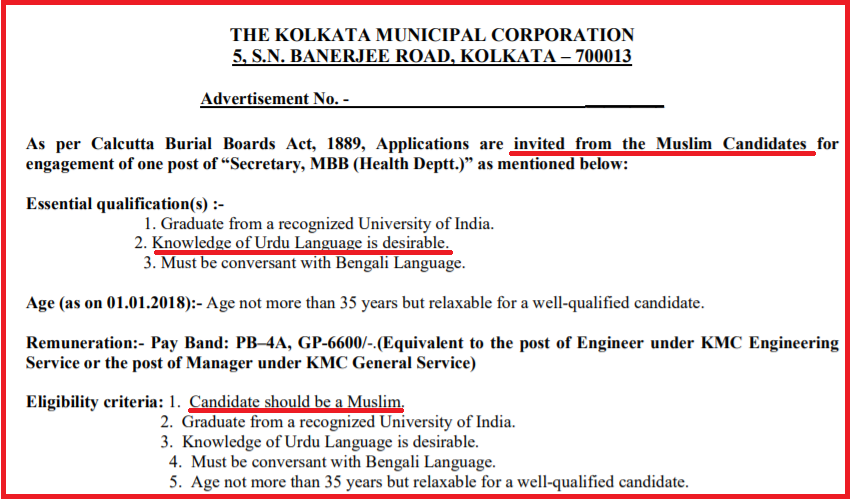
Accusations of minority appeasement might be levelled against the Kolkata Municipal Corporation, after an advertisement [PDF], for the post of Secretary, MBB (Health Department) has come to light. As per the advertisement dated 26th February, applications were invited from “Muslim Candidates” for the possible post of “Muhammadan Burial Board”.

To make the corporation’s intention clearer, it proceeded to declare in the “essential qualifications” section that the candidate should be a Muslim. It also sought that it would be desirable if the candidate possesses the knowledge of Urdu.

Here is the advertisement in question:

Kolkata Municipal Corporation seeks only Muslim candidates for Health department job, later 'corrects' it
Advertisement

As seen above, the advertisement clearly states that the candidate should be a Muslim and that Urdu’s knowledge is desirable.

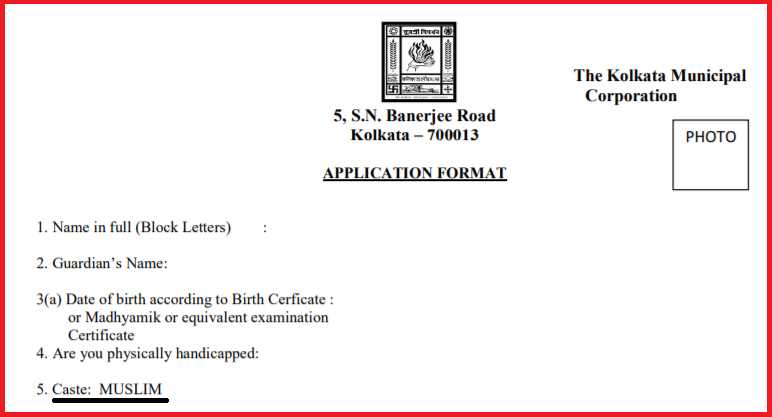
To further drive home the point, the corporation pre-filled the caste column with “Muslim” in the prescribed application format:

Kolkata Municipal Corporation seeks only Muslim candidates for Health department job, later 'corrects' it
Application format accompanying the advertisement

As made amply clear from the advertisement, the corporation only sought Muslim candidates for the job, which could have led to questions about a possible minority appeasement policy being undertaken by the organisation.

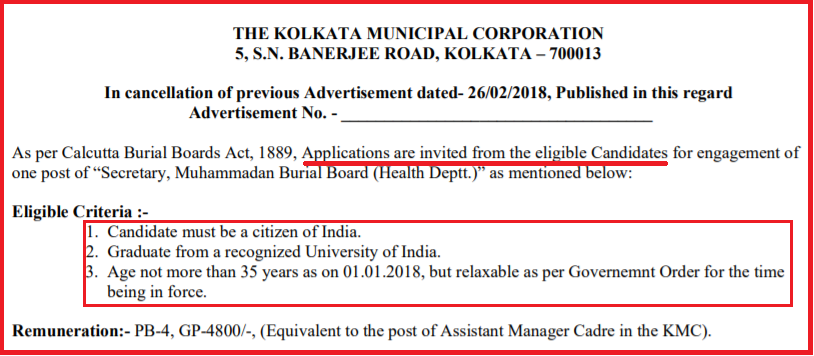
Since then, the Kolkata Municipal Corporation has issued a corrected advertisement [PDF], after the previous one was ‘cancelled’. The latest advertisement has made the job open for all and doesn’t require the knowledge of Urdu:

Kolkata Municipal Corporation seeks only Muslim candidates for Health department job, later 'corrects' it
Revised Advertisement

As seen, no criteria for being a Muslim is prescribed in the revised advertisement. What is also interesting is that the grade pay involved has also been reduced from 6,600 to 4,800.

The date to submit applications for the initial advertisement was from 26th February to 10th March and in case of the new one is from 14th March to 13th April. Using this information some might hazard a guess that the controversial application wasn’t cancelled immediately, and if it indeed was, the corporation displayed no hurry to promptly put out the rectified one.

This raises the question as to why was the initial advertisement issued and what led to its ‘cancellation’? Was the “only Muslim” criteria initially prompted via the fact that the job pertained to some Muslim burial board? If true, that would indeed have been a fallacy, as the Mamata government has already set a “religion no bar” precedence by appointing a Muslim as the head of the Tarkeshwar Temple’s board.

Such a ‘correction’ of sorts was also recently noticed in Karnataka.

We had reported how the BJP had alleged that Siddaramiah has asked for the opinion of district police heads in the state regarding withdrawal of cases lodged against minorities in communal incidents. The letter signed by AIGP (General) of Karnataka, addressed to 23 district police heads (including communally sensitive Mangaluru) asked for their clear opinion regarding withdrawal of cases lodged against minorities for the past five years.

Following a backlash, the Siddaramaiah government proceeded to ‘correct’ the letter in question by asking the police to review cases against all innocent people involved in various cases (including communal incidents) in the state. The government used the defence of a ‘clerical error’, to address the issue of specific reference to minorities in the earlier letter.

Trouble mounts for P Chidambaram : Government puts 20:80 Gold Scheme under scanner

0

The 20:80 Gold Scheme sanctioned by the then UPA government in its last days in office has been in the scanner since the Nirav Modi, Mehul Choksi scam shook the nation. P Chidambaram had sanctioned a scheme that benefited 13 private companies including that of Mehul Choksi.

According to reports, this may mean action against former Finance minister P Chidambaram.

A statement by the Ministry of Commerce said, “Government will definitely examine the circumstances as to why private parties PTHs/STHs (Premier Trading Houses and Star Trading Houses) were benefitted by allowing to import gold under 20:80 scheme by the previous government when the government was in transition and will take necessary action against the persons involved”.

The commerce ministry statement explains how restrictions on gold imports were put to address the issue of Current Account Deficit. Then through two modifications (the first on 22.7.2013 and then on 14.8.2013) the 20:80 scheme was introduced. It allowed only PSUs and banks like MMTC, STC to import gold.  But later P Chidambaram signed an order in May 2014 that allowed even the PTHs and STHs to import gold.

The statement adds, “The then Finance Minister approved the modified scheme on May 13, 2014, even though the model code of conduct was in place since March 5, 2014, with the announcement of the Lok Sabha polls, and the counting was due on May 16, 2014.”

As per CAG data, the import of the selected companies shot up to 320% after the order. Chidambaram had signed the order days before vacating his office. The order helped STHs and PTHs make disproportionate amounts of profit.

The statement, citing CAG data, includes that charging a premium of Rs 2 lakh per kg of gold, the private companies made a windfall gain of 4500 crores during June 2014 to November 2014 and a total of 282.77 MTs of gold was imported by the 13 companies. The statement also adds that even the export obligations were met by exporting plain jewellery and those pieces of jewellery were being melted by offshore front or shell companies and being imported again.

The NDA government had scrapped the 20:80 scheme in November 2014.

Challenges faced by farmers in India : Insights from the Swaminathan Report

0

The recent ‘Kisan long march’ by farmers in Maharashtra caught national attention. The recent Gujarat election results had highlighted the dangers for BJP if it ignored rural India. The temptation among political parties to support short-term measures like higher MSP and farm loan waiver has become an instrument of political manoeuvring as it can draw votes. But what is the long-term solution for India’s farm distress? One can address the solution only if the nature of the problem has been identified in the first place. The five main problems facing Indian agriculture are

  • Uncertainty in the water supply
  • Lack of remunerative income
  • Fragmentation of land holdings
  • Lack of access to formal credit and insurance
  • Allied infrastructure ( R&D, market access and storage facilities)

These problems have been analysed and some recommendations have been made by the Swaminathan report. Its full implementation and necessary improvisations on the ground are perhaps the solutions to the problem. The article briefly summarises the contents and issues dealt with in the report.

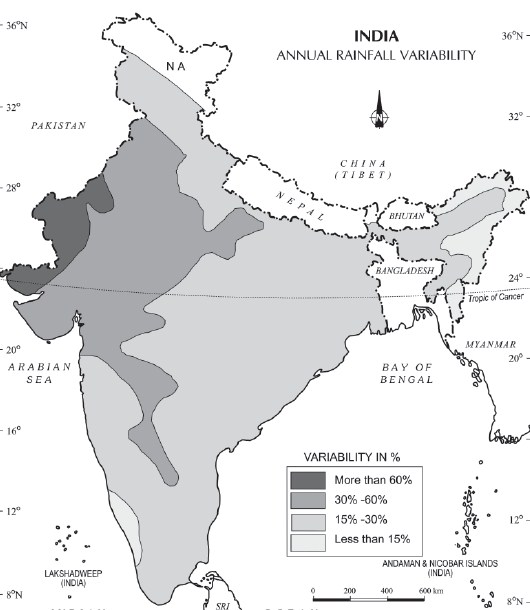
Firstly, the nature of farming profession itself is risky because of uncertainty in water availability for agriculture. As per World Bank, the percentage of irrigated agricultural land in India is 36% (2013). Almost 2/3rd of farmers in India are dependent on monsoon rains. The variation of rainfall in each region is also uncertain.

Variability of rainfall in India

The Revised Draft National Policy for Farmers,  popularly known as Swaminathan report [ pdf ] says the following on this issue:

Jal Swaraj or self-sufficiency in irrigation water availability is the need of the hour. Though the total rainfall in our country is satisfactory, its distribution is highly skewed, with most of the rainfall occurring in 100 hours in a year. It is also important to note that the majority of farmers depend on groundwater for irrigating their crops. This resource, in which farmers have invested their hard-earned savings, is today increasingly depleted with groundwater tables declining. Therefore rainwater harvesting and aquifer recharge have become essential for ensuring the stability of supply.

This can be addressed by expanding the irrigation and water conservation programmes. Completing the existing irrigation projects in time is also important. Use of groundwater is also an option. PMKSY (Pradhan Mantri Krishi Sinchayi Yojana) is one of the initiatives trying to address this problem.

The second main reason for farm distress is the fluctuation of the market prices even though their input costs are fixed. The MSP offered to farmers does not result in remunerative income for the farmers. Therefore it is important to ensure that the farmer gets a higher price for his/her produce.  The Swaminathan report says (emphasis added)  :

The time has, therefore, come when we should focus more on the economic well-being of the women and men feeding the nation than just on production. It is clear that the human dimension must be the principal determinant of agricultural policies and not just production in physical terms. The aim of this Policy is to stimulate attitudes and action which will result in assessing agricultural progress in terms of the net income of farm families rather than just in million tonnes of farm commodities produced, and which will help to place faces before figures. [..] The MSP should be at least 50% more than the weighted average cost of production. 

One of the suggestions, an MSP of 50% higher than the cost of production in the report has been taken for implementation in this year’s budget. In the long run, it will consume more government resources for the sector.  Will the country be ready to pay higher taxes? Instead of singing paeans to farmers, the profession needs to be made a remunerative one. At the same time alternative jobs in the non-farm sector, value addition and diversification in Agri sectors will help in increasing income of rural India.

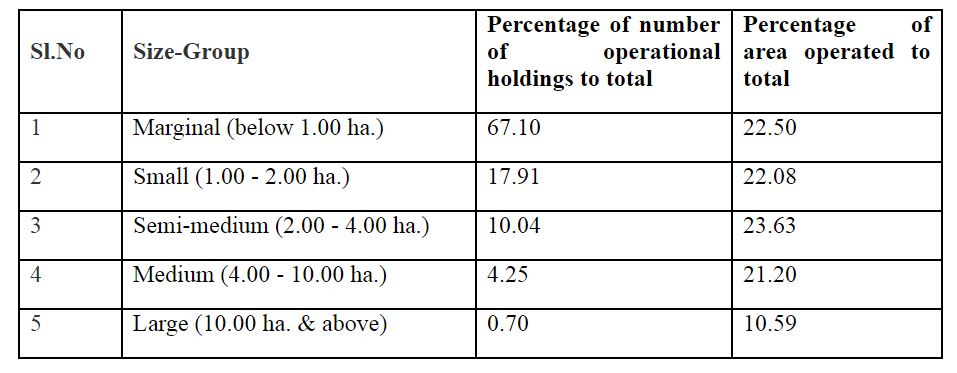
The third main cause for the decline in farm income is fragmentation of land holdings among farmers. Inheritance of land among successive generations of children in farming community has reduced the average size of land holdings. This makes the income of each family limited and reduces the scope for additional investments by the farmer. The Swaminathan report says :

The ownership of land is highly skewed with over 60% of the rural households owning less than one hectare. Farmers owning over one hectare comprise about 28% of rural families. The landless population amounts to 11.24% of rural households. 

Source: Agriculture census 2010-11

The problem of diminishing landholding size cannot be addressed without reducing the dependency of rural India on farming. Proposals for setting farmer cooperatives can address the issue partially. Increasing the number of crops or output from the same land maybe another option. However, it depends on water resources at the disposal of the farmer.

Access to credit and insurance have been two main issues. Since the farmers need formal credit to meet their requirements before the sowing season. In addition to this, appropriate insurance schemes are also necessary to protect them from risks. If the insurance schemes are not subscribed, or the schemes are ineffective, then the farmer is pushed into debt. The Swaminathan report says :

Agriculture is a high-risk economic activity. Credit without insurance is an added risk factor. Farmers need user-friendly insurance instruments covering production, right from sowing to post-harvest operations and also to cover the market risks for all crops throughout the country, in order to insulate them from financial distress and in the process make agriculture financially viable. Satellite imagery and agro-climatic analyse can play a significant role in evaluating the extent of crop losses and thus speed up the process of settling claims.

The move to increase the capital of NABARD from 5000 crores to 30,000 crores and the Pradhan Mantri Fasal Bima Yojana are two moves that seem to indicate that the government is moving in the right direction. However, it has to reach every farmer in order to prevent debt traps in future. If formal credit doesn’t reach all farmers, it will drive them towards moneylenders who demand higher interest rates and unfair terms.

Last but not the least, allied infrastructure including R&D (research and development), roads and storage facilities are an important component in order to help farmers sell their produce in time and at a cost that is remunerative. Distress sales and middlemen should not drive farmers towards desperation. E-Nam, PM Kisan Sampada and PMGSY (Pradhan Mantri Gram Sadak Yojana) are part of the solution. R&D collaboration with pioneers like Israel can also be pursued diligently. Regarding R&D the Swaminathan report rightly says :

Science and technology are the drivers of change in farm operations and output. New technologies, which can help enhance productivity per unit of land and water, are needed for overcoming the prevailing technology fatigue. Frontier technologies like biotechnology, information and communication technology (ICT), renewable energy technologies, space applications and nanotechnology provide opportunities for launching an “evergreen revolution” capable of improving productivity in perpetuity without ecological harm.

The challenge of climate change will also require active research and change of strategy to ensure farmers are not adversely impacted. The challenge is huge and complex. It will require continuous efforts from the governments as well as farmers to endure them in coming days. Loan waivers and higher MSPs are partial short-term solutions. They are not a substitute for a sustainable long-term solution.

Supreme Court indicts Hooda, terms the land acquisition ‘nothing but fraud on power’

0

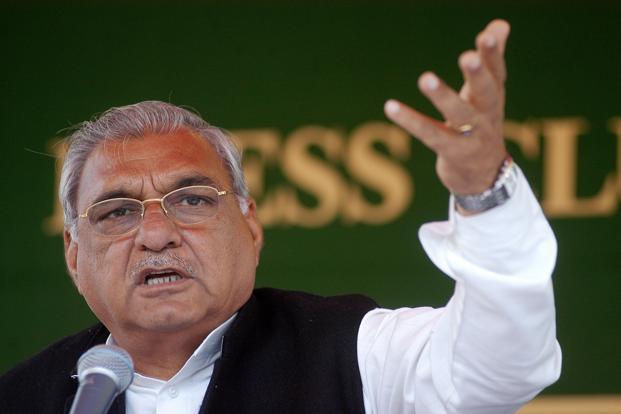
The Supreme Court on Monday set aside the 2007 order of Congress’ Bhupinder Singh Hooda’s Haryana Government and has taken away land from builders. The court has asked the CBI to get to the bottom of the alleged fraud.

Terming the decisions ‘nothing but fraud on power’, the Court came down heavily on the former government. The Supreme Court ruling came on a plea that had challenged the Haryana government’s decision to acquire land, by way of an August 27, 2004, notification, measuring around 912 acres in three villages, namely Manesar, Lakhnoula and Naurangpur of Gurgaon district for the purpose of setting up the Chaudhari Devi Lal Industrial Township.

As per reports, on February 26, 2005, 224 acres of land was released from acquisition by the government but builders approached the farmers for purchase of their land at throwaway prices. Using this ‘smoke screen’, builders coerced landowners to sell 400 acres at a throwaway price of Rs 100 crore against a market price of Rs 1,600 crore. Just two days before the pronouncement of award for the land acquired by the government on August 26, 2007, an order was passed on August 24, 2007, dropping the acquisition.

As reported in Times of India,

Finding ‘middlemen’ getting a windfall from the fraud, a bench of Justices Adarsh Kumar Goel and Uday Umesh Lalit said, “The CBI may do well to unravel the truth. In any case, such hefty sums which were made over to ‘middlemen’ cannot be said to be rightfully earned by and belonging to them… In our view, this money rightfully belongs to the state and none other. We direct the authorities of the state as well as the central government to reach the depths of such transactions and recover every single pie and make it over to the state government. A complete investigation in the transactions, including unearthing unnatural gains received by ‘middlemen’, shall be undertaken by the CBI.”

The bench came down heavily on the builder-Hooda government nexus and ordered that the 688 acres of land, which was notified to be acquired but was not, is now deemed to have been acquired by the Haryana State Industrial Development Corporation (HSIDC) and Haryana Urban Development Authority (HUDA) and the land would now vest in them instead of the builders.

Writing the 97-page judgment for the bench throwing light on every aspect of the massive fraud and saying that ‘public interest’ was murdered, Justice Lalit said the land transferred to builders between August 27, 2004 and January 29, 2010, along with the licences granted to builders, would now vest with HSIDC and HUDA. The builders will get interest-free refund from the government at the rate at which they had purchased the land from the farmers, and the amount they had invested to develop the land, the bench said.

The report further said the landowners who lost land would be entitled to initiate proceedings for enhanced compensation that is over and above the price for which they had sold their land to the builders. The report provides that in case the builder has completed construction on the land, the claimants, after verification, shall be eligible for plots or apartments.

The Supreme Court quoted the CBI report which said, “Some politicians who were also important functionaries of state government, government officers and their agents caused a wrongful loss of Rs 1,500 crore to landowners of Manesar, Naurangpur and Lakhounla and corresponding gains to themselves.” The Court observed that the money rightfully belongs to the state and none other and directed the state as well as central government to reach the bottom of this.

Hu Holi, an Adidas and Pharrell Williams collaboration draws flak for cultural appropriation

0

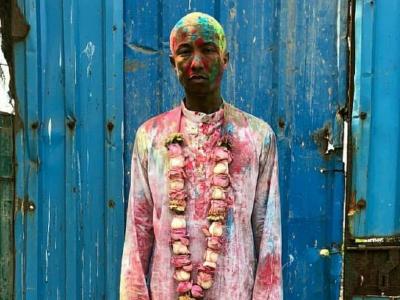
Pharrell Williams’ pictures of him celebrating Holi with the Bollywood stars with deadpan and confused expressions were viral last week, with many taking digs at how glum the ‘Happy’ singer looked.

The Holi party was organised by sportswear brand Adidas to launch Pharrell’s new collection ‘Hu Holi’, which is a tribute to the Indian festival of colours. However, Pharrell’s collection sparked debate on the cultural appropriation with people accusing the brand of commercialising a much loved Hindu festival and tradition to sell shoes.


The fact that a German company was using an American celebrity to sell $250 shoes did not go down too well with many.


Rajan Zed, a Hindu statesman and president of the Universal Society of Hinduism, has called for Williams and Adidas to apologise for the same and rename the collection. He says this collection trivialises traditions, concepts, symbols and beliefs of Hinduism. Saying that they should have done their homework before taking Hindu concepts frivolously, Zed said this attempt of trivialising may hurt the followers.

This is how the Fadnavis govt tactfully made peace with the farmers agitating in Mumbai

0

The state of Maharashtra witnessed long farmers march from Nashik to its capital Mumbai, which was organised by the All India Kisan Sabha (AIKS). SAIKS is the peasant’s arm of the Communist Party of India – Marxist (CPIM). This march started on 7th March.

Some of the demands by the farmers included complete loan waivers, claims made by the farmers under the Forest Rights Act and opposing the government’s plan to link rivers in Thane, Nashik and Palghar, alleging that it might submerge tribal lands.

Ever since the march was launched, it was marred by allegations of having political undertones, most prominently of being backed by the CPM.

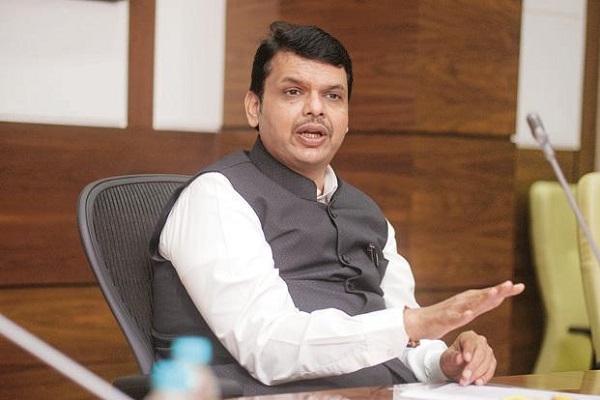
The BJP government in the state led by Devendra Fadnavis chose to adopt a tactful approach to the protest, by choosing to hold talks with the farmer groups rather than using force to disperse the protesters.

As per reports, a large chunk of the marching protesters comprised of tribals whose chief demand was getting land ownership which was guaranteed to them under the Forest Rights Act, passed by the erstwhile Congress-led government.

The protest was successfully called off by the farmers on Monday after the government assured that it would clear all the pending claims made by the tribals and waive all the loans taken by the farmers until June 2017.

This though just told a part of the story and didn’t shed light on the whole discussion, and manner in which the situation was addressed and then subsequently solved by the Fadnavis government.

Author and columnist Mayuresh Didolkar, as a result, decided to do something about it and listed out the mains points of discussion which were mentioned by CM Devendra Fadnavis while addressing the issue.

As curated by Mayuresh, Fadnavis promptly cleared the air regarding the nature of the people participating in the march. Contrary to popular perception, the main protesters weren’t farmers but were “tribal land labourers”, who formed about 90% of the crowd. The main demand of these land labourers, as also mentioned above, was their failure to fully or partially acquire their rightful jungle land.

Thus the state government had decided to settle all litigation pertaining to these lands within six months by constituting a special team. The tribals in question though needed to provide proofs regarding the same which are prior to 2005, which will result in their demands getting fulfilled.

When it comes to the matter of water and irrigation via river linking, Fadnavis claimed that proposals had been sent to the central government. The state government’s contention is that the state’s water must remain in the state, and it should end up in the Godavari and Girna basin.

As per Fadnavis, there was also a demand for constructing 31 dams in the state, regarding which the government would decide to post a feasibility study.

Coming to the issue of farm loan waivers, the last loan waiver had come in 2008 hence all the beneficiaries since 2009 have been included in the current scheme. While addressing the matter of farmers who had not benefited from the 2008 loan waiver, Fadnavis assured that if such farmers have taken a loan from 2001 to 2008, they would be included in the current scheme.

For loan waivers, a committee had been formed to address the difficulties regarding it. He also informed that a government resolution regarding waivers for families having a combined loan of less then Rs 1.5 lakh has already been sent to the banks.

Finally, Fadnavis informed the media that as a result of their assurances, the Kisan Sabha leaders were satisfied and had decided to call off their protests. In order to aid the return of these farmers, the state government had arranged adequate rail transport.

Faster, Higher, Stronger : India’s economy is soaring and there’s a reason why the Media doesn’t care

India’s economy is NOT in the news. In fact, India’s economy is the most boring, most irrelevant and most worthless topic that any news channel or any journalist or any academic could possibly discuss right now.

Why? Because India’s economy is soaring, that’s why!

And if they start talking about this, Modi will get the credit. There is a reason news channels are discussing some remark by some new entrant in BJP. Because India’s Index of Industrial Production (IIP) number just came out yesterday. And news channels would rather tell the world anything than admit that the IIP number is a scorching 7.5%

Untitled.png

Industrial Production is up! Inflation is down!

For Indian media, it is time to scale down, roll up and pretend like the economy simply does not exist.

What are the insta-economists on news channels supposed to tell the viewers? That vehicle sales are up as much as 23% in February?

Untitled.png

Or that lakhs of borrowers are now going to formal lenders as India moves towards a formalized, first world like the economy?

Untitled.png

That would be like admitting that Modi’s decision to inflict short-term pain in order to bring about important structural changes was the right thing to do. That when Narendra Modi took over the reins of the country, he first gave it two years to recover from the decade of decay under Dr Singh and Sonia Gandhi. In this period, India soared to become the world’s fastest-growing economy.

Then, Modi intervened. He brought in structural changes that oriented India towards becoming more of a formalized economy. The greatest tax reform in history was enacted and implemented. This resulted in a brief, six-month lull where the Indian economy spluttered as it absorbed the shock of change.

This period is now over and India’s economy has bounced back to reclaim the World No. 1 spot.

“Economists” who made a lot of hay in this intervening six month period have gone completely silent now. Basically, they are hiding under their desks, banking on public memory to run out quickly. They are hoping we all forget the brief period when everyone from Sagarika Ghose to Vinod Dua was an economist.

Ironically enough, this episode shows that the Indian left can teach the right a masterclass in political propaganda. When the tough reforms were coming, the left identified the opportunity quickly. They also realized that it would be a small window before the rewards for this short-term pain would begin to show. So they jumped in all at once and dumped their entire payload in a very focused manner in a very short span of time. In doing so, they maximized their effectiveness and their impact. Beginning mid-November, the left began a tactical withdrawal on the economic front, making sure that they would not be caught on the wrong foot when the Q3 GDP figures came in end February.

By the time the Q3 GDP figures arrived to vindicate Narendra Modi, the news cycle had moved very far away from the economy. The strike on Modi’s economic record was thus carried out with surgical precision, it’s timing and length managed to perfection.

Amazingly, the right has also moved on from talking about the economy. Ironically, the right is in lockstep with the left, always walking one step behind them. As of now, the right is busy responding to the latest item on the left’s agenda, as usual. Guess who has forgotten to showcase their own achievements on the economy?

‘The Wire’ now defends Chidambaram’s 20:80 Gold Scheme and they are wrong

Noor Mohammad, in his article “By Blaming UPA’s 80:20 Gold Import Scheme, BJP is Trying to Deflect Attention from PNB Fraud”, published March 11, 2018, in The Wire writes:
“Fearing a political backlash over the mega fraud perpetrated by Nirav Modi and Mehul Choksi in the Punjab National Bank (PNB), the ruling Bharatiya Janata Party(BJP) is trying to divert public attention by blaming it on the Congress-led UPA government’s 80:20 gold import scheme.”

On the one hand, Mr Mohammad — who had incidentally written two blatantly factually incorrect articles on khadi and rural electrification – claims that the party in office at the Centre, and by implication the current administration, is deflecting attention from the alleged PNB fraud case by citing the last administration’s 80:20 gold import scheme. On the other, he defends the 80:20 gold import scheme which was evidently controversial and suspects in both its intent as well as timing.

Not surprisingly, the writer’s claims become even more suspect when we take a closer look at the evidence available in the public domain regarding the gold import scheme.

(Incidentally, Mr Mohammad’s two previous articles mentioned above were refuted by The True Picture in “Who is Spinning Tales on Khadi Sales?” and “‘The Wire’ Writer Who Got Khadi Story Wrong Now Spins a Yarn About Rural Electrification” respectively.)

Let us now look in detail at the evidence on the 80:20 gold import scheme.

WHAT WAS THE 80:20 SCHEME?

  • The UPA government was reportedly “worried” about rising gold imports and their impact on the current account deficit (CAD), which stood at $88 billion or 4.7% of GDP in 2012-13.
  • On May 13, 2013, the RBI asked banks not to import gold on a consignment basis.
  • This somehow ended up setting the stage for the most controversial and perhaps draconian step for bullion trade since the imposition of the Gold Control Act.
  • The scheme was introduced when gold imports had hit unprecedented highs and were pressuring the CAD, resulting in a sharp fall in the rupee’s exchange rate against the dollar, then quoting at nearly Rs 70.
  • After consultation, the RBI issued a circular on July 22, 2013, ruling that all gold imports would come with a commitment of re-exporting 20%. The export conditions were such that each a lot imported had to meet export requirements for the import of the next lot.
  • Export zones were kept out of the scheme’s purview. Of all the imported lots, 80% could be sold in the domestic market, provided 20% was exported. Since gold imports must have RBI sanction, these were executed by means of the apex bank with instructions from the Ministry of Finance.

Mr Mohammad, in his article, writes that the scheme was successful. He says:

But in his apparent attempt to blame the current administration, Mr Mohammad clearly ignores the increased percentage of smuggling that took place under the purview of the said scheme. Reportedly, the 80:20 scheme led to an increase in gold smuggling. The details below serve as evidence:

  • Gold import prior to the imposition of the restrictions was 294 tonnes, worth Rs 770 billion, in April and May 2013.
  • After the imposition of the strictures, total gold imports in the following 10 months of 2013-14 stood at 325 tonnes.
  • No doubt, imports fell from over 300 tonnes in May 2013 to just 10 tonnes in a month after the 80:20 scheme came into effect.
  • However, smugglers made huge amounts of money as they were getting a 10% duty margin plus premium, as there was a big shortage of gold.
  • Smuggling, which was not apparently prevalent prior to 2012, crossed 100 tonnes and was financed through hawala and/or unofficial dollars.
  • In the absence of the scheme, this foreign exchange would have come through official channels.

THE TIMING: STAR TRADING HOUSES (STHS) & PREMIER TRADING HOUSES (PTHS)

It should be noted that it was only on May 21, 2014, the then UPA administration decided to allow “star trading houses (STHs)”, “premier trading houses (PTHs)”, and units located in Special Export Zones (SEZs), to import gold and sell up to 80% of imports in the local market.

What is the significance of the timing? Well, May 21, 2014, was a mere five days after the UPA government was defeated in the 2014 general election, as well as just five days before the new NDA government took office.

Mr Mohammad writes: “Before the PNB scam came into light, the BJP-led NDA government had not detected any flaw in the 80:20 gold import scheme.”

This is incorrect.

As per the evidence available in the public domain, the NDA government was informed about the flaw in the 80:20 scheme by the Directorate of Revenue Intelligence (DRI) long before the PNB scam came to light.

Reportedly, as per the DRI report, the export obligations were mostly met by exporting costly machine-made jewellery, such as bangles and chains, which were re-melted in Dubai and cast into primary bars for re-import. The report also said: “exports are generally related to front/ shell companies in UAE, Hong Kong and Singapore.” As per the DRI report, reportedly, this practice began after the UPA government relaxed the scheme to allow STH/ PTHs to import gold.

Let us look at some of the reported findings of the DRI report:

  • The report apparently claims that the actual purpose was to use export as a cover for import. By making machine-made plain chains and bangles, “they are keeping the cost of export as low as possible”.
  • The report apparently also said that another reason for exporting plain jewellery and not studded ones was because “Dubai has a customs duty of 0.325% and Sharjah a duty of 0.18% on studded gold jewellery.”
  • Reason for exporting plain jewellery and not studded ones was because “Dubai has a customs duty of 0.325% and Sharjah a duty of 0.18% on studded gold jewellery.”
  • According to the evidence cited in media reports, “The comparative data of exports that the DRI studied showed that the quantity of gold export surged to 20,166.89 kg (worth Rs 4,799.80 crore) between January and July 2014, compared to 6,063.92 kg (worth Rs 1,599.45 crore between January and July 2013, and 1,508.56 kg (worth Rs 404.93 crore) during January and July 2012.”
  • Reportedly, the DRI report also said: “It is seen from above data that exports of plain gold jewellery in terms of quantity have in 2014 grown at an astronomically high rate of 1,236%, compared to the same period during 2012…”

The sudden and rushed change in the rules made by then Finance Minister P. Chidambaram reportedly resulted in a spike in gold imports. In the six months from June 1 to November 30, 2014, gold imports rose to 553 tonnes. Almost 60% of this was accounted for by only 13 PTHs and STHs.

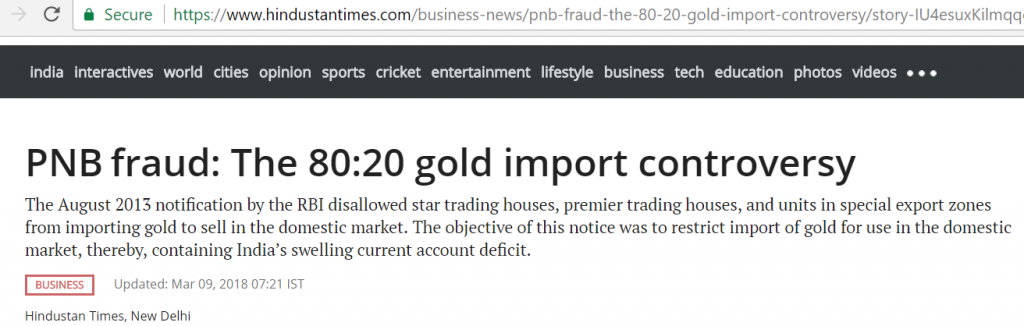
The RBI’s May 21, 2014, notification bringing in the change actually overturned August 14, 2013, notification, also by the RBI, which had barred STHs, PTHs, and units in SEZs, from importing gold for sale in the domestic market. The August 2013 notification was aimed at restricting gold imports for use in the domestic market. This was ultimately aimed at curbing the ballooning the CAD.

EARLY WARNINGS

On July 26, 2014, the Indian Bullion and Jewellers Association (IBJA) had severely criticised the change in policy and wrote a letter to the RBI saying that the change helped only large private trading houses and conglomerates, many of which had no history of gold imports, and thus uninterested in promoting the jewellery business: “(They) do not have a mechanism to ensure the end use of gold sold… [and] are engaged in circular/fictitious export”. This was also because of the 20% re-export stricture.

The letter also said: “Having achieved the targeted current account deficit (CAD) level, the outgoing government did not care for future sustenance of the CAD and deliberately yielded to the cronies by effecting last minute changes in the gold policy”.

The CAG, in its 2016 report, had raised the alarm on the allegedly preferential treatment meted out to 13 trading houses vis-à-vis gold imports. The IBJA had also listed 13 trading houses allegedly using circuitous routes to export jewellery and bringing it back to India where the same bullion would be sold at a hefty premium.

The 13 trading houses that allegedly increased their imports during the period in question were: Rajesh Exports, MD Overseas, Kundan Rice Mills, Kanak Exports, Edelweiss Commodities, Zaveri & Co, Riddhi Siddhi Bullions, Khandwala Enterprise, Jindal Dyechem, Gopal Jewels, Reliance Industries, GITANJALI GEMS, and Su-Raj Diamonds.

Thus, from the evidence in the public domain, the then UPA government’s decision to allow STH and PTH houses to import gold had resulted in the Mehul Choksi-led Gitanjali Gems importing gold and selling about 80% of the total bullion in the local market under the 80:20 scheme. This, it may now seem, encouraged gold hoarding and preferentially allowed some traders to indulge in profiteering by artificially inflating the retail prices.

SCRAPPING OF THE 80:20 SCHEME

During June-November 2014, India reportedly imported 588.1 tonnes of gold. Again, 352.86 tonnes were shipped in by 13 STH and PTHs that included companies that ranged from rice exporters to stock-brokerage firms as well as to large manufacturing conglomerates. The import surged to 151.6 tonnes in November 2014.

Anxious at what this import was doing to the Indian economy, the current government took action and scrapped the scheme. The RBI’s circular stated: “It has been decided by the Government of India to withdraw the 20:80 scheme and restrictions placed on the import of gold. Accordingly, all instructions issued about the scheme from time to time starting with circular number 25 dated August 14, 2013, stand withdrawn with immediate effect”.

CONCLUSION

To say that the party in office, or even the Central government, is deflecting public attention would then appear to be baseless. First of all, we cannot draw a direct correlation between the 80:20 gold scheme and the PNB scam per se. However, it seems to be quite evident from the information in the public domain that the scheme, controversial and suspect as it was, created an enabling environment for malpractice and perhaps even fraud. The role of the then UPA government in the 80:20 scheme and the reported early warning given to Raghuram Rajan as well as the involvement of Nirav Modi and Mehul Choksi, founder of Gitanjali Gems, would appear to demand a closer re-look at how the scheme benefited select trading houses, including the one in question here.

OpIndia Editor’s Note :

The leftist propaganda website ‘The Wire’, has a history of shoddy journalism. Just recently, we had preemptively busted an impending hitjob against the Finance Minister Arun Jaitley and his daughter law firm which was meant to be a desperate bid to connect the firm to Mehul Choksi. After that, the portal had cried foul and conceded that this was their plan. Earlier, ‘The Wire’ had conducted a hit job against Amit Shah’s son Jay Shah for which, the High Court has found a prima facie case of defamation. They had also infamously compared General Bipin Rawat to General Dyer for which they faced severe criticism. Vinod Dua has already spread several lies. In fact, reports had claimed that a report in ‘The Wire’ had also led to violent protests in Assam district bordering Nagaland.

We had pointed out how ‘The Wire’ has not a single article detailing P Chidambaram’s 20:80 Gold Scheme that facilitated the Mehul Choksi scam and that these desperate hot jobs to tie the Finance Minister to Choksi is a bid to protect Chidambaram and Congress. It is thus not surprisingly, that the first thing they write on the subject is an article defending the UPA’s scheme.