

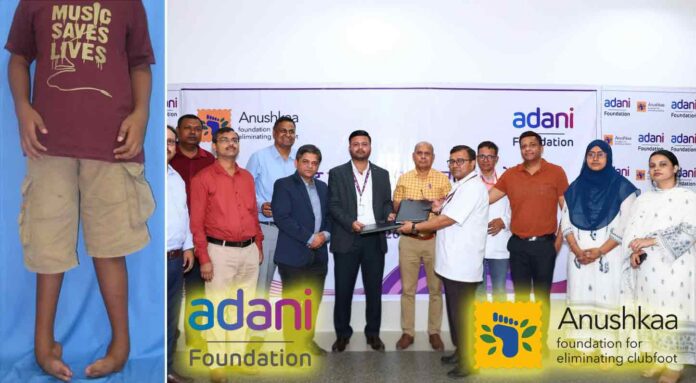
In a significant initiative aimed at addressing a common yet treatable childhood disability, the Adani Foundation and the Anushkaa Foundation have announced a three-year partnership to provide treatment and follow-up care to more than 10,000 children affected by clubfoot in five states.
The partnership, announced on World Clubfoot Day on 3rd June, will focus on Madhya Pradesh, Haryana, Uttar Pradesh, Maharashtra, and Himachal Pradesh. It will be implemented in collaboration with the National Health Mission (NHM) to strengthen early identification, referral systems, and access to quality care through public healthcare networks.
The programme was formally launched at the Manyavar Kanshiram Samyukth Chikitsalay and Trauma Centre in Kanpur, Uttar Pradesh, the state that bears one of the highest burdens of clubfoot cases in the country, with an estimated 6,000 children born with the condition annually. Clubfoot, a congenital deformity where one or both feet turn inward, affects nearly one in every 800 newborns in India.
If left untreated, it can severely limit mobility and quality of life, though it can be effectively corrected using the globally recognised Ponseti method when detected early.
Under the initiative, 67 clubfoot clinics will be supported across 61 districts. The programme will also focus on building clinical capacity by strengthening the skills of 51 healthcare professionals and sensitising more than 30,000 frontline health workers to ensure timely detection and referral of cases.
The initiative will support more than 10,000 children over three years through a model combining community outreach, clinical care, capacity building and family support. The partnership combines Adani Foundation’s community reach with the Anushkaa Foundation’s specialised expertise in clubfoot care and public health partnerships.
Dr Priti Adani, Chairperson of the Adani Foundation, emphasised the importance of early intervention. “No child should be held back by a condition like clubfoot that is treatable when identified early. Every child deserves the opportunity to move, learn, play, and participate fully in life,” she said. Highlighting the Foundation’s long-standing commitment to specially-abled individuals, Dr Adani added that the partnership reflects their philosophy of enabling children to live with dignity and realise their full potential.
Deepak Premnarayen, Founder of the Anushkaa Foundation, noted that while clubfoot is one of the most treatable childhood disabilities, thousands of children still miss timely care. “This partnership with the Adani Foundation will help expand access to quality treatment across 61 districts in five states while strengthening systems for early diagnosis and intervention,” he stated.
India sees an estimated 33,000 children born with clubfoot every year, with nearly 12,000 cases occurring in the five states covered by this programme. The initiative aims to address a substantial portion of this burden by combining community outreach, clinical care, capacity building, and family support.
The Anushkaa Foundation, inspired by lived experience and founded by the Premnarayen family, currently supports clubfoot treatment programmes across 165 districts in 13 states and has already enabled care for over 26,000 children. One in six children born with clubfoot in India now receives treatment through its supported clinics.
The partnership comes as the Adani Foundation approaches its 30th anniversary on August 11. Operating in 7,247 villages across 22 states and impacting over 13.3 million lives annually, the Foundation continues to focus on healthcare, education, sustainable livelihoods, and community development.
What is Clubfoot disease
Clubfoot, also known as Congenital Talipes Equinovarus, is a common congenital birth defect in which one or both feet are turned inward and downward at the time of birth. It is not painful for newborns, but if left untreated, it can cause severe mobility problems, difficulty in walking, pain, and lifelong disability. This condition significantly affects a child’s ability to participate in education, play, and daily social activities.
The exact cause of clubfoot remains unknown in most cases, though it is believed to result from a combination of genetic and environmental factors. It occurs more frequently in boys than in girls and is associated with risk factors such as a family history of the condition, multiple births like twins or triplets, and breech presentation during delivery. Importantly, clubfoot is not caused by anything the mother did or did not do during pregnancy.
Clubfoot cannot be prevented, but it is highly treatable when identified early. The globally accepted gold-standard treatment is the Ponseti method, a non-surgical approach that corrects more than 95 per cent of cases when initiated in infancy. This involves gentle manipulation of the foot followed by weekly plaster casts, usually for six to eight weeks, to gradually correct the position. In most cases, a minor outpatient procedure called percutaneous Achilles tenotomy is performed.
After correction, children must wear a foot abduction brace, mainly during sleep, for three to five years to prevent relapse. With timely and proper treatment, affected children can achieve normal mobility and lead active, healthy lives.
In India, clubfoot is quite widespread, with an estimated 33,000 children born with the condition every year. Nearly 12,000 of these cases occur in the five states covered under the Adani Foundation and Anushkaa Foundation partnership, Madhya Pradesh, Haryana, Uttar Pradesh, Maharashtra, and Himachal Pradesh. Uttar Pradesh alone accounts for around 6,000 new cases annually. The condition affects approximately one in every 800 to 1,000 newborns across the country.
