

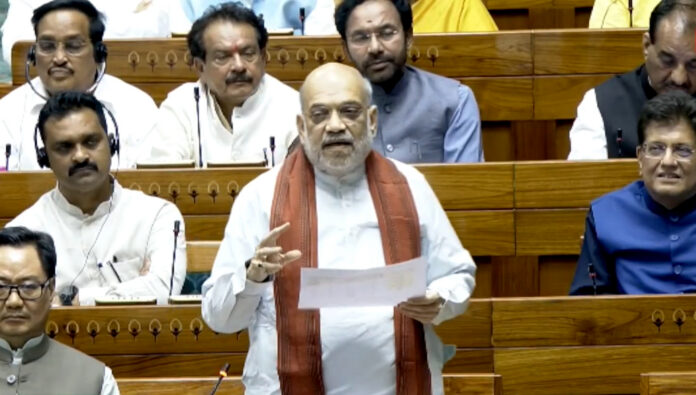
Union Home Minister Amit Shah explained the technical and constitutional necessity of the three bills introduced to operationalise the 33 per cent women’s reservation in his address in the Lok Sabha on the first day of the special three-day parliamentary session. He directly confronted and dismantled what he described as confusion and false narratives spread by the Congress, Samajwadi Party (SP), and other opposition parties regarding delimitation, southern states’ representation, timing of implementation, and demands for religion-based quotas.
Shah, who introduced the Union Territories Laws (Amendment) Bill, 2026 (alongside the Constitution (One Hundred and Thirty-First Amendment) Bill, 2026, and the Delimitation Bill, 2026, moved by Law Minister Arjun Ram Meghwal), emphasised that the measures were essential to bring the Nari Shakti Vandan Adhiniyam, 2023, to its “logical end”. He accused the opposition of creating a “false narrative” purely for political gain and noted that they had pre-decided to oppose the bills.
Removing Confusion on Delimitation and Southern States’ Representation
Opposition leaders, including Congress MP KC Venugopal, Priyanka Gandhi Vadra and Gaurav Gogoi, had claimed the bills were a “backdoor” attempt at delimitation that would undermine federalism and reduce the representation of southern states in the Lok Sabha. Shah firmly rebutted these assertions, stating that a deliberate narrative of confusion was being spread.
He provided concrete examples to demonstrate that no state would suffer any loss and that southern representation would actually increase in absolute terms while maintaining proportional shares. He said, “a narrative is being created and confusion is being spread that these three bills, the Constitutional Amendment Bill and the two related laws on delimitation and changes in election procedures, will reduce the representation of southern states in the Lok Sabha and cause them significant loss… In Karnataka, out of the current strength of 543 seats in the Lok Sabha, there are 28 seats, which is about 5.15 per cent of the total representation. After the passage of this bill and the Constitutional Amendment, Karnataka’s seats will increase from 28 to 42. In a House of 816 members, its share will be around 5.14 per cent. So, there will be no real loss to Karnataka.”
He extended similar assurances to Tamil Nadum where representation will rise from 39 to 59 seats, and reiterated that “no state, be it north or south, will be discriminated against in the delimitation exercise”. The total strength of the Lok Sabha would increase to accommodate the women’s quota without altering existing proportional allocations.
Shah said the proposed framework ensures that no region will lose seats in absolute terms and that southern states will see a rise in representation. He added that the exercise is designed to maintain balance and fairness while accommodating changes in population.
Union law minister Arjun Ram Meghwal earlier said that the number of seats of all states will be increased by 50%, which means the proportion of Lok Sabha seats of each state and UT will remain same. The government has maintained that the delimitation will be based on the 2011 census.
Debunking Claims on Timing and Political Motives behind Delimitation
Responding to SP leader Akhilesh Yadav and others who suggested the bills were timed to influence ongoing or forthcoming state elections in Tamil Nadu and West Bengal, Shah clarified that the provisions will be implemented long after the current elections. He said, “there is a statement being made that elections are taking place in Tamil Nadu and West Bengal and that a new Act has been brought in. That is not correct. Let me clearly state that the Delimitation Commission’s report will come into effect only when it is accepted by Parliament and receives the approval of the President. Therefore, there is no question of it being implemented before 2029. Even the elections up to 2029 will be conducted under the existing system and existing constituencies. So there is no need for Akhilesh ji to be worried.”
This explanation directly countered opposition allegations that the government was rushing the process for electoral advantage.
Religion-Based Reservations
Amit Shah also confronted SP MPs, including Dharmendra Yadav, who demanded specific provisions for Muslim women or backwards-class women within the quota. He described such demands as unconstitutional and clarified the government’s firm position. He said, “The question of providing reservations to Muslim women on the basis of religion does not even arise. Our Constitution does not allow at all to give reservation on the basis of religion. I want to make it clear that our government’s resolve is that Muslims will not be given reservations on the basis of religion. Such a reservation is unconstitutional.”
He added pointedly, “We are not stopping the Samajwadi Party from giving all their tickets to Muslim women.”
Shah further informed the House that the national census process had already commenced and would include caste enumeration, but stressed that this had no bearing on religion-based quotas.
When Congress leader KC Venugopal attempted to debate the merits of the bills at the introduction stage, Shah intervened to clarify parliamentary procedure, stating that only technical objections were permissible at that point and that the government would provide a “strong reply” during the full debate.
In his address, Amid Shah maintained that the bills were a straightforward, fair, and balanced step to ensure women’s participation in policy-making without disrupting the federal balance or current seat allocations. He assured the House that the process reflected the government’s commitment to inclusive democracy rather than any partisan agenda.
PM Modi addressed the house before the home minister, and called on all parties to set aside differences and pass the amendments unanimously, warning that historical opposition to women’s rights carries lasting political consequences. He assured that there will be no discrimination in delimitation, adding that the reforms would benefit the nation’s democracy and collective decision-making, not any individual or party.
The Constitution (One Hundred and Thirty-First Amendment) Bill, 2026 seeks to amend the Constitution, including Articles 81 and 82, to increase the strength of the Lok Sabha from the current 543 seats to approximately 850. This expansion is intended to accommodate the one-third reservation for women without reducing the existing representation of other groups. As per the government, 50% seats will be increased in every state and UT, preserving the current proportion of seats of the states and the UTs in the parliament. Of the 850 seats, around 283 will be reserved for women.
The Delimitation Bill, 2026, provides for the constitution of a new Delimitation Commission to redraw parliamentary and assembly constituencies on the basis of the latest population data. It forms a key part of the process to operationalise the women’s reservation law, which was passed in 2023 but requires fresh delimitation to take effect.
The Union Territories Laws (Amendment) Bill, 2026, makes corresponding changes to laws governing Union Territories to align their electoral frameworks with the proposed delimitation exercise and expanded seat allocation.
The special session, which runs from 16 to 18 April, has been convened specifically to debate and pass these measures.
