

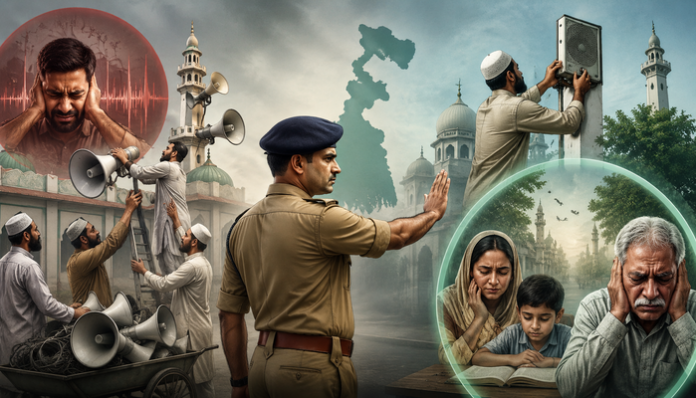
As the West Bengal government has launched a statewide action to curb noise pollution by removing loudspeakers from all religious places, several Muslims organisations are crying victim by alleging discrimination. The West Bengal police reached out to mosque committees across the state, asking them to remove high-decibel loudspeakers and replace them with sound boxes. Over the past few days, the police held several meetings with mosque committees seeking their cooperation.
While various mosques complied with the government’s decision on Wednesday (5th August), some sections of the community were triggered by the move. Commenting on the matter, Indian Secular Front (ISF) MLA Nawsad Siddiqui alleged that the police were removing loudspeakers used as public address systems. He claimed that the action violated religious rights enshrined in the Constitution. Siddiqui wrote a letter on Wednesday to West Bengal Director General of Police (DGP) S N Gupta, seeking clarification on the alleged action and an inquiry into the matter.
“If there are specific complaints regarding noise pollution caused by loudspeakers, action should be taken only after a proper investigation, issuance of notice, and an opportunity to be heard, in accordance with the law,” ISF legislator from Bhangar constituency in South 24 Parganas wrote in the letter. “Under no circumstances should action be taken against religious institutions through oral instructions or by force,” he added.
He stated in the letter that he had been receiving many complaints from various districts alleging that police are issuing notices regarding the use of loudspeakers at political, social and religious programmes. Siddiqui also urged the DGP to initiate disciplinary action against any police officer found to have abused their authority or acted arbitrarily. He said that he would approach the Calcutta High Court against the police action.
Notably, Siddiqui comes from a party whose founder, Maulana Abbas Siddiqui, had made hateful remarks during the COVID-19 pandemic. The Maulana had said that he was demanding a virus from Allah that kills 50 crore people in India in one go. A video of the Maulana making the statement had gone viral.
Opposing the government’s decision to remove loudspeakers, Maulana Muhammad Shafique Qasmi, the Imam of Kolkata’s Nakhoda Mosque, alleged that the mosque officials were given threats to remove the loudspeakers. “There is no court order or government notification that says loudspeakers must be summarily removed from all mosques. If there were such orders, the Imams and masjid committees should have been informed by the government. Instead, masjid officials were threatened and asked to remove the loudspeakers. Isn’t this a violation of law?” the Maulana reportedly said, adding that there are over 62,000 mosques in the state as per Waqf board records but the actual number might be much higher.
“I appeal to Chief Minister Suvendu Adhikari through the media to interfere in this matter and direct the police to control noise instead of harassing people by removing the loudspeakers. I want to tell the director general of the state police that this action will only create anger against the administration. We are not here to fight with the government. If there is any problem, then let us find a solution through discussion,” Maulana Qasmi said.
The State government refutes allegations of discrimination
Refuting the allegations that the action targets Muslims religious places, Urban Development Minister Agnimitra Paul said that the decision is applicable to all religious places, including temples. It is not only for mosques. The cabinet decided to enforce noise restriction guidelines in religious places. It is a part of that initiative. Not only mosques, but temples and other religious places will also have to abide by the restrictions. We will not allow anyone to violate it,” Paul said.
The decision to implement noise pollution control rules in religious institutions across the state was taken by the Suvendu Adhikari-led government in its first cabinet meeting. The state government had directed the police to ensure compliance with the West Bengal Pollution Control Board’s prescribed noise limits: 55 decibels during the day and 45 decibels during the night in residential areas.
