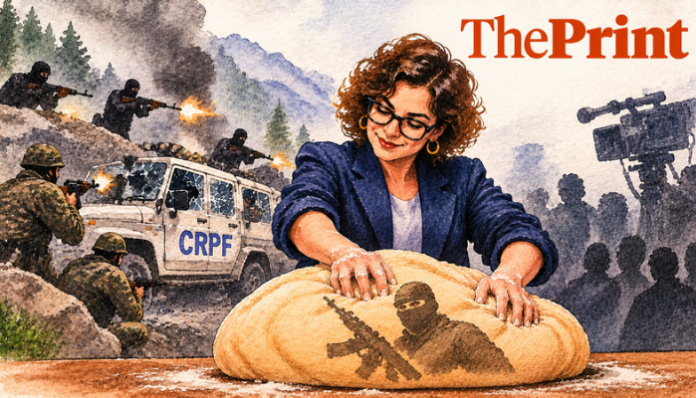
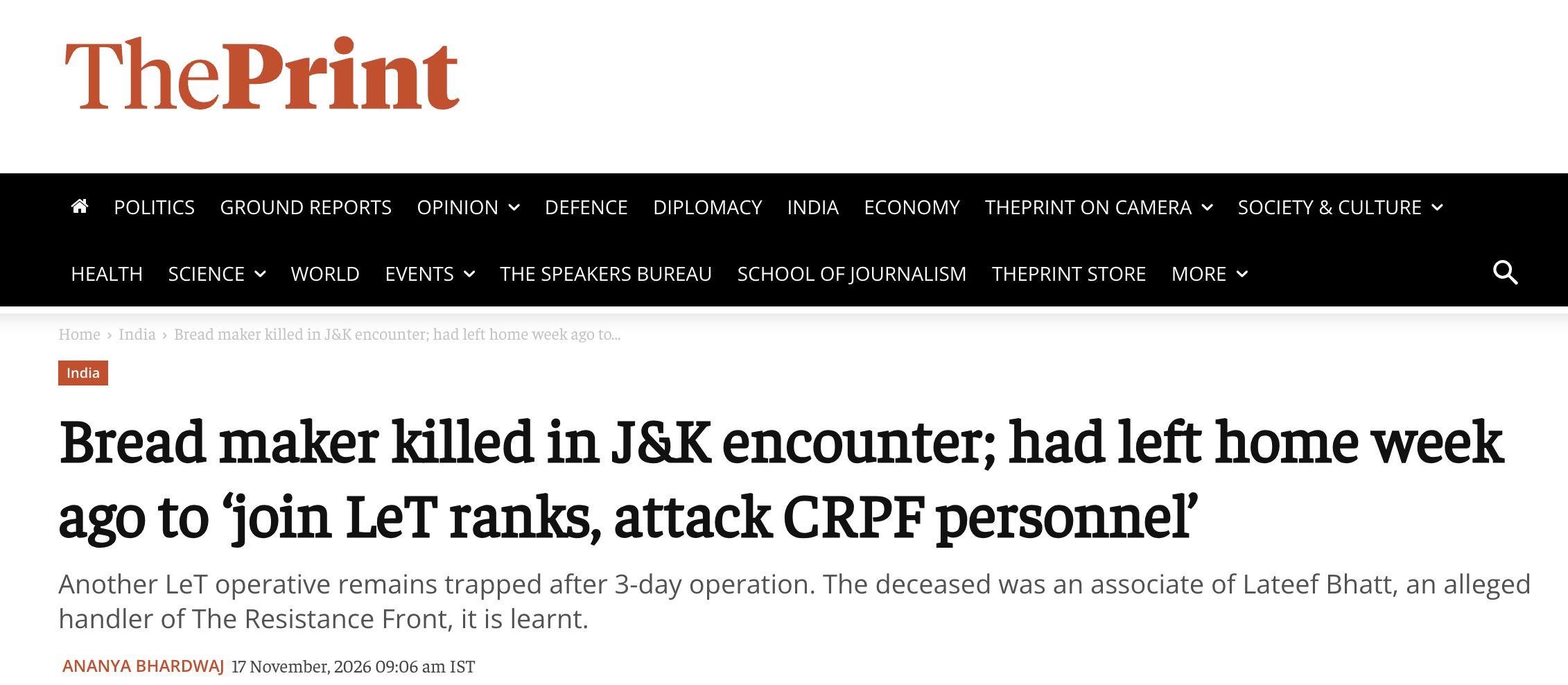
In the crowded annals of Indian journalism’s attempts to discover the inner pastry chef lurking inside every Kalashnikov-wielding jihadi, ThePrint has delivered what may be its flakiest contribution yet. On 16 November, the Shekhar Gupta-founded outlet published a report on a Lashkar-e-Taiba (LeT) operative killed in a Jammu and Kashmir encounter under the headline: “Bread maker killed in J&K encounter; had left home week ago to ‘join LeT ranks, attack CRPF personnel’.”
Not “LeT terrorist killed.” Not “CRPF attacker neutralised.” Not even the more neutral “terror operative killed in Kulgam.” The lead noun of the sentence is “bread maker.” One imagines the headline sub-editor pausing, weighing “LeT operative” against “bread maker,” and choosing the one that pairs best with a warm cup of chai and a sympathetic sigh. The three CRPF personnel wounded in the attack, meanwhile, do not merit a single word in the headline that introduces the story of the man linked to their injuries
The loaf of the matter
The operative was identified as 19-year-old Umer Nisar Dar from Arreh village in Kulgam, who had been missing from his home since 10 November, before joining the terror ranks. According to ThePrint’s own reporting, Dar was an associate of Lateef Bhatt, a handler of The Resistance Front (TRF), a proxy of the LeT. Investigators subsequently established that Dar had been providing shelter and logistical support to Bhatt for approximately five to six months before the attack, hardly the CV of a man whose primary identity was flour, water, and yeast.
On 10 November, Dar and Bhatt conducted reconnaissance at multiple locations, including Mir Bazar, Akhran, Hablish and Kilam, to identify targets and plan attacks on security forces. CCTV footage from 10 and 11 November captured their movements during the reconnaissance and their subsequent flight after the attack.
The attack itself took place near Mir Bazar on 11 November, when assailants opened fire with an AK-46 on a CRPF bridge guard party, injuring Constable Rakesh Dass (leg wounds), Constable Santosh Chadru (abdomen and spine injuries), and Head Constable Somveer Singh (left arm wound). ThePrint’s own article names these three injured personnel in the body of the text, but by the time the headline was composed, they had evidently been kneaded into oblivion. The “bread maker,” by contrast, made the marquee.
There is a certain grim comedy in imagining the editorial meeting. “We have a terror operative linked to an attack that injured three CRPF men,” one editor might have said. “Yes,” another replies, “but did you know he used to make bread?” Cue the violins. Cue the soft-focus lens. Cue the headline that reads less like a news report and more like the opening line of a Netflix biopic about a misunderstood youth who fell in with the wrong crowd while simply trying to earn an honest crust.
The Burhan Wani “Son of Headmaster” playbook, reprints and all
This is not a novel editorial experiment. It is the latest printing of a template that Indian psudo liberals have been perfecting for nearly a decade. In 2016, after Hizbul Mujahideen commander Burhan Wani was killed, a substantial section of the media and the commentariat insisted on introducing him as the “son of a headmaster” who “excelled at school” before he “left home aged just 15”.
OpIndia noted at the time that “a long line of pseudo-intellectuals” kept “arguing that Wani was not so much a terrorist than a son of a ‘headmaster’ who was done to death by the Indian security agencies”. A section of India’s mainstream media organisations and individuals, including the likes of Barkha Dutt, attempted to normalise referring to Wani as a “son of a headmaster” and a “budding cricketer,” focusing on his background and qualities rather than his role in violence and terrorism.
The pattern is now so well-established that it has its own morbid taxonomy: the headmaster’s son, the fruit seller’s son, the budding cricketer, the hardworking student, the intelligent medico. ThePrint has simply added a new entry to the collection: the bread maker.
Breaking: Burhan Wani hizbul commander, son of school headmaster who used social media as weapon of war, killed in Anantag. BIG STORY
— barkha dutt (@BDUTT) July 8, 2016
The structural logic of this framing is as consistent as it is insidious. The terrorist’s civilian occupation is promoted to the headline; his terror affiliation is demoted to a subordinate clause or the body of the text; and the victims of his violence are either omitted entirely from the headline or mentioned only as passive recipients of injury. In ThePrint’s case, the headline does mention “attack CRPF personnel,” but only as the reported content of what Dar had “left home to join”, a grammatical construction that frames the attack as a future intention rather than a past atrocity, and frames Dar as a bread maker who happened to have plans rather than a terrorist who carried them out.
A body of work, or a body of dough?
ThePrint did not stop at one headline. Its subsequent coverage continued the pattern with a certain artisanal consistency. A follow-up report on Lateef Bhatt’s killing described Dar as “newly inducted operative Umer Nisar Dar (19), a bread maker from Arreh village in Kulgam”. Another report noted that Dar, “a bread maker from Arreh village in Kulgam, was providing shelter and assistance to Bhatt for the past five to six months”.
The occupation travels with him through every article, a loyal companion to the terror operative, ensuring that readers never forget that the man who helped plan an assault on security forces once kneaded dough for a living. One waits for the inevitable follow-up: “Bread maker’s sourdough starter found at encounter site; security forces recover flour, yeast, and a copy of the LeT recruitment manual.”
The victims as footnotes
ThePrint did not stop at one headline. Its subsequent coverage continued the pattern with a certain artisanal consistency. A follow-up report on Lateef Bhatt’s killing described Dar as “newly inducted operative Umer Nisar Dar (19), a bread maker from Arreh village in Kulgam”. Another report noted that Dar, “a bread maker from Arreh village in Kulgam, was providing shelter and assistance to Bhatt for the past five to six months”.
The occupation travels with him through every article, a loyal companion to the terror operative, ensuring that readers never forget that the man who helped plan an assault on security forces once kneaded dough for a living. One waits for the inevitable follow-up: “Bread maker’s sourdough starter found at encounter site; security forces recover flour, yeast, and a copy of the LeT recruitment manual.”
The flour of the matter, or: journalism as patisserie
There is an Islamic jihadi pseudo-liberal school of thought popular in certain newsrooms and certain drawing rooms that humanising terrorists is a mark of sophistication. It signals that one is not a crude nationalist, that one can see the “complexity” of the conflict, that one understands that the man who fired on a CRPF party was also, once upon a time, a boy who woke up at dawn to bake bread for his village.
This is the aesthetic of the well-meaning liberal, and it has a predictable output: every dead jihadi becomes a tragic figure with a trade, and every dead or wounded security person becomes a statistic. The bread maker gets the elegy; the constable with the spinal injury gets a clause. ThePrint has mastered this aesthetic to the point of self-parody. One can almost hear the editorial voice: “Yes, he joined the LeT, yes, he conducted reconnaissance, yes, he was linked to an attack that wounded three security personnel, but have you considered his relationship with bread?”
The joke, of course, is not funny. It is a serious dereliction of editorial responsibility dressed up as sensitivity. When it chooses “bread maker” as the operative word in a headline about a terror operative, it is not being neutral. It is making an editorial choice that privileges the perpetrator’s backstory over the victims’ injuries and the public’s need to understand the attack. It is, in effect, doing the work of narrative laundering: taking a jihadi and scrubbing him clean with the soft brush of civilian employment until he emerges as a sympathetic figure who happened to have a bad week.
A baker’s dozen of bad headlines
ThePrint’s “bread maker” headline is not an isolated slip of the keyboard. It is the latest product of a long-running editorial project to humanise jihadis by foregrounding their civilian identities and backgrounding their violence. From the “son of a headmaster” to the “bread maker,” the formula is unchanged: find the most sympathetic fact about the terrorist, put it first, and let the terror recede into the subordinate clause. The archive of the report, preserved for posterity, ensures that this editorial choice cannot be dismissed as a momentary lapse or a sub-editor’s error. It was a decision, made by people who know better, in a newsroom that prides itself on knowing better.
The three CRPF personnel wounded in the attack deserve better than to be the unnamed backdrop to a headline about a terrorist’s former profession. The reading public deserves better than to be served a soft-focus profile of a man who, by the outlet’s own account, spent months sheltering a wanted terrorist commander and helping to plan an assault on security forces.
And journalism deserves better than to have its craft reduced to the art of finding the most palatable noun for a man who joined a banned terror outfit and took up arms against the Indian state. ThePrint has given us the bread maker. One can only hope the next headline does not introduce a terrorist as a “part-time pastry chef and full-time recon specialist.” Though, given the pattern, it is probably already in the oven.