

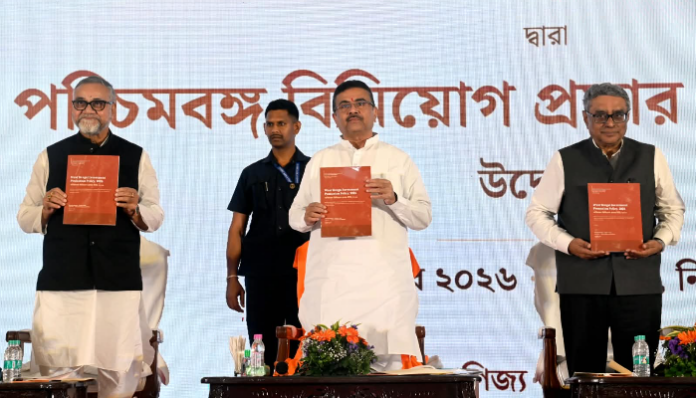
On 5th November (Thursday), Chief Minister Suvendu Adhikari announced the West Bengal Investment Promotion Policy, 2026, which promises government-backed land banks, job opportunities, better economic output, employment-linked incentives, and time-bound clearances to entice investment.
Soon after, he issued a stern warning against attempts to close industrial units through violent trade unionism or extortion, promising the immediate arrest of those responsible for such actions.
“There is a dedicated helpline number for registering complaints of extortion. I am requesting the investors to register their complaints on that helpline number. I assure that action will be taken within 15 minutes from the time the complaint is registered, and the perpetrators will be dealt with strictly as per legal provisions,” he stated.
He further declared, “I will not allow any attempt at unnecessary cease-work at any industrial unit. Those who will try to do so will be put in jail. I will ensure that they will stay in jail for a long time. If there is any complaint against any management, there is a proper way to address that by approaching the labour commission.”
“DISRUPT FACTORY WORK AND FACE JAIL WITHIN 15 MINUTES” Bengal CM Suvendu Adhikari sends an unmistakable warning to CPM and TMC as Bengal rolls out its new Industrial Policy. + No factory gate blockades. + No forced shutdowns. + No political muscle-flexing to hold industry hostage. + Workers can raise grievances through the Labour Commissioner. THE MESSAGE Bengal is open for business. Bengal means business.
— Rahul Shivshankar (@RShivshankar) November 6, 2026
Adhikari launched a stinging assault on the former Mamata Banerjee-led Trinamool Congress over the yearly “Bengal Global Business Summit,” which was supposed to be held under her government to draw investment to the state. He charged, “Over Rs 650 crore was spent in organising eight such summits. The previous government claimed that memoranda of understanding worth Rs 16 lakh crore were signed in these eight summits. But ultimately nothing fructified. It even showed infrastructure development projects as proposed investments.”
He added that the TMC government disregarded the state’s own tax income collection and pointed out that the state exchequer suffered significant losses as a result of corruption’s patronage. The chief minister assured, “However, things have started improving in the first six months of our new government. The state’s revenue has increased according to the respective periods of the two financial years from April to September 2025 and from April to October 2026.”
He informed that the earnings have grown by Rs 4,000 crore compared to last year, even though no fresh initiatives are currently feasible, remarking, “Our goal is to increase the state’s own tax revenue by stopping money laundering and extortion and create an environment for investment in industry.”
The Suvendu government has conveyed that Bengal will establish a non-lapsable, dedicated fund to offer incentives under the fresh policy. This move is an attempt to regain the trust of investors, which was damaged by the TMC regime’s shocking removal of industrial incentives. The state will officially notify that investors will be provided with the guaranteed advantages and that future policy changes won’t limit the already agreed-upon fiscal benefits.
Adhikari also lashed out at the Trinamool Congress government for failing to provide promised incentives and making businesses obtain land on their own. He mentioned, “Our government’s commitment, we will fulfil it 100 per cent. The earlier government deleted the word ‘incentive.’ We have (re)introduced the word ‘incentive,’ and made a provision of ₹5,000 crore.”
The government has set 30 days for the issuance of Certificates of Incentives, 45 days for Certificates of Entitlement, and an extra 30 days for the disbursement of aid following the submission of claims to resolve incentive delays. The benefits of the new policy will be available to businesses established or expanded after 9th May, when the saffron government took over. However, he made it clear that due to the state’s dire financial situation, the ₹50,000 crore in incentive dues will not be paid at this time.
Adhikari ruled out the TMC’s land policy and the Left Front’s forced land acquisition, stating that his government would encourage direct talks with landowners and provide compensation above market prices where needed.
He outlined, “We will neither have a forcible land acquisition policy like the erstwhile Left Front government nor have a flawed land policy like the Trinamool Congress government, which had asked industries to buy their own land without any government support. Our government is making arrangements to acquire land to create a land bank for industries.”
Firms that own unutilised industrial plots given to them by the TMC government are required to start projects within three months or return the property in exchange for a reimbursement of the original purchase price. According to Adhikari, in the upcoming months, investments of ₹1 lakh crore might be made possible by available industrial land.
Moreover, discussions on a car project on the Singur land dedicated to the Tata Nano plant are in progress with Ashok Leyland. Thirty-three business organisations, including Amul, Vedanta, Reliance, and Campa Cola, have been granted land by the government.
The policy states that if investors arrange land independently and the fixed capital investment exceeds ₹500 crore, the venture will be designated as a strategic and mega project. A project that receives land from the government and requires a fixed capital investment of more than ₹1,000 crore would fall in the same category.
It intends to promote both large and small industrial and service enterprises by providing state GST refunds, electricity duty exemptions, contributions to the employees’ provident fund, and exemption from stamp duty and registration fees.
Employment creation has emerged as a major factor in determining government assistance under the policy. For ten years, eligible manufacturing facilities could be awarded up to 50% of employment-linked aid, while service-sector enterprises may receive up to 75%. Incentives of up to 100% are available to qualified MSMEs that hire women and transgender people.
Capital subsidies will rise to 120% for units in priority and backward areas and 110% for thrust-sector units. In addition to strategic industries like defence, semiconductors, and electric vehicles, the policy encompasses manufacturing, MSMEs, IT, healthcare, tourism, education, financial services, and renewable energy. The policy identifies evolving digital technologies, defence, food and marine products, green hydrogen and waste-to-energy, semiconductors and electronics, and others as thrust sectors.
