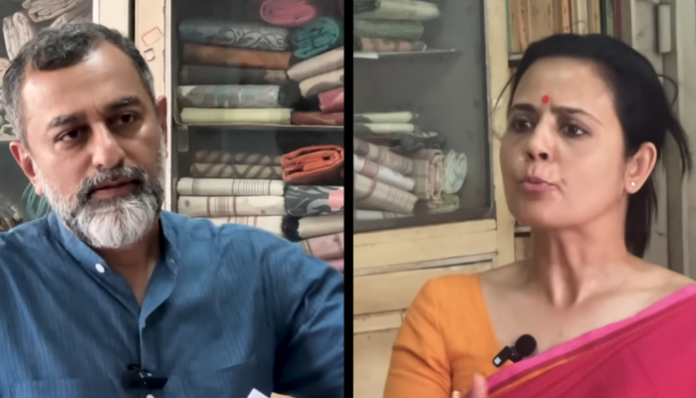
All India Trinamool Congress (AITC or TMC) Lok Sabha MP Mahua Moitra has once again drawn strong ire due to her misleading comments over the acute shortage of industries in West Bengal during an interview with Sreenivasan Jain for Newslaundry, which was published on 14th April (Tuesday). The state is undergoing assembly elections with voting scheduled to occur on 23rd and 29th April.
“How many new investments and new projects have taken off in the past five or 15 years? I’m not talking of proposals or MoUs (Memorandum of Understandings) but actual implementations,” Jain asked, to which she replied, “Now remember one thing that Bengal has never been a hub for large manufacturing and cannot be. It is a partition state it is still an agrarian economy with very small land holdings.”
“It is not possible for us to give a thousand acres or 2,000 acres or you know very large tracks of land which is possible in many other states where they’re not that dependent on agriculture. Bengal is a very fertile land. People are still dependent on agriculture. So, this is something that stands in the way of very large manufacturing investments,” Mahua added.
However, the falsehoods were promptly dismantled not just by the Bharatiya Janata Party but also by the netizens, who emphasised that the region was historically a manufacturing giant, and the current industrial landscape is a direct outcome of the policies of the ruling party.
BJP and netizens remind Moitra of the actual cause for the decline of industries in Bengal
BJP retorted that the “truth cannot be changed for convenience” and pointed out how the state was the nation’s production powerhouse, which housed Hindustan Motors, the makers of the iconic Ambassador cars, Bengal Chemicals & Pharmaceuticals Limited (BCPL), India’s first pharmaceutical business, engineering firm Burn & Company and the major tire manufacturer, Dunlop, alongside multiple others industries and a vast network of jute mills and foundries.
This large-scale industrial dominance contributed 20% of the country’s production. BJP remarked that the state is not devoid of potential or industry but rather dearth of a willing leadership under the “dictatorial TMC government.” It charged that “corruption, strikes, violence, lack of Ease of Doing Business (EoDB) and a broken business climate under Chief Minister Mamata Banerjee pushed 6,688 companies out of Bengal between 2011 and 2025. First, they destroyed the industrial backbone. Now, they deny it ever existed. They lie. They deflect. They deny. But Bengal remembers. And Bengal will respond.”
𝐓𝐌𝐂’𝐬 𝐬𝐡𝐚𝐦𝐞𝐥𝐞𝐬𝐬 𝐥𝐢𝐞 𝐞𝐱𝐩𝐨𝐬𝐞𝐝!
— BJP (@BJP4India) April 15, 2026
“Bengal was never a manufacturing hub and never can be.”
Then how do you explain the legacy of Hindustan Motors, Burn & Company, Bengal Chemicals & Pharmaceuticals, Dunlop India and more?
Under Mamata Banerjee, corruption,… pic.twitter.com/nMFoNy1NS2
Amitabh Chaudhary referred to Moitra’s claims as a “big lie” and noted that Bengal’s manufacturing sector declined from 20% in 1920 to 5% in 2025. Her declaration of inability to provide 2000 acres of land for manufacturing was similarly exposed by him.
“Tata motors has to shut down its Singur plant because of Mamata Banerjee. JSW (formerly Jindal South West) alone is holding 4300 acres of land in Salboni. They are not able to expand, and Mamata has asked them to return the land. No one is willing to invest because of corruption and cut money. Panagarh Industrial Area is approximately 2000 acres, with hardly any investors,” he stated.
Motor mouth Mahua saying that “West Bengal was never a manufacturing hub” ; is a Big lie.
— Amitabh Chaudhary (@MithilaWaaala) April 14, 2026
West Bengal manufacturing share in India:
1960: 20%
2025: 5%
West Bengal cannot provide 2000–3000 acres of land for manufacturing? Another lie.
Tata motors has to shut down its Singur… pic.twitter.com/PMBZMXAhGM
Raghunath AS expressed that Kolkata transitioned from the commercial capital of India to ceding its position to Mumbai and then to Delhi/NCR (National Capital Region). The primary factors contributing to this drop comprised labour militancy, frequent strikes and policy uncertainty during the 1970s and 1980s. He also highlighted tolabaji (extortion) along with poor industrial policies of both the Left and the subsequent TMC governments.
“Many companies either closed down, became sick units, or relocated manufacturing, or their corporate headquarters and decision-making centres,” he conveyed and proceeded to name the entities that migrated the state including Hindustan Unilever, Bata India, Hindustan Fertiliser Corporation, Mackinnon, Mackenzie Andrew Yule & Company, Tata Steel and Birla Group among several others.
Kolkata went from being India’s commercial capital to losing ground to Mumbai and later Delhi/NCR. Labour militancy, frequent strikes, and policy uncertainty in the 70s–80s and later tolabazi, bad industrial policies of during post CPM rule are the key reasons. Many companies…
— Raghunath AS 🇮🇳 (@asraghunath) April 14, 2026
Sougat Chakraborty mocked that Moitra’s fabrications could be disproven with just a Google search and then illustrated that it identified Bengal as a manufacturing hub, which accounted for nearly 27% of the country’s overall output in 1950-51.
One Google search that’s all it required. pic.twitter.com/Eh9nvwF0Rz
— Sougat Chakraborty (@sougat18) April 13, 2026
Similar sentiments were reiterated by another individual who accused Moitra’s party of expelling the companies from the state, after which she asserts that it has consistently fallen short of manufacturing.
First, drive out all the manufacturing and then claim that Bengal has never been a hub. Hindustan Motors, Chittaranjan Loco, Durgapur Steel and many more disagree …
— Klingon (@agneepankh) April 14, 2026
Bengal had emerged as a major industrial region during the British Raj, and sectors like Jute, Tea, Coal mining, Engineering and heavy industries, Iron and steel, Paper, Leather and Chemicals had flourished. Even before the British rule, Bengal had major industries in the sectors of cotton and silk textiles, shipbuilding, salt, indigo dye production and others.
Post independence, steel and other metals, heavy engineering, jute, tea, coal, chemicals, fertilisers and other sectors continued to grew in the state. But the state has regressed a lot in the last couple od decades under left and TMC rules.
How industries were pushed to move away from the state
More than 6,000 enterprises quit Bengal during the past 14 years, according to information shared by the Modi government in the Parliament in July 2025. Over 2,000 of these, including 39 listed, transitioned in the past five years. Many of the firms relocated to Gujarat, Delhi, Uttar Pradesh and Maharashtra. This industrial migration took place while the TMC was in power.
Moreover, the centre mentioned that only a few modest investments had been promised, presenting a grave and worrying scenario for the nation’s fourth most populous state. Over 2200 businesses, or one-third, abandoned Bengal since 2019. Importantly, this pattern persisted after the TMC was elected in 2011. 110 of the 6688 corporations featured on the stock market.
According to the government, the companies gave a variety of justifications for shifting their headquarters, such as cost effectiveness, improved management control and administrative and operational convenience. Bengal stood 2nd after Maharashtra in relation to the number of registered companies until the 1970s, but it slid to the 9th place by 2021.
Moitra’s grand statements fall apart under unbiased analysis
Moitra’s assertions related to the job prospects in West Bengal also crumbled when subjected to analysis. She boasted about 14 lakh employment opportunities per year in the state, but Jain highlighted, “When you talk about jobs, Mamata Banerjee last month said that 84 lakh unemployed youth registered for a dole scheme (Banglar Yuba Sathi) for 21 to 40 age group, of your government. They get Rs 1,500 a month. We did the math. 84 lakhs amount to 40% of the working population between 21 and 40.”
“You promised five lakh new jobs a year in 2021 and you’re saying you’ve actually created three times that amount. Is that correct? Is that a credible claim,” he earlier inquired. However, Moitra enthusiastically answered, “Of course, it is. It’s something that has been placed in our assembly. Do you think that the data report card and the economic numbers that we place in the West Bengal assembly as part of the budget report is going to be a lie?”
However, her responses were soon shown to be more grounded in political narrative than concrete numbers. The entire episode primarily served as her desperate endeavour to mask the overwhelming shortcomings of the TMC government.
Conclusion
The state has been inching towards its industrial decline since the Communist Party of India (Marxist)-led front governed for 34 consecutive years, and the momentum only accelerated after the TMC ascended to power, promising a new beginning and blaming the “openly anti-industry policies” of the former administration for the precarious situation.
The government clearly failed to fulfil its commitments, and its leaders have shamelessly opted to rewrite the history of the state, denying its manufacturing roots. The blatant disregard for reality and the effort to disseminate disinformation could either be an awful move on Moitra’s part to cover up the disastrous policies of her government or she could be actually ignorant of the legacy of the state she purports to represent.
Regardless, both instances reflect her shocking disconnect from facts, whether it was intentional or artificial. However, the BJP’s attack and the public’s reaction have shown that there are no safe spaces for these political deceptions, which, conversely, have illuminated the outrageous actions of TMC against the industry sector.