

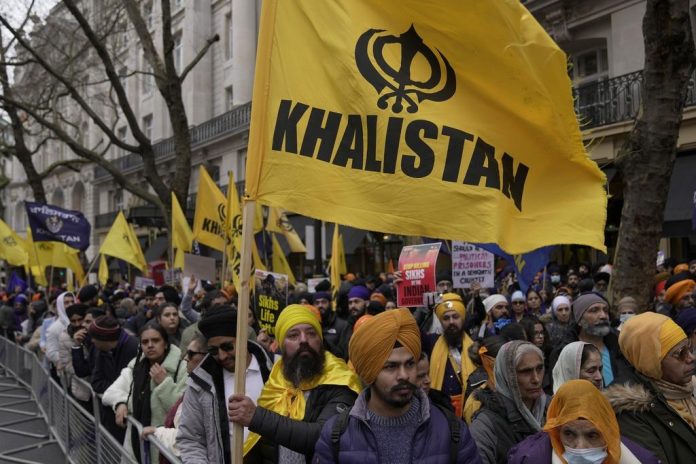
On 11th December, a Canadian court ordered the deportation of Khalistani Sikhs for Justice (SFJ) member Gurpreet Singh from the country.
Singh had asked the court to halt the deportation order to India, claiming that he would suffer irreversible harm in India and would be punished for his pro-Khalistan actions in the two countries. However, the court rejected his claims. Notably, the terrorist outfit SFJ has been banned in India.
Singh submitted the plea “for an order staying his removal from Canada to India, scheduled for tomorrow, December 12, 2025, pending the determination of his Application for Leave and for Judicial Review of the December 10, 2025, decision of an Inland Enforcement Officer at the Canadian Border Services Agency (the Officer). The Officer refused Mr Singh’s request to defer his removal from Canada, finding that there was insufficient objective and compelling evidence to warrant exercising the limited discretion to defer removal.”
Canada will deport Sikhs for Justice (SFJ) Canada member Gurpreet Singh after he entered the country illegally and was convicted of assault with a weapon.
— Journalist V (@OnTheNewsBeat) December 16, 2025
This should be automatic and not after hundreds of court hearings pic.twitter.com/bXfkYl9XkW
Singh cited his father’s 18th November declaration, which outlined that the former took part in the Farmer’s Protest in India and demonstrated against the alleged government’s repression of Sikhs’ right to free speech in March 2023, among other things. “Mr Singh joined Sikhs for Justice in Canada, which will place him at risk upon return, given that other Khalistan supporters have been jailed; and the police have attended their home in India in search of Mr Singh,” the court order read.
Singh reiterated that “he and his young son will suffer irreparable harm from his removal.” However, the minister of citizenship and immigration who is the Respondent in the case mentioned that Singh did not bring up a significant point in the Officer’s ruling that satisfied the nation’s “elevated test.”
The court pointed out that the Officer fairly concluded that the circumstances did not justify using the limited discretion to postpone removal after taking into account all of the arguments and the minimal new evidence that was submitted. It further conveyed that although the country condition paperwork (country of origin information) was used to depict threats to Sikh activists generally, the Officer appropriately found that there was no proof of a specific risk to Singh.
Additionally, there were no specifics or dates of any purported personal hazards in Singh’s father’s affidavit. After taking into account the further documents that Singh had submitted, the Officer clarified that the aforementioned affidavit did not demonstrate a new risk that had not been taken into account in the PRRA (Pre-Removal Risk Assessment in Canadian immigration).
“Mr. Singh has not provided sufficient evidence of irreparable harm to himself, but rather relies on the same allegations of risk previously assessed and generalized risks; Mr. Singh has not established how his removal will cause irreparable harm to his son, beyond the inherent consequences of family disruption upon removal; and, Mr. Singh has not identified any impact of his removal on his probation order in Canada,” the verdict noted.
It then declared that “the balance of convenience favours the Respondent to ensure the integrity and confidence in Canada’s immigration system, which includes ensuring that the provisions of the Act are carried out, including the statutory duty under section 48 of the Act is to enforce a removal order as soon as possible.” Afterwards, Singh’s appeal was dismissed by the judge.
