

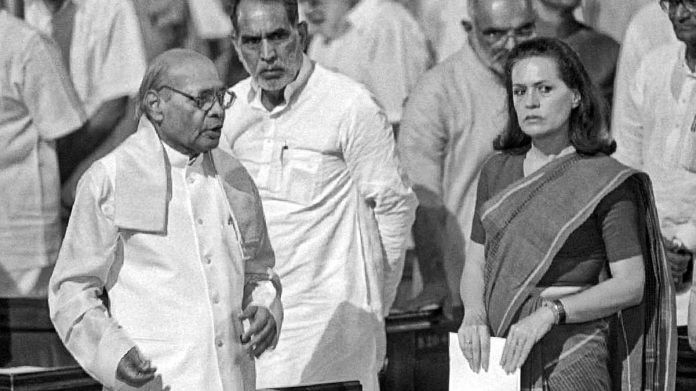
Former Congress leader Prithviraj Chavan has suggested that Sonia Gandhi may have deliberately avoided giving former Prime Minister PV Narasimha Rao the recognition he deserved within the Congress because it could have upset certain political and social constituencies. His remarks have revived questions about the Congress leadership’s treatment of Rao, including the controversial circumstances surrounding his funeral in December 2004, when his mortal remains were not allowed inside the party headquarters at 24, Akbar Road, in New Delhi.
Chavan was speaking about Sonia Gandhi’s recently released memoir, Belonging: A Journey of Love, amid criticism that the book overlooks important aspects of India’s political history and the contributions of leaders who served the Congress outside the Nehru-Gandhi family.
Acknowledging that Rao was not accorded the dignity expected of a former Prime Minister and Congress president, Chavan said the allegation was partly true. He suggested that Rao’s handling of the Hindu-Muslim situation during his tenure may have influenced the decision not to honour him formally through the party.
“When Narasimha Rao died, I think he was not given due dignity as a former Congress president and a former Prime Minister; that is the allegation. And I think it is partly true that he could have been given Congress party honours,” Chavan said.
He went on to offer his interpretation of why Sonia Gandhi may have been reluctant to honour the former Prime Minister.
“He comes out in a bad light as far as the Hindu-Muslim or communal situation is concerned. So I think it is quite possible that she felt honouring him could hurt certain forces in the country. That is my reading of it; I don’t know what actually happened, nor do I know whether she has spoken about it in the book,” he added.
Chavan was careful to clarify that he was offering his personal assessment and did not claim to know what had transpired within the Congress leadership.
How Sonia Gandhi’s Congress leadership treated Narasimha Rao even after his death
The controversy surrounding Rao’s treatment by the Congress leadership did not begin with Sonia Gandhi’s memoir. It dates back to December 2004, when the former Prime Minister died in New Delhi.
Rao passed away on December 23, 2004, at the age of 83. His mortal remains were brought out in a flower-decked military gun carriage the following day and taken towards the Congress headquarters at 24, Akbar Road. As was customary for former Congress presidents, the party headquarters was expected to be a place where Congress workers could pay their last respects.
However, the hearse carrying Rao’s body was not allowed to enter the Congress headquarters. The carriage remained outside the gates for nearly 40 minutes as senior leaders, including Sonia Gandhi and then Prime Minister Manmohan Singh, paid their respects. The mortal remains were subsequently flown to Hyderabad, where his funeral was conducted with full state and military honours.
The episode was particularly striking given Rao’s stature within the Congress. He had served the party for decades, occupied the highest constitutional office in the country and completed a full five-year term as Prime Minister. Yet, even after his death, his mortal remains were not allowed inside the party headquarters for Congress workers to pay their final respects.
There were also questions about why Rao’s last rites were not conducted in Delhi. An account of the events was subsequently provided by Sanjaya Baru, who served as media adviser to Manmohan Singh during his tenure as Prime Minister.
In his book The Accidental Prime Minister, Baru recounted that Ahmed Patel, Sonia Gandhi’s close political aide, had approached him with a message for Rao’s family. Patel wanted Baru to convey that the former Prime Minister’s funeral would not take place in Delhi and that his last rites would instead be conducted in Hyderabad.
Baru said he refused to communicate the message to Rao’s son. The account suggested that Sonia Gandhi’s decision had been conveyed to the family through Patel rather than directly by the Congress leadership.
The episode added to the perception that Rao had been sidelined by the Congress leadership after his departure from the Prime Minister’s Office in 1996. His relationship with the Gandhi family had remained strained, particularly after he was replaced as Congress president following the party’s electoral defeat.
Rao’s legacy and the renewed controversy over Sonia Gandhi’s memoir
Rao was Prime Minister between 1991 and 1996 and presided over one of the most consequential periods in India’s economic history. With Manmohan Singh as his Finance Minister, his government initiated landmark economic reforms that dismantled several decades of restrictive economic policies and opened India to greater global investment.
He was also the Prime Minister when the Babri structure was demolished in December 1992. The incident became one of the most controversial episodes of his tenure and remains central to debates over his political legacy.
Rao was the first Prime Minister outside the Nehru-Gandhi family to complete a full five-year term. He assumed office in 1991 following the assassination of Rajiv Gandhi during the Lok Sabha election campaign.
Despite his contributions, his relationship with the Congress leadership remained strained after he left office. The party’s subsequent reluctance to publicly celebrate his legacy became a recurring point of criticism, particularly from his family and political opponents.
