

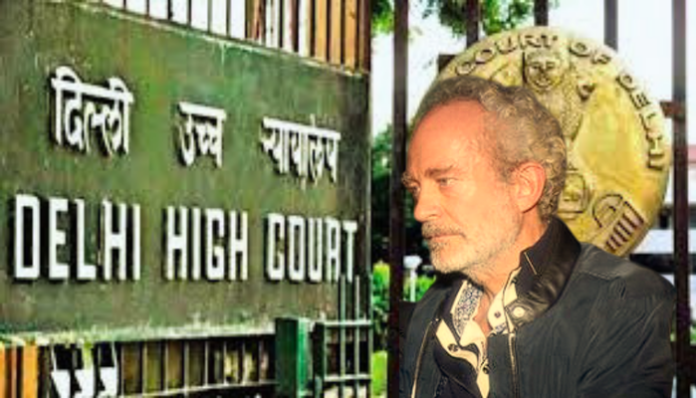
The Delhi High Court on Wednesday (8th April) rejected the bail plea of Christian Michel, who is an accused in the AgustaWestland VVIP chopper scam. A Division Bench of Justices Navin Chawla and Ravinder Dudeja also rejected Michel’s challenge to the India-UAE extradition treaty, 1999.
In his plea, Michel had requested the High Court to make a declaration to the effect that Section 21 of the Extradition Act, which forbids India from trying an extradited individual for any offence not expressly listed in the extradition order, should take precedence over the 1999 India-UAE extradition treaty. Notably, the India-UAE extradition treaty allows prosecution not only for the offences for which extradition is granted but also for other “connected” offences.
Michel also challenged a trial court order rejecting his application under Section 436A of the CrPC. The provision allows for the release of undertrial prisoners who have served half of the maximum imprisonment prescribed for their alleged offence. “We see no merit in the petition. The same is accordingly dismissed,” the High Court said, rejecting Michel’s plea.
The bench also upheld a trial court order rejecting his application seeking release from prison on the ground that he had undergone the maximum punishment of seven years.
Notably, this was Miche’s second petition before the Delhi High Court. Earlier, on November 17, he filed a plea before the High Court seeking a declaration that Article 17 of the extradition treaty was illegal. But it was rejected.
What is the case against Christian Michel?
British national Christian Michel was extradited to India from Dubai on December 4, 2018. He was accused of acting as a middleman in the ₹3,600 crore AgustaWestland VVIP chopper deal case. The case involves allegations that bribes were paid to several politicians, bureaucrats and military officers in exchange for getting this deal during the Congress-led government.
In 1999, the Indian Air Force needed new helicopters for the movements of VVIPs. At that time, Mi-8 helicopters were used to transport VVIPs, including the Prime Minister and the President. These helicopters were old, could not fly at night and also could not fly at high altitudes, with a maximum limit of 2000 meters.
Accordingly, bids were invited for the supply of 12 helicopters in 2006, and one of the conditions specified was that the helicopter must be able to fly up to an altitude of 6000 meters. The maximum altitude of the AgustaWestland AW-101 helicopter is 4500 meters, which made it ineligible for the bid. Subsequently, in 2005, the Indian Air Force, under its Chief S P Tyagi, modified the tender terms by reducing the altitude requirement to 4,500 meters, after which the AW-101 became eligible for the deal. Finally, a deal was signed in 2010 by the Congress-led government to purchase 12 AW-101 helicopters for ₹3,600 crore.
Later on, in 2012, reports of corruption in the deal emerged in the media. A year later, the Italian government arrested AgustaWestland CEO Bruno Spagnoli and parent company Finmeccanica’s chairman Giuseppe Orsi on the allegations of paying bribes to secure the deal with India. The investigation in Italy revealed that IAF chief S P Tyagi and his family were among those who received this bribe, through middlemen Christian Michel, Carlo Gerosa and Guido Haschke. According to the CBI, bribes were estimated at around ₹423 crore. Consequently, the then defence minister A K Anthony cancelled the deal, and an investigation was launched in India.
