

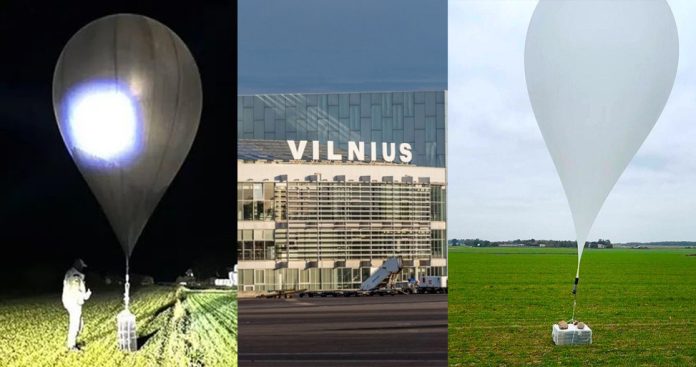
Air traffic at Vilnius International Airport in Lithuania were suspended last night due to disruptions caused by dozens of weather balloons used by smugglers entering Lithuanian airspace from neighbouring Belarus. The balloons, suspected of carrying contraband cigarettes, posed a significant safety risk, leading to the diversion of multiple flights and highlighting ongoing smuggling challenges in the region. The flight operations resumed on Wednesday morning after the balloons disappeared.
The disruption began late Tuesday evening when authorities detected the unauthorized aerial objects drifting into the airspace around the capital. According to Lithuania’s National Crisis Management Centre (NCMC), the balloons were part of a smuggling operation transporting illicit cigarettes, a common tactic employed by criminals exploiting the border with Belarus. As a precautionary measure, airport operations were halted, resulting in incoming flights being redirected to alternative destinations, including Kaunas Airport in Lithuania and Warsaw in Poland.
Cigarette smuggling balloons disrupt operations at Vilnius airport in Lithuania’s — National Crisis Management Center https://t.co/e1bftNNSx2 pic.twitter.com/u9gGjK98Mu
— Rapid Report (@RapidReport2025) October 21, 2025
“Operations have been disrupted due to weather balloons used to smuggle cigarettes from Belarus,” the NCMC said in its statement. A spokeswoman for Lithuanian Airports said that about 30 flights carrying around 4,000 passengers were affected. After the airport operations resumed, scheduled departures from Vilnius were delayed.
As per officials, the weather balloons were launched from multiple sites in Belarus as part of a coordinated operation. “The intensity and number of balloon launches were very high, and most likely this wasn’t from a single point – it was a coordinated operation,” said NCMC head Vilmantas Vitkauskas.
Around 14 of the weather balloons launched from Belarus over the weekend floated over the Vilnius area. At least 11 balloons were recovered containing over 18,000 packs of black-market cigarettes. Search for all the balloons continues by the police.
This marks the second such event at Vilnius Airport this month alone. On October 5, a similar influx of helium-filled balloons carrying contraband led to a temporary shutdown, causing widespread delays and cancellations affecting thousands of travellers.
Flights holding or diverting as Vilnius has closed due to “unauthorized meteo balloons in the vicinity of the airfield.” Estimated reopening: 2140 UTC.https://t.co/zlI0Ddq0TU pic.twitter.com/1fZMLNIOm9
— Flightradar24 (@flightradar24) October 21, 2025
Lithuanian officials noted that these rudimentary smuggling methods, cheaper and less detectable than drones, have become increasingly prevalent, with 544 balloons recorded entering the country from Belarus so far this year. A total of 966 balloons were recorded in the year 2024.
The packets carried by balloons include geolocation tags, helping their recovery by the smugglers. Recently Polish police detained a Belarusian citizen carrying smuggled cigarettes in his car. A geolocation tag was reportedly found on his phone linked to the illicit goods.
The incident underscores broader aviation security concerns across Europe, where unexplained aerial intrusions have repeatedly disrupted operations at several airports. A similar incident last month involved drone sightings that forced the closure of several Danish airports and restricted airspace in Norway and Germany during September. While those events were not directly linked to smuggling, they prompted urgent calls from European leaders to bolster air defence systems amid heightened geopolitical tensions, including Russia’s ongoing invasion of Ukraine. Moscow has denied involvement in the drone incursions, dismissing some as accidental.
