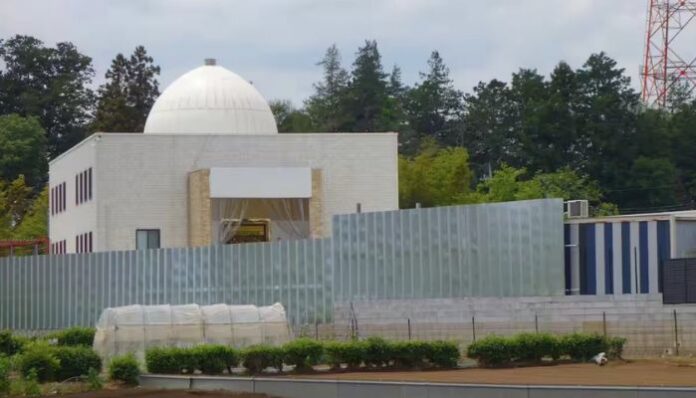
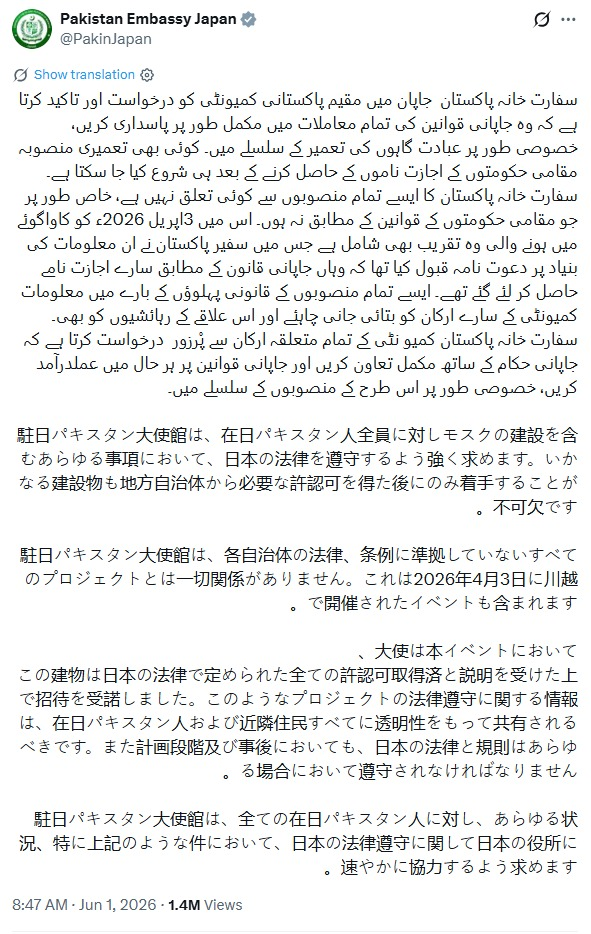
In a major embarrassment for Pakistan, the Pakistan Embassy in Japan issued a statement on the 31st of May 2026, urging Pakistani Muslims in Japan to “abide by” the Japanese laws in all matters, particularly the construction of mosques. The statement came in the backdrop of the Kawagoe illegal mosque construction controversy.
“The Embassy of Pakistan in Japan strongly urges all Pakistanis residing in Japan to comply with Japanese laws in all matters, including the construction of mosques. Any construction must be undertaken only after obtaining the necessary permits from local authorities. The Embassy of Pakistan in Japan has no involvement whatsoever with any projects that do not comply with the laws and regulations of each local government. This includes the event held in Kawagoe on April 3, 2026,” the Pakistani Embassy in Japan said.

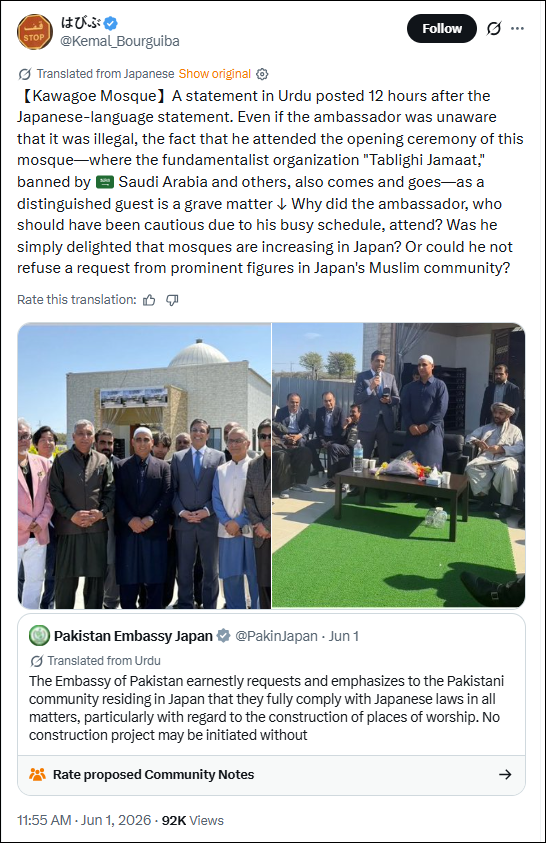
Addressing the issue of the Pakistani ambassador attending the inauguration event of the Japan Jame Masjid Ramzan in Kawagoe, the Embassy said that the ambassador Abdul Hameed accepted the invitation “after being informed that the building had obtained all necessary permits as stipulated by Japanese law.”
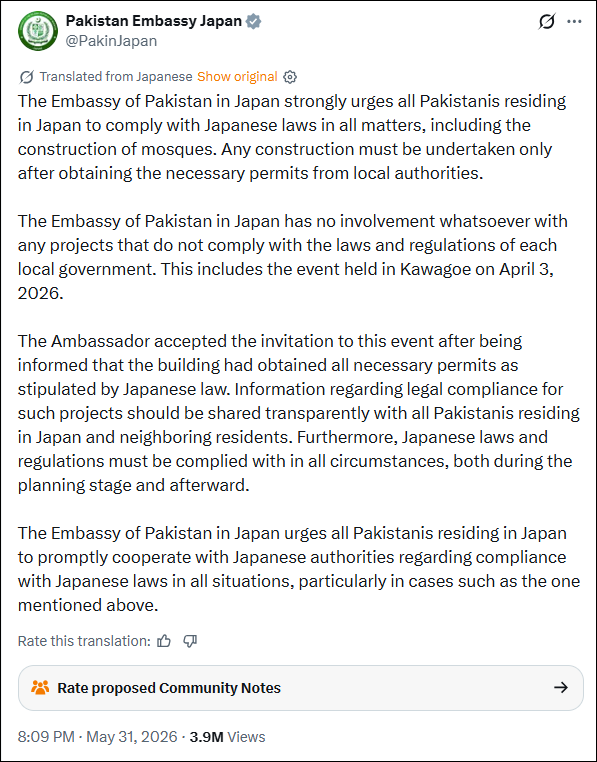
“Information regarding legal compliance for such projects should be shared transparently with all Pakistanis residing in Japan and neighbouring residents. Furthermore, Japanese laws and regulations must be complied with in all circumstances, both during the planning stage and afterward,” the Pakistan Embassy in Japan added.
On social media, several Japanese people have expressed anger over the Pakistani official attending the opening ceremony of a mosque with alleged links to the Islamist organisation Tablighi Jamaat.
“A statement in Urdu posted 12 hours after the Japanese-language statement. Even if the ambassador was unaware that it was illegal, the fact that he attended the opening ceremony of this mosque—where the fundamentalist organisation “Tablighi Jamaat,” banned by Saudi Arabia and others, also comes and goes—as a distinguished guest, is a grave matter. Why did the ambassador, who should have been cautious due to his busy schedule, attend? Was he simply delighted that mosques are increasing in Japan? Or could he not refuse a request from prominent figures in Japan’s Muslim community?” one X use wrote.
Some have even raised concerns that Pakistan may be backing mosque construction at specific locations in Japan at China’s behest for information gathering, since Japan and China are historical adversaries, although no media reports have indicated this angle so far.
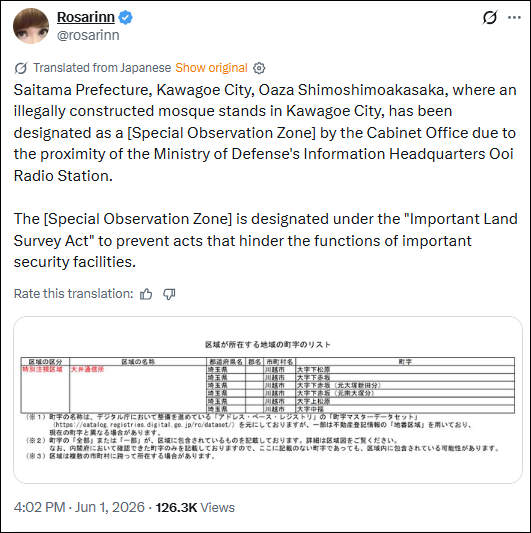
“Saitama Prefecture, Kawagoe City, Oaza Shimoshimoakasaka, where an illegally constructed mosque stands in Kawagoe City, has been designated as a [Special Observation Zone] by the Cabinet Office due to the proximity of the Ministry of Defence’s Information Headquarters Ooi Radio Station. The [Special Observation Zone] is designated under the “Important Land Survey Act” to prevent acts that hinder the functions of important security facilities,” a Japanese X user wrote.
The Kawagoe Japan Jame Masjid Ramzan: An illegal mosque and Pakistani Islamist intransigence
Pakistan Embassy in Japan had to issue an embarrassing statement schooling its Muslim nationals to abide by Japanese laws, especially in matters of mosque construction, due to the controversy of the illegal building and opening of the Japan Jame Masjid Ramzan, in Kawagoe City, Saitama Prefecture.
The Saitama Prefecture is a rural Shimo-Akasaka area, an urbanisation-controlled area, having strict building restrictions under the City Planning Act. However, as is the case with Islamists all across the world, local laws mean little to them in matters of Islamic expansion and takeover. The Masjid was illegally constructed on the land owned by a Pakistani-owned company.
Japanese media reports that the real estate registry classified the land in question as “forest land”.
In October 2024, the local residents protested against the nearly completed mosque structure. Since then, the city officials issued multiple stop-work orders; however, the Muslims did not comply and continued the construction work. Initially, the workers reportedly claimed that they could not understand Japanese, apparently to justify their non-compliance.
The land on which the Kawagoe, Japan Jame Masjid Ramzan stands was acquired in March 2025 by a Pakistan-affiliated company. The illegal mosque held its opening ceremony on 3rd April 2026. The event was attended by Pakistani ambassador Abdul Hameed, drawing criticism from the Japanese people for his presence at the opening of an illegal Islamic structure.
Amusingly, in almost all mosque-related disputes anywhere in the world, Muslims claim that the mosque was already there and will stay there till ‘Qayamat’ or Islamic judgment day. This is an Islamist playbook of bolstering and legitimising their claim over land they illegally occupy and erect mosques over.
In the Kawagoe Jame Masjid case, the owners are reported to have submitted a ‘corrective plan’, claiming that the illegal mosque “was always there”. The local Japanese authorities rejected these claims, as prior architecture, let alone a mosque, existed in records.
Many Japanese people have even brought up the old images of the same spot where the illegal mosque stands now, confirming that the Pakistani Muslim owners of the mosque were blatantly lying to justify the illegal encroachment. The delay tactics fell flat as the old images and official records confirm that no prior structure existed at that location.
The authorities have ordered the demolition of the illegal mosque, forcing the Pakistani embassy to distance itself from the incident.
From the Sambhal Jama Masjid in India’s Uttar Pradesh, which originally was a Hindu temple, to the Kawagoe Mosque in Japan, which is built on forest land, this ‘mosque was always there’ exemplifies Islamist intransigence.
The mosque controversy has reignited the debate around the influx of Muslims, demographic shifts, and fears of an Islamist takeover of Japan
A significant section of Muslims believes that it is their religious duty to spread Islam and convert more and more Kafirs or non-Muslims. Earlier, wars and conquests were a means of imposing Islam; in modern times, many travel to distant lands for this purpose, while others further the agenda wherever they live.
Japan is grappling with a serious population decline crisis. In fact, the crisis is accelerating faster than multiple official projections. Japan has one of the world’s lowest fertility rates and oldest populations. This has led to record-low births.
Japan’s Total Fertility Rate (TFR) dwindled to 1:15 in 2024, marking a ninth consecutive year of decline. In 2023, Tokyo’s TFR dipped below 1.0.
According to Japanese media reports citing official data, Japan recorded 705,809 births in 2025, down from around 721,000 in 2024. The number of natural declines and deaths also presents an alarming picture.
Overall, Japan has been below the replacement rate of 2.1 for decades, with its TFR hovering between 1.1 and 1.2.
The crisis has resulted in labour shortages in care, manufacturing, and services, exacerbated by slower economic growth, deflationary pressures, and challenges to funding infrastructure.
There have been reports of rural depopulation, school closures, and even the emergence of “ghost towns” or “dying villages”. These areas mainly include villages vacated by an ageing population and abandoned industrial hubs decimated by sudden economic shifts.
Although very limited success has been achieved, the Japanese government has been running various financial incentive schemes, implementing childcare expansion, enacted work-life reforms to increase Japan’s birth rates. However, cultural factors like later marriages, high child-rearing costs, gender roles, etc, coupled with economic uncertainties, continue to exacerbate the crisis.
Clearly, the demographic crisis of Japan is conducive to Islamist migrants to expand their tentacles. In recent years, due to a worker shortage, Japan has been importing workers from Pakistan, Bangladesh, and Indonesia, who are mainly Muslims. A significant number of Muslims are taking advantage of Japan’s immigration policies and making their way to the country. These Muslims mainly work as technical interns, caregivers, and other such jobs, filling demographic gaps; low birth rates and an ageing population.
There have been reports of Muslim migrant workers indulging in the propagation of Islam, converting Japanese locals, doing interfaith marriages, etc, to spread Islam, deepen their roots, and increase their population.
By the end of 2024, the Japanese media and researchers estimated that the number of foreign Muslims in the country stood at 360,000, while the total number of Muslims was around 420,000, including around 55,000 Japanese converts, marking an increase from 110,000 to 230,000 around 2010-2020. In short, the Muslim population in Japan has surged by four times in just 15 to 20 years. The number of mosques has also increased from 24 in 2001 to more than 164 in 2025.
With an increased presence of Muslims, there have been visible changes in the outlook of localities, culture and society. More mosques, more Muslims, more Islam and more trouble. There have been incidents wherein Muslims would offer namaz on roads, and in other non-permitted areas, in accordance with their usual global practice of exerting religious dominance, telling the local kafirs, ‘we have arrived’.
Though a secular country, Japan has Shinto-Buddhist traditions as its dominant religion, and has cremation as a near-universal practice. There have been incidents of commotion over this since Muslims believe in the burial of their dead, as Islam prohibits cremation. Since the Islamic tradition is not compatible with that of the local Japanese people, and Muslims remain adamant about these issues, concerns have been raised over the failure of Muslims to assimilate and respect local culture.
In May this year, a massive protest erupted over the construction of a mosque in the city of Fujisawa. The city inhabiting 440,000 people, has witnessed a rapid increase in the Muslim population. The mosque in question was being constructed by a Sri Lankan businessman, Mohamed Khaleel, who said that he wants to build a mosque because the Ebina Masjid 20 kilometres away is not sufficient to cater for the surging Muslim population in Fujisawa.
Interestingly, Khaleel and other local Muslims settled on a 980-square-meter site of an abandoned factory on the northern outskirts of Fujisawa in 2021. Operating in mission mode, they established the Fujisawa Masjid NPO, collected funds, bought the land and began obtaining permits for mosque construction.
The modus operandi is concerning. A group of Muslims settled near an abandoned factory in 2021, and quickly raised funds, and by 2025, built a mosque. A significant section of Japanese people is alarmed by how Muslim immigrants are expanding their religious footprint across Japan, in a fashion hinting at a deliberate conspiracy to eventually outnumber non-Muslim locals by both increasing their own population and brainwashing locals into converting to Islam.
This is a pattern of even small Muslim communities quickly prioritising erecting mosques, minarets, giving Islamic calls for Namaz loudly, and using public spaces for Namaz. Muslims have no qualms about violating local laws and bypassing permits to assert religious dominance. This Islamist playbook has been witnessed in Europe as well, wherein this has scaled to large complexes as Muslims exploit the ‘secular’ laws of tolerant nations to further their communal and Islamist agenda.
Not to sound cliché, but demography is destiny. Lebanon was Christian-dominated once, but now, Muslims have become a majority, comprising around 65 to 70% of the population and enjoy dominance, while Christians have become a minority in their own historical homeland. India is also sitting on a similar demographic timebomb, as the Hindu majority faces the danger of being outnumbered by the Muslim ‘minority’.
A 2020 research carried out by Pierre Rostan and Alexandra Rostan estimated a timeline of many European countries turning into Muslim-majority in the coming centuries. Based on the migration scenario, the research estimated that among the High-Growth Muslim population countries, six of them will reach a majority of the Muslim population in the next 200 years. Belgium (in 2175), Bulgaria (in 2160), Cyprus (in 2175), France (in 2165), Sweden (in 2170) and the United Kingdom (in 2195) will all have a Muslim-majority population.
From one mosque emerges a Muslim area, a Muslim area soon becomes a strict no-go zone, streets are blocked, demands for Sharia law implementation come up, in fact, parallel Sharia courts also emerge. France, the UK, Sweden, the US and many Western countries, along with India in Asia, are grappling with the Islamist expansionist demographic war against Kafirs. Japan is also heading the same way with its suicidal policy of importing Pakistani and Bangladeshi Muslims.