

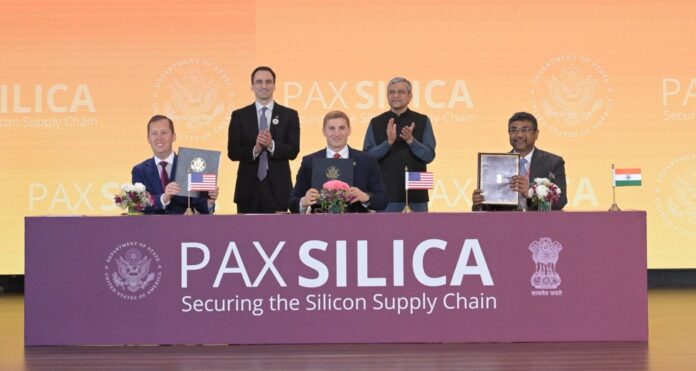
In a landmark development strengthening Indo-US technological and strategic ties, India today signed the Pax Silica Declaration, formally joining the United States-led Pax Silica initiative. The signing ceremony took place on the sidelines of the India AI Impact Summit 2026 in New Delhi, marking a crucial step in securing resilient global supply chains for artificial intelligence (AI), semiconductors, and critical minerals.
The Pax Silica initiative, launched by the US Department of State in December 2025, aims to foster a “secure, prosperous, and innovation-driven” ecosystem for technologies foundational to the AI era. Drawing its name from the Latin “pax” (peace and stability) and “silica” (the precursor to silicon used in semiconductors), the framework seeks to reduce coercive dependencies, particularly on dominant suppliers like China, in critical areas such as rare earth minerals, energy inputs, advanced manufacturing, chip production, and AI infrastructure.
Pax Silica is envisioned as a strategic coalition of trusted nations committed to securing the “silicon stack”, from critical minerals and semiconductor fabrication to advanced AI systems and deployment infrastructure. The initiative seeks to reduce overconcentration in global supply chains, prevent economic coercion, and ensure that emerging technologies are developed and governed by open, democratic societies.
The non-binding Pax Silica Declaration affirms a shared commitment among partner nations to advance mutual prosperity, technological progress, and economic security. It emphasises that “a reliable supply chain is indispensable to our mutual economic security” and recognises AI as a “transformative force for long-term prosperity,” while stressing the need for trustworthy systems to safeguard shared interests.
India’s entry into the coalition, following initial signatories including the United States, Australia, Japan, South Korea, the United Kingdom, Singapore, Israel, Greece, and others, comes after months of discussions and is seen as both strategic and essential for New Delhi. Union Minister for Electronics and Information Technology Ashwini Vaishnaw represented India at the signing, while the United States was represented by Under Secretary of State for Economic Affairs Jacob Helberg and US Ambassador to India Sergio Gor.
Addressing the gathering, Minister of Electronics and Information Technology Ashwini Vaishnaw framed the moment as one that transcends a ceremonial signing. “We are not just holding a summit; we are building the future,” he said, emphasising that new foundations and new opportunities are being created for the younger generation.
Speaking at the event, Under Secretary Helberg hailed the moment as a rejection of “weaponised dependency” and coercion in global supply chains. “As we sign the Pax Silica declaration, we say no to weaponised dependency, and we say no to blackmail,” Helberg stated. “Together, we say that economic security is national security… Pax Silica is a declaration that the future belongs to those who build, and when free people join forces.”
Ambassador Gor described India’s participation as “strategic and essential,” noting that it signals a coalition of capabilities among like-minded democracies to shape the 21st-century technological and economic order.
For India, joining Pax Silica offers significant advantages, including reduced reliance on China for rare earth imports, enhanced access to trusted supply chains for semiconductors and AI technologies, and opportunities to boost domestic electronics and chip manufacturing under initiatives like the India Semiconductor Mission. The move aligns with India’s broader goals of self-reliance in critical technologies while deepening strategic relationship with the US amid evolving global geopolitical dynamics.
