

Karnataka seems to be dealing with a major problem related to the influx of Bangladeshi intruders akin to other parts of India. Multiple reports have come to light highlighting the issue, and concerns have been conveyed about it as well. On 18th May (Monday), Hindu organisations staged protests outside the Sri Siddharoodha Railway Station in Hubballi and sought more stringent monitoring of people entering from West Bengal and eastern areas, reported Organiser.
Pramod Muthalik and members of the Sri Rama Sene staged the agitation in response to assertions that a number of suspected Bangladeshi nationals have recently reached Hubballi and other southern Indian cities in quest of safe havens. The development transpired after Suvendu Adhikari’s crackdown on these elements in the state. According to Hindu groups, illegal Bangladeshis could possibly be trying to move to southern states like Kerala, Tamil Nadu and Karnataka to protect their identity and for work after the assembly election in Bengal.
Illegal Bangladeshi In Hubballi: ಅಕ್ರಮ ಬಾಂಗ್ಲಾ ವಲಸಿಗರ ದಾಖಲೆ ಪರಿಶೀಲನೆ ನಡೆಸುತ್ತಿರುವ ಪೊಲೀಸರು
— Republic Kannada (@KannadaRepublic) May 23, 2026
WATCH #RepublicKannada LIVE: https://t.co/hNIigZLnqy#bangladeshi #policeraid #hubbli #karnataka #IllegalBangladeshiimmigrants #Bangladeshiimmigrants #republickannada pic.twitter.com/tZs5dyZ86b
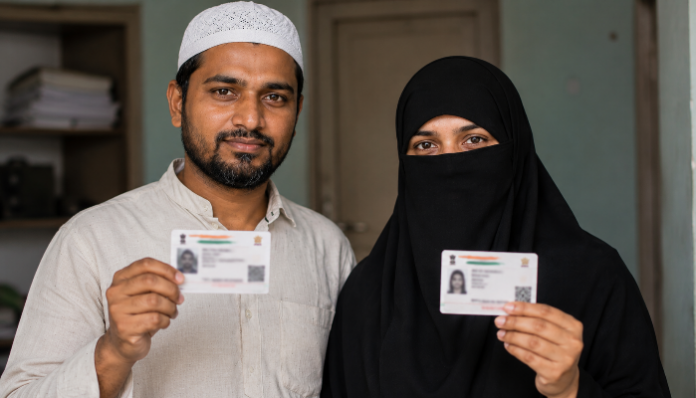
The demonstrators complained that people with fictitious Aadhaar cards were being permitted to travel freely without thorough verification and railway police were only performing cursory checks on dubious passengers on train. They pointed out that about 10 suspicious individuals from West Bengal had lately been questioned at the Hubballi train station. The latter alleged that they were going to the Bagalkot district for labour jobs and were permitted to proceed after presenting their Aadhaar cards.
However, the occurrence led to anger as agitators contended that fraudulent identification documents can also be produced unlawfully and Aadhaar cards alone could not be regarded as adequate proof of citizenship. Muthalik expressed, “It is not enough to simply check Aadhaar cards and let people go. There must be proper investigation because fake documents are being widely misused. Authorities must ensure that infiltrators do not settle in Karnataka.”
He also advocated for better collaboration among local police, railway officials and intelligence services to track migration patterns and identify persons who are illegally residing in the state. The demonstration gained traction forcing police and railway staff to inspect more persons as they boarded trains, especially the Shalimar Express from West Bengal. However, protestors maintained that due to the high passenger count and lack of employees at the station, the action was merely symbolic.
Karnataka’s enforcement agencies have stepped up their verification campaigns against unauthorised migrants in Bengaluru and other cities in recent months. There have been reports of large-scale deportation efforts in other areas of the state involving suspected these intruders. On the other hand, complaints have been also voiced by Hubballi’s locals and vendors, asking for strict vetting procedure.
Over 20 lakh illegal Bangladeshi immigrants in Karnataka
It is estimated that Karnataka could be home to as many as 20 lakh illegal immigrants from Bangladesh, according to intelligence department, reported Udayavani in January. Insiders stated that 70-80% of them possess Indian identity cards. Bangladeshi infiltrators have been entering India via West Bengal for the past 20-25 years. They usually stay in the state for 2-3 years and unlawfully acquire official Indian documents, such as Aadhaar cards and electoral ID cards with assistance from local networks. Subsequently, they relocate to other states, including Karnataka.
Some Bangladeshi nationals enter West Bengal and proceed directly to Bengaluru. Afterwards, some of them fabricate documents and move to neighbouring regions for employment. It is assessed that there are around 5,00,000 to 6,00,000 of these Bangladeshis in Bengaluru and its rural regions, 8,00,000 to 10,00,000 in Malnad and Karavali as well as 20,00,000 across the state, including North Karnataka and Old Mysore. Police revealed that they have already obtained Indian papers.
Bangladeshi infiltrators, who claim to be from Bengal, are working at construction sites, areca nut plantations, coffee plantations and junk shops in Bengaluru, Bengaluru Rural and Malnad for lower daily wages. According to sources, employers prefer them as they accept daily wages that are 100-150 rupees lower than those given to locals.
In the state, the majority of Bangladeshis reside in Bengaluru and Bengaluru Rural, where they make a living as rag pickers, construction labourers, salon workers, sanitation staff in hospitals and provide services in restaurants and hotels along with selling daily essentials and clothing on the roadside.
Likewise, they also work at areca nut and coffee plantations, in resorts, estates and farmhouses located in Chikkamagaluru, Udupi, Shivamogga, Kodagu, Dakshina Kannada and Uttara Kannada districts. Some of them have been found living with their families.
Another pressing concern is that illegal Bangladeshi immigrants residing in the coastal and Malnad regions for 15 years have not only acquired Indian identity cards but have also used them to access various state and central government schemes, including shelter homes. They have even purchased properties valued in lakhs of rupees. Similarly, they utilised their bogus Indian identity to secure passports and relocate to other nations after 15-20 years.
